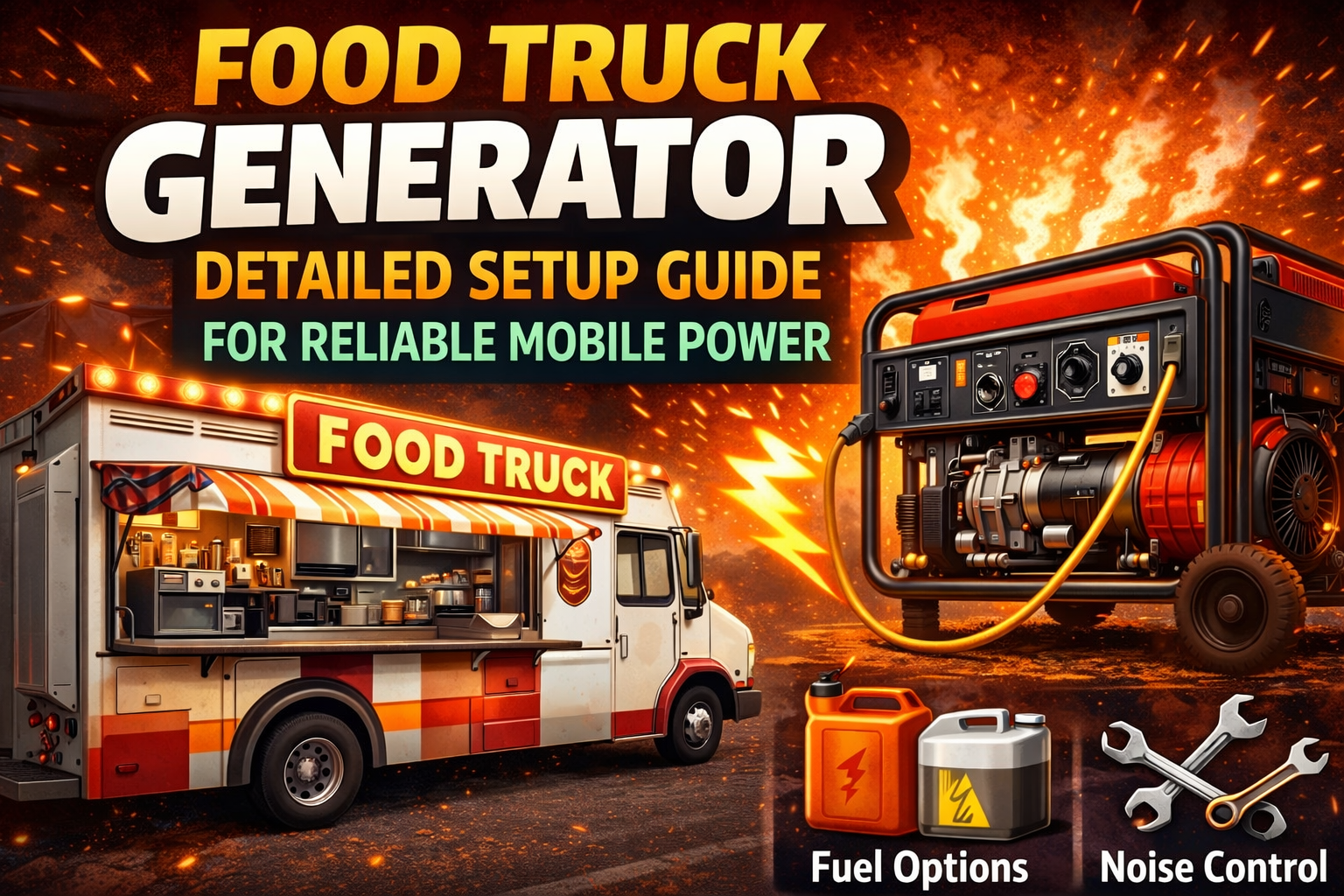
Do you want to operate a food truck with complete success? You need only one thing, and that is a full-power electricity supply 24/7. All of the appliances inside the food truck require it. From cooking appliances to cooling equipment to heating appliances, they need a stable electric connection. Having said that, you need to install a generator of an appropriate size that can handle your food truck well. As a result, you are able to deliver excellent services to a large number of customers.
In this guide, you will know how to select the accurate size of a generator for different food trucks, different variations of food trucks, a step-wise guide on how to install the generator, and much more. Stay Tuned!
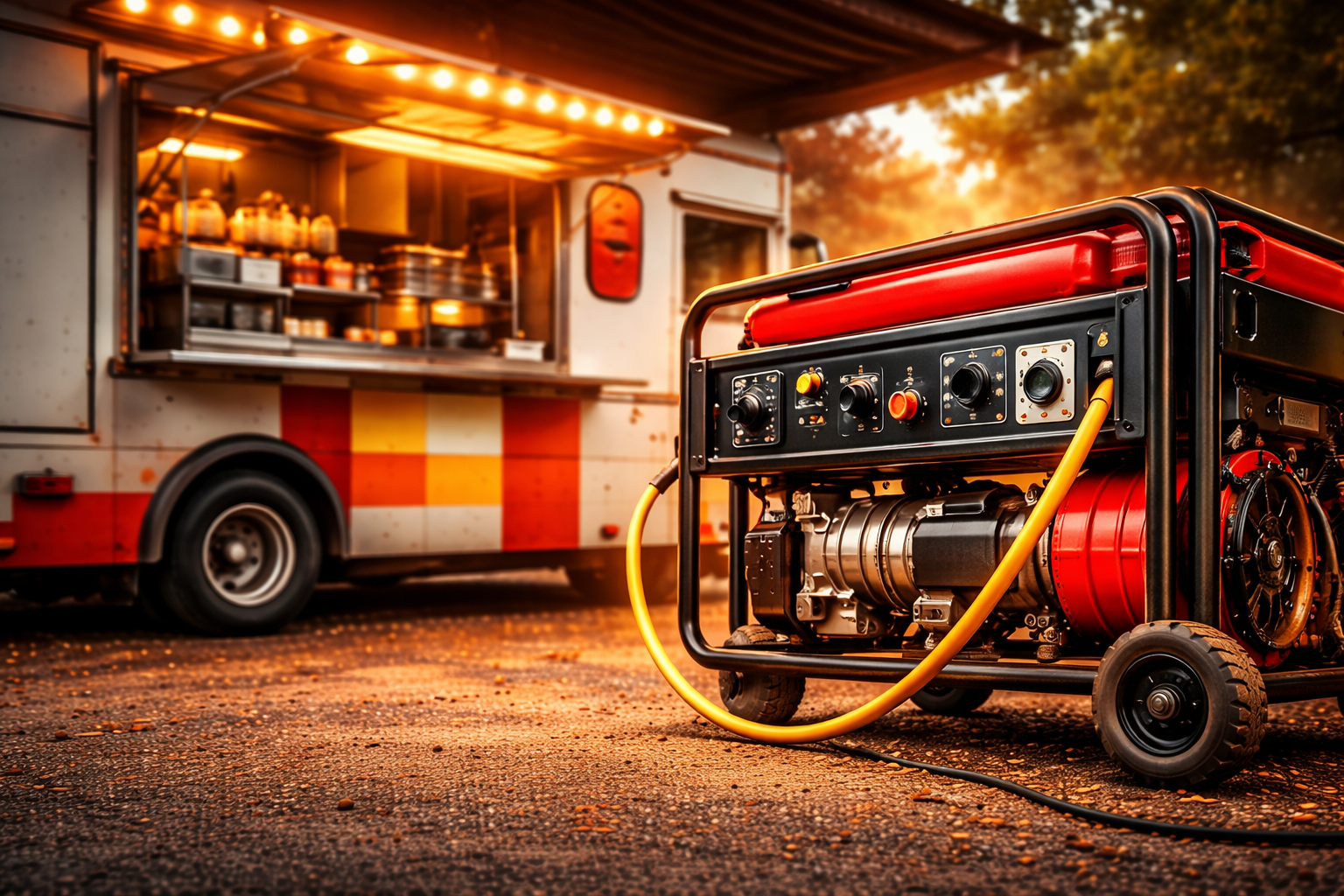
Why Food Trucks Require an Efficient Generator
Being a business owner, your mobile food truck needs a long-term power solution to give exceptional customer service.
- Cooking Equipment: Includes fryers, warmers, ovens, and microwaves. These require a huge amount of voltage for smooth working.
- Refrigeration: Include fridges and freezers. They run every bit of the second to maintain the shelf-life of the majority of food products and meet the regulatory standards.
- POS Systems & Lighting: An appropriate power supply will result in smooth payments with a lighted customer window.
- Ventilation: Hood and exhaust fans are a must to keep the internal environment airy and breathable. Use strong material wire for these fans.
- Business Sustainability: If the generator gives a good power supply, you will be able to maintain your business for years.
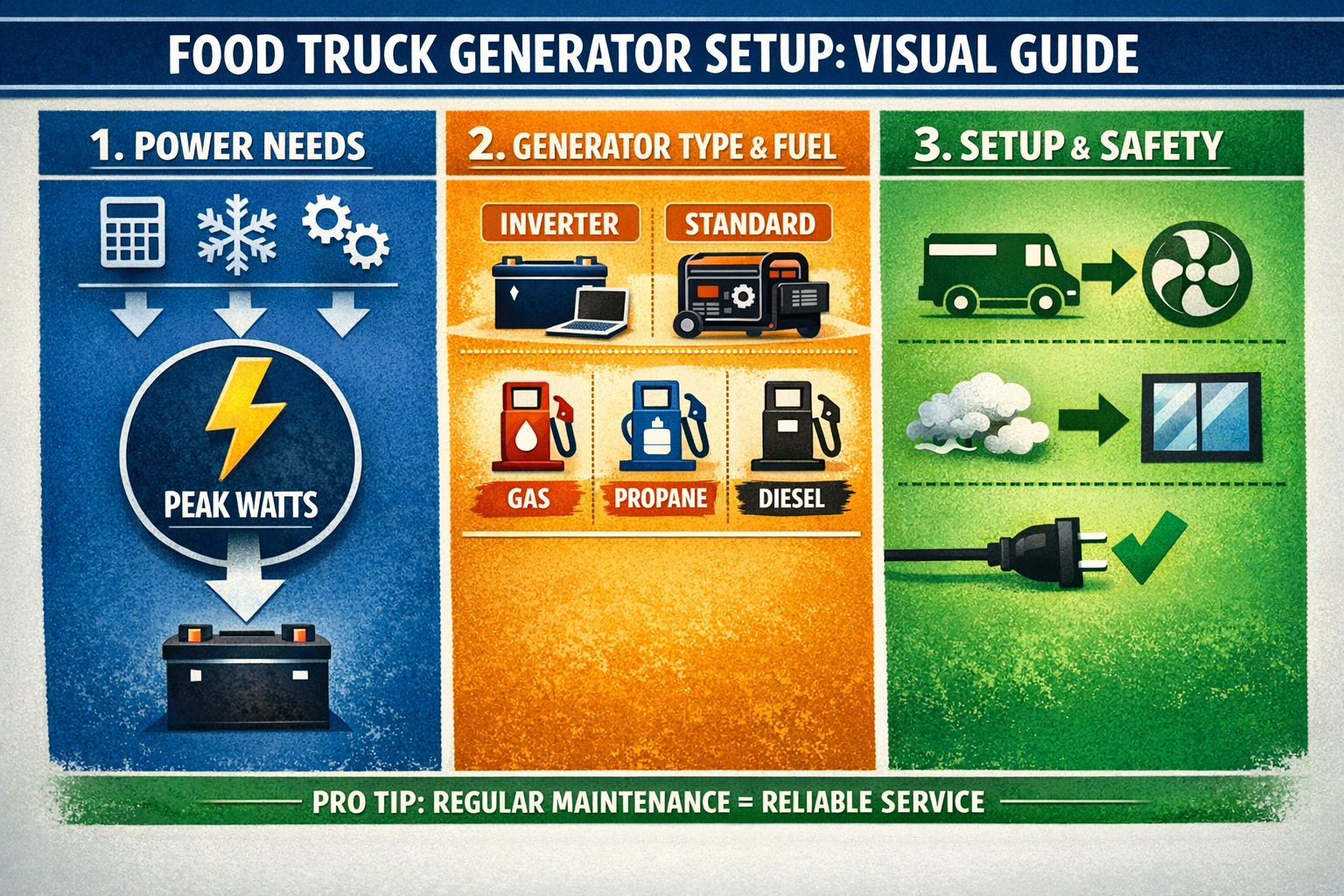
How to Select the Accurate Food Truck Generator Size
The most common mistake that business owners make nowadays is considering a generator having an inappropriate size. If you want to buy a perfect generator size, you must do some calculations.
1. Calculate Total Power Requirements By the Truck
First of all, note down all the electrical items needed in your truck and check their label of power in Watts.
| Equipments/Appliances | Running/Operating Watts (Avg) | Starting Watts (Surge) |
| Refrigerator (Commercial-based) | 700 W | 2,200 W |
| Freezer (Chest) | 500 W | 1,500 W |
| Electric Fryer (If using an Air Fryer, calculate their specifications accordingly) | 3,000 W | 3,000 W |
| Coffee Maker | 1,500 W | 1,500 W |
| Microwave-Oven | 1,000 W | 1,200 W |
| Hood Fan | 400 W | 1,000 W |
| Air Conditioning Unit (approx. 13,500 BTU) | 1,500 W | 3,000 W |
| Lighting System (LED) | 100 W | 100 W |
| POS System | 50 W | 50 W |
2. Running (Operating) Watts vs. Starting Watts
The motors installed in the air conditioners, refrigerators, and fans need a high voltage to start. This phenomenon is called the Starting Watts, also referred to as the Surge.
- Running Watts: The constant power required by the electrical equipment to operate.
- Starting Watts: The temporary electrical power required to start the appliances.
Formula:
- Add up all Running Watts of appliances and equipment.
- Point out the single highest value of the Starting Watt figure and add this value to the total.
- The output value will be your food truck generator’s minimum size.
3. Recommended Generator Sizes
- Small Vending Machine-Type or Small Cart (Having a Coffee/Ice Cream): 3,000–5,000 Watts (Fueled with Gasoline Inverter).
- Medium-Sized Truck (Having a Grill/Fridge): 6,000 – 8,000 Watts.
- Large-Sized Truck (Having an Electric Cooking/AC): 10,000–15,000+ Watts (recommended to buy the Diesel Silent Generator).
Types of Food Truck-Related Generators
Portable/Movable Generators
These are the basic units with open frameworks. They are mostly available at construction locations.
- Advantages: Easy to afford and easily replaceable.
- Disadvantages: Very loud (gives >75 dBA), not fuel-conserving, and forms dirty power that can damage other expensive appliances.
Inverter-Associated Generators
The best choice for small and medium basic trucks. They maintain the engine’s RPM at a constant value and adjust the power load as well.
- Pros: Tremendously peaceful (50-60 dBA), fuel-saving, and protective for food service POS systems.
- Cons: Difficult to afford.
Built-In (Onboard) Generators
These are the generators that fit in the trucks permanently. They include mostly the diesel generators fixed within a specific chamber.
- Benefits: Pushing the on-off button, extracts fuel from the truck’s main fuel tank, long-term reliability.
- Limitations: Heavy on the pocket and needs a professional service team to install it.
Tip: Huaquan provides the best compact silent diesel generators that handle your large commercial food trucks efficiently.
Fuel Choices for Food Truck Generators
- Gasoline: Available all over the globe. Its fuel transpires rapidly, and carbon monoxide chokes when operating the generator at a zero load. It is harmful to fill it in an extremely hot tank.
- Diesel: Considered as the most efficient selection even for high-power generators (higher than 10,000W). It also protects the engines and performs well for a long time.
- Propane (LPG): Has a higher working and storage life. It gives a double benefit if you use propane for your cooking appliances and cylinders as well.
- Dual-Fuel: Considered a better choice as you can switch between two options. Like you can use diesel and propane alternatively if one of the two finishes.
Step-Wise Food Truck Generator Setup Guide
Step 1: Select Appropriate Location
If you are using a mobile unit, never place the generator inside the food truck. You must install it on the front side or the back side.
Otherwise, it will accumulate Carbon Monoxide and result in poisoning. One thing you must be careful about is to keep the chimneys of the generator away from the customer queue and delivery window.
Step 2: Insert Mounting System
The generators oscillate continuously. For this purpose, use a rubber-material insulation padding system for temporary installation or a sliding tray for long-term installation. After inserting, tighten it with steel confinement to prevent its theft.
Step 3: Install Electrical Connection
You must not insert the extension wires through a window openly. For this,
- Insert a Power Inlet Box on the outside of the food truck.
- Go for a Transfer Switch or a breaker-related panel to dissipate power across the different points efficiently.
Step 4: Fuel Storage Tanks
If you are using a diesel-fueled generator, connect it to the truck’s main fuel container. You can also insert a specific auxiliary tank for this purpose. The fuel lines must be resistant to heat and protected.
Step 5: Noise Reduction Protective Measures
The commercial events often have strict noise regulation targets. For instance, upto 65 dBA. If your generator gives a large noise, insert a baffled box with a smooth airflow venting system. Or you can also optimize to a Silent Generator edition with a covered system.
Safety Measures for Operating a Food Truck Generator
- CO-Associated Detectors: Install a carbon monoxide detector inside your food truck. The detector must be powered through a battery.
- Grounding: The majority of food trucks can handle neutral situations well. But you must check your food truck’s specifications. In other cases, you must insert a grounding rod for standing situations.
- Refueling and Replacing: You should not put fuel in when the food generator is hot. You must wait for 15-20 minutes to allow it to cool and get stable. Otherwise, it will result in sparking fire.
- Weather Protection Guide: In extreme weather situations, use a large cover or a tent to avoid damaging your generator.
Maintenance Hacks for Long-Term Reliable Use
- Daily Inspection: Check the fuel levels before you turn on the food truck generator.
- Weekly Checking: Inspect the air filters and passageways after a week. The filters can become choked due to oil, grease, and cooking smoke.
- Monthly Probing: Look over the battery of the generator and inspect both terminals to allow the smooth working of the generator at heavy load.
- Annual Surveying: Replace the spark-related plugs (gas) and fuel filters (diesel) to clean the valves.
Common Food Truck-Related Generator Problems
- Overloading Issues: Stumbling breakers when the air conditioner and high-voltage cooking appliances are switched on simultaneously. Solution: Switch on one appliance at a time to avoid giving generators a tough time.
- Surging Problems: The generator’s engine gives an inappropriate, buzzing sound. Solution: Clean the injectors and replace the fuel and air filters. (Consult our detailed guide on Generator Surging).
- Overheating Issues: Halting down on extremely hot days. Solution: Achieve an optimal air flow through the passages and around the generator’s huge box.
Best Generator Specifications for Food Trucks
When you are buying a food truck, you must consider these characteristics of generators to get the best performance:
- Low Noise (<68 dBA): Important for a smooth customer experience and low chances of noise pollution.
- Electric On and Off: Necessary for a smooth and instant start, as no one likes to pump the coil 10-15 times to start it in this technological era.
- Low Oil Shutdown: Safeguards the engine when there is low fuel, especially when you don’t remember to check the tank.
- 50-Amp Outlet (14-50R): Appropriate for large-service-based food trucks to work the best at full-range power.
FAQs
What is the appropriate size generator that I must consider when buying a food truck?
If you want to buy a basic food truck with a refrigerator, lighting, and a coffee maker, go for a generator with a power range between 5k-7k watt. If you are considering a food truck equipped with electric cooking appliances and an air conditioner as well, buy a 10,000-watt generator or even higher.
What is the power range required by a food truck generator?
You can easily calculate this. First, calculate the total running watts of the generator, and add 2k watts to provide for extra compensation. Most of the advanced generators run between 6k and 12k watts.
Can I use inverter-associated generators for food trucks?
Yes, you can use them as they are the appropriate selection for small and medium standard trucks. They are peaceful and fuel-conserving, optimizing the efficiency even in inverter generators. If you buy a large food-service-based truck for market operations, consider a liquid-run diesel-based generator for long use.
Can I run all the equipment and appliances of a food truck on a generator?
This is possible only if you have a generator of sufficient size. If you have a small generator of low size, you must maintain the power and adjust the appliances. For instance, switch off the air conditioner when you are using the electrical cooking range.
What is the suitable choice of fuel for a generator when I am buying for a food truck?
Diesel is the appropriate choice for long-term use and ensuring safety. Other than this, you can use propane if you have well-maintained storage and carrying tanks inside the food truck.
Final Note: Food Truck Generator
If you buy a food truck generator, know that it is the best investment in your business journey. Though it requires a considerable amount of money, it will protect you from cancelling the orders at the last moment or delivering burnt food to the customers.
For market-based operations, you need a food truck powered with an appropriate generator. Are you planning to buy a new one or optimizing to a better version? Contact Huaquan Silent Diesel-based Generator for profitable money spending. We provide reliable food trucks that can handle the daily rigors and maintain your kitchen framework.
⚡ Explore Related Solutions
- 🏭 500kW Diesel Generator
- 🏭 1000kW Diesel Generator
- 🏭 500kW YC Diesel Generator
- 🔧 KMS (Cummins/Doosan) Series
- 🏥 Portable Generator
- 📋 Diesel Generator Sets
- 📋 Order Process — How to Buy
- 📋 Contact Us
💡 Need a customized solution? Contact our engineering team for project-specific recommendations.