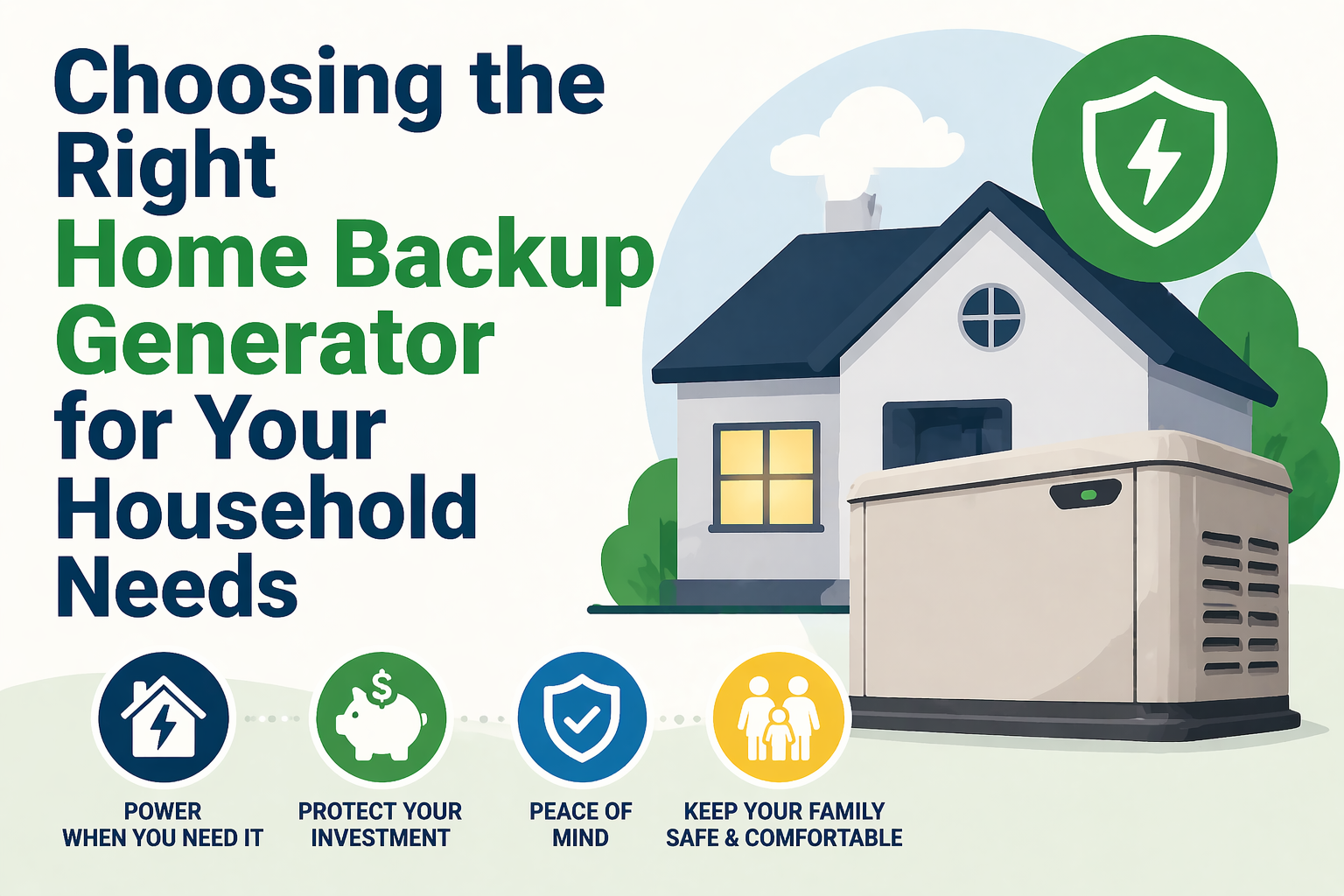
Whenever there is an unexpected power shutdown, it disturbs your whole routine and sometimes damages your electrical appliances and spoils the food. To combat this situation, investing in an efficient Home backup generator is the best solution. It will protect your house as well as the expensive appliances.
Choosing the best model of generator for your residential unit needs extensive research. It depends on your power needs, fuel supply, and the available budget. When you carefully consider these factors, you will be able to decide the best type of generator suitable for your home. After reading this guide by Huaquan, you will be able to decide the best one for your house!
What is a Home Backup Generator?
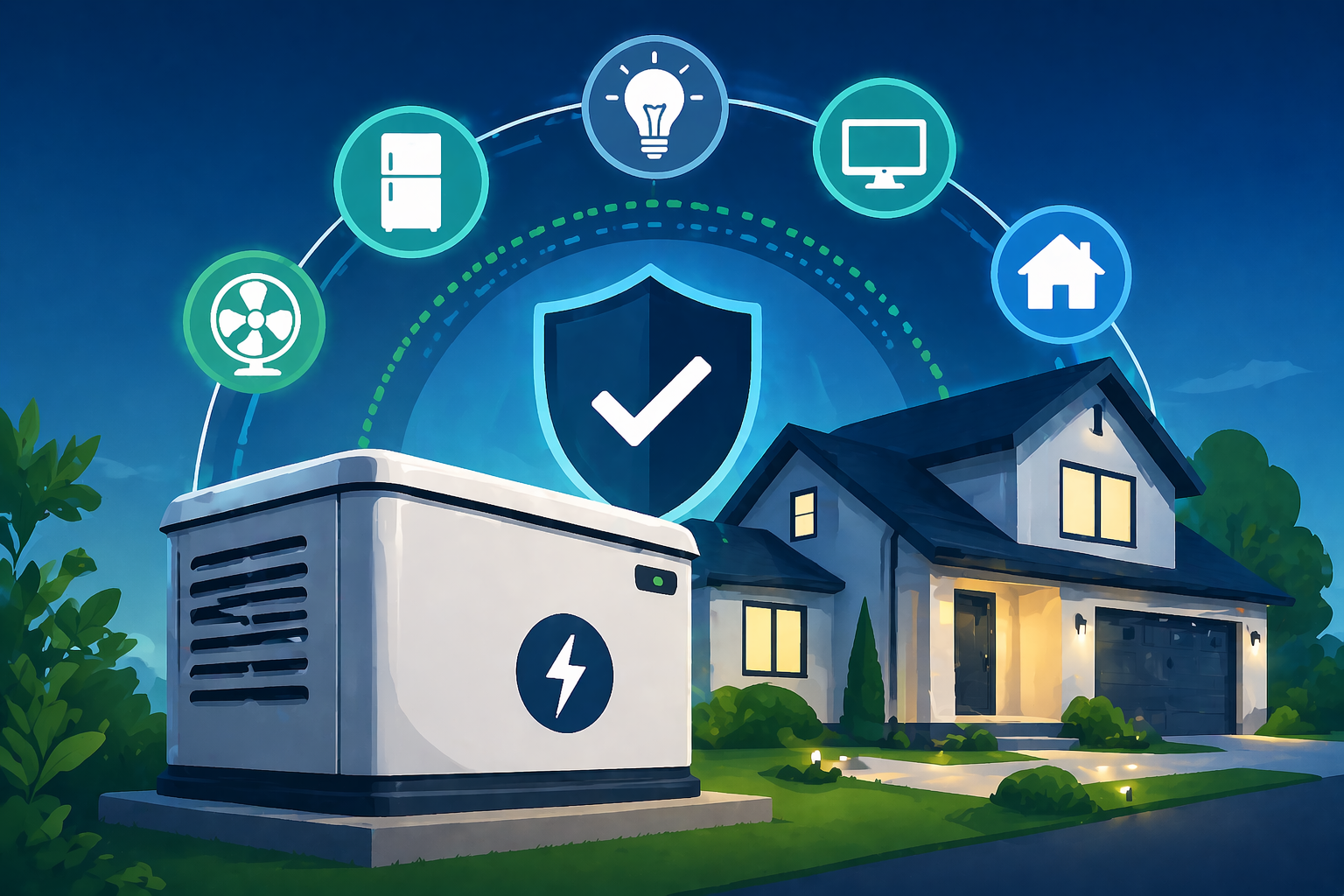
A residential unit backup generator is a single, independent power replacement system to support your house in the absence of electricity from the main grid. It includes an internal heating system working closely with an alternator to get usable electrical energy as a result. There are different types of home backup Generators that you must understand before buying for yourself.
Common Types of Home Backup Generators
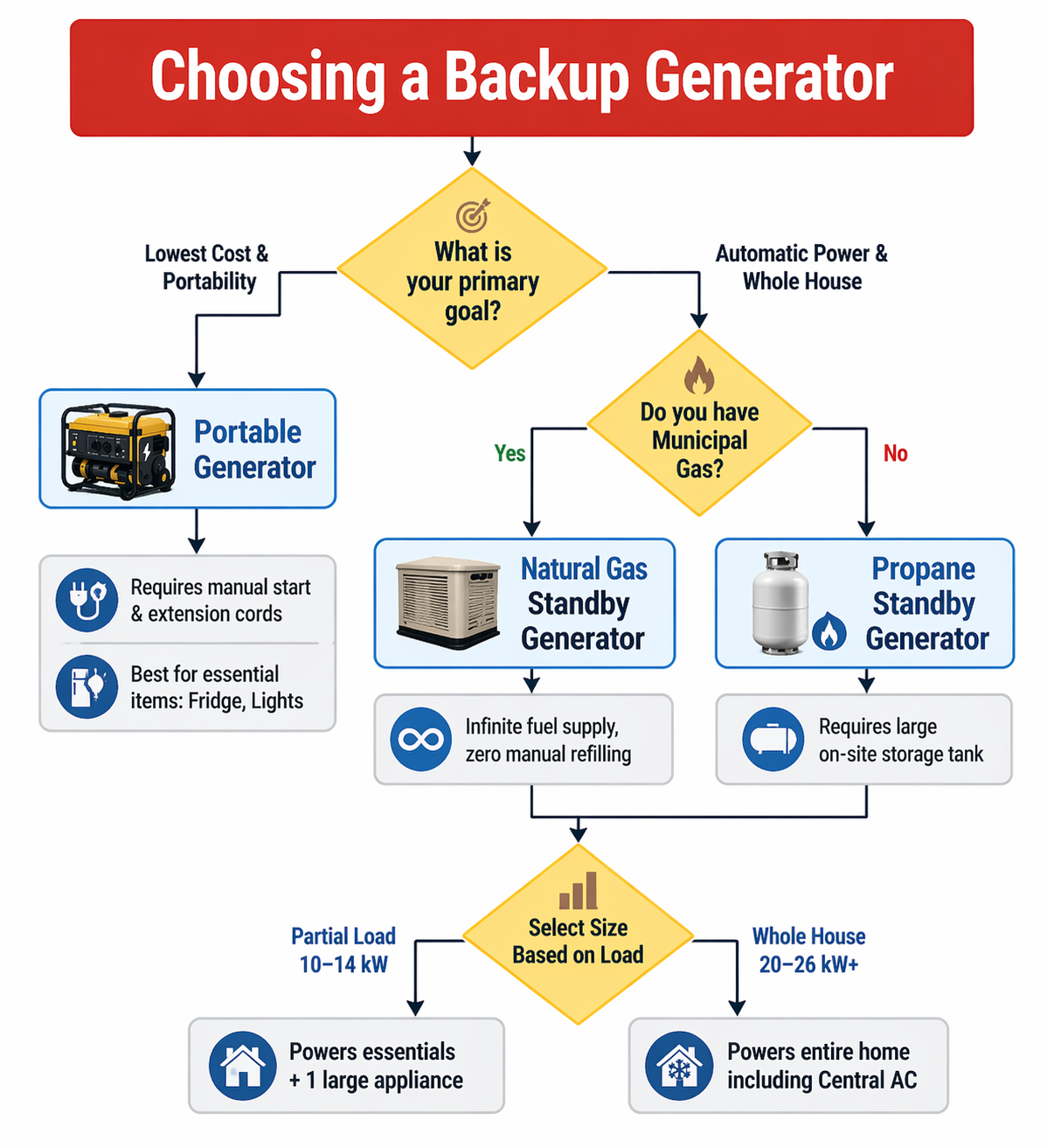
Portable Generators
These are easy-to-carry generators that you can easily carry with you to any distant location. They just require an inlet box with a specific transfer switch for installation.
- Advantages: Affordable, easy to carry for camping, offsite picnic spots, tailgating, and can be used for food trucks.
- Limitations: Limited capacity of power handling (range between 2000W and 12,000W). You will be required to refuel it on your own, even in extreme weather conditions.
Standby Generators
These are permanent generators that are fixed above the ground on a concrete pad. The electricians integrate them into the home’s electrical panel via an Automatic Transfer Switch (ATS). It starts instantly when the grid supply powers off.
- Pros: Gives full protection to your home even in your absence. Can handle large power watts (ranging from 10kW to 26kW+) efficiently.
- Cons: Higher initial as well as installation costs, requires experts for its correct installation, and demands extensive permits.
Calculating Your Power Needs
Before selecting a generator model, you must assess your own locality.
- Calculating wattage requirements for all essential appliances: Take a tour of your site and list down all the essential devices. Note down their running wattages as well as the starting surge required by them to work at moderate speed. Add them and calculate the required value.
- Identifying critical systems to power during a breakdown: Divide your requirements into basic or luxury. In basic, you should include water pumps, refrigerators, medical equipment, and essential lights. Whereas in luxury, you can include dryers, televisions, projectors, and much more.
- Determining if you require a whole-house or a partial backup replacement: If you need to keep food free from spoilage and pipes from freezing, you can consider a partial solution supported by a Portable Generator. If you want to power up your whole house, including all luxury items, you need a complete solution system.
Types of Fuel for Home Backup Generators
Gasoline
Gasoline is available at any gas station or fuel pump. It is easy to burn and can operate appliances and motors in the harsh, cold weather conditions. It has a short life span, ranging from 3 to 6 months if not stored with appropriate stabilizers. You must refill its tanks on your own. It can support easy-to-carry generators for vacationing, camping, food trucks, tailgating, and low-capacity backup of homes more efficiently
Diesel
Diesel has a greater energy density and offers a higher amount of unbothered fuel, perfect for long-term use. It uses less fuel volume, thus operating at a low operational budget and being durable for years. But, they sound irritating due to extensive mechanical noises and heavy weights. They produce a large amount of nitrogen oxides (NOx) emissions. Diesel generators are more suitable for commercial-based buildings, manufacturing plants, remote areas, and a heavy-capacity, long-lasting backup option.
Propane
Liquid Petroleum ignites cleanly with no toxic emissions, making it the best choice for residential units. Propane does not decompose over a period of time, which enables it to be stored confidentially in proper storage containers. It is perfect for home-based units, distant area residential places, and such types of locations requiring standby generators and fuel storage for a long period.
Natural Gas
Natural gas is affordable, gives great value for money, and proves to be eco-friendly. It works in connection with the municipal gas supply, being the most abundantly available fuel type. It is suitable for both long-term residential power supply generators and extensive commercial buildings in cities.
How to Select the Appropriate Size Generator for Your Home
- Calculating wattage requirements: You must calculate the running wattage of your essential appliances to buy an accurately sized generator. Add the highest starting wattage value to your total. It will help you adjust the generator capacity to the load.
- Importance of matching capacity: If you buy a generator that is exactly the same number as your calculated value, it will leave no more space. You must add almost a 20-25% extra for future needs. For instance, if your power needs say 8,000 watts, you should buy a generator of 10,000-watt capacity.
- Sizing instructions:
- Essential Appliances and Lighting Load (3kW – 7kW): Includes the refrigerator, internet adapter, essential lights, and electronic device chargers. These can be supported by a medium-capacity portable generator.
- Partial House Load (8kW – 14kW): Includes more than essentials, such as a water pump, oven, and small-unit window ACs. You can support these by a large-capacity portable or a small standby generator.
- Whole House Load (15kW – 26kW+): Includes simple as well as heavy machinery, such as all ACs, water heaters, insulations, and electric ovens. For this, you must install a permanent, standby generator.
Installation Considerations for Home Backup Generators
- Professional installation vs DIY: You must not install the large-capacity generator yourself. Dealing with underground wires will be dangerous. You can only do it for a portable generator that can be installed with a simple inlet box. For this, you must also have an in-depth knowledge of installation.
- Permits and locality codes to consider: Several authorities need strict follow-ups of noise regulations, property maintenance rules, and HOA guidelines. These include obtaining electrical, building, plumbing, and installation permits. They range from a minimum of $50 to a maximum of several hundred dollars. The range depends on your government’s criteria.
- Choosing the accurate location: The accurate place for installing a generator is a leveled ground with a concrete-mixed pad. You must get it installed almost 5 feet from the entrance door, windows, and exhausters to avoid entry of carbon monoxide into the home space.
Maintenance and Durability of Home-Specific Backup Generators
- Routine maintenance tips: You must check oil levels, insert fresh fuel, and keep air vents free of debris and leaves. After long running periods, check if there is any ignited plug or burnt switch.
- Servicing schedule: You must change the oil of easy-to-carry generators every 2 to 4 days of continuous usage. On the contrary, the permanent generators need expert servicing every year to evaluate their efficient working.
- Why maintenance is important: Fresh fuel, cleaned oil, and dust-free air filters decrease the resistance and friction caused by the engine. If the engine runs smoothly, it will utilize fuel efficiently and operate at optimal power. These measures will increase the life of the generator.
Average Costing of Home Backup Generators
- Initial cost range: An easy-to-carry generator will range between $500 and $2,500. In contrast, a permanent, heavy-capacity generator will cost around $3,000 to $6,000 for the generator unit. The standby generators demand expert installation of excavation and gas plumbing. This installation adds around $3,000 to $5,000 to the total budget.
- Running/Operational costs: Other factors also matter that come under the operational costs. These include fuel supply (for propane), utility bills (for gas), maintenance costs (charged around $200–$400/year), and other repairs.
- Value for money: There is no doubt that the starting as well as running costs are huge. But a home power backup generator protects appliances from damage, pipes from burning, basements from flooding, and expensive groceries from spoilage.
Final Thoughts
If you want to protect your home against power outages, you must make an educated decision. It depends on several factors, including the locality’s conditions, power requirements, and financial budget.
The choice of a home backup generator depends completely on your needs. If you just want to light up your house’s basic appliances, go with a large-capacity portable generator for easy adaptation. In contrast, if you require an extensive, entire-house power supply, consider a high-capacity, permanent generator powered with propane or natural gas. Before selecting your specific type, you must calculate the starting and running wattages of all appliances, choose the correct fuel type, and plan to carry out a regular maintenance plan.
Protect Your Home and Secure Your Family with Huaquan
Don’t allow the power breakdowns to disturb your routine next time. Contact Huaquan, to explore our vast range of home backup generators to protect your appliances as well as your family.
FAQs
What is the most efficient type of fuel I can consider for a residential unit backup generator?
Natural gas is the most efficient source for residential entities because of its vast supply through pipelines. If you live in rural or remote areas, propane is more preferable because it leaves behind no residue, does not degrade, and remains stable in storage tanks for long.
Can I use a portable generator as a complete power backup for my whole house?
No, you can’t use a portable generator for the whole house. Portable units can power up the basic appliances only. They don’t have the starting surge to allow the heavy appliances (AC and heaters) to gain momentum. You can use a portable generator to support the mandatory circuit panels through a handheld transfer switch.
Is regular maintenance necessary even if I use my generator occasionally?
Yes, you must perform maintenance with proper scheduling. Even if you use a generator once or twice a year, you must maintain it properly. When the generator is not in use, the battery can drain due to the accumulation of moisture and debris in the engine. Apart from maintenance, you must get its annual checkup done to evaluate its performance.