Immer wenn es zu einem unerwarteten Stromausfall kommt, Es stört Ihre gesamte Routine und beschädigt manchmal Ihre Elektrogeräte und verdirbt das Essen. Um dieser Situation entgegenzuwirken, investing in an efficient Heim backup generator is the best solution. Es schützt sowohl Ihr Haus als auch die teuren Geräte.
Choosing the best model of generator for your residential unit needs extensive research. It depends on your power needs, Kraftstoffversorgung, and the available budget. When you carefully consider these factors, you will be able to decide the best type of generator suitable for your home. After reading this guide by Huaquan, you will be able to decide the best one for your house!
What is a Home Backup Generator?
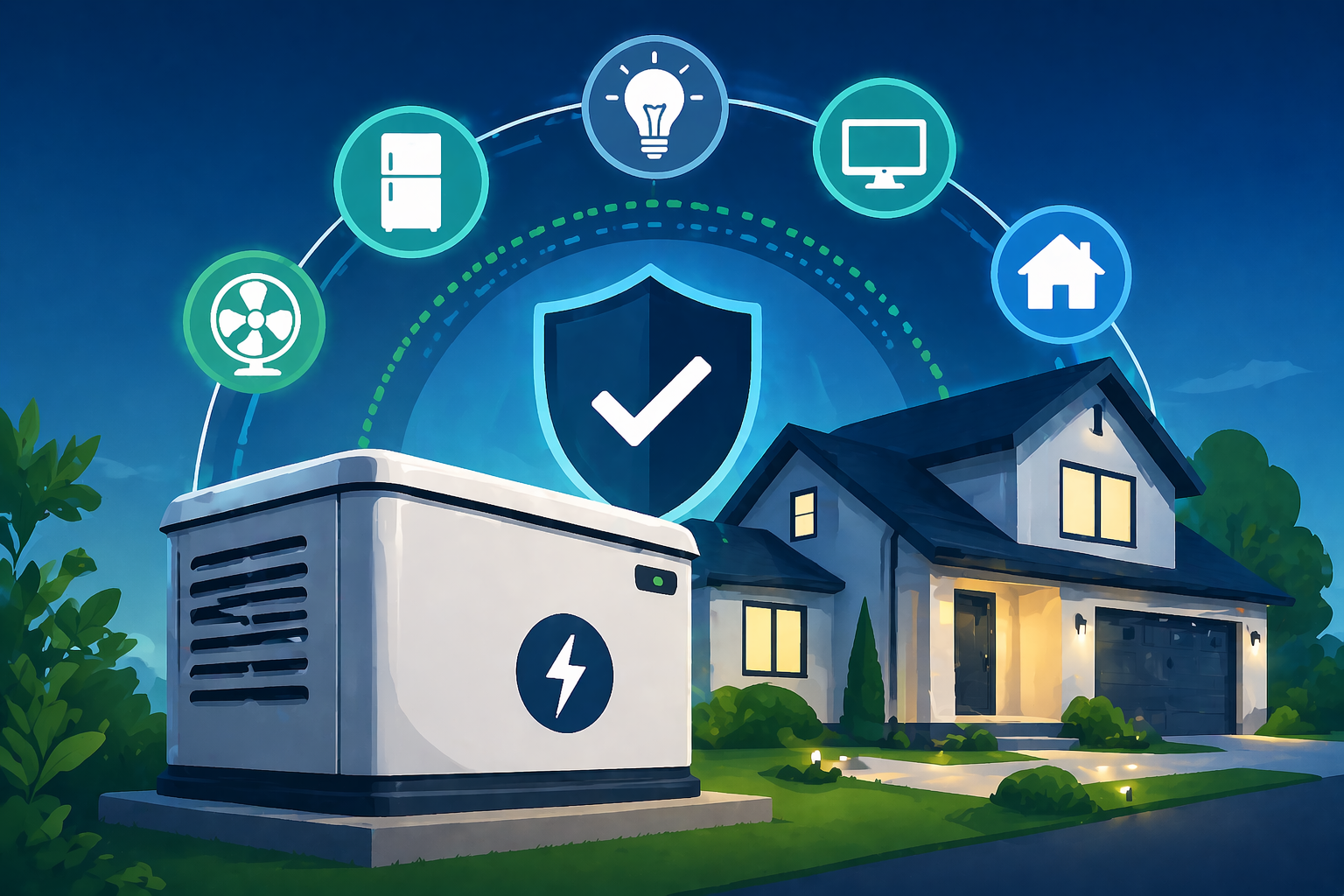
A residential unit backup generator is a single, independent power replacement system to support your house in the absence of electricity from the main grid. It includes an internal heating system working closely with an alternator to get usable electrical energy as a result. There are different types of home backup Generatoren that you must understand before buying for yourself.
Common Types of Home Backup Generators
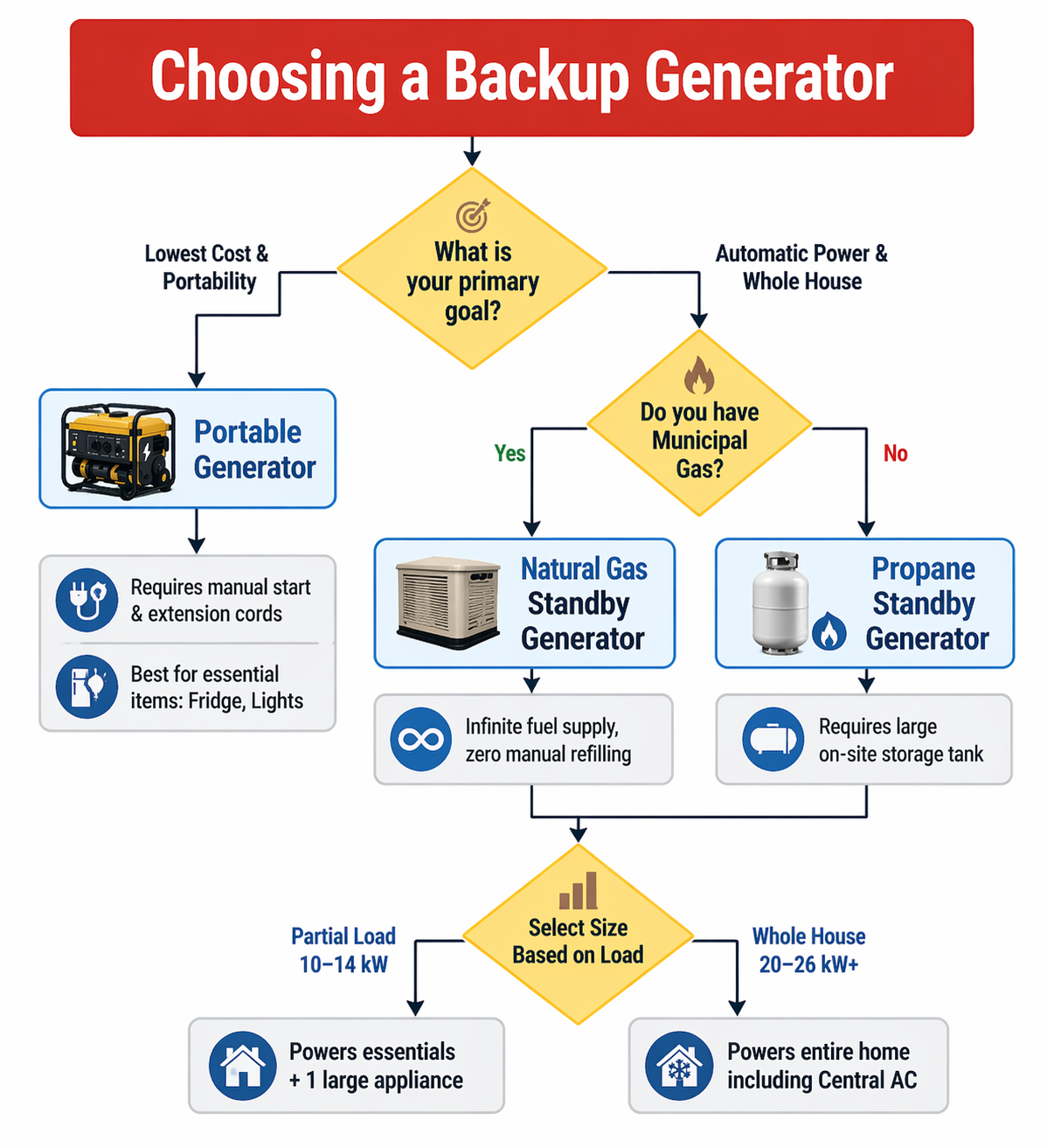
Tragbare Generatoren
These are easy-to-carry generators that you can easily carry with you to any distant location. They just require an inlet box with a specific transfer switch for installation.
- Vorteile: Erschwinglich, easy to carry for camping, offsite picnic spots, Tailgating, and can be used for food trucks.
- Einschränkungen: Limited capacity of power handling (range between 2000W and 12,000W). You will be required to refuel it on your own, even in extreme weather conditions.
Standby-Generatoren
These are permanent generators that are fixed above the ground on a concrete pad. The electricians integrate them into the home’s electrical panel via an Automatic Transfer Switch (ATS). It starts instantly when the grid supply powers off.
- Vorteile: Gives full protection to your home even in your absence. Can handle large power watts (ranging from 10kW to 26kW+) efficiently.
- Nachteile: Higher initial as well as installation costs, requires experts for its correct installation, and demands extensive permits.
Calculating Your Power Needs
Before selecting a generator model, you must assess your own locality.
- Calculating wattage requirements for all essential appliances: Machen Sie einen Rundgang durch Ihre Website und listen Sie alle wichtigen Geräte auf. Note down their running wattages as well as the starting surge required by them to work at moderate speed. Addieren Sie sie und berechnen Sie den erforderlichen Wert.
- Identifying critical systems to power during a breakdown: Divide your requirements into basic or luxury. In basic, you should include water pumps, Kühlschränke, medizinische Ausrüstung, und wesentliche Lichter. Whereas in luxury, you can include dryers, Fernseher, Projektoren, und vieles mehr.
- Determining if you require a whole-house or a partial backup replacement: If you need to keep food free from spoilage and pipes from freezing, you can consider a partial solution supported by a Tragbarer Generator. If you want to power up your whole house, including all luxury items, you need a complete solution system.
Types of Fuel for Home Backup Generators
Benzin
Benzin ist an jeder Tankstelle oder Zapfsäule erhältlich. Es ist leicht zu verbrennen und kann Geräte und Motoren unter rauen Bedingungen betreiben, kalte Wetterbedingungen. Es hat eine kurze Lebensdauer, reicht von 3 Zu 6 Monate, wenn nicht mit geeigneten Stabilisatoren gelagert. You must refill its tanks on your own. It can support easy-to-carry generators for vacationing, Camping, Imbisswagen, Tailgating, and low-capacity backup of homes more efficiently
Diesel
Diesel hat eine höhere Energiedichte und bietet eine größere Menge ungestörten Kraftstoffs, Perfekt für den Langzeitgebrauch. Es verbraucht weniger Kraftstoffvolumen, Dadurch ist das Betriebsbudget gering und die Lebensdauer über Jahre hinweg gewährleistet. Aber, they sound irritating due to extensive mechanical noises and heavy weights. They produce a large amount of nitrogen oxides (NOx) Emissionen. Diesel generators are more suitable for commercial-based buildings, Produktionsstätten, abgelegene Gebiete, und eine schwere Kapazität, dauerhafte Backup-Option.
Propan
Liquid Petroleum ignites cleanly with no toxic emissions, Damit ist es die beste Wahl für Wohneinheiten. Propan zersetzt sich im Laufe der Zeit nicht, Dies ermöglicht eine vertrauliche Aufbewahrung in geeigneten Lagerbehältern. Es eignet sich perfekt für Heimgeräte, abgelegene Wohngebiete, und solche Arten von Standorten erfordern stehen zu Generatoren und Kraftstoffspeicher über einen längeren Zeitraum.
Erdgas
Erdgas ist erschwinglich, bietet ein gutes Preis-Leistungs-Verhältnis, und erweist sich als umweltfreundlich. Es funktioniert in Verbindung mit der kommunalen Gasversorgung, ist der am häufigsten verfügbare Kraftstofftyp. It is suitable for both long-term residential power supply generators and extensive commercial buildings in cities.
How to Select the Appropriate Size Generator for Your Home
- Calculating wattage requirements: Um einen genau dimensionierten Generator zu kaufen, müssen Sie die Betriebsleistung Ihrer wichtigsten Geräte berechnen. Add the highest starting wattage value to your total. It will help you adjust the generator capacity to the load.
- Importance of matching capacity: If you buy a generator that is exactly the same number as your calculated value, it will leave no more space. You must add almost a 20-25% extra for future needs. Zum Beispiel, if your power needs say 8,000 Watt, you should buy a generator of 10,000-watt capacity.
- Sizing instructions:
- Essential Appliances and Lighting Load (3kW – 7kW): Includes the refrigerator, internet adapter, essential lights, and electronic device chargers. These can be supported by a medium-capacity portable generator.
- Partial House Load (8kW – 14kW): Includes more than essentials, such as a water pump, Ofen, and small-unit window ACs. You can support these by a large-capacity portable or a small standby generator.
- Whole House Load (15kW – 26 kW+): Includes simple as well as heavy machinery, such as all ACs, water heaters, insulations, and electric ovens. Dafür, you must install a permanent, Standby-Generator.
Installation Considerations for Home Backup Generators
- Professionelle Installation vs. Heimwerker: Sie dürfen den Großleistungsgenerator nicht selbst installieren. Der Umgang mit Erdkabeln ist gefährlich. Dies ist nur bei einem tragbaren Generator möglich, der mit einem einfachen Einlasskasten installiert werden kann. Dafür, Sie müssen außerdem über fundierte Kenntnisse in der Installation verfügen.
- Permits and locality codes to consider: Mehrere Behörden benötigen eine strikte Einhaltung der Lärmschutzvorschriften, Regeln zur Grundstückspflege, und HOA-Richtlinien. Dazu gehört die Beschaffung von Strom, Gebäude, Sanitär, und Installationsgenehmigungen. Sie reichen von mindestens $50 bis zu einem Maximum von mehreren hundert Dollar. Die Reichweite hängt von den Kriterien Ihrer Regierung ab.
- Choosing the accurate location: The accurate place for installing a generator is a leveled ground with a concrete-mixed pad. You must get it installed almost 5 feet from the entrance door, windows, and exhausters to avoid entry of carbon monoxide into the home space.
Maintenance and Durability of Home-Specific Backup Generators
- Routine maintenance tips: You must check oil levels, insert fresh fuel, and keep air vents free of debris and leaves. After long running periods, check if there is any ignited plug or burnt switch.
- Servicing schedule: You must change the oil of easy-to-carry generators every 2 Zu 4 days of continuous usage. Im Gegenteil, the permanent generators need expert servicing every year to evaluate their efficient working.
- Why maintenance is important: Fresh fuel, cleaned oil, and dust-free air filters decrease the resistance and friction caused by the engine. If the engine runs smoothly, it will utilize fuel efficiently and operate at optimal power. These measures will increase the life of the generator.
Average Costing of Home Backup Generators
- Initial cost range: An easy-to-carry generator will range between $500 Und $2,500. Im Gegensatz, a permanent, heavy-capacity generator will cost around $3,000 Zu $6,000 for the generator unit. The standby generators demand expert installation of excavation and gas plumbing. This installation adds around $3,000 Zu $5,000 to the total budget.
- Running/Operational costs: Other factors also matter that come under the operational costs. These include fuel supply (for propane), utility bills (for gas), Instandhaltungskosten (charged around $200–$400/year), and other repairs.
- Value for money: There is no doubt that the starting as well as running costs are huge. But a home power backup generator protects appliances from damage, pipes from burning, basements from flooding, and expensive groceries from spoilage.
Letzte Gedanken
If you want to protect your home against power outages, you must make an educated decision. Es hängt von mehreren Faktoren ab, including the locality’s conditions, power requirements, and financial budget.
The choice of a home backup generator depends completely on your needs. If you just want to light up your house’s basic appliances, go with a large-capacity portable generator for easy adaptation. Im Gegensatz, if you require an extensive, entire-house power supply, consider a high-capacity, permanent generator powered with propane or natural gas. Before selecting your specific type, you must calculate the starting and running wattages of all appliances, choose the correct fuel type, and plan to carry out a regular maintenance plan.
Protect Your Home and Secure Your Family with Huaquan
Don’t allow the power breakdowns to disturb your routine next time. Kontaktieren Sie Huaquan, to explore our vast range of home backup generators to protect your appliances as well as your family.
FAQs
What is the most efficient type of fuel I can consider for a residential unit backup generator?
Natural gas is the most efficient source for residential entities because of its vast supply through pipelines. If you live in rural or remote areas, propane is more preferable because it leaves behind no residue, does not degrade, and remains stable in storage tanks for long.
Can I use a portable generator as a complete power backup for my whole house?
NEIN, you can’t use a portable generator for the whole house. Portable units can power up the basic appliances only. They don’t have the starting surge to allow the heavy appliances (AC and heaters) to gain momentum. You can use a portable generator to support the mandatory circuit panels through a handheld Transferschalter.
Is regular maintenance necessary even if I use my generator occasionally?
Ja, you must perform maintenance with proper scheduling. Even if you use a generator once or twice a year, you must maintain it properly. When the generator is not in use, the battery can drain due to the accumulation of moisture and debris in the engine. Apart from maintenance, you must get its annual checkup done to evaluate its performance.