120V vs 240V Generators: Complete Guide to Voltage Selection
Choosing between a 120V and 240V generator is not just about matching your appliance voltage. It affects power delivery, wiring requirements, safety, and cost. This guide explains the differences, when you need each voltage, and how to select the right generator for your specific situation.
Understanding Voltage: 120V vs 240V
In North America, residential power is delivered as 120/240V single-phase. Your breaker panel has two 120V legs that combine to provide 240V for large appliances. A 120V generator provides power on one leg only, while a 120/240V generator provides both legs, enabling full panel coverage. The key relationship is: Power (Watts) equals Voltage times Current. At 240V, the same power requires half the current, meaning thinner wires and less voltage drop over distance. This is why large appliances use 240V — the reduced current means smaller wires, lower heat generation, and more efficient power delivery.
When You Need 120V Only
120V-only generators are suitable when you only need to power standard household outlets including lamps, TVs, computers, and phone chargers. They work for 120V tools like drills, circular saws, and shop vacs. Camping and tailgating applications are all 120V since typical camping appliances run on 120V. Emergency backup for just a refrigerator and lights can be handled by a 120V generator with sufficient wattage. Most small portable generators (under 5,000W) are 120V only.
When You Need 240V
You need 240V output when powering well pumps (most residential well pumps are 240V, 1-2 HP), electric water heaters (typically 240V, 3,000-4,500W), electric dryers (240V, 4,000-6,000W), central air conditioning (240V compressor, 2,000-7,000W starting), electric vehicle charging (Level 2 requires 240V, 30-50A), welding equipment (most welders require 240V), large workshop tools like table saws and air compressors, and any appliance with a 240V plug (NEMA 6-15, 6-20, 6-30, 14-30, or 14-50 configuration). If you have any of these appliances and want them operational during an outage, you must choose a generator with 240V output.
Generator Voltage Configurations
| Configuration | Output | Typical Use | Transfer Switch |
|---|---|---|---|
| 120V only | 1-5 kW, 120V outlets only | Camping, small backup | None (extension cords) |
| 120/240V (single phase) | 5-25 kW, both 120V and 240V outlets | Whole house backup | Required (manual or auto) |
| 120/208V 3-phase | Commercial generators | Commercial buildings | 3-pole ATS |
| 277/480V 3-phase | Industrial generators | Industrial facilities | 3-pole ATS |
How 120/240V Generators Work
A 120/240V generator has two 120V windings connected in series. The connection point is the neutral. Across the two outer terminals, you get 240V. From either outer terminal to neutral, you get 120V. The key consideration is load balancing — try to distribute loads equally between the two 120V legs. If you load one leg with 35A and the other with 10A, the generator is unbalanced and can only deliver 20A on the heavily-loaded leg before the 120V output sags, while the other leg has unused capacity. Most home standby generators manage this automatically through their connection to the breaker panel, but portable generators with multiple outlets require manual load balancing awareness.
Wiring Your Generator to Your Home
There are three methods for connecting a generator to your home electrical system. Extension cords (no transfer switch) are only for portable generators, running cords from the generator to individual appliances with a maximum of 50 feet on 12-gauge cord and no 240V appliances possible. A manual transfer switch is installed at your breaker panel, allows you to select which circuits to power, and requires manual switching during outages, costing $300-$800 plus installation. An automatic transfer switch (ATS) is used with standby generators, detects outage, starts the generator, and transfers load automatically within 10-30 seconds. Never backfeed by plugging a generator into a wall outlet as this is extremely dangerous and can kill utility line workers.
Frequently Asked Questions
Can I run a 120V appliance on a 240V generator?
Yes. 120/240V generators have standard 120V outlets in addition to the 240V outlet. You can run 120V and 240V appliances simultaneously. The 120V outlets are powered by one leg of the 240V output.
Can I run a 240V appliance on a 120V generator?
No. A 120V-only generator cannot power 240V appliances. Attempting to do so will not damage the appliance but it simply will not operate. Motors will hum but not start, and heating elements will produce no heat. You need a 120/240V generator for any 240V appliance.
What size generator do I need for a well pump?
Most residential well pumps are 240V, 1-2 HP. A 1 HP well pump requires approximately 1,000W running and 4,000-6,000W starting. You need a 120/240V generator rated at least 5,000W to start a 1 HP well pump. A 7,500W generator provides comfortable margin for the well pump plus additional loads.
How do I know if my appliance is 120V or 240V?
Check the nameplate or plug type. Standard 120V plugs have two parallel prongs (NEMA 1-15 or 5-15). 240V plugs have one prong rotated 90 degrees or two angled prongs (NEMA 6-15, 6-20, 6-30, or 14-30, 14-50). Large appliances like dryers, ranges, and well pumps are always 240V.
Does a 240V generator use more fuel?
No. Fuel consumption is based on the electrical load in watts, not the voltage. A 5,000W load at 120V and a 5,000W load at 240V consume the same amount of fuel. However, 240V loads tend to be larger appliances (water heaters, dryers, well pumps) which draw more watts and therefore more fuel.
Understanding 120V and 240V Power
In North America, standard household power is 120V for general-purpose outlets, lighting, and small appliances. Larger appliances like electric dryers, electric water heaters, well pumps, and central air conditioners require 240V. A 120V generator provides only 120V outlets (standard 5-20R receptacles), limiting you to plugging in devices with standard plugs. A 240V generator includes both 120V outlets and a 240V outlet (usually NEMA L14-30R or NEMA 14-50R), allowing you to power 240V appliances directly or connect to a transfer switch for whole-house backup. Power is the product of voltage and current (P=VI). A 240V 30A circuit delivers 7,200 watts — the same as two 120V 30A circuits, but 240V is more efficient for large loads because current is halved, reducing voltage drop and allowing smaller wire gauges. For a given wattage, 240V transmission losses are 50% less than 120V.
120V Generator Limitations
A pure 120V generator has a major limitation: you can only draw power through 120V outlets. Your generator might be rated for 5,000 watts, but the 120V outlets might be limited to 20A each (2,400W). To use the full 5,000W capacity, you need to distribute load across multiple 120V outlets. More importantly, you cannot power any 240V appliance without a step-up transformer (which wastes power and adds cost). Common 240V loads you cannot power: central AC (3-5kW), electric water heater (4.5-5.5kW), electric range (5-8kW), well pump (1-3kW), electric dryer (5kW), or a transfer switch connection for whole-house backup. For homes with natural gas appliances (gas water heater, gas furnace, gas range), a 120V generator is often sufficient. For homes with electric appliances, a 240V generator is necessary.
240V Generator Advantages
A 240V generator provides flexibility: it powers both 120V and 240V loads through a single connection. Using a transfer switch, a 240V generator can back up your entire electrical panel (up to its rated capacity). The 240V outlet connects to a double-pole breaker in your panel, energizing both legs of your house’s electrical system. This means 120V loads on either leg receive power, and any 240V loads (like your well pump or central AC) work normally. Installation requires a licensed electrician to install a transfer switch or interlock kit. Most 240V generators (5kW+) use a NEMA L14-30R twist-lock receptacle (30A, 4-wire: L1, L2, neutral, ground). Larger units (10kW+) may use NEMA 14-50R (50A, 4-wire). For most homeowners, a 7-10kW 240V generator provides the best balance of cost and capability.
Which Voltage Do You Need?
Check your home’s major appliances: if you have electric water heater, electric range, electric dryer, central AC, or a well pump, you need a 240V generator. If all major appliances are gas-powered and you only need to power lights, refrigerator, and electronics, a 120V generator is adequate. For maximum flexibility and whole-house backup capability, choose a 240V generator — it can still power all your 120V devices, plus provides the option for 240V loads. The cost difference between a 120V and 240V generator of the same wattage is minimal ($50-200), but the 240V generator requires a transfer switch installation ($500-1,500 professionally installed).
Diesel Generator Maintenance Schedule
Proper maintenance is the single most important factor in diesel generator reliability and longevity. A well-maintained generator can last 20,000-30,000 hours, while one that’s neglected may fail within 5,000 hours. The following schedule covers all sizes but intervals may vary by manufacturer — always consult your owner’s manual.
Daily/pre-start checks (2 minutes): Check engine oil level (dipstick), coolant level (reservoir), fuel level, battery voltage (12.6V+ for a 12V system), and inspect for fluid leaks under the generator. Look for loose wires, belt condition, and exhaust system integrity. For automatic standby generators, the weekly exercise cycle performs these checks automatically with the generator controller.
Weekly checks (10 minutes): Run the generator under load for 30 minutes. Check for unusual noises, vibration, or exhaust smoke color. Black smoke indicates overloading or dirty injectors. Blue smoke indicates oil consumption. White smoke (after warm-up) indicates coolant or unburned fuel. Inspect the radiator fins for debris (grass, leaves, dust) — clogged radiators cause overheating, the leading cause of generator failure.
Monthly checks (30 minutes): Test the ATS operation by simulating a power failure (turn off the utility breaker). Verify the generator starts automatically, transfers the load within 30 seconds, runs smoothly, and re-transfers when utility power returns. Check the battery terminals for corrosion and tighten if loose. Test the battery with a load tester — a battery that tests weak should be replaced preventively (every 3-5 years is typical).
Quarterly maintenance (1-2 hours): Change engine oil and oil filter. Use the correct viscosity diesel oil (typically CI-4/CK-4 grade, 15W-40 for temperate climates). For a 60kVA generator: 7-10L of oil. For a 500kVA generator: 25-40L. Check and adjust fan belt tension. Inspect all hoses for cracks or swelling. Clean the air filter (replace if more than 2 years old). Drain any water from the fuel/water separator. Check the coolant freeze protection level (antifreeze test strip). Inspect the exhaust system for leaks — exhaust leaks are dangerous and reduce engine power.
Annual maintenance (2-4 hours + parts): Replace fuel filters (primary and secondary). Replace air filter. Replace coolant every 2 years (OAT coolant). Check and adjust valve clearance. Test injectors (pop test pressure and spray pattern). Test the radiator cap pressure. Check all wiring connections and tighten. Perform a full-load test (using a load bank if possible) for 2-3 hours to verify the generator can handle rated load and to burn off any wet stacking deposits. Change transmission fluid (if applicable for certain industrial generators). Grease all bearings per manufacturer specifications.
Major service (every 5-10 years or 5,000-15,000 hours): Overhaul the alternator (bearing replacement, insulation test, re-greasing). Overhaul the engine (piston rings, bearings, injectors, valve grind). Full load bank test with data logging. Replace all rubber hoses and belts preventively. Replace the radiator (coolant passages corrode over time). Replace the voltage regulator and AVR components. The cost of a major service ranges from $2,000 for a 60kVA to $20,000+ for a 2000kVA generator.
| Maintenance Task | Frequency | 20-100kVA Cost | 100-500kVA Cost | 500-2500kVA Cost |
|---|---|---|---|---|
| Oil + filter change | 250h or annually | $50-150 | $150-400 | $400-1,500 |
| Fuel filter replacement | 500h or annually | $20-80 | $80-200 | $200-600 |
| Air filter replacement | 1,000h or annually | $30-100 | $100-300 | $300-800 |
| Coolant change | 2 years | $50-150 | $150-500 | $500-2,000 |
| Valve adjustment | 1,500h | $200-500 | $500-1,200 | $1,200-3,000 |
| Injector service | 2,000h | $300-800 | $800-2,000 | $2,000-6,000 |
Generator Operating Efficiency: Understanding BSFC
Brake Specific Fuel Consumption (BSFC) is the key metric for generator efficiency. It measures how many grams of fuel the engine consumes to produce one kilowatt-hour of mechanical energy at the flywheel. Lower BSFC means better efficiency. Modern diesel generators achieve BSFC of 195-230 g/kWh depending on load, engine technology, and size. A 2000kVA Industrial Generator with a 16-cylinder MTU engine might achieve 190 g/kWh at 75% load — meaning it’s 44% efficient at converting fuel energy to mechanical power (diesel fuel has about 46 MJ/kg energy content). A small 20kVA generator might only achieve 230 g/kWh (36% efficiency). The difference of 40 g/kWh between a well-tuned large engine and a small naturally aspirated one means the large engine uses 17% less fuel for the same power output.
Efficiency by Load Level: Generators are least efficient at very light loads. Below 30% load, BSFC can increase by 20-30% compared to the optimum point. This is because the engine’s internal friction and parasitic losses (coolant pump, oil pump, fan) are relatively constant, making up a larger percentage of total fuel consumption at low power output. At 25% load, a 500kVA generator might achieve 290 g/kWh instead of its 205 g/kWh optimum at 75% load — a 41% efficiency penalty. This is why right-sizing is so important: a 500kVA generator running at 125kW (25% load) uses about 36 L/h, while a properly sized 150kVA generator running the same 125kW at 83% load uses only 28 L/h — saving 22% on fuel.
Efficiency by Generator Size: Larger generators generally achieve better specific fuel consumption because larger engines have lower surface-to-volume ratios (less heat loss per unit of power), more efficient combustion chambers, turbocharging with aftercooling, and electronic fuel injection (common rail) that precisely controls injection timing and pressure. Below is a comparison of typical BSFC values at 75% load:
| Generator Size | Typical BSFC @75% | Fuel Consumption @75% | Overall Efficiency |
|---|---|---|---|
| 20-60 kVA | 215-230 g/kWh | 4-14 L/h | 31-33% |
| 60-200 kVA | 205-220 g/kWh | 14-40 L/h | 32-35% |
| 200-500 kVA | 198-212 g/kWh | 40-100 L/h | 33-36% |
| 500-1000 kVA | 195-208 g/kWh | 100-200 L/h | 34-37% |
| 1000-2500 kVA | 190-205 g/kWh | 200-500 L/h | 34-37% |
Key Diesel Generator Components
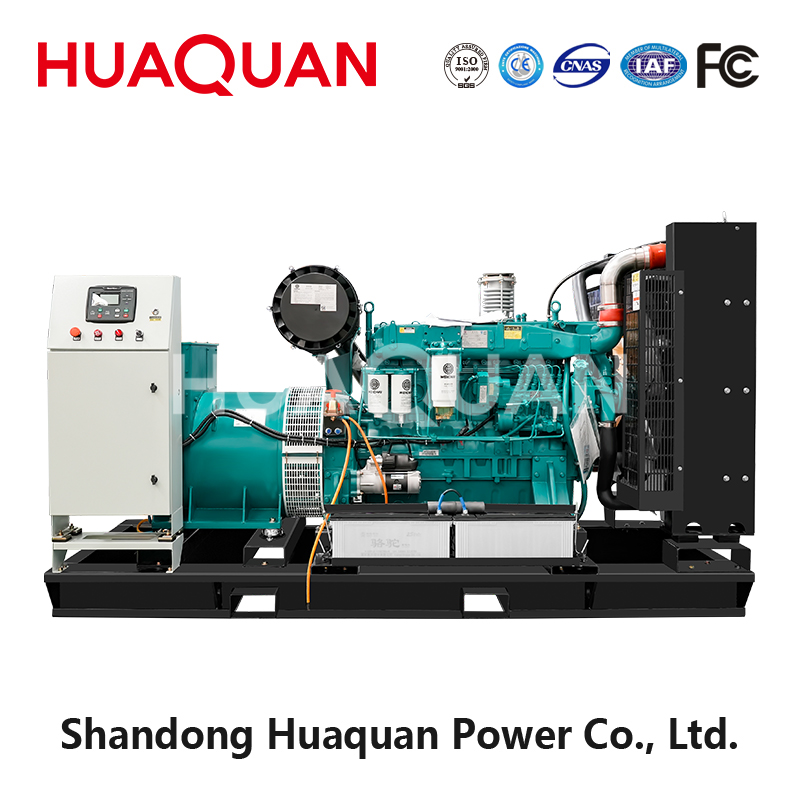
Engine: The heart of the generator. Diesel engines are rated in kW mechanical output. Common manufacturers: Cummins (QSK, QSL, QSM series), Perkins (1100, 1200, 4000 series), MTU (2000, 4000 series), Weichai (WP series), Yuchai (YC series). Engine displacement ranges from 2.3L (20kVA) to 60L+ (2500kVA). Key specifications: cylinder count (2-16), bore and stroke, compression ratio (16:1 to 22:1), aspiration (naturally aspirated, turbocharged, turbo aftercooled), and rated RPM (1500 for 50Hz, 1800 for 60Hz). Engine blocks are cast iron for durability, with wet liners or parent bore cylinders. Modern engines use electronic common rail fuel injection with injection pressures of 1,600-2,500 bar for better combustion, lower emissions, and reduced noise. The engine rating (standby vs prime vs continuous) determines the allowable duty cycle — a standby engine cannot run more than 500 hours/year at full load, while a continuous engine runs 24/7 at 100% load.
Alternator: Converts engine mechanical power to electrical power. Common manufacturers: Stamford (AvK), Leroy-Somer, Marathon Electric, Mecc Alte. Alternators are rated in kVA and include a voltage regulator (AVR or electronic). PMG (Permanent Magnet Generator) alternators provide superior motor starting capability and voltage regulation (±0.25%) compared to self-excited alternators (±1.0%). The alternator must match the engine’s power output: typical matching is engine kW = 1.1x alternator kW at 0.8 power factor. So a 100kW engine drives an alternator rated for 125kVA (100kW / 0.8 PF = 125kVA). The alternator’s insulation class (H for tropical, F for standard) determines allowable temperature rise. Class H insulation allows 125C temperature rise for 40C ambient, giving 180C maximum — critical for generators in hot climates.
Voltage Regulator: Controls the alternator’s output voltage. Electronic AVRs (Automatic Voltage Regulators) maintain voltage within ±1% for self-excited alternators and ±0.25% for PMG types. The AVR senses output voltage and adjusts the excitation current to the alternator’s field windings to maintain the setpoint voltage (typically 400V or 480V). AVR faults are a common failure mode — symptoms include voltage fluctuations, under/over voltage, or complete loss of output. Spare AVRs are inexpensive insurance ($200-500). The AVR is susceptible to moisture and vibration — mounting it in a sealed compartment improves reliability. Digital AVRs with CAN bus communication enable remote adjustment of voltage and droop settings.
Governing System: Controls engine speed (and therefore frequency). Electronic governors maintain frequency within ±0.5% under varying loads (ISO 8528 G3 standard). Mechanical governors are less precise (±2.5%) and found only on older generators. The governor senses engine speed via a magnetic pickup and adjusts the fuel injection pump to maintain the target RPM. For paralleling generators, governors enable isochronous load sharing (±0.25% frequency regulation). The isochronous mode allows multiple generators to share load proportionally without a “droop” characteristic. Most modern controllers include integrated electronic governing — the controller directly controls the engine speed actuator, eliminating the separate governor.
Cooling System: Rejects ~60-70% of fuel energy as heat. Radiator fans move 50-500 m3/minute of air depending on generator size. For indoor installations, remote radiators (roof or wall-mounted) with electric fan drives eliminate the need for large ventilation openings. Heat recovery systems can capture 30-40% of coolant and exhaust heat for building heating, absorption chillers, or process steam. A 1000kVA generator at 75% load rejects ~800kW of heat — enough to heat 8-10 average homes. The coolant system uses a 50/50 mix of antifreeze and water for freeze protection to -37C. Pressurized systems (15-20 PSI) raise the boiling point to 120C+, allowing higher operating temperatures and better engine efficiency.
Exhaust System: Directs combustion gases safely away and reduces noise. Components: exhaust manifold, flexible bellows, silencer (critical grade for sensitive areas), rain cap, and heat insulation. Exhaust backpressure must be below the engine manufacturer’s maximum (typically 5-10 kPa). Excessive backpressure reduces power output and increases fuel consumption. Exhaust stack height is determined by local air quality regulations — typically 3-15m above ground level. Critical grade silencers achieve 35-45 dBA noise reduction. Exhaust heat is 30-40% of total input energy — heat recovery boilers can generate steam or hot water for facility use.
Fuel System: Day tank (integral sub-base or close-coupled) with automatic fill from bulk storage. Components: fuel supply pump, fuel/water separator, primary and secondary filters, injection pump (mechanical or electronic), injectors, and return line. Electronic fuel systems (common rail) enable precise injection timing and multiple injection events for reduced emissions and noise. Fuel cooler required for common rail systems to prevent overheating of return fuel. The fuel return line carries excess fuel (not injected) back to the tank — it’s typically 3-5x the consumption rate and generates heat that must be dissipated. Biofuel compatibility (B5 to B100) requires material compatibility checks (hoses, seals, filters) for the specific blend.
Control Panel: Modern microprocessor controllers (Deep Sea, ComAp, DSE, Woodward) provide: auto start/stop, voltage and frequency regulation, protective relaying (overcurrent, over/under voltage, reverse power, high temperature, low oil pressure), remote monitoring via Ethernet or cellular, exercise scheduling, and fault logging. Higher-tier controllers include paralleling capability, load sharing, and power metering. The controller is the brain of the generator — a quality Deep Sea 73xx or ComAp InteliGen costs $1,500-5,000. Advanced features include: load-dependent start (auto-start paralleled units as load increases), power export metering (for grid sellback), and fuel consumption tracking with cost allocation.
Start-up Procedures: Cold start procedures extend engine life significantly. Pre-heat glow plugs for 10-30 seconds before cranking (automatic on modern controllers). For temperatures below -10C, use an engine block heater (1-3kW electric immersion heater) to maintain coolant at 30-40C. This reduces starting current draw from batteries and reduces cold-start wear. Let the engine reach stable coolant temperature (60C+) before applying load — this takes 5-10 minutes. Apply load gradually: 25% for 2 minutes, 50% for 2 minutes, then full load if needed. Cold start excessive load is a common cause of piston scuffing and turbocharger oil seal failure. For emergency generators, automatic transfer logic should warm up the engine before transferring load — a common programming oversight.
Shutdown Procedures: Before shutdown, run the generator at no load for 3-5 minutes to allow the turbocharger to cool down. Shutting down a hot turbo (glowing red at 800C+) stops oil circulation immediately, causing heat soak that cokes oil in the turbo bearings. This “hot shutdown” is the leading cause of turbocharger failure. After the cool-down period, the controller opens the main breaker, runs the engine at no load for 30 seconds, then stops. Exercise generators should run at minimum 30% load during test cycles — running at no load for extended periods causes wet stacking (unburned fuel and soot accumulation in the exhaust system).
Battery System Maintenance: The starting battery is the most common cause of generator failure. A 12V diesel generator battery should maintain 12.6V (open circuit, fully charged). Below 12.4V (75% charged), the battery is at risk of sulfation — permanent capacity loss. Use a three-stage battery charger (bulk, absorption, float) integrated with the generator controller. Battery temperature compensation is critical — charging voltage should be adjusted by -0.003V/cell/C above 25C. Check specific gravity with a hydrometer annually (1.265-1.275 for a flooded lead-acid battery at 25C). Replace batteries every 3-5 years preventively. AGM or gel batteries have longer shelf life but are more expensive.