Diesel generator vibration level specifications define the maximum acceptable oscillation amplitude for generator sets during operation. Huaquan Power manufactures Generators that meet strict international vibration standards, ensuring equipment longevity, structural safety, and comfortable operating environments.
What Is the Vibration Level in Diesel Generators?
Understanding Vibration Fundamentals
Vibration in diesel generators arises from the reciprocating and rotating motion of internal engine components. Specifically, crankshaft rotation, piston movement, and combustion forces generate oscillating forces transmitted through the engine block to the mounting frame. Consequently, controlling these forces is essential for reliable generator operation.
Huaquan Power incorporates advanced vibration analysis during the design phase of every generator model. Furthermore, each unit undergoes rigorous factory testing to verify compliance with applicable vibration standards before delivery to customers worldwide.
Vibration Measurement Parameters
Engineers measure diesel generator vibration using three primary parameters: displacement, velocity, and acceleration. Additionally, each parameter serves different diagnostic purposes and applies to different frequency ranges. Therefore, selecting the correct parameter ensures meaningful vibration assessment for specific operating conditions.
| Parameter | Unit | Frequency Range | Application | Sensor Type |
|---|---|---|---|---|
| Displacement | μm (micrometers) | 1 – 200 Hz | Low-frequency vibration | Proximity probe |
| Velocity | mm/s | 10 – 1000 Hz | General condition monitoring | Velocity transducer |
| Acceleration | m/s² or g | 100 – 10000 Hz | Bearing diagnostics | Accelerometer |
What Standards Govern Diesel Generator Vibration Levels?
ISO 8528 Standard
ISO 8528 specifically addresses reciprocating internal combustion engine-driven generating sets and defines vibration measurement methods and limits. Importantly, this standard classifies generators into different vibration grades based on their intended installation environment. Huaquan Power generators typically achieve Grade G2 or better, suitable for most industrial and commercial applications.
| ISO Grade | Vibration Velocity (mm/s RMS) | Installation Type | Typical Application | Comfort Level |
|---|---|---|---|---|
| G1 | 0 – 1.8 | Sensitive equipment areas | Hospitals, laboratories | Imperceptible |
| G2 | 1.8 – 4.5 | General purpose | Office buildings, factories | Barely noticeable |
| G3 | 4.5 – 11.2 | Industrial environments | Construction sites | Noticeable |
| G4 | Above 11.2 | Special applications | Remote locations | Strongly noticeable |
ISO 10816 Standards
ISO 10816 provides vibration severity criteria for rotating machinery in general. Additionally, this standard helps evaluate the mechanical condition of generator engines and alternators by comparing measured vibration against defined threshold zones. Consequently, maintenance teams use ISO 10816 to schedule preventive maintenance based on actual vibration data.
How Is Vibration Measured in Diesel Generator Sets?
Measurement Points and Positions
Standard vibration measurement on diesel generators requires sensors at specific locations: the engine block, alternator frame, and common base frame. Moreover, measurements should occur in three orthogonal directions — horizontal, vertical, and axial — at each point. Huaquan Power service technicians follow strict measurement protocols to ensure consistent and comparable results.
Measurement Conditions
Vibration measurements must occur under defined operating conditions to produce meaningful data. Specifically, the generator should operate at rated speed and between 75% and 100% of rated load. Furthermore, ambient temperature and mounting conditions significantly affect readings, so documentation of test conditions is essential.
| Condition | Requirement | Why It Matters | Huaquan Power Standard |
|---|---|---|---|
| Load | 75 – 100% rated | Steady-state operation | Tested at 100% load |
| Speed | Rated RPM | Operating frequency | 1500/1800 RPM models |
| Temperature | Normal operating range | Thermal expansion effects | Recorded with reading |
| Mounting | Installed or factory mount | Foundation effects | Anti-vibration pads included |
| Fuel | Specified grade | Combustion stability | As per manual |
What Causes Excessive Vibration in Diesel Generators?
Imbalance and Misalignment
Rotating component imbalance and shaft misalignment represent the leading causes of excessive vibration. Furthermore, fan imbalance, damaged couplings, and bent crankshafts introduce forces that increase vibration amplitude significantly. Therefore, precision alignment during installation and periodic balancing checks are critical maintenance procedures.
Foundation and Mounting Issues
Incorrect foundation design or deteriorated mounting elements transmit vibration poorly, allowing excessive movement. Importantly, loose anchor bolts, cracked concrete pads, and degraded isolation mounts all contribute to elevated vibration levels. Huaquan Power provides detailed foundation specifications for every generator model to prevent such issues.
| Vibration Source | Frequency Characteristic | Severity Impact | Detection Method | Common Fix |
|---|---|---|---|---|
| Crankshaft imbalance | 1x RPM | High | Orbit analysis | Balancing |
| Misalignment | 1x and 2x RPM | High | Laser alignment | Realignment |
| Worn bearings | High frequency | Medium-High | Spectrum analysis | Bearing replacement |
| Loose mounting | Multiple harmonics | Medium | Visual/torque check | Retightening |
| Combustion irregularity | Half-order harmonics | Medium | Cylinder pressure | Fuel system repair |
How Is Vibration Controlled in Diesel Generator Sets?
Anti-Vibration Mounting Systems
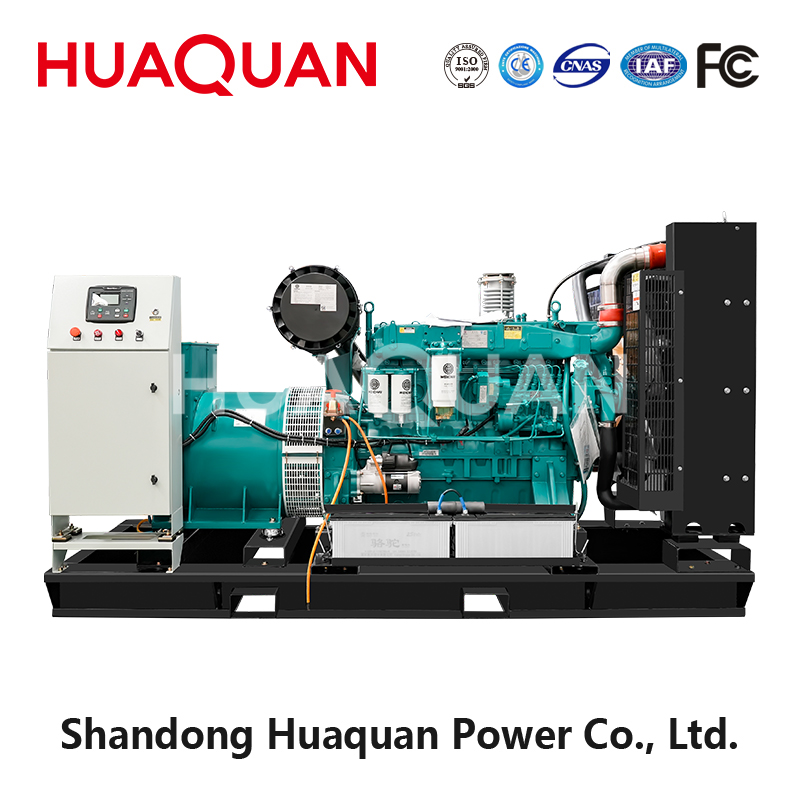
Anti-vibration mounts, also called isolation pads or spring isolators, absorb oscillating forces before they reach the foundation. Huaquan Power offers multiple mounting solutions, including rubber compound pads for smaller units and coil spring isolators for large-capacity generator sets. Moreover, the selection depends on generator weight, vibration frequency, and installation requirements.
| Isolation Type | Natural Frequency (Hz) | Isolation Efficiency | Generator Size Range | Service Life |
|---|---|---|---|---|
| Rubber pad | 8 – 15 | 70 – 85% | Below 200 kW | 5 – 10 years |
| Spring isolator | 2 – 5 | 85 – 95% | 200 – 1000 kW | 15 – 25 years |
| Air spring | 1 – 3 | 95 – 99% | Above 500 kW | 10 – 20 years |
| Inertia block + spring | 1 – 2 | 97 – 99% | Above 1000 kW | 25+ years |
Flexible Couplings and Exhaust Systems
Flexible couplings between the engine and alternator absorb small angular and parallel misalignments, reducing transmitted vibration. Additionally, flexible exhaust connections prevent engine vibration from stressing the exhaust piping system. Huaquan Power installs high-quality flexible elements in every generator set as standard equipment.
What Vibration Limits Apply to Containerized and Silent Generators?
Containerized Generator Vibration Requirements
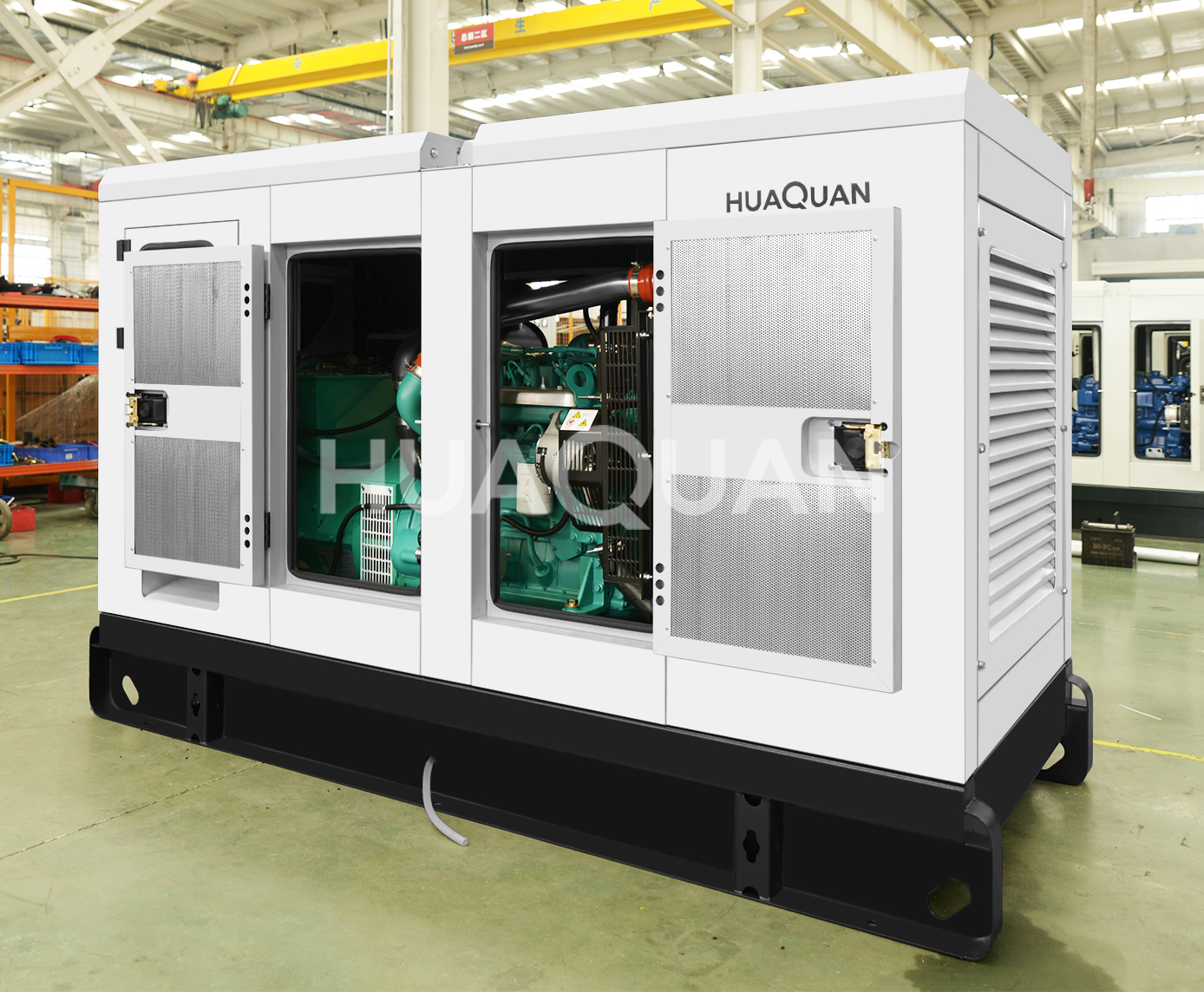
Containerized generators from Huaquan Power feature built-in vibration isolation systems integrated into the container structure. Furthermore, the canopy design incorporates acoustic insulation that also dampens vibration transmission to the surrounding environment. Consequently, these units achieve lower external vibration levels than open-frame generators of equivalent power.
Silent Generator Vibration Control
Silent generators require especially effective vibration control because the canopy amplifies structure-borne noise. Therefore, Huaquan Power employs multi-stage isolation with rubber pads, spring mounts, and constrained-layer damping materials in the canopy panels. Additionally, the intake and exhaust systems use flexible connections that decouple vibration transmission paths effectively.
| Generator Type | Typical Vibration (mm/s) | Isolation Method | External Impact | Compliance Standard |
|---|---|---|---|---|
| Open frame | 4.0 – 8.0 | Anti-vibration pads | Moderate | ISO 8528 G3 |
| Canopy type | 2.0 – 5.0 | Spring mounts + damping | Low | ISO 8528 G2 |
| Containerized | 1.5 – 3.5 | Integrated isolation | Very low | ISO 8528 G2 |
| Silent type | 1.0 – 2.5 | Multi-stage isolation | Minimal | ISO 8528 G1-G2 |
FAQ: Diesel Generator Vibration Levels
Q1: What is the acceptable vibration level for a diesel generator?
Acceptable diesel generator vibration depends on the application, typically ranging from 1.8 to 4.5 mm/s RMS for general-purpose installations per ISO 8528 Grade G2. Huaquan Power generators are designed and tested to meet these standards. Sensitive installations like hospitals may require G1 compliance below 1.8 mm/s RMS.
Q2: How do you measure vibration on a diesel generator?
Vibration is measured using accelerometers or velocity transducers placed at the engine block, alternator frame, and base structure in horizontal, vertical, and axial directions. Measurements must occur at rated speed and 75-100% load. Huaquan Power service teams use professional vibration analyzers with FFT capability for comprehensive assessment.
Q3: Can excessive vibration damage a diesel generator?
Yes, sustained excessive vibration accelerates wear on bearings, loosens fasteners, cracks structural components, and degrades electrical connections. Furthermore, vibration can damage connected equipment like switchgear and piping systems. Huaquan Power recommends immediate investigation when vibration exceeds the rated ISO grade threshold by more than 25%.
Q4: Do anti-vibration mounts really reduce generator vibration?
Properly selected and installed anti-vibration mounts reduce transmitted vibration by 70% to 99%, depending on the isolation type and system design. Spring isolators achieve 85-95% efficiency for mid-range generators. Huaquan Power engineers calculate the optimal isolation system for each generator model during the design phase.
Q5: How often should vibration be checked on diesel generators?
Huaquan Power recommends baseline vibration measurement at commissioning, followed by quarterly checks during the first year. After the warranty period, semi-annual monitoring is sufficient for stable units. Any sudden change in vibration level warrants immediate inspection, regardless of the scheduled maintenance interval.