Introduction
If you own a mining industry and want to extract the ore or some specialized metals, a consistent power supply is often a necessity. The grid supplies a good portion of energy, but what if it goes on outage? Even if you have installed the solar panels, they don’t provide energy during the night. Generators for mining operations are the ultimate need.
Today, we will discuss the power consumption, needs, and how the generator is the best option to meet the needs. Let’s discuss it in detail.
Why Do Mining Operations Need Generators?
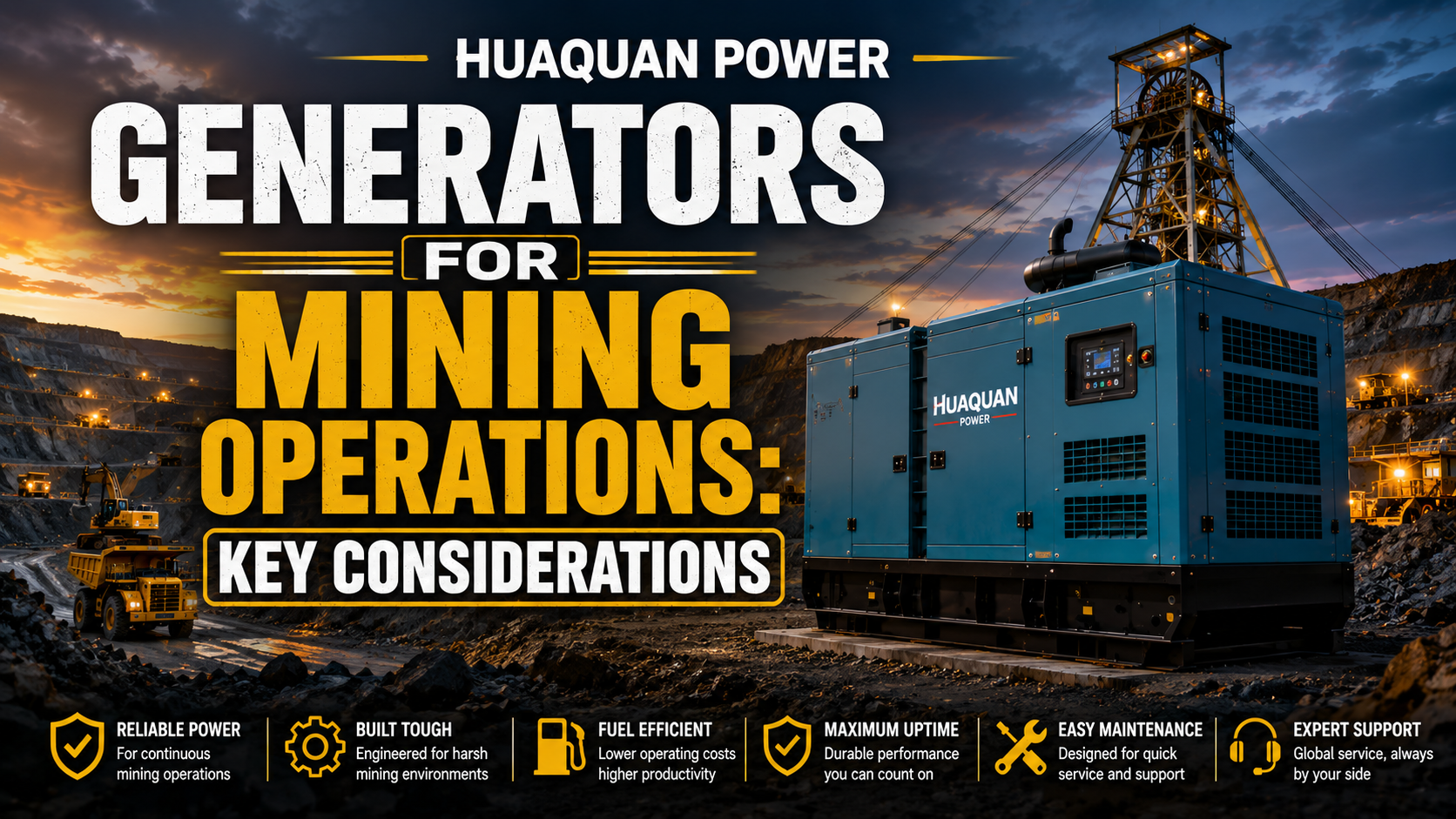
Mining Operations work around the clock and require a consistent and high-quality energy supply. A single minute power cut can cause the comprehensive blockage of all the mining activities. Therefore, there is a need for a continuous power supply for mining operations.
Generators are the ultimate backup sources that support several days of backup supply. They help in the operations of the following tasks.
- Ore extraction equipment
- Crushing and screening plants
- Conveyor systems
- Ventilation equipment
- Water pumping stations
- Processing facilities
- Site lighting
- Communication systems
- Workshops
- Worker accommodation camps
Major Power Consumers in Mining Operations
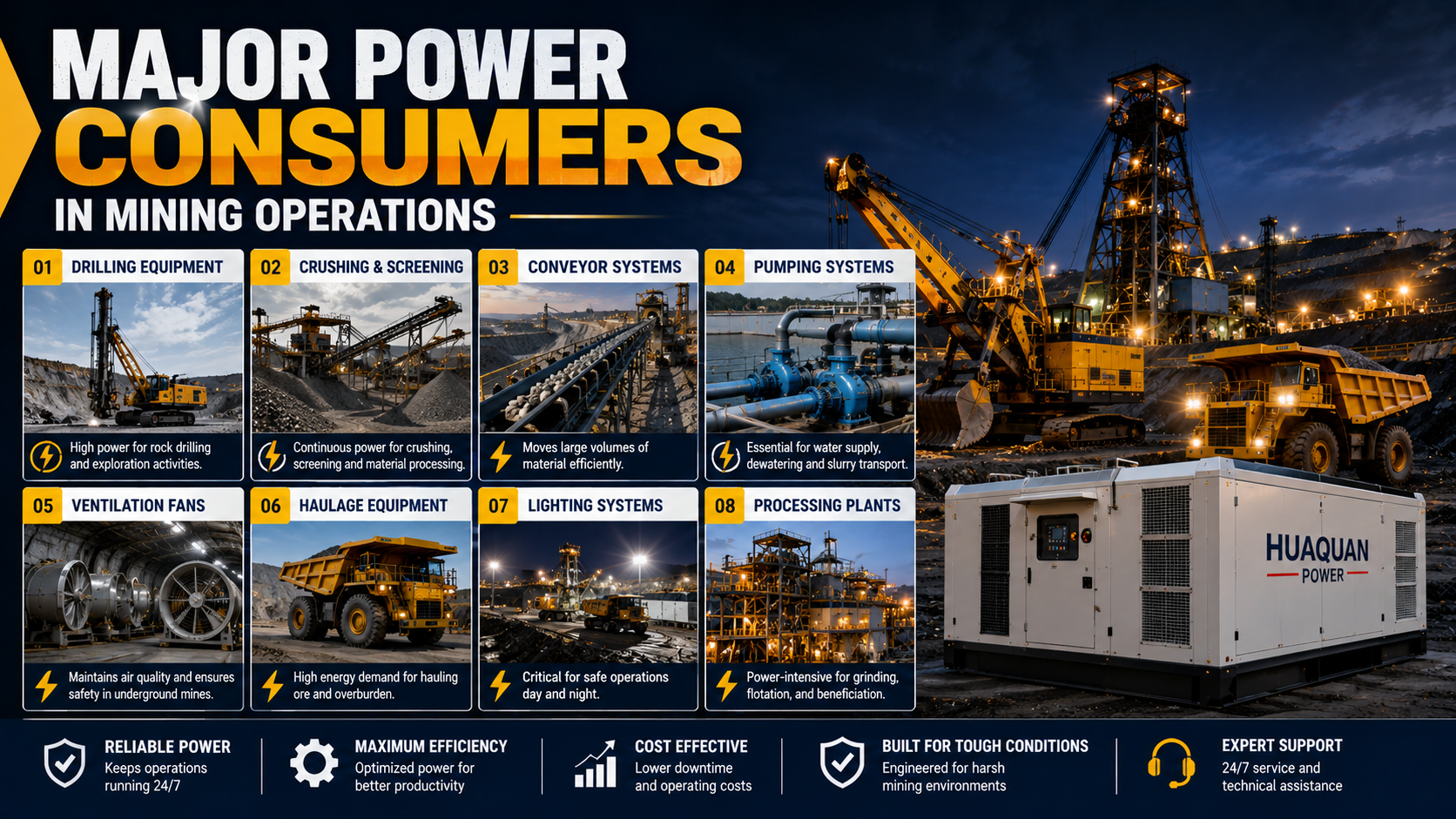
There are several devices that operate constantly and help in the extraction of materials. Here is the list of those devices that are essential to operate and require a power supply.
- Excavators
- Conveyor belts
- Crushers
- Grinding mills
- Water pumps
- Ventilation fans
- Compressors
- Processing equipment
- Lighting
- Administrative buildings
Here are the power requirements for all these devices.
| Equipment | Typical Power Requirement |
| Conveyor Belt | 30–250 kW |
| Crusher | 100–800 kW |
| Grinding Mill | 500–3,000 kW |
| Ventilation Fan | 100–1,000 kW |
| Water Pump | 20–300 kW |
| Air Compressor | 75–500 kW |
| Processing Plant | 500 kW–5 MW |
| Site Lighting | 10–100 kW |
| Workshop Equipment | 20–150 kW |
| Administration Building | 30–100 kW |
Key Considerations for Mining Operations
If you are looking for generators for mining operations, then we have added expert tips and key considerations. Focus on each step and make the right choice for the correct results.
Key Consideration #1: Understand Types of Generators
There are three main considerations of the generators.
Diesel Generators
Diesel generators are the most famous and main types of generators used in remote sites, such as mining operations. They offer robust operations and provide energy supply as long as you have sufficient fuel supply available.
The benefits of using the diesel generators are:
- High fuel efficiency
- Reliable performance
- Long operating life
- High power output
Natural Gas Generators
Since diesel generators produce noise and are not an eco-friendly solution, you might look for quieter operations and a sustainable energy supply. A natural Gas Generator is the ultimate solution in such a case.
It doesn’t produce noise and has lower carbon emissions. Here are a few more benefits.
- Cleaner combustion
- Lower emissions
- Reduced engine wear
- Quieter operation
Hybrid Generators
Hybrid generators are not just a combo of two technologies. Instead, they are comprehensive solutions that offer a consistent energy supply. The components of hybrid generators are here.
- Diesel generators
- Solar photovoltaic systems
- Battery Energy Storage Systems (BESS)
- Wind turbines (where feasible)
- Energy Management Systems (EMS)
Key Consideration #2: Calculate Total Load
You should calculate the total load consumption by the operational tools at the mining sites. Suppose here is the list of tools used during the operations.
- Processing equipment
- Ventilation systems
- Pumps
- Crushers
- Conveyors
- Lighting
- Workshops
- Offices
- Worker accommodation
Calculation Example
Based on the standard operating conditions, we have determined the quantities of tools used and the power consumption.
Let’s calculate the final load requirements.
Crusher = 400 kW
Conveyors = 360 kW
Water Pumps = 160 kW
Ventilation = 300 kW
Workshop = 60 kW
Lighting = 40 kW
Total Connected Load = 1,320 kW
Total load is not what you need. Instead, during the design of your generators, you must have the 20-25% extra capacity for future expansions or a safety margin to avoid damage to the appliances.
Let’s recount the total generator power supply.
1,320 × 1.25 = 1,650 kW
1650kW is the total power required.
| Equipment | Quantity | Running Load |
| Crusher | 1 | 400 kW |
| Conveyor Belt | 3 | 120 kW each |
| Water Pumps | 2 | 80 kW each |
| Ventilation Fans | 2 | 150 kW each |
| Workshop | 1 | 60 kW |
| Site Lighting | 1 | 40 kW |
Key Consideration #3: Running Load vs Starting Load
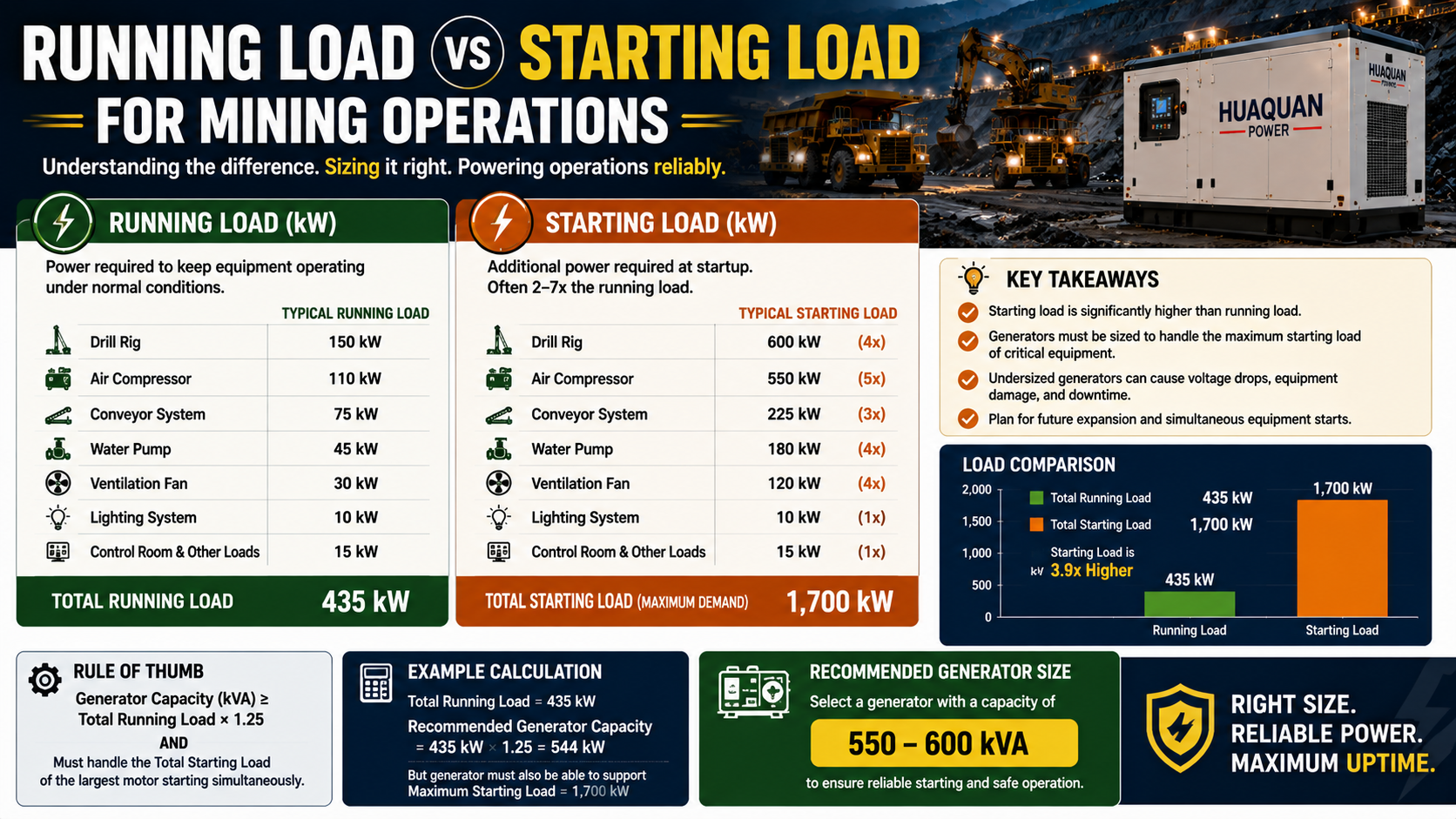
Machinery with motor components has different running loads compared to starting loads. Running load is the average load on which the device operates, while starting load is the initial power consumption.
Most often, the starting load is 2-7 times more than the running load. Therefore, you should get a protected system with an effective running load.
Examples of devices having different running and starting loads include:
- Crushers
- Grinding mills
- Large pumps
- Conveyors
- Ventilation fans
What if you don’t consider the running loads? In that case, a few more cases could happen.
- Generator overload
- Voltage drops
- Equipment shutdown
- Reduced motor life
- Production interruptions
Key Consideration #4: Fuel Availability and Storage
Mining sites and operations are often in remote areas away from the grid supplies. In that case, you can either install the solar panels, batteries, and generator systems.
However, generators for mining operations rely only on a consistent supply. Suppose you have to operate the generators for several days; the fuel storage is crucial. Here are a few things to consider.
- Distance to fuel suppliers
- Fuel transportation methods
- On-site storage capacity
- Expected generator runtime
- Emergency fuel reserves
Calculation Example
To help you better understand the fuel consumption cases, we have detailed the whole scenario.
Suppose an example of the above generator power, but the load is 75% of the total power consumption.
In that case:
Average Generator Load = 1,500 × 75%= 1,125 kW
At this loadload, a generator often consumes around 260 liters of diesel in the 24 hours.
Daily Fuel Consumption = 260 × 24 = 6,240 liters/day
Suppose the mine requires a 5-day fuel reserve.
Fuel Storage Requirement
= 6,240 × 5 = 31,200 liters
Adding a 15% emergency reserve:
31,200 × 1.15 = 35,880 liters
Here is the list of power consumption and fuel storage systems.
| Backup Duration | Approximate Fuel Storage |
| 24 Hours | 6,500 Liters |
| 48 Hours | 13,000 Liters |
| 72 Hours | 19,500 Liters |
| 5 Days | 36,000 Liters |
| 7 Days | 50,000 Liters |
Key Consideration #5: Environmental Conditions
Environmental conditions can affect the generators and provide the consumption impacts. You should plan and consider the following environmental conditions.
- High ambient temperatures
- Dust and airborne particles
- Heavy rainfall
- Snow and ice
- High-altitude locations
- Corrosive environments in coastal mines
Harsh weather and environmental fluctuations adversely impact and decrease performance.
Key Consideration #6: Choose the Correct Generator Rating
Based on the generator ratings, there are three typical options available to you. Let’s discuss three options and understand them in detail.
Prime Power
Prime Power generators are the primary choice when you have voltage fluctuations and need the safety of operations in mining sites. They handle a wide range of devices and provide a consistent energy supply without impacting any tools.
They are ideal in those areas where there is a utility grid available. As a result, they act as a primary source of energy. Common applications are:
- Open-pit mines
- Underground mines
- Mineral processing plants
- Remote exploration camps
- Off-grid mining facilities
Continuous Power
Continuous power generators are also like the prime power generators, except that there are a few differences. For example, continuous power generators operate only at constant loads. They can handle the situations with varying load conditions.
The common applications of such generators are:
- Continuous processing plants
- Fixed industrial production lines
- Constant-load mining applications
- Dedicated pumping stations
Standby Power
Do you want an emergency backup generator for your mining operations? There come the standby power generators— they offer a consistent load supply only when the utility grid fails.
Such generator types are used in:
- Grid-connected mining facilities
- Administrative buildings
- Warehouses
- Maintenance workshops
- Emergency systems
| Feature | Standby Power | Prime Power | Continuous Power |
| Primary Purpose | Emergency backup | Main power source | Continuous constant-load operation |
| Utility Grid Required | Yes | No | Usually No |
| Operating Hours | During outages only | Unlimited with varying load | Unlimited at constant load |
| Load Variation | Limited | High | Minimal |
| Overload Capability | No | Yes (typically up to 10% for a limited time, depending on manufacturer) | No |
| Best Applications | Backup power | Remote mining operations | Processing plants with steady demand |
| Typical Mining Use | Offices, warehouses, emergency systems | Crushers, conveyors, camps, processing plants | Fixed industrial processes |
| Fuel Consumption | Low (occasional use) | Moderate to High | Optimized for steady operation |
| Initial Investment | Lowest | Moderate | Moderate to High |
| Most Suitable for Remote Mines | No | Yes | Only for constant-load operations |
Key Consideration #7: Consider Future Expansion
Future expansions are always typical. For this, you should plan and consider:
- Reserving additional generator capacity.
- Installing modular generator systems.
- Allowing space for additional fuel tanks.
- Designing expandable switchgear.
Key Consideration #8: Redundancy and Reliability
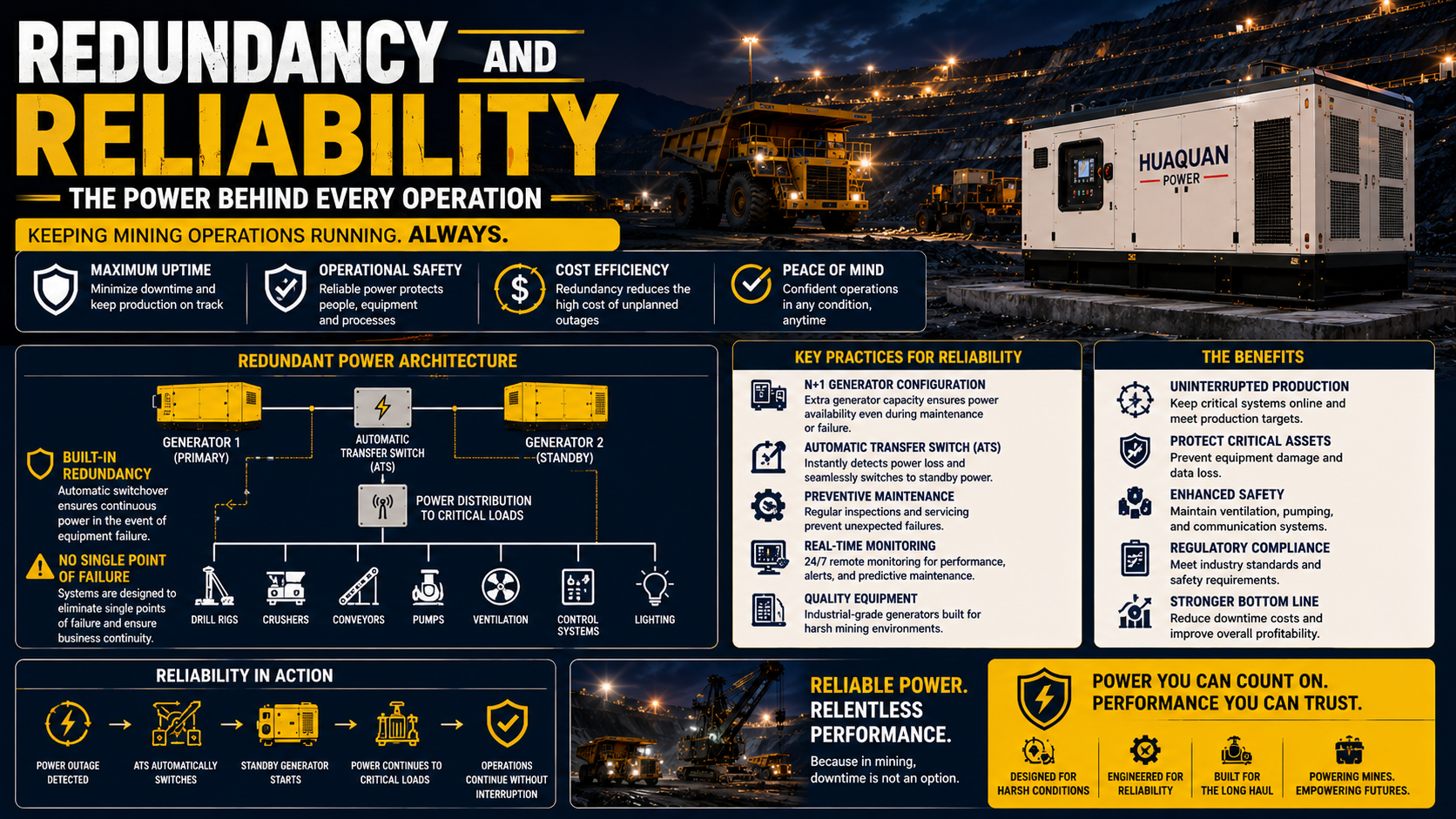
Power interruptions can halt the whole operation. Therefore, redundancy strategies are the saviors at this point. They feature a high-quality management system and offer easier availability of the tools.
There are three main redundancy strategies.
- N is the minimum number of generators required.
- N+1 is an additional generator required to handle the failure of one component.
- N+2 has two additional generators for the two-component failure.
Example
Suppose you are working on a mining site. N+1 redundancy will be one generator with an additional generator as a standby supply.
If you have two generators normally installed, then one additional supply will have three generators in total.
Key Consideration #9: Maintenance Accessibility
Maintenance is crucial. When you are choosing a generator, you must always consider maintenance hassles and accessibility. Choose those generators with low maintenance hassles and easy accessibility.
Here are a few components that should be accessible.
- Engine compartments
- Filters
- Cooling systems
- Control panels
- Fuel systems
Routine maintenance typically includes:
- Oil changes
- Fuel filter replacement
- Air filter cleaning
- Coolant inspection
- Battery testing
- Load bank testing
Key Consideration #10: Emission Regulations
Carbon emissions are a major issue for the generators. To comply with the generators for mining rules, you should have:
- Engine emission certification
- Fuel efficiency
- Exhaust after-treatment systems
- Noise control measures
- Carbon reduction initiatives
FAQs
- Can renewable energy be integrated into mining power systems?
Yes, 100%, you can integrate renewable energy sources. For example, solar supply or hydropower are common resources for renewable energy supply.
- Why is fuel storage important for mining generators?
Fuel is the main source of energy. Generators operate for several days only if you have a sufficient fuel supply. Therefore, fuel storage is essential and should be in accordance with the requirements.
- What is the difference between prime and standby generators?
Prime generators are often the primary sources and provide a constant energy supply. Standby generators are for only emergency situations. They work when there is a power outage.
- How do engineers determine the correct generator size for a mine?
The correct generator size depends on several factors. For example, count total load consumed by the devices, account for motor starting currents, apply a safety margin (typically 20–25%), and consider future expansion.
- Why are diesel generators commonly used in mining operations?
Compared to other generator types, diesel generators are more effective for mining operations because of high power output, excellent durability, reliable performance under heavy loads, and long operating hours.
- What environmental factors affect generator performance in mines?
There are several factors, such as high temperatures, dust, humidity, altitude, and corrosive conditions, that affect the generator operations in the mining sites.
- Why is redundancy important in mining power systems?
If you run out of power or any component fails, there must be another source of energy available. Redundant strategy provides an additional backup source in the mining operations.
- How often should mining generators be maintained?
Maintenance depends on several factors, such as operating conditions and aggressive use. However, you should do regular inspections, oil changes, filter replacements, coolant checks, and load testing.
- How can mining companies reduce generator operating costs?
Mining companies reduce operating costs by selecting the right generator type, ensuring correct sizing, and planning the future expansion of the energy.
- What is the highest operating cost for mining generators?
Fuel is the main factor behind the operating costs. You should optimize the fuel consumption and then enjoy the seamless and affordable power operations in mining areas.
Conclusion
Whenever you are choosing a generator for an outage in mining operations, always focus on quality generators for mining operations. Measure the accurate power requirements. Eliminate risks of oversizing and undersizing and enjoy the seamless power supply. Also, get the premium-quality energy supply with the top-notch brand— Huaquan Power.
We have gas, diesel, automatic, and hybrid generators for mining operations. They get installed on your sites and optimize the energy consumption. You get a consistent energy supply and enjoy a seamless power. Contact us for your generators!!