
Você está usando diesel Geradores? Se sim, então você pode precisar saber o método para ajustar a folga das válvulas dos geradores a diesel. Ajustando a folga das válvulas de Gerador Diesel ajuda você a fornecer a máxima eficiência do motor. Esta manutenção impedirá a perda de energia e evitará danos internos graves. Neste guia, nós o guiaremos por completo Método para ajustar a folga das válvulas de geradores a diesel.
O que é folga de válvula?
A distância entre a válvula e o balancim é conhecida como folga da válvula. Esta é uma área importante a ser considerada para a manutenção do seu motor. À medida que o gerador superaquece, os metais tornam-se imensamente grandes. As válvulas não conseguem fechar completamente sem esta folga.
Vazamento de válvulas causa perda de compressão do cilindro. Isto proporciona baixa partida e alto consumo de combustível. Há casos em que isso resulta em sedes de válvulas queimadas. Uma lacuna excessiva, por outro lado, tem barulho. Quando a folga é exagerada, produz um forte ruído de batida ou clique.
Eventualmente, esse estresse mecânico danifica a ponte da válvula ou a haste. As especificações do fabricante devem ser mantidas. Testes frequentes garantem o tempo de admissão e escape. Esta precisão torna o ciclo de combustão limpo e forte.
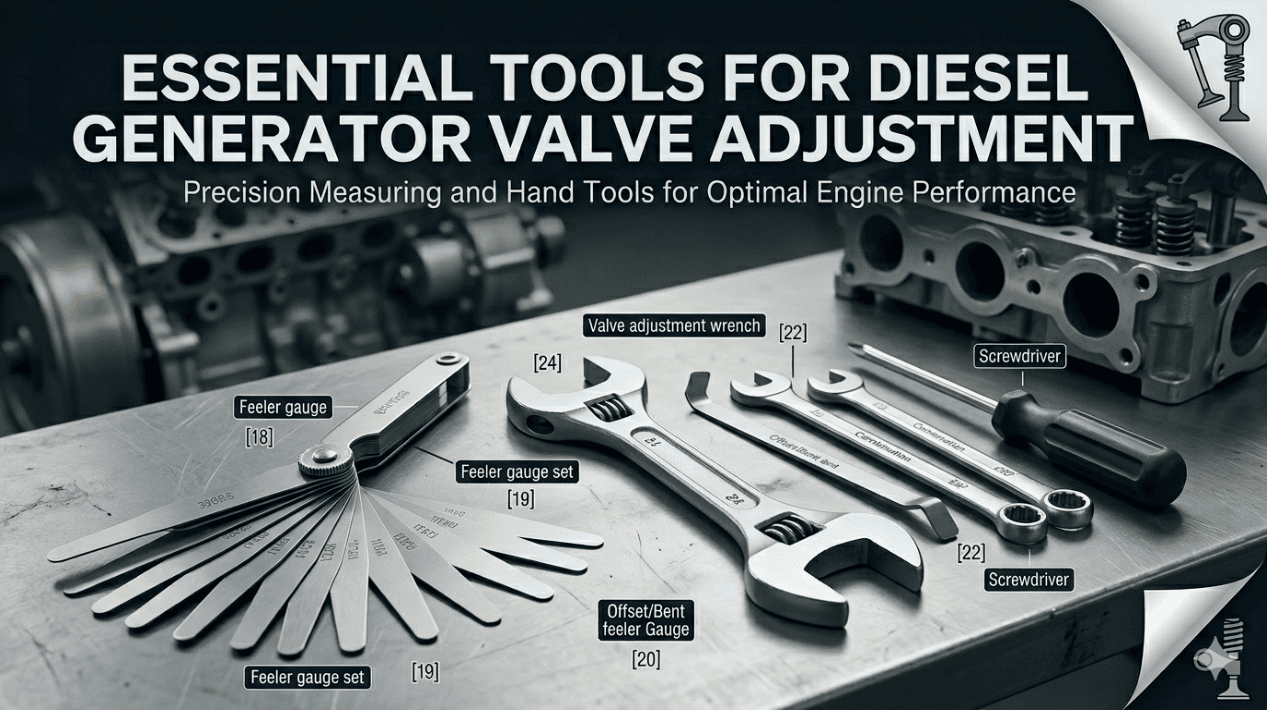
Ferramentas essenciais para o processo de ajuste
As ferramentas essenciais para o processo de ajuste incluem:
1. Ferramentas de medição de precisão
- Conjunto de medidor de folga: É a ferramenta mais essencial para o ajuste que compreende finas lâminas de metal. As lâminas meta têm espessuras diferentes. Você precisa de um conjunto completo que consista em medidas métricas e imperiais.
- Medidores de folga/dobrados: Esses tipos de medidores permitem que você alcance o balancim com mais facilidade.
- Ferramentas manuais para ajuste
- Chaves combinadas
- Chaves de fenda
- Chave de ajuste de válvula
Para dica:
Sempre faça os ajustes quando o motor estiver frio. À medida que o metal se expande com o aquecimento, isso fornecerá leituras erradas. Isso garante que você não aperte demais os parafusos da tampa. Esteja sempre pronto para ter um pano sujo por perto. Encontre marcas de tempo com uma lanterna LED brilhante. Certifique-se sempre de limpar as ferramentas antes que elas entrem em contato com o motor. A presença de sujeira no trem de válvulas leva ao desgaste prematuro dos componentes.
Preparando seu gerador a diesel para manutenção
Antes de ir trabalhar, a segurança deve ser sua primeira consideração. Desconecte o gerador e acione a parada de emergência. Deixe o motor esfriar até a temperatura ambiente. Nunca tente manipular as válvulas de um motor diesel quente. Desacople o pólo negativo da bateria de partida. Isso ajuda a evitar a partida do motor durante o trabalho. Limpe a tampa da válvula por fora. Limpe os detritos com uma escova ou ar comprimido.
Você surge para não ter poeira no óleo. Retire os tubos de respiro e qualquer chicote de fios que esteja bloqueando. Desaparafuse cuidadosamente os parafusos da tampa do cabeçote. Levante a tampa diretamente para cima para evitar danos à junta. Verifique os balancins quanto a desgaste evidente.
Localizando o ponto morto superior do cilindro um
Sob o ponto morto superior (TDC) você tem que inserir o pistão. É aqui que as duas válvulas estão fechadas. Gire o virabrequim no sentido horário ou anti-horário. Aplique uma chave grande no parafuso da polia dianteira. Siga as marcas de sincronização no volante do motor.
Posicione o ponteiro com o “TDC” marca ou o 0 marca. Inspecione os balancins do primeiro cilindro. A folga em ambos os braços deve ser pequena. Caso estejam apertados, gire a manivela 360 graus. Nesta fase você está pronto para iniciar o ajuste.
Encontrando o ponto morto superior para o cilindro um
A primeira coisa que você precisa fazer é ver qual válvula é qual. A válvula de admissão é normalmente maior em tamanho. A válvula de escape está localizada próxima ao coletor de escape. Verifique o manual do gerador para determinar a lacuna. Essas duas válvulas tendem a ter configurações variadas nas folgas.
Ajustando as folgas das válvulas de admissão e escape
Insira o calibrador de folga apropriado na lacuna. Deslize entre o balancim e a haste. Você deve experimentar algum leve, resistência suave. Isso pode ser chamado de leve sensação de arrasto. Caso o medidor esteja muito solto, aperte-o. Se não entrar, solte-o.
Desparafuse a porca de travamento do balancim. Segure a porca usando uma chave inglesa. Gire o parafuso de ajuste usando uma chave de fenda. Gire no sentido horário para diminuir a folga da válvula. Gire-o no sentido anti-horário para aumentar a lacuna. Deixe o calibrador de folga no espaço.
Quando sentir resistência, aperte a contraporca. Com a chave de fenda no lugar, aperte o parafuso de ajuste no lugar. Isso não permitirá que o parafuso gire com a porca. Você deve verificar novamente depois de apertar a contraporca. The final tightening usually varies in the clearance.
Following The Engine Firing Order Sequence
You are not able to change all of the valves simultaneously. You need to adhere to the definite engine firing order. In four-cylinder engine, it is usually 1-3-4-2. In the case of a 6-cylinder engine, it will be 1-5-3-6-2-4. Get this information on your engine data plate.
When the first cylinder is completed, rotate the crankshaft. Set the engine in the usual direction of running. Stop when the second cylinder attains Top Dead Center. Both clog valves in that cylinder should be loose. Remake the adjustment of these particular valves.
Repeat this with each line of the cylinders. Mark every rocker arm with a chalk mark. This will assist you in monitoring your progress fairly easily. It does not allow you to miss out on a valve. A balanced and smooth engine is guaranteed by accurate tracking.
Work slowly with each set of valves. Hurrying in this process results in the imbalance of engine performance. You desire that all the cylinders would give out the same power. This minimizes the vibration and increases the life of the generators. The secret of professional job lies in consistency.
Final Inspection And Engine Testing Phase
Reconnect the negative end of the starting battery. Keep tools out of the way of moving machinery. Keep off any rags or rubbish in the engine compartment. Before starting, check the status of engine oil. Evacuate the premises of all human beings.
Switch on to the diesel generator and idle. Be very attentive to the engine noise. A humming rhythm should be heard, soft, and quiet. No more great din of metallic rattle. When the engine is quiet it signifies that you have adjusted it correctly.
Monitor the exhaust by any color of smoke. The smoke color is black or white, this means something could happen. Inspect the valve cover area of the car to confirm the absence of oil. One leak will lead to a big mess. Tighten sloppy bolts in case of oil.
Allow the generator time to work ten minutes. Keep an eye on the engine temperature and the pressure of the oil. When a steady temperature is observed, the valves are seating. Switch off the engine and make one last check. Congratulations now you have finished a professional maintenance task.
Common Signs Of Incorrect Valve Clearance
You have to be aware of bad gap indicators. When it is a loud clicking sound the gap is wide. This tappet noise wear out the tips of the valve. It results in the loss of much power in the engine. Another typical symptom here is high fuel consumption.
When the distance is too small it is quiet. In fact, this is worse to your engine. The valves will not be closed when they become hot. This results in a loss in compression in a short time. The engine will not start all the time.
At some point, the valves will be burnt or broken off. This has disastrous effects to the piston head. There may be red hot exhaust glowing as well. This is due to the fact that the fuel is burnt in the pipe. These costly engine repairs are avoided due to regular checkups.
Frequently Asked Questions (Perguntas frequentes)
Is a generic feeler gauge set usable?
Sim, provided that it has metric sizes. The millimeters are the most used in most diesel engines. Make sure the gauge is not bent.
Why do we need to have more clearance with the exhaust valve?
The exhaust valves become very hot compared to the intake ones. During the combustion process, they increase in size. This extra expansion can be achieved by a bigger gap.
What happens when I am not able to locate the TDC mark?
Instead, you can see the rocker arms move. Check others when one of the valves opens and closes. This is referred to as the valve overlap method.
Conclusão:
An important manutenção thing that all generators operators should do is proper valve clearance adjustment. It provides a way of making your diesel generator reliable and efficient throughout the power cycle. By taking these steps into consideration, your investment will be secure, and unnecessary expenditures on engine repairs would be avoided. Get a more professional help of the experts at HuaQuan Power to consult on generating power and technical advice.
Manufacturer of Generators in China – HuaQuan.
HuaQuan is one of the leading Chinese manufacturers of diesel generators which offers high performance in power provision to industries. We provide an international supply chain of equipments that are subjected to the highest global quality standards and certifications. Our crew provides committed technical superiority and full maintenance services to ensure that you can operate your equipment over a long period of time. You either require a solid energy source to power your industrial facilities or an emergency backup, we offer reliable sources of energy depending on the requirements.
We have our official site, that is, you can visit https://huaquanpower.net/to see more information about our products and technical specification and professional support services.

