
Are you using diesel Generators? If yes, then you might need to know the method for adjusting the valve clearance of diesel generatos. Adjusting the valvae clearance of Diesel Generator helps you in providing the maximum efficiency of engine. This maintenance will stop loss of power and prevent severe internal damages. In this guide, we will guide you the entire Method For Adjusting The Valve Clearance Of Diesel Generators.
What is valve clearance?
The distance between the valve and rocker arm is known as valve clearance. This is an important area to be considered for the maintenance of your engine. As the generator overheats, the metals become immensely large. The valves are not able to close completely without this gap.
Valves leaking cause loss in cylinder compression. This gives low starting and high consumption of fuel. There are instances where it results in burnt valve seats. A gap that is excessive, on the other hand, has noise. When the clearance is overdone it produces a heavy tapping or clicking noise.
Eventually such mechanical stress damages the valve bridge or pushrod. The specifications of the manufacturer must be maintained. Frequent tests guarantee the intake and exhaust timing. This accuracy makes the combustion cycle clean and strong.
Essential Tools For The Adjustment Process
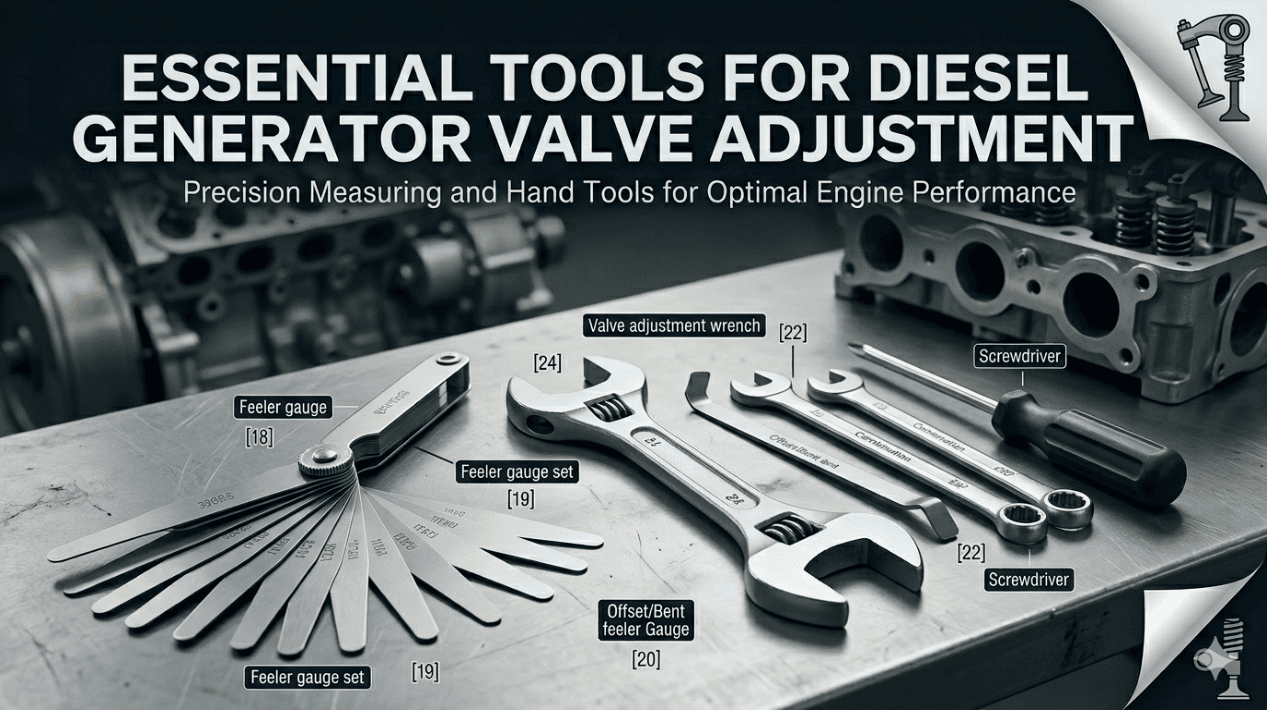
Essential tools for the adjustment process includes:
1. Precision Measuring tools
- Feeler gauge set: It is the most essential tool for the adjustment which comprises thin metal blades. Meta blades have different thickness. You need a complete set that consists of both metric and imperial measurements.
- Offset/Bent feeler Gauges: These type of gauges enable you to reach out to the rocker arm with more ease.
- Hand tools for adjustment
- Combination wrenches
- Screwdrivers
- Valve adjustment wrench
Pro Tip:
Always do the adjustments when the engine is cooled off. As metal expands on heating, this will give you wrong readings.This makes sure that you do not over-tighten cover bolts. Always be ready to have a dirty rag in the vicinity. Find timing marks by a bright LED flashlight. Always make sure to clean the tools before they come in contact with the engine. The presence of dirt in the valve train leads to premature wearing of components.
Preparing Your Diesel Generator For Service
Before going to work, safety should be your very first consideration. Disconnect the generator and flip the emergency stop. Allow engine to cool down to room temperature. Always do not attempt to manipulate the valves of a hot diesel engine. De-couple the negative post of the starting battery. This helps avoid the cranking of the engine during work. Wipe the valve cover on the outside. Clean the debris with a brush or compressed air.
You arise not to have dust in the oil. Take out the breather pipes and any wire harness which is blocking. Unscrew the bolts carefully of the cylinder head cover. Raise the cover directly upwards to prevent damage to the gasket. Check the rocker arms in terms of evident wear.
Locating Top Dead Center Cylinder One
Under Top Dead Center (TDC) you have to insert the piston. This is where the two valves are closed. Turn the crankshaft clockwise or anti-clockwise. Apply a large wrench on the front pulley bolt. Follow the timing marks on engine flywheel.
Position the pointer with the “TDC” mark or the 0 mark. Inspect the first cylinder rocker arms. The play on both arms is to be small. In case they are tight, turn the crank 360 degrees. At this stage you are ready to start adjustment.
Finding Top Dead Center For Cylinder One
The first thing you have to do is to see which valve is what. The intake valve is normally larger in size. The exhaust valve is located next to the exhaust manifold. Check your manual on the generator to determine the gap. These two valves tend to have varying settings in clearances.
Adjusting The Intake And Exhaust Valve Gaps
Insert the appropriate feeler gauge in the gap. Slide between the rocker and the stem. You must experience some slight, smooth resistance. This can be referred to as a slight drag feel. In case the gauge is too loose, tighten it. If it will not go in, loosen it.
Unscrew the lock nut of the rocker arm. Hold the nut using a wrench. Rotate the adjusting screw using a flat screwdriver. Spin it clockwise to narrow the gap of the valve. Turn it in a counter-clockwise direction to make the gap larger. Leave the feeler gauge in the space.
When you have a feel of resistance tighten the lock nut. With the screwdriver in place, tighten the adjusting screw in place. This will not allow the screw to rotate with the nut. You should check again after tightening the lock nut. The final tightening usually varies in the clearance.
Following The Engine Firing Order Sequence
You are not able to change all of the valves simultaneously. You need to adhere to the definite engine firing order. In four-cylinder engine, it is usually 1-3-4-2. In the case of a 6-cylinder engine, it will be 1-5-3-6-2-4. Get this information on your engine data plate.
When the first cylinder is completed, rotate the crankshaft. Set the engine in the usual direction of running. Stop when the second cylinder attains Top Dead Center. Both clog valves in that cylinder should be loose. Remake the adjustment of these particular valves.
Repeat this with each line of the cylinders. Mark every rocker arm with a chalk mark. This will assist you in monitoring your progress fairly easily. It does not allow you to miss out on a valve. A balanced and smooth engine is guaranteed by accurate tracking.
Work slowly with each set of valves. Hurrying in this process results in the imbalance of engine performance. You desire that all the cylinders would give out the same power. This minimizes the vibration and increases the life of the generators. The secret of professional job lies in consistency.
Final Inspection And Engine Testing Phase
Reconnect the negative end of the starting battery. Keep tools out of the way of moving machinery. Keep off any rags or rubbish in the engine compartment. Before starting, check the status of engine oil. Evacuate the premises of all human beings.
Switch on to the diesel generator and idle. Be very attentive to the engine noise. A humming rhythm should be heard, soft, and quiet. No more great din of metallic rattle. When the engine is quiet it signifies that you have adjusted it correctly.
Monitor the exhaust by any color of smoke. The smoke color is black or white, this means something could happen. Inspect the valve cover area of the car to confirm the absence of oil. One leak will lead to a big mess. Tighten sloppy bolts in case of oil.
Allow the generator time to work ten minutes. Keep an eye on the engine temperature and the pressure of the oil. When a steady temperature is observed, the valves are seating. Switch off the engine and make one last check. Congratulations now you have finished a professional maintenance task.
Common Signs Of Incorrect Valve Clearance
You have to be aware of bad gap indicators. When it is a loud clicking sound the gap is wide. This tappet noise wear out the tips of the valve. It results in the loss of much power in the engine. Another typical symptom here is high fuel consumption.
When the distance is too small it is quiet. In fact, this is worse to your engine. The valves will not be closed when they become hot. This results in a loss in compression in a short time. The engine will not start all the time.
At some point, the valves will be burnt or broken off. This has disastrous effects to the piston head. There may be red hot exhaust glowing as well. This is due to the fact that the fuel is burnt in the pipe. These costly engine repairs are avoided due to regular checkups.
Frequently Asked Questions (FAQs)
Is a generic feeler gauge set usable?
Yes, provided that it has metric sizes. The millimeters are the most used in most diesel engines. Make sure the gauge is not bent.
Why do we need to have more clearance with the exhaust valve?
The exhaust valves become very hot compared to the intake ones. During the combustion process, they increase in size. This extra expansion can be achieved by a bigger gap.
What happens when I am not able to locate the TDC mark?
Instead, you can see the rocker arms move. Check others when one of the valves opens and closes. This is referred to as the valve overlap method.
Conclusion:
An important maintenance thing that all generators operators should do is proper valve clearance adjustment. It provides a way of making your diesel generator reliable and efficient throughout the power cycle. By taking these steps into consideration, your investment will be secure, and unnecessary expenditures on engine repairs would be avoided. Get a more professional help of the experts at HuaQuan Power to consult on generating power and technical advice.
Manufacturer of Generators in China – HuaQuan.
HuaQuan is one of the leading Chinese manufacturers of diesel generators which offers high performance in power provision to industries. We provide an international supply chain of equipments that are subjected to the highest global quality standards and certifications. Our crew provides committed technical superiority and full maintenance services to ensure that you can operate your equipment over a long period of time. You either require a solid energy source to power your industrial facilities or an emergency backup, we offer reliable sources of energy depending on the requirements.
We have our official site, that is, you can visit https://huaquanpower.net/to see more information about our products and technical specification and professional support services.

