One of the largest continuous operating expenses you will encounter at a facility running on standby or prime backup power is the cost of diesel. Fuel management is a significant cost item for a large industrial engine, because it may consume thousands of liters of fuel in just a few days of running.
First, it is important to keep in mind that there is no fixed amount of fuel consumption. It depends on the electrical load applied, the mechanical condition of the engine, the environment of operation, the power factor and the specific design of the generator model by the manufacturer.
The idea here is to give you actionable ideas that will help you reduce your overall fuel bill while maintaining the reliability of your facility’s power supply. No matter if you are operating a hospital, data center or a remote construction site, learning how to load and maintain your 500kVA Generator can save your business thousands of dollars in wasted diesel each year.
In this article by Huaquan, you will learn actionable strategies to optimize electrical loads, improve mechanical efficiency, and drastically reduce the daily diesel consumption of your 500kVA generator.
How Many Liters of Fuel Will a 500kVA Generator Use?
To reduce your fuel consumption, you must be aware of how much fuel your machine can consume.
Convert 500kVA to kW
The difference between kVA and kW is that Generators are rated in apparent power (kVA), while you actually pay for real power (kW). It’s basically this simple:
kW = kVA × Power Factor
Generally, the power factor of any industrial 3-phase generator is 0.8. So:
500kVA × 0.8 = 400kW
The typical rating for a 500kVA unit is approximately 400kW of usable power, but please check the manufacturer’s data sheet for exact ratings.
Typical Fuel Consumption for Various Loads
The harder the electrical load, the more effort the engine has to put in and the more fuel it will use. The following is an example of a typical Cat C15 500kVA specification to illustrate the change in consumption levels at various load levels:
| Generator load | Electrical output | Fuel consumption (L/hour) | Specific fuel consumption (L/kWh) |
| 100% | 400kW | 108.8 L/hour | 0.272 L/kWh |
| 75% | 300kW | 85.6 L/hour | 0.285 L/kWh |
| 50% | 200kW | 61.1 L/hour | 0.306 L/kWh |
| 25% | 100kW | 34.6 L/hour | 0.346 L/kWh |
Note: These are only sample numbers. Actual consumption will always differ depending on the age of the engine, the efficiency of the alternator, the quality of the fuel, the ambient temperature and the application.
Why Is a 500kVA Generator’s Fuel Consumption High?
If your generator is consuming diesel at a rate that exceeds the manufacturer’s recommended rate, there are a few possible reasons:
- Running all the time with very light loads
- Incorrect generator sizing
- Dirty air and fuel filters
- Worn or poorly calibrated fuel injectors
- Low-quality or contaminated diesel fuel
- Poor engine lubrication
- Cooling-system problems (overheating)
- High electricity loss in the plant
- Frequent start-ups and sudden, major load changes
- Fuel leaks or unauthorized fuel removal (theft)
- Inaccurate fuel and power-output readings
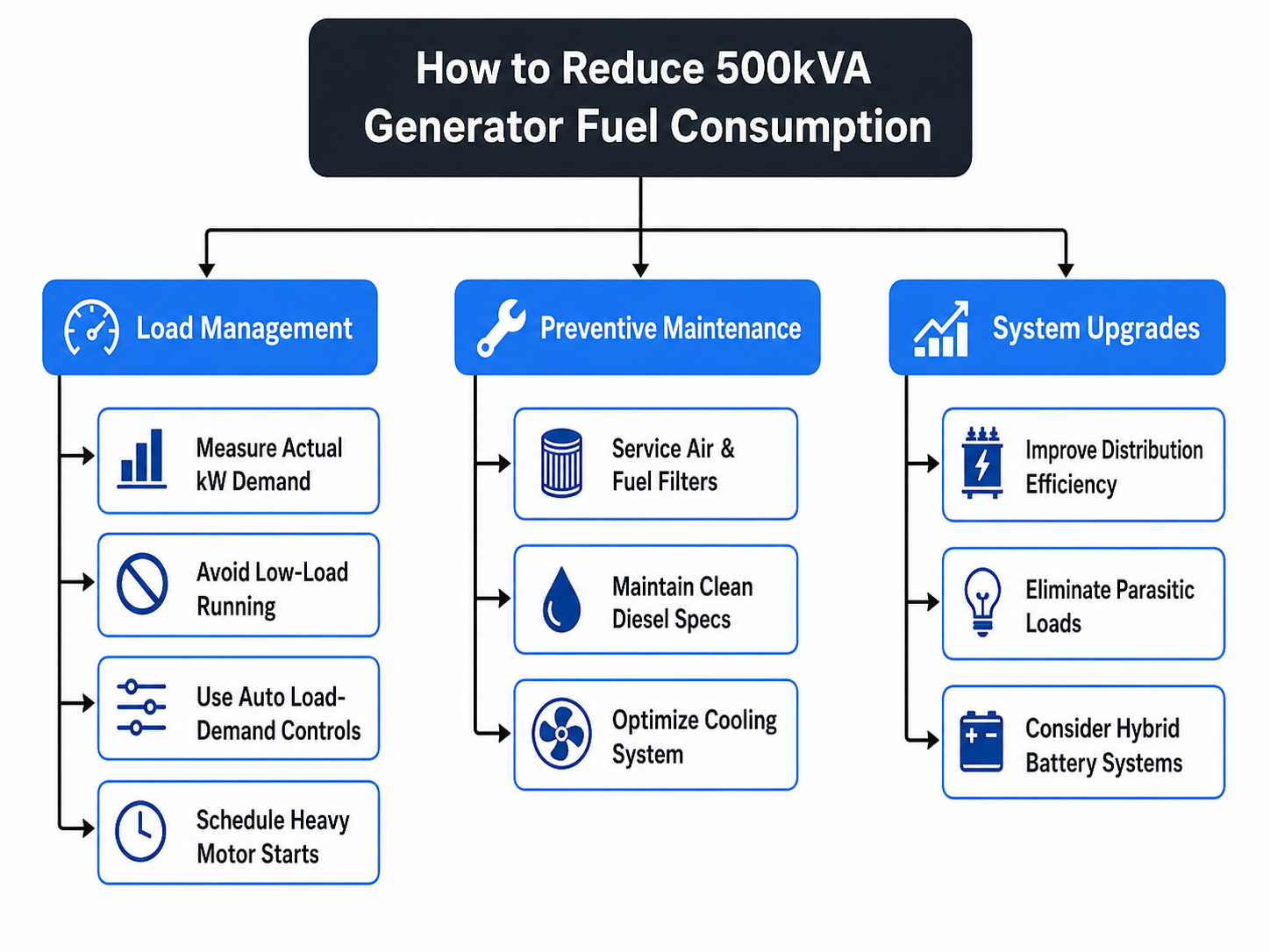
12 Ways to Reduce 500kVA Generator Fuel Consumption
1. Measure the Actual Electrical Load
What you can’t measure you can’t manage. Get a digital power meter and accurately record your average, minimum and peak kW demand. Don’t assume that the number of machines connected equals the load. Create a daily or weekly load profile to see where and when your power is being used.
2. Don’t Operate the Generator at Low Load
Sure, running a generator at 25% load requires less fuel per hour, but at that load the fuel burned per kWh is much higher, as the chart above illustrates.
Low load operation results in inefficient combustion, thick carbon deposits on the pistons and the harmful condition known as wet stacking, in which unburned fuel leaks out into the exhaust. Never exceed the manufacturer’s recommended load limit. Cummins engineers say that keeping other generators running when they are not needed wastes capacity and lowers efficiency. Paralleling generator sets effectively increases the load on the operating unit, significantly improving fuel efficiency.
3. Select the Right Size of Generator
If the generator is too large, it will run for most of its life under severe underloading, wasting fuel and wearing out its engine. The reverse causes the generator to run overloaded all the time, leading to mechanical wear and thermal shutdowns. Always size conservatively for average demand, peak demand, heavy motor-starting currents and realistic future expansion. If your facility has highly variable loads, multiple modular or paralleled generators may be recommended.
4. Use Automatic Load-Demand Controls
Automatic controls can start and stop generator sets as demand requires when a facility runs multiple generators. This maintains your required power redundancy while at the same time shutting down any unnecessary running units, saving fuel in the process.
5. Don’t Start Everything at the Same Time, Schedule Loads
Large motors, big water pumps, industrial compressors, HVAC systems and more starting all at once create a big spike in peak demand. Plan for heavy loads to be introduced gradually. Where feasible, use soft-start equipment and variable-frequency drives, and isolate essential life-safety equipment from nonessential convenience equipment.
6. Make Sure the Air-Intake System Is Maintained
To produce efficient combustion, a diesel engine requires a large amount of oxygen. Regularly check and change out clogged air filters. Inspect the turbocharger and intake piping for vacuum leaks, loose clamps or restrictions. With low airflow, the engine has to pump out more fuel to make up for it, which destroys your combustion efficiency.
7. Service the Fuel System
An unmaintained fuel system quickly kills fuel economy. Aim to cover:
- Fuel-filter replacement
- Water-separator draining
- Injector testing and calibration
- Fuel-pump inspection
- Fuel-line leak detection
- Main tank cleaning
- Microbial contamination prevention
8. Use the Correct Specification Diesel Fuel
Use the fuel specified by the engine’s manufacturer. Keep water, sediment, microbial growth (diesel algae) and dirt out of your bulk storage tank. Do not store diesel for extended periods without using biocide treatment or a fuel polishing system. Contaminated fuel is unsuitable for the injectors and will create sloppy combustion due to a bad spray pattern.
9. Maintain the Cooling and Lubrication Systems
It’s as simple as that, wasted energy is engine friction. Always follow oil change recommendations for correct viscosity oil grade and change times. Inspect the cooling system, clean the radiator and check the thermostat, fan belts and hoses for corrosion and damage. The engine’s operating temperature falls outside its maximum thermal efficiency range whenever it runs abnormally hot or cold.
10. Evaluate and Enhance Electrical Distribution Efficiency
If the electricity generated from the fuel is lost before it can be used by the machines, this is wasted. Enhance the efficiency of your facility by addressing the following:
- Proper sizes (undersized cables will add heat and resistance)
- Loose electrical connections
- Voltage imbalance
- Excessive cable length
- Transformer losses
- Harmonic-producing loads
- Phase balancing
Note: Though the improvement of your facility’s power factor can free up generator capacity, fuel consumption is dependent on real power (kW). Power factor correction is NOT a magic fuel saving solution.
11. Minimize Unnecessary Loads and Parasitic Loads
All watts consumed are a result of fuel usage. Turn off:
- Unnecessary warehouse lighting
- Pumps or exhaust fans when not in use
- Battery chargers that are operating when they are fully charged
- Space heaters used unwisely in heated or unheated rooms
- Temporary site equipment not dismounted and left plugged in
- Equipment left on outside working hours
12. Take Hybrid Generator System into Account
When using an off-grid location, connect to a commercial battery bank or solar power array. Use the batteries during low-load periods quietly and efficiently and only use the heavy generator at efficient battery charging times or during times of high demand operation. Before taking up installation of a hybrid system, one needs to evaluate the technical and financial viability.
How to Calculate the Fuel Efficiency of a 500kVA Generator
To determine if your fuel-saving strategies are working, you must run the math.
Liters per Kilowatt-Hour Formula
This is the true measure of engine efficiency: Fuel efficiency in L/kWh = Fuel consumed in L/hour ÷ Actual output in kW Example: 108.8 L/hour ÷ 400kW = 0.272 L/kWh
Daily Fuel Consumption Formula
Daily diesel use = Average fuel consumption per hour × Operating hours Example: 85.6 L/hour × 10 hours = 856 liters per day
Fuel-Cost Formula
Fuel cost = Liters consumed × Diesel price per liter
Fuel-Savings Formula
Fuel savings percentage = ((Previous consumption − New consumption) ÷ Previous consumption) × 100
How to Carry Out a Fuel Consumption Audit
If payment on your fuel bills feels too high, use the following step-by-step audit process:
- Accurately log generator running hours on the digital controller.
- Accurately measure the amount of diesel added to the tank and the quantity of diesel remaining in the tank.
- Note the total number of kWh that the master breaker recorded.
- Record the average and peak electric demand.
- Work out how many L/hour and L/kWh you have now.
- Compare these results directly to the fuel curve published by the manufacturer.
- Check the mechanical maintenance record.
- Recognize low load operating times (e.g. night shifts).
- Eliminate the largest mechanical and electrical losses.
- Re-test to see the results after improvements.
Preventive Maintenance Checklist for Better Fuel Economy
The most straightforward way to conserve fuel is to maintain your generator thoroughly. Follow intervals as recommended by the generator manufacturer, and not on generic schedules.
Daily Checks
- Fuel level
- Oil level
- Coolant level
- Visual leak check
- The warning indicators found on the control panel
- Operating temperature
- Stability of the voltage and frequency
Check Once a Week/Month
- Air-filter restriction indicators
- Starting battery condition
- Radiator core cleanliness
- Drain fuel-water separator
- Check drive belts and coolant hoses
- Look for exhaust smoke, either black or white
- Tighten electrical connections
Scheduled Service Checks
- Change oil & filters
- Primary & secondary fuel filtering replacement
- Testing and inspection of injectors
- Valve-clearance adjustment
- Professional load-bank testing
- Alternator bearing inspection
- Control-system firmware calibration
Conclusion
Managing the operating costs of industrial backup power takes far more than just glancing at the fuel tank once a week. Focus on load management, get your electrical sizing right, implement thorough preventive maintenance and properly measure your electrical consumption to reduce your monthly fuel costs significantly.
Keep in mind, when observing the actual performance of your engine, it’s much more valuable to see L/kWh than L/hour. Continuous monitoring of this parameter can ensure your 500kVA Generator is operating at its optimum performance, ensuring reliable power at your facility and safeguarding your facility’s profitability.
Contact the Huaquan team today for expert load analysis, professional maintenance services, and advanced hybrid backup power solutions.