Introduction
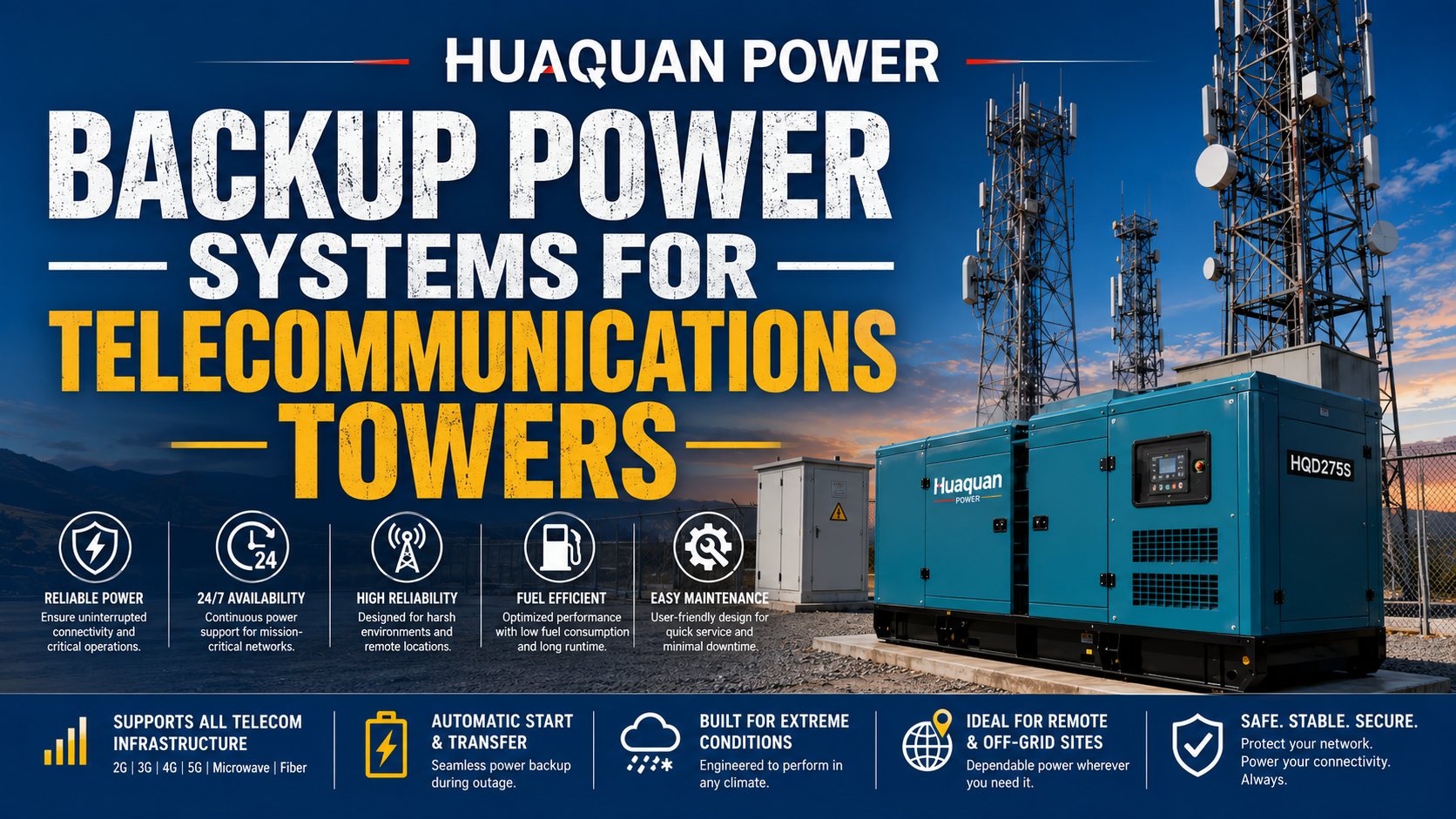
Modern communication systems heavily rely on telecommunication towers. The consistent internet supply and communication between different devices and cloud management systems make it easier to control things. Since telecom Towers operate round the clock, power outages can interrupt them. That is where backup power systems step in.
Today, we will discuss the backup power systems for telecom towers and understand how the whole process and system work.
Why are Backup Power Systems Crucial for Telecom Towers?
You might wonder why you should have backup power systems. There are several reasons behind this fact. For example:
- Continuous mobile communication
- Reliable internet connectivity
- Emergency service availability
- Network stability
- Business continuity
- Reduced service interruptions
- Improved customer satisfaction
- Protection of critical communication infrastructure
Types of Backup Power Systems for Telecommunications Towers
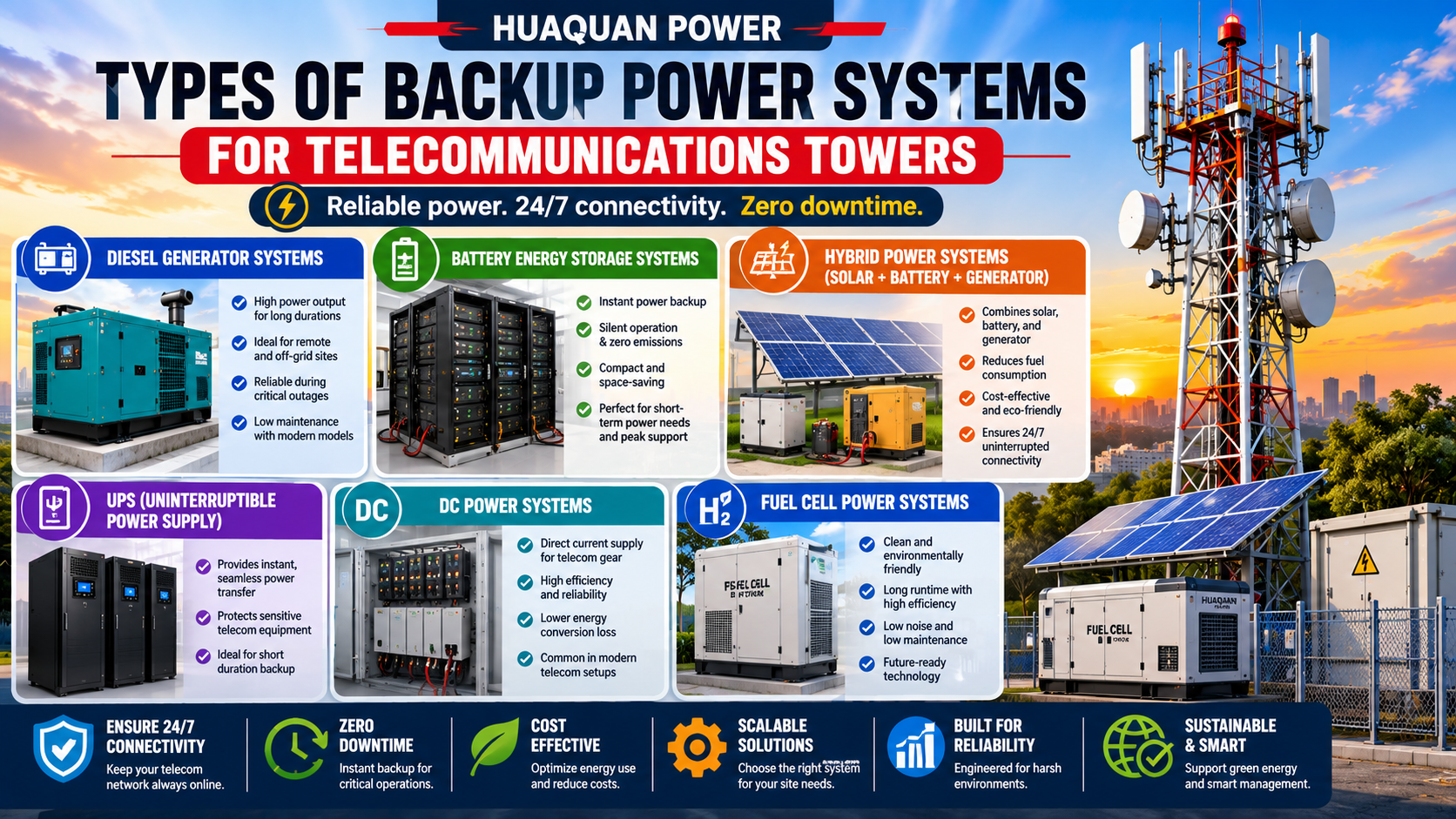
There are several types of backup power systems for telecom towers. Here are a few necessary types to know.
Battery Backup Systems
Batteries are the crucial and even primary backup power systems in several scenarios.
For example, you install the solar setup. Batteries help store the excess energy produced during the daytime and utilize it at night or during power outages.
The benefits of the battery backup systems are:
- Immediate response. You get an instant energy supply without any delays of seconds.
- Quiet operation as they are not like the Generators or other systems.
- Zero local emissions and sustainable energy usage make them an ideal choice.
- High reliability when you have sufficient power stored inside your battery backup power systems.
Diesel Generator Backup Systems
Diesel Generators have been serving the backup energy systems for several years. Thanks to its high output energy supply and powerful production, it brings quality results.
There are a few benefits of diesel generators.
- High power output because of diesel as the main fuel.
- Long operating time as you have a continuous fuel supply and maintenance.
- Reliable performance throughout the day and night.
- Suitable for remote locations where you want an independent energy source.
Hybrid Power Backup Systems
A hybrid power system is not a single source of energy. But it combines multiple sources of energy. For example:
- Utility grid
- Solar photovoltaic panels
- Battery Energy Storage System (BESS)
- Diesel generator
- Energy Management System (EMS)
There are several benefits of combining and using several energy sources.
- There is a continuous energy supply.
- Fuel consumption and operational costs are very low with quality energy supply issues.
- Instant energy is available in case of an outage.
- You get free energy with the solar systems and optimize your system better.
Solar Powered Backup Systems
Solar Energy is the leading source of renewable energy compared to other components. It is being installed on a large scale around the world. Thanks to its availability and easier installation.
There are several benefits of solar power backup systems.
- Reduced fuel costs as you are relying on solar energy throughout the day.
- Lower emissions as the energy is sustainable and renewable.
- Minimal operating expenses because a single solar system can survive 20-25 years of operation.
- Greater energy independence if you live in remote areas.
Factors To Consider When Designing Backup Power Systems
If you are planning to operate backup power systems for your telecom towers, there are several factors to consider before their use. We have added several tips here.
Tip #1: Total Power Requirement
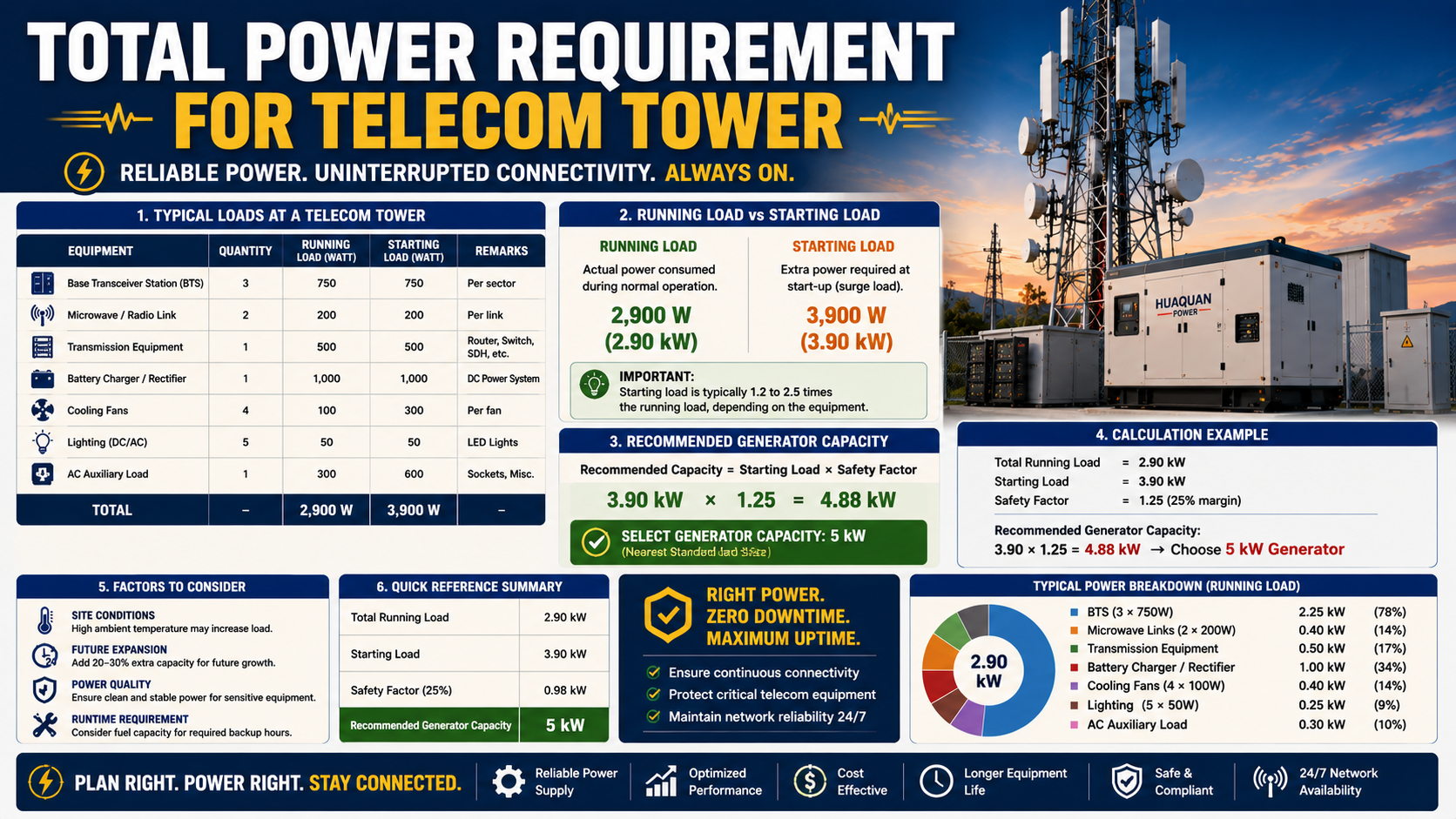
First, you should know the total power required to operate the telecom towers. A tower comprises several components instead of only the tower.
You should make a comprehensive list of tools, including those that operate only during the outage hours. We have compiled a list of tools, such as:
- Base Transceiver Station (BTS)
- Microwave radio equipment
- Cooling systems
- Network switches and routers
- Security systems
- Tower lighting
- Battery chargers
- Remote monitoring equipment
Here is the table of loads connected and used.
| Equipment | Quantity | Power Rating | Total Load |
| BTS Cabinet | 2 | 2.5 kW | 5.0 kW |
| Microwave Radio | 2 | 0.8 kW | 1.6 kW |
| Air Conditioner | 2 | 2.0 kW | 4.0 kW |
| Router & Switches | 1 | 1.2 kW | 1.2 kW |
| Security System | 1 | 0.3 kW | 0.3 kW |
| Tower Lighting | 1 | 0.4 kW | 0.4 kW |
Let’s calculate the total power consumption. Based on the given situation, there are connected loads of 12.5kW.
If you keep a future expansion of 20-25%, then you should buy roughly 15 kW of backup power systems. It would be a more suitable choice.
Tip #2: Required Backup Duration
How long do you want to run your tools? Remember:
- Large-capacity batteries operate for longer hours.
- Generators are the best option when you need a 12- to 24-hour energy supply consistently.
The longer the backup runtime, the higher the capacity and the more powerful the system should be.
Here is the list of recommended backup solutions.
| Grid Reliability | Recommended Backup Duration |
| Highly Reliable Urban Grid | 2–4 hours |
| Moderate Reliability | 6–12 hours |
| Frequent Power Interruptions | 12–24 hours |
| Remote Telecom Sites | 24–72 hours |
| Disaster Recovery Sites | 72+ hours |
For long outages, we recommend:
- Larger battery setups.
- Quality solar systems that operate throughout the day.
- Generators, especially the diesel generators. Choose natural gas generators when there is abundant access to natural gas.
Tip #3: Select the Appropriate Backup Power Technology
There are four backup power systems we have discussed earlier. Take an overview of them.
- Always prefer solar systems for the free energy supply during the daytime or sunlight.
- Choose battery storage systems to store energy throughout the peak production hours with solar energy.
- Install backup generators to avoid power outages when your utility grids or solar systems are not producing energy. Even the batteries are discharged.
Do you know the best option? A hybrid system combining all the above options is the best system available.
| Backup Solution | Best For | Advantages | Limitations |
| Battery Backup | Short outages | Instant response, silent operation | Limited runtime |
| Diesel Generator | Long outages | High reliability, extended runtime | Fuel and maintenance required |
| Solar + Battery | Remote sites | Low operating cost, renewable energy | Weather dependent |
| Hybrid Power System | Critical telecom towers | High efficiency and reliability | Higher initial investment |
Tip #4: Environmental Conditions
Telecommunication towers are often installed in remote areas and experience harsh environmental conditions. There are several factors that affect outdoor installations.
For example:
- Ambient temperature
- Dust concentration
- Coastal salt exposure
- Heavy rainfall
- Snow and ice
- High altitude
You should already have a plan to fight all such factors. Here are a few recommendations for you.
| Site Condition | Recommended Solution |
| Desert Locations | Heavy-duty air filtration and enhanced cooling |
| Coastal Areas | Corrosion-resistant enclosures |
| Mountain Regions | Generator derating for altitude |
| Heavy Rainfall | Weatherproof canopy with IP-rated electrical equipment |
| Cold Climates | Engine block heaters and battery heaters |
Tip #5: Plan Fuel Storage Capacity
Fuel Storage capacity is essential. It determines if you’ll have sufficient fuel available in case of an outage. Suppose an example here.
Assume:
Generator Capacity = 20 kW
Average Load = 75%
Fuel Consumption = 4.5 L/hour
Required Runtime = 48 hours
Fuel Required
4.5 × 48 = 216 liters
Adding a 20% reserve
216 × 1.20 = 260 liters
If you buy a fuel tank with a capacity of 250-300 liters, it would be sufficient to operate your telecom towers for 48 hours. Remember, if you want an energy supply for more than 72 hours, you should plan higher fuel capacities.
Tip #6: Design for Future Network Expansion
You are not running the whole backup power system for one day or two. Most people plan for several years. In the future, there can be the addition of new technology and advanced equipment.
Therefore, future expansion is a wise idea. You should plan it before it is too late. When designing your backup power systems, always consider the addition of:
- Additional BTS cabinets
- Extra antennas
- 5G radio equipment
- Additional cooling units
- Edge computing hardware
Future planning keeps your system upgraded and running safely.
Tip #7: Implement Remote Monitoring
Telecommunication towers offer the unbeatable technology for remote monitoring and connections. Sitting miles away, you can control your system through cloud management.
This remote monitoring system can help with tracking:
- Generator operating status
- Fuel level
- Battery voltage
- Battery temperature
- Utility availability
- Alarm conditions
- Maintenance reminders
Sitting miles away, you can better change and optimize your system based on your needs.
Tip #8: Evaluate Maintenance Requirements
If you are looking for the longevity of your system, always maintain the system before potential failures.
During maintenance, you should check the following components.
- Engine oil replacement
- Fuel filter replacement
- Battery inspection
- Coolant level checks
- Air filter cleaning
- Generator load testing
How often should you maintain your system? That is the key question and depends on the situation. There should be a weekly routine for the inspection. Moreover, you should inspect critical backup generators regularly for timely availability and operation.
Tip #9: Consider Total Cost of Ownership (TCO)
Purchasing equipment or installing a system is often a one-time investment for the upcoming 10-20 years. However, you should calculate all the costs in the total cost of ownership.
For example:
- Initial equipment purchase. Include all the tools you have purchased.
- Installation costs, as you have to hire the technical experts for installation purposes.
- Fuel consumption, whether it is a diesel generator or a natural Gas Generator.
- Scheduled maintenance for the generators.
- Replacement batteries, depending on how and when you replace them.
- Spare parts act as backup components in sudden failures.
- Remote monitoring services have higher expenses and a comprehensive system. You should include them as well.
Tip #10: Ensure System Reliability and Redundancy
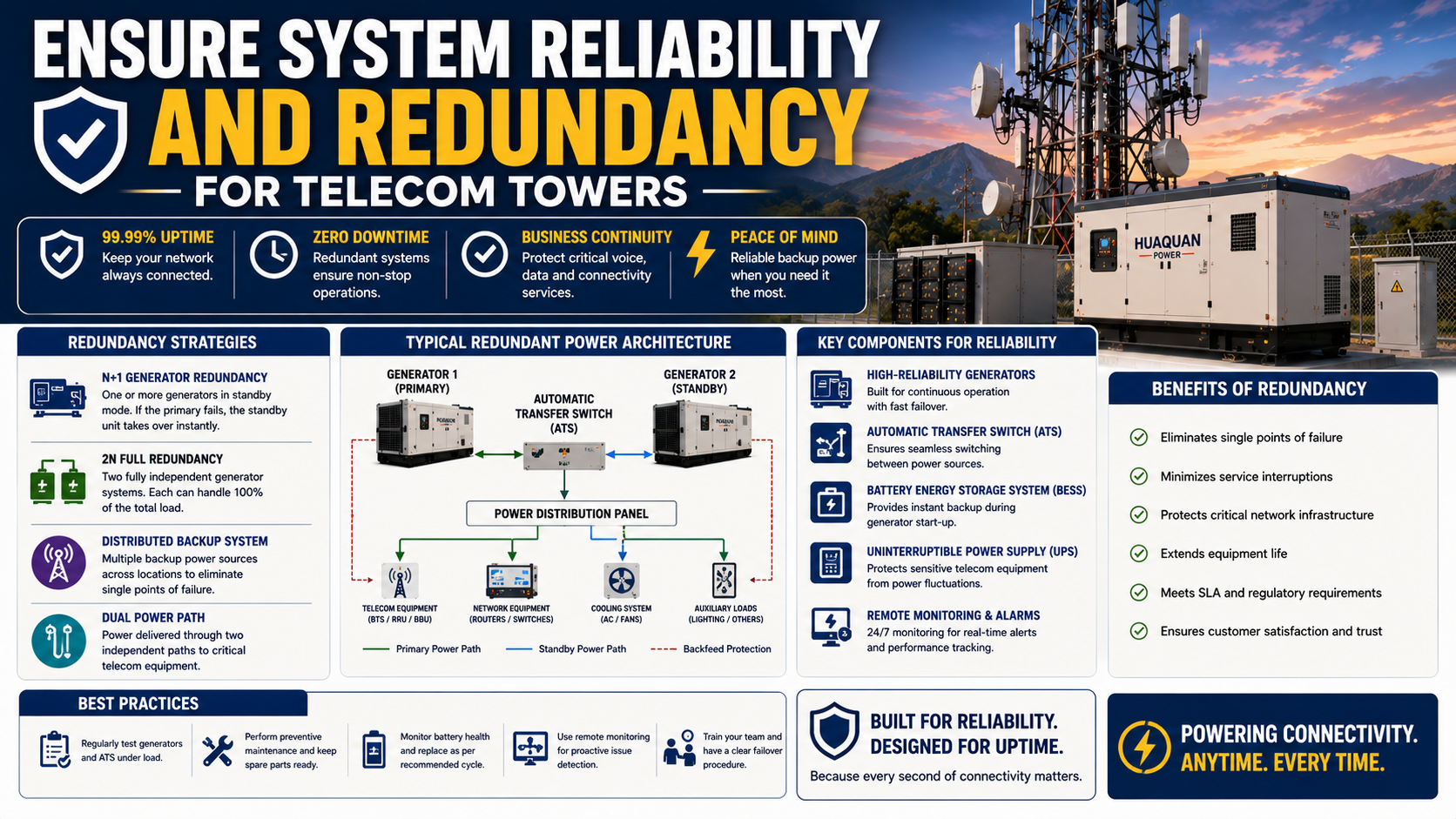
Do you want to avoid the sudden potential failures of the backup power systems? Plan before you fail. Choose the backup component supply and introduce the redundancy to avoid several issues and ensure reliability.
For example:
- N+1 generator configuration for high reliability in case of failures.
- Redundant battery strings if batteries fail to operate.
- Dual fuel supply arrangements in case the fuel runs out of storage systems.
- Multiple communication links for better runtime and efficiency.
- Automatic Transfer Switch redundancy to automate the transfer of energy consumption between different sources.
FAQs
- How long should a telecom tower backup system operate?
Telecom Towers operate 24/7 and can’t bear a single second of power outage. Your backup system should be designed as such to provide energy for one or two days if interruptions occur.
- Can solar power replace diesel generators for telecom towers?
Technically, you should not replace the diesel generators with solar power. It is because a diesel generator makes energy available 24/7, while solar panels can generate energy only during sunlight availability.
- How is the backup power capacity calculated?
Backup power capacity depends on several factors. Total equipment power consumption, starting loads, peak consumption, and finally future expansion.
- What is the most common backup power source for telecom towers?
A diesel generator is the most common backup source available. It offers a constant energy supply and provides the system with the right power.
- Why do telecommunications towers require backup power systems?
Telecommunication towers provide uninterrupted communication services during utility outages, allowing mobile networks, internet services, and emergency communications. Therefore, they need backup power systems to supply energy and operate.
- What is the biggest mistake when designing telecom backup power systems?
The biggest mistake is the undersizing of the backup power systems. You don’t calculate the future expansions and buy a system with an undersized setup.
- How often should telecom backup power systems be maintained?
Weekly maintenance is an essential case. However, you should regularly maintain the telecom backup power systems and get a consistent energy supply.
- What factors affect generator fuel consumption?
Generator fuel consumption depends on several factors. For example, generator size, operating load, engine efficiency, runtime, maintenance condition, and environmental factors such as temperature and altitude.
- What is the advantage of a hybrid telecom power system?
Hybrid backup power systems are better for many reasons because they reduce fuel consumption, optimize energy efficiency, and provide a non-stop energy supply with the batteries and generators.
- Why is battery backup used with generators?
The main purpose is to reduce the generator fuel consumption. However, the generator takes time while batteries supply instant energy. It can also be another reason.
Conclusion
Having high-end backup power systems is ideal for several reasons. You get a continuous energy supply and demand. There are no issues with the interruption of the power supply at the telecom towers. If you have customers connected to your services, they remain happy and rate your services better.
Do you want to get high-quality generators as your smooth backup systems? Contact Huaquan Power as we provide the premium diesel generators for your service. You get the long-term performance and easier installation at your remote telecom towers. Contact our experts to get your quote!!