Introduction
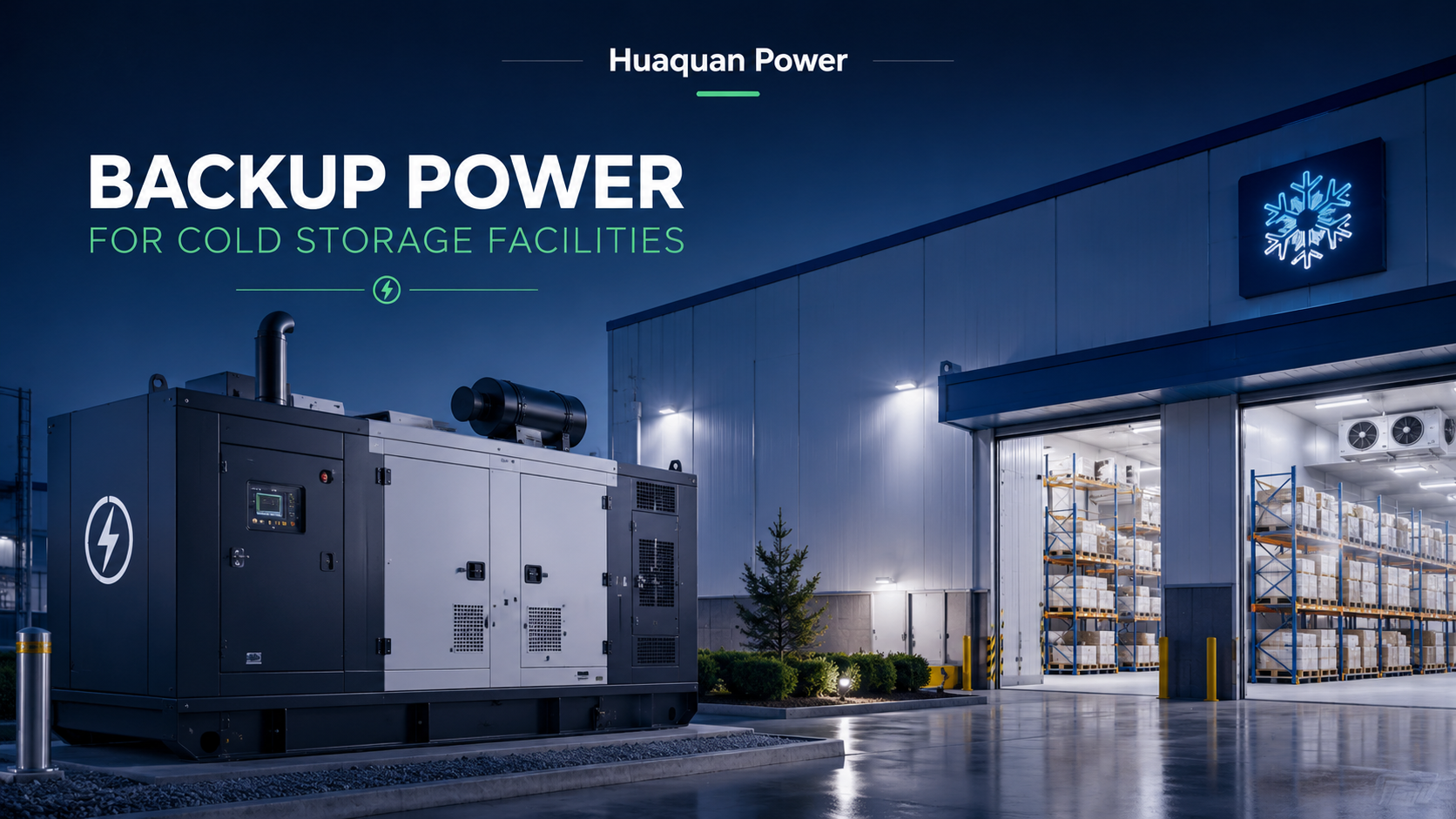
Cold storage facilities store a variety of items. Whether you are storing frozen food, fresh produce, pharmaceuticals, seafood, dairy products, or chemicals, slight interruptions in the power can impact all the stored materials. They might decay faster. Backup Power for Cold storage facilities helps here.
It provides a seamless power supply and ensures a positive experience. Today, we will discuss a comprehensive system for backup power for cold storage facilities and understand how this works.
Step 1: Cold Storage Facilities Requiring Power
First, you must know all the tools and equipment that require power. Whether they are critical or not, you should keep a list of all the tools.
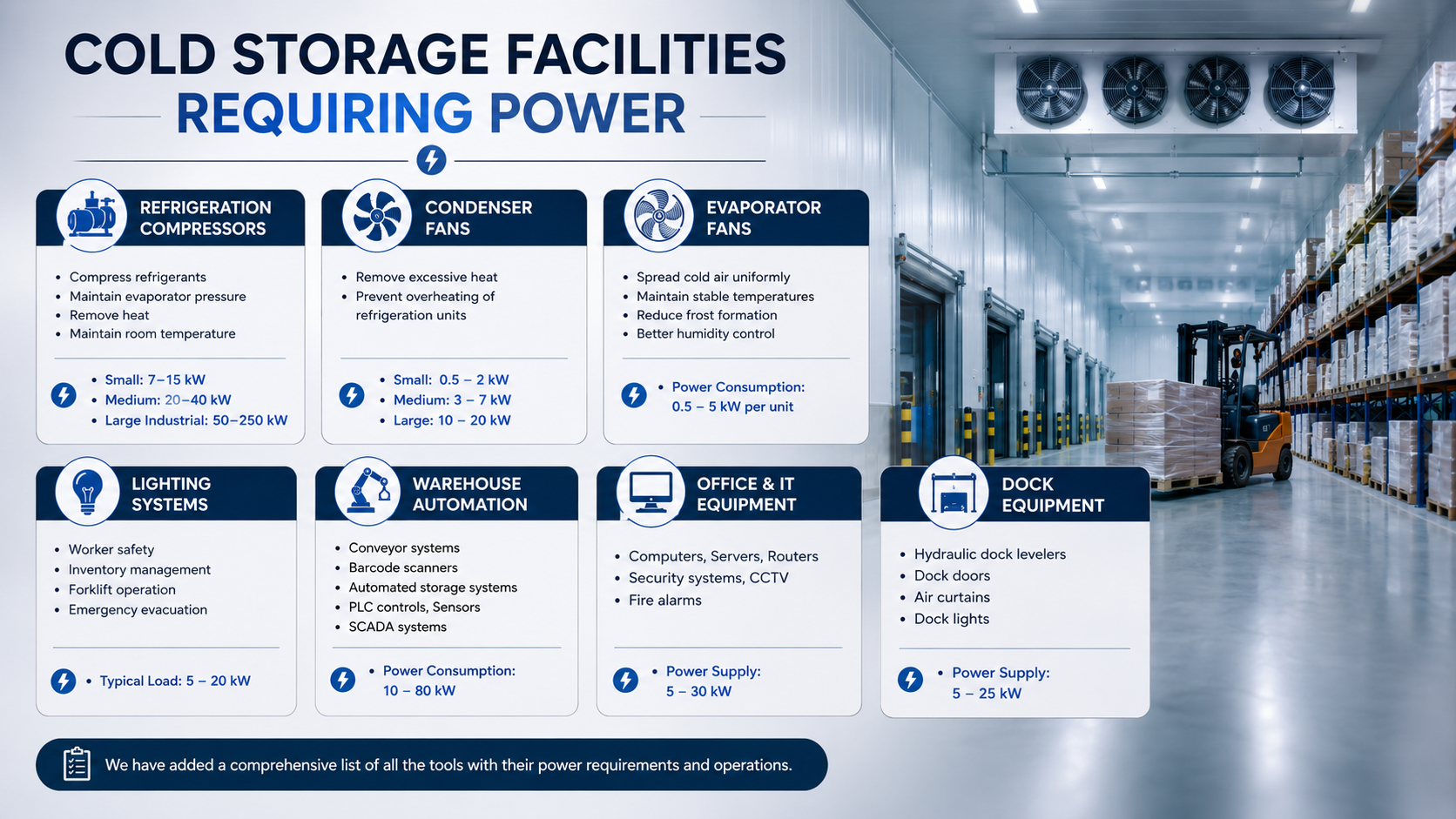
Here are a few tools discussed.
Refrigeration Compressors
Compressors are one of the largest components with a high power consumption. They operate at high power ranges because of the following critical tasks.
- They compress refrigerants and provide integral functionality.
- Maintain evaporator pressure
- Remove heat
- Maintain room temperature
Running power depends on the compressors. For example:
- Small compressors require 7–15 kW.
- Medium compressors require a 20–40 kW power.
- Large Industrial consumes a higher power range of 50–250 kW.
Condenser Fans
Overheating can impact the internal components of the refrigeration units. Condenser Fans help remove the excessive heat.
The running load is as follows.
- Smaller fans require less power of 0.5 — 2 kW.
- Medium fans have a higher power consumption up to 3–7 kW.
- Larger fans require a high power of 10–20 kW.
Evaporator Fans
When your refrigerator system produces the cold, the evaporator fans take responsibility. They spread the cold air throughout the storage systems.
The benefits of such fans are:
- Uniform cooling
- Stable temperatures
- Reduced frost formation
- Better humidity control
The power consumption is anywhere between 0.5 and 5 kW per unit.
Lighting Systems
Lighting systems are crucial and provide the seamless lighting of the whole cold storage facility.
They are essential for:
- Worker safety
- Inventory management
- Forklift operation
- Emergency evacuation
Their typical load varies between 5 and 20 kW depending on the system.
Warehouse Automation
Nowadays, advanced facilities have introduced automation in the warehouse systems. There are advanced systems, such as:
- Conveyor systems
- Barcode scanners
- Automated storage systems
- PLC controls
- Sensors
- SCADA systems
Based on these systems, the power consumption is 10-80kW.
Office and IT Equipment
If you store records or keep the safety systems on with the CCTV cameras, then the office and IT equipment are there.
Here is some equipment:
- Computers
- Servers
- Routers
- Security systems
- CCTV
- Fire alarms
They consume a power supply between 5 and 30 kW.
Dock Equipment
Loading docks also deploy several tools. The examples of the tools include:
- Hydraulic dock levelers
- Dock doors
- Air curtains
- Dock lights
They consume a power supply between 5 and 25 kW.
We have added a comprehensive list of all the tools with their power requirements and operations.
Step 2: Determining Critical Loads
Among these tools, not every tool is critical. There are a few tools that won’t be required to operate during the outages. Let’s understand and divide them into their priorities.
When choosing a backup power source for cold storage facilities, you should always run the loads based on the power availability and priority.
| Priority | Equipment | Backup Required | Reason |
| Critical | Refrigeration Compressors | Yes | Maintain product temperature |
| Critical | Evaporator Fans | Yes | Air circulation inside cold rooms |
| Critical | Condenser Fans | Yes | Heat rejection |
| Critical | Refrigerant Pumps | Yes | Refrigeration operation |
| Critical | PLC & Automation | Yes | System control |
| Critical | Temperature Monitoring | Yes | Regulatory compliance |
| Critical | Fire Alarm | Yes | Safety requirement |
| Critical | Emergency Lighting | Yes | Worker safety |
| Critical | CCTV & Security | Yes | Facility protection |
| Important | Warehouse Lighting | Yes | Safe operations |
| Important | Dock Equipment | Usually Yes | Shipping continuity |
| Important | Conveyors | Usually Yes | Product movement |
| Optional | Office Air Conditioning | No | Comfort only |
| Optional | Battery Chargers | No | Can be delayed |
| Optional | Staff Kitchen Equipment | No | Non-essential |
| Optional | Decorative Lighting | No | Not operationally necessary |
Step 3: Record Running Load
Since you are going to operate several of the devices in the system, you should calculate the running power of each.
Examples
Suppose we have the following tools that are essential to operate and require power.
Based on these devices, the total running load is:
| Equipment | Quantity | Unit Power | Total Running Load |
| Screw Compressors | 3 | 75 kW | 225 kW |
| Reciprocating Compressor | 1 | 40 kW | 40 kW |
| Condenser Fans | 8 | 4 kW | 32 kW |
| Evaporator Fans | 18 | 2 kW | 36 kW |
| Refrigerant Pumps | 2 | 12 kW | 24 kW |
| Cooling Tower Fan | 1 | 18 kW | 18 kW |
| Conveyor System | 1 | 25 kW | 25 kW |
| Dock Equipment | 2 | 5 kW | 10 kW |
| Warehouse Lighting | — | — | 18 kW |
| PLC & Controls | — | — | 6 kW |
| Servers & Network | — | — | 5 kW |
| Security Systems | — | — | 3 kW |
| Fire Alarm | — | — | 1 kW |
Running Load= Refrigeration Equipment+ Material Handling + Lighting + Controls & IT
Running Load = 375+35+18+15 =443 kW
It is the total running load necessary for the operations of all the devices.
Step 4: Consider Starting Load
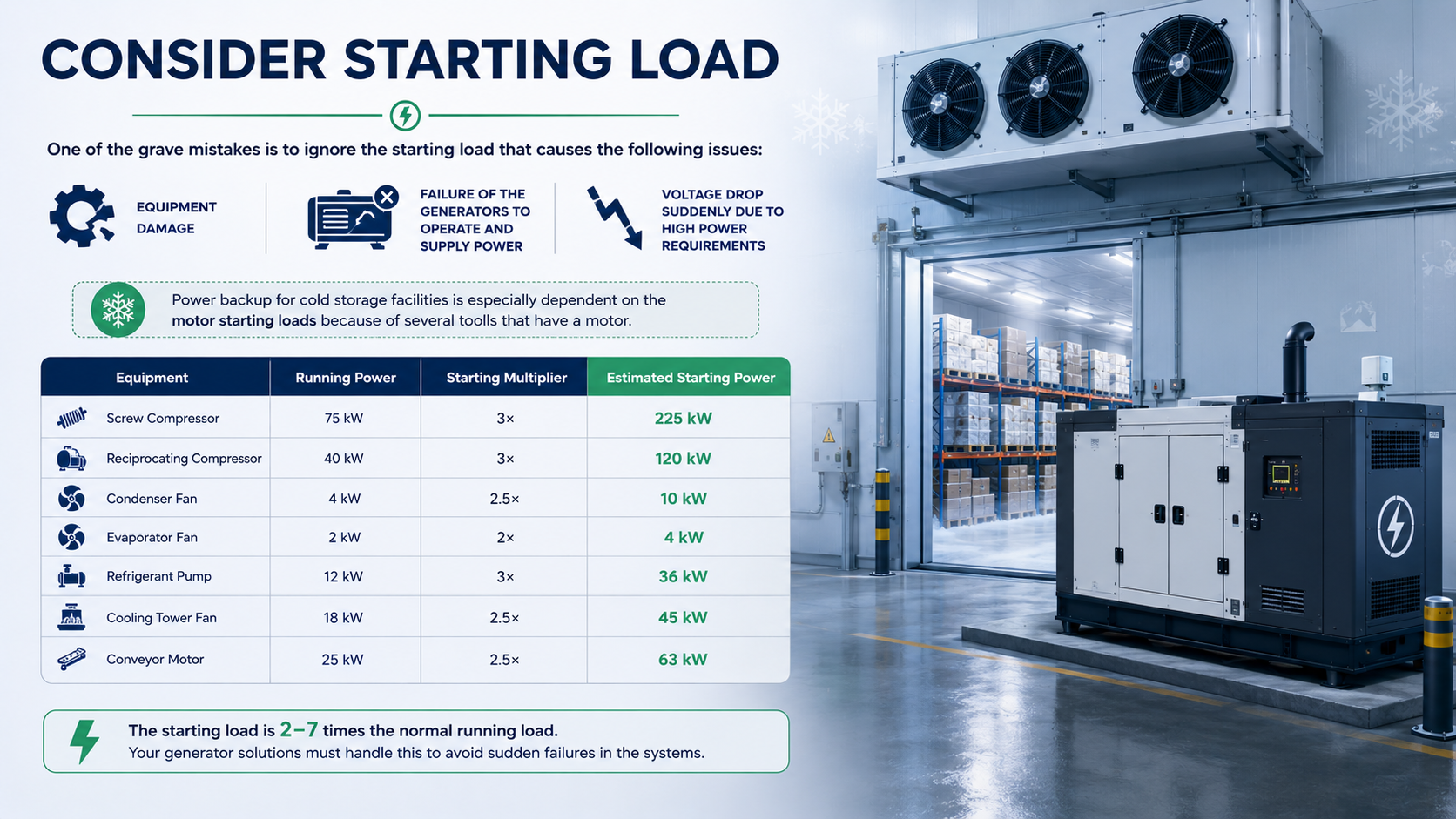
One of the grave mistakes is to ignore the starting load that causes the following issues:
- Equipment Damage
- Failure of the Generators to operate and supply power
- Voltage Drop suddenly due to high power requirements
Power backup for cold storage facilities is especially dependent on the motor starting loads because of several tools that have a motor.
| Equipment | Running Power | Starting Multiplier | Estimated Starting Power |
| Screw Compressor | 75 kW | 3× | 225 kW |
| Reciprocating Compressor | 40 kW | 3× | 120 kW |
| Condenser Fan | 4 kW | 2.5× | 10 kW |
| Evaporator Fan | 2 kW | 2× | 4 kW |
| Refrigerant Pump | 12 kW | 3× | 36 kW |
| Cooling Tower Fan | 18 kW | 2.5× | 45 kW |
| Conveyor Motor | 25 kW | 2.5× | 63 kW |
The starting load is 2-7 times the normal running load. Your generator solutions must handle this to avoid sudden failures in the systems.
Step 5: Consider Future Expansion
Are you going to expand the system in the future? It is typical that cold storage facilities always include more machines and tools, such as freezer rooms, compressors, evaporators, conveyors, or automated handling systems.
You should always keep a reserve capacity of 20-25%, depending on future expansions.
Examples
Suppose the above example of the running load.
| Item | Load |
| Current Running Load | 443 kW |
| Planned Additional Cold Room | 45 kW |
| Future Conveyor Expansion | 18 kW |
| Future Automation | 14 kW |
| Total Planned Expansion | 77 kW |
| Design Reserve (Approx.) | 30 kW |
You should have a generator capacity of at least 550 kW to meet the increasing needs of the system for future expansion.
Step 6: Choose Generator Ratings
There are three different types of generator ratings.
- Prime generators. They handle a variable load and provide the energy for several days if you have a fuel supply.
- Continuous generators also have a non-stop energy support, but they offer constant load support.
- Standby Generators. They are useful in emergency backup systems and supply non-stop power when operated.
| Generator Rating | Operating Purpose | Typical Annual Hours | Load Variation | Suitable for Cold Storage |
| Standby Power | Emergency backup during utility failure | Up to 200 hours | Variable | ✔ Most common choice |
| Prime Power | Primary power where the grid is unreliable | Unlimited (variable load) | Variable | ✔ Suitable for frequent outages |
| Continuous Power | Permanent power source with constant load | Unlimited | Constant | ✔ Best for off-grid facilities |
| Facility Type | Recommended Generator Rating |
| Urban cold storage warehouse | Standby |
| Food processing cold storage | Standby or Prime |
| Pharmaceutical cold storage | Standby with redundant generator |
| Remote agricultural cold storage | Prime |
| Mining cold storage warehouse | Prime |
| Off-grid frozen storage facility | Continuous |
Step 7: Consider Fuel Consumption and Runtime Requirements
Fuel consumption depends on the generators. High power generators consume optimal fuel when they are run at 70-85% of their maximum load ratings.
For high efficiency, you should always target a load of 70-85%. Generators with a load of less than 30% have a very low fuel efficiency.
| Generator Size | Approximate Fuel Consumption at 50% Load | At 75% Load | At Full Load |
| 200 kVA | 22 L/hr | 31 L/hr | 40 L/hr |
| 300 kVA | 33 L/hr | 46 L/hr | 60 L/hr |
| 500 kVA | 55 L/hr | 78 L/hr | 100 L/hr |
| 750 kVA | 82 L/hr | 116 L/hr | 150 L/hr |
| 1000 kVA | 110 L/hr | 155 L/hr | 200 L/hr |
Example
For runtime, you should have a different range of fuel storage facilities depending on the power requirements and load.
Suppose a 500kVA generator. It operates at 75% of its maximum capacity. The runtime and power consumption will be:
- Fuel Consumption will be 78 L/hr at 75% load.
- Suppose your Required Runtime is 24 hours.
- Total Fuel Needed is 1,872 L
- Recommended Storage (15% Reserve) should be 2,150 L.
Step 8: Use an Automatic Transfer Switch
An automatic transfer is pretty critical and helps transfer the energy from one source to another very quickly. For example, it has several advantages.
- Power efficiency and high energy reliability.
- Seamless transmission of the power
- Continuous power supply and transmission through the system.
How Does an ATS Work?
Backup Power for Cold storage facilities requires ATS for seamless power transmission. The typical mechanism is here.
- Step 1: A utility power outage occurs.
- Step 2: ATS detects a power outage and starts a backup system automatically.
- Step 3: The generator reaches rated voltage and frequency.
- Step 4: ATS provides the seamless transmission of power from critical loads to generators.
- Step 5: When Utility power returns and stabilizes, ATS transfers load back to the utility.
- Step 6: The generator cools down and stops.
Step 9: Do Load Sequencing
Running all the loads simultaneously can create very high current and voltage requirements. It can shut down your whole system if you don’t have sufficient capacity of generators to handle it.
Therefore, you should consider the load sequencing and operate the devices in the following sequences to avoid sudden and huge starting currents.
| Startup Order | Equipment |
| 1 | PLCs, control panels, SCADA, monitoring systems |
| 2 | Refrigerant pumps and oil pumps |
| 3 | First refrigeration compressor |
| 4 | Remaining compressors (one at a time) |
| 5 | Condenser fans |
| 6 | Evaporator fans |
| 7 | Warehouse lighting |
| 8 | Conveyor systems |
| 9 | Dock equipment |
| 10 | Office equipment and optional loads |
Step 10: Perform Routine Testing and Preventive Maintenance
Routine and preventive maintenance can avoid the long-term costs and improve the tool’s reliability. Therefore, backup power for cold storage facilities should be tested in the following sequences.
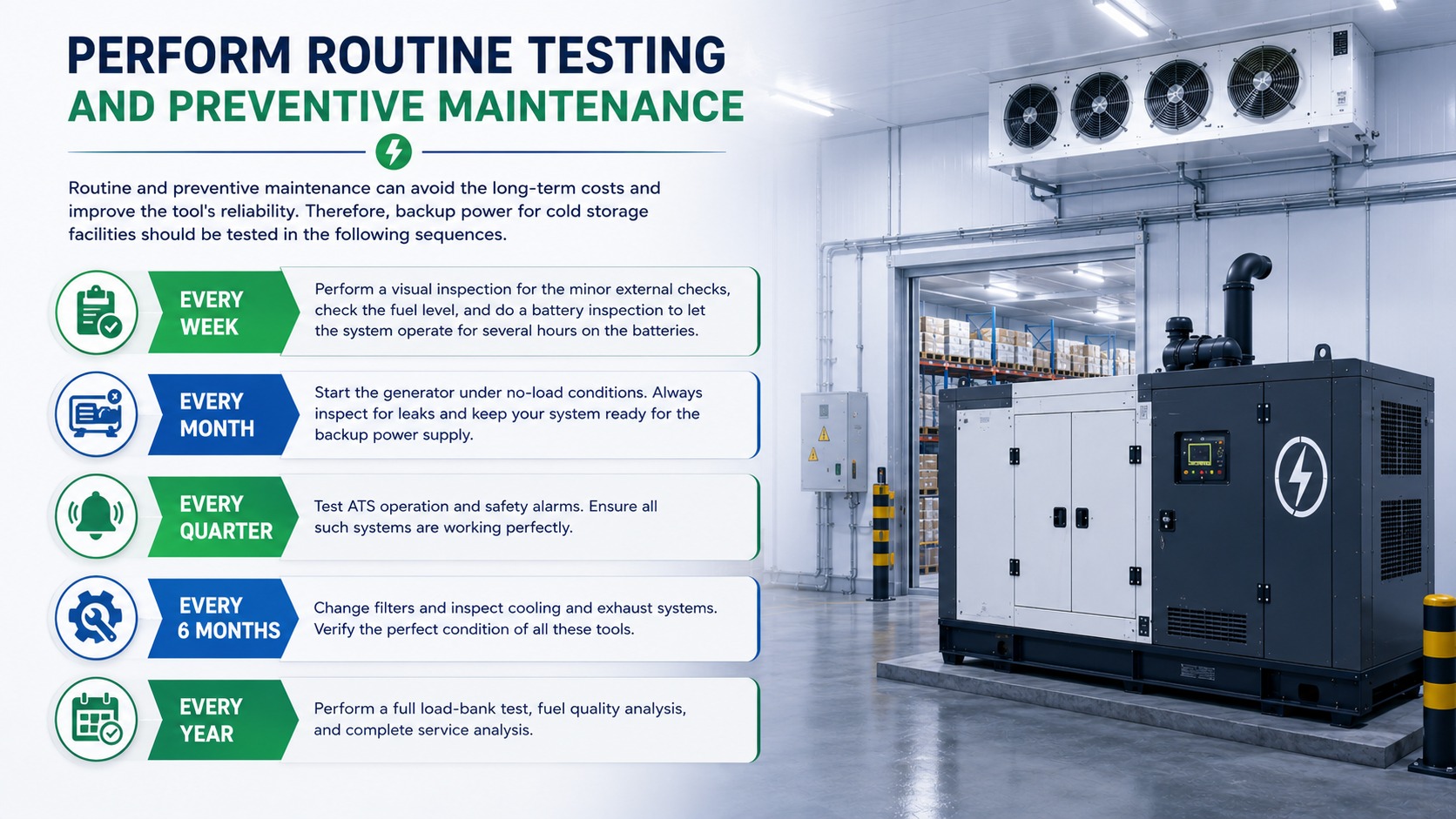
- Every week, you should perform a visual inspection for the minor external checks, check the fuel level, and do a battery inspection to let the system operate for several hours on the batteries.
- In the monthly inspection, you should start the generator under no-load conditions. Always inspect for leaks and keep your system ready for the backup power supply.
- In quarterly perspectives, test ATS operation and safety alarms. Ensure all such systems are working perfectly.
- Every 6 Months, you should change filters and inspect cooling and exhaust systems. Verify the perfect condition of all these tools.
- Annual inspection is the most comprehensive. It includes a full load-bank test, fuel quality analysis, and complete service analysis.
FAQs
- How long should a backup generator be able to operate?
It depends on the outage conditions. However, most facilities expect a backup supply of 24 to 72 hours for power outage cases.
- How much reserve capacity should be added?
Whether it is for safety purposes or future expansion, you should keep a 25% reserve capacity. It helps in the critical hours.
- Why are refrigeration compressors important in generator sizing?
Refrigeration compressors are the largest components and have higher starting motor currents. Therefore, you should consider them during the generator sizing and choose the right size.
- Should every electrical device be connected to the backup generator?
No. You should not connect all the electrical devices to the backup generators. Instead, add only critical and essential loads to the generators so you can operate them during power outage hours.
- What type of generator is best for a cold storage facility?
Standby generators are the best option as they act during an emergency and provide energy to the cold storage facilities very effectively.
- How often should backup generators be tested?
A backup generator should be tested daily for routine inspection. Perform visual inspection tests weekly, operational tests monthly, ATS testing quarterly, and a full load-bank test.
- Can renewable energy replace a backup generator?
No. A renewable energy resource can’t replace the backup generators. It is because renewable energy is available only during specific times, while the standby generators are available all the time.
- Why is an Automatic Transfer Switch (ATS) necessary?
An automatic transfer is a pretty essential tool that provides a seamless transfer of energy. It detects the power failure chances and transmits them to the backup generators.
Conclusion
When choosing the backup power for cold storage facilities, you should always focus on the power requirements. Consider the top equipment and divide it into critical tools and non-essential power systems. Power all the equipment that is essential and critical. Generators help power up the supply and provide seamless power transmission as long as you have the fuel.
If you are looking for backup power systems, contact Huaquan Power. We have a wide range of generator options and provide seamless integration with your system. You’ll enjoy a high-quality system that keeps your cold storage facilities alive. Contact our experts to get a quote for your project!!