Your diesel generator must start quickly when a severe storm takes out the local power grid or a remote job site calls for reliable heavy-duty power. When critical equipment needs backup power, there is no time for delays. While most owners monitor oil and fuel levels closely, they often overlook one of the most important parts of the starting system: the Generator Battery.
Without this single component, even a robust Industrial Generator is of no use. If it can’t start, it can’t produce power. Routine maintenance is still the safest way to keep your backup power system ready when needed.
This guide by Huaquan covers generator battery terminal cleaning, load testing and the effects of extreme weather on battery performance. These maintenance tips can help improve starting reliability and reduce the risk of unexpected power failures.
Why Generator Battery Maintenance Matters
The generator can be a sophisticated piece of equipment, but it all begins with electrical energy. Without a healthy battery, the engine cannot begin the combustion process. If the battery isn’t up to the task, the generator won’t start and you could end up without backup power when you need it the most.
Regular maintenance helps to increase the reliability of the system and avoid failures during power outages. Believe it or not, technicians can trace many starting problems back to battery neglect. Proper maintenance also extends battery life, reduces replacement costs and lowers the risk of acid leaks that can damage the generator enclosure and nearby equipment.

What Does a Generator Battery Do?
The primary function of a Generator Battery is to provide a powerful burst of direct current (DC) power to the starter motor. The starter motor’s duty is to start the diesel engine by rotating its heavy crankshaft fast enough to create the compression needed for fuel ignition. The engine will not start without that initial surge of power.
The battery also energizes several vital electronic systems that operators find throughout the generator. It supplies power to digital control panels, sensors and communication devices. For standby applications, it maintains communication with the automatic transfer switch (ATS) so that the generator will know when to start if there is a loss of electricity from the utility. When the engine is operating, the charging alternator assumes responsibility for the control system and recharges the battery for the next time the system needs it.
Common Signs of a Weak Generator Battery
A mechanic doesn’t have to be an expert to recognize the signs and symptoms of a dying battery. You can monitor your generator to help you detect problems before they become a total failure.
- Slow cranking: The engine will start up more slowly than usual and will take longer.
- Clicking sound when starting: If the clicking sound is heard as the unit is starting, the battery is likely to have sufficient power to activate the starter solenoid but insufficient cold cranking amps (CCA) to crank the engine over.
- Complete failure to start: The engine does not respond when the key is turned or the start button is pressed.
- Low battery warnings: Modern control panels may have warning codes or low-voltage alarms.
- Terminal corrosion: If there is white, green or bluish corrosion around the terminals, this can impede the flow of electricity to the starter cables.
- Battery case is swollen or leaking: If the battery case is swollen or leaking acid, it may have been heated too much or overcharged.
- Rapidly drains its charge: Battery dies and needs to be charged often.
- Dim display screens: If the display on the control panel flickers, dims or resets during a start attempt, the battery may be weak.
Generator Battery Maintenance Checklist
To keep the Generator Battery in good condition, follow a regular maintenance routine. This checklist covers the key checks needed for reliable operation and starting.
Inspect the Battery Regularly
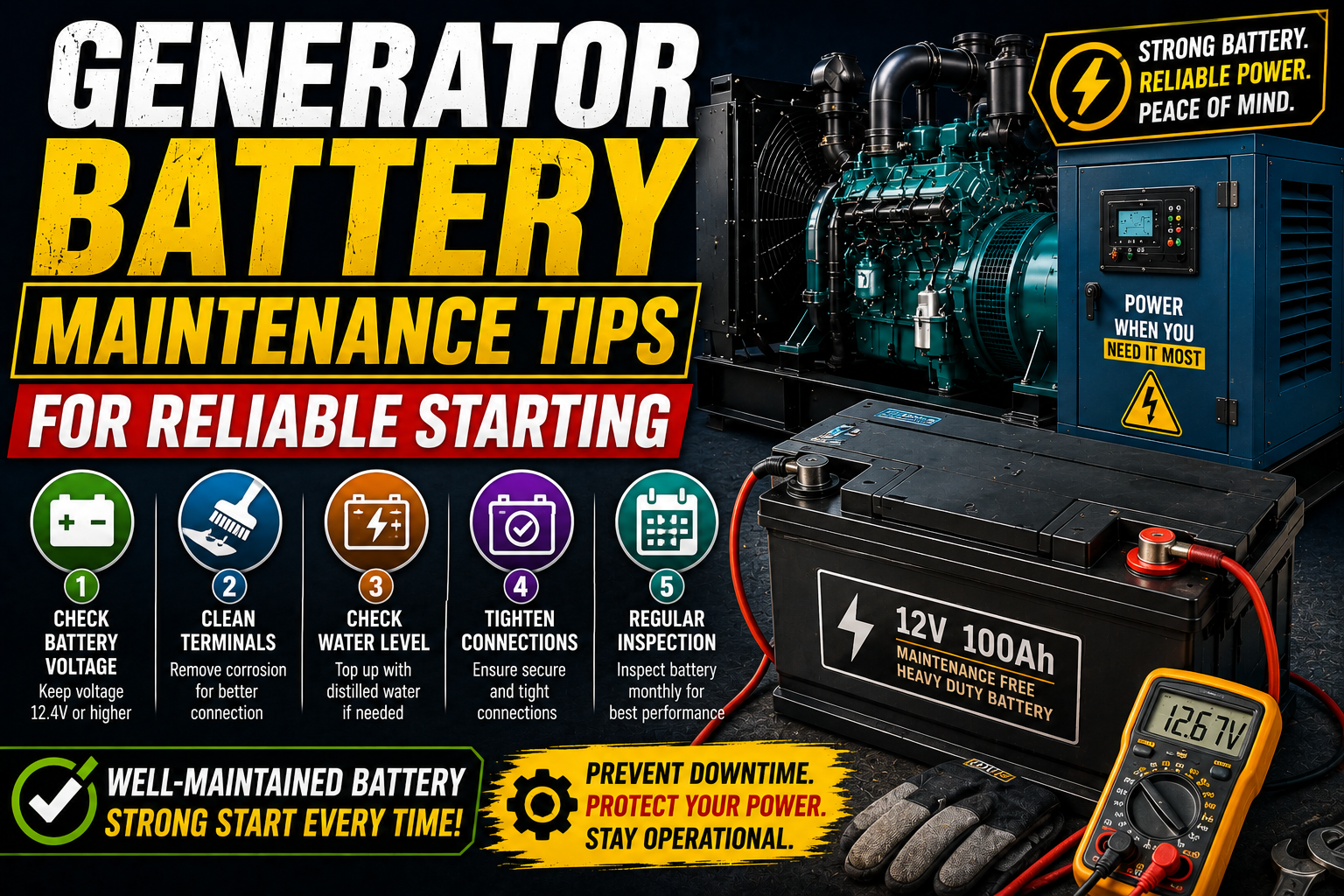
Carefully check the battery visually. Check for cracks, swelling, leaks or any sign of damage to the battery case. Be sure to securely fasten the battery, as the engine vibration can cause damage to the internal plates over time. Regularly inspect cable connections for looseness or damage, and look for exposed wiring that could trigger electrical faults.
Clean Battery Terminals
Always keep battery terminals clean. Even if the battery holds a charge, corrosion often restricts electrical flow and prevents the generator from starting. Safely disconnect the cables and clean any buildup from the terminals and cable clamps. Once cleaned, reconnect everything securely. If necessary, you can use dielectric grease or terminal protection spray to minimize corrosion and ensure good electrical contact in the future.
Check Battery Voltage
Measure voltage with a digital multimeter. A fully charged 12-volt Generator Battery will have a voltage of 12.4 to 12.6. Lower readings could mean a discharged battery or lower battery performance. It could also signal that battery replacement is imminent. Regular voltage tests can help prevent serious starting problems during an outage.
Keep the Battery Fully Charged
Always connect the battery charger to standby Generators. If you are not using portable generators for a long time, you should charge them as well. When you leave a battery in a discharged state, it can start to suffer from sulfation, and therefore, the battery cannot take up and retain a charge. Consistent charging helps maintain battery health and reliable starting.
Test the Battery Under Load
While battery voltage can give clues to the condition of a battery, it is not always accurate. A battery may look all right but fail to supply the necessary power to the starter motor when needed. Load testing is a test to determine the performance of the battery under real starting conditions. Periodic load testing is part of preventive maintenance for critical back-up power systems.
Check Electrolyte Levels
Use a working flooded lead-acid battery and periodically check and keep the electrolyte level up and the plates covered. Refill with distilled water as needed; do not overfill cells. In this aspect, sealed AGM batteries and Gel batteries don’t require any maintenance and should not be opened or topped with fluid.
How Often Should You Check a Generator Battery?
The frequency of Generator Battery checks is dependent upon the environment it is being used in and its significance to your operation. A generator that is used for critical systems should be treated as such and treated differently as opposed to a generator that is only occasionally used.
Check the charger every month and do a visual check at least monthly. Include voltage check and terminal cleaning in regular generator maintenance every three to six months. Load testing should be performed every 6 to 12 months, particularly for standby units that are used to protect commercial facilities. If your generator is exposed to extreme heat or freezing temperatures in the winter, increase the frequency of the inspections because extreme weather can accelerate battery deterioration.
Generator Battery Charging Tips
Proper charging is one of the best ways to extend battery life. Failure can be avoided by using an excellent quality smart trickle charger or maintainer. These chargers will constantly check battery parameters and automatically reduce the amperage to a low float charge when a battery is fully charged. That feature is important because it helps to avoid overcharging.
Cheap chargers can create problems. They do not reduce output but rather keep power flowing into a fully charged battery. This can, over time, harm the internal components and significantly reduce battery life.
Be sure to use the appropriate charger for the battery type. A flooded lead-acid battery charger might have its charging parameters set to harm the AGM (Absorbent Glass Mat) battery. Quickly examine charger cables as well. Check for loose connections, damaged insulation, or rodent damage. If the voltage warning light is triggered often, then the charger is faulty and needs to be replaced right away in order to prevent future starting problems.
When Should You Replace a Generator Battery?
Never wait until a battery has died to replace it. If a Generator Battery fails a load test, it is recommended to replace the battery immediately. It also goes for a battery that always needs to be recharged but never retains a charge for more than a few days.
Another warning sign is slow cranking. If the generator does not turn over even after 24 hours of full charging, the battery may be approaching end-of-life. Believe it or not, many generator failures during emergencies occur because generator owners don’t take action on these early warning signs.
Physical damage is never to be ignored. If the battery case is swollen, has visible cracks, or the acid has leaked out, it must be removed and disposed of safely. Typically, manufacturers recommend replacing the flooded battery every 24 to 36 months. Well-made AGM batteries can be used for 36 to 48 months. It’s better to have an old battery replaced before bad weather strikes than to rely on a battery that could fail when you need it.
Conclusion
There’s nothing a powerful diesel generator can do if it can’t start up when you need it. This is why Generator Battery maintenance is so crucial to reliable backup power. Regular inspections, terminal cleaning, proper charging and load testing help keep the system ready for action.
Preventive maintenance also minimizes the chances of unexpected failures and can increase battery life. When the time arrives, it’s always better to replace an old battery before it becomes a problem.
Need a reliable Generator Battery for your diesel generator? Choose quality replacement batteries and maintenance parts to keep your equipment ready when power matters most. Contact us today for dependable generator parts and expert support.