Introduction
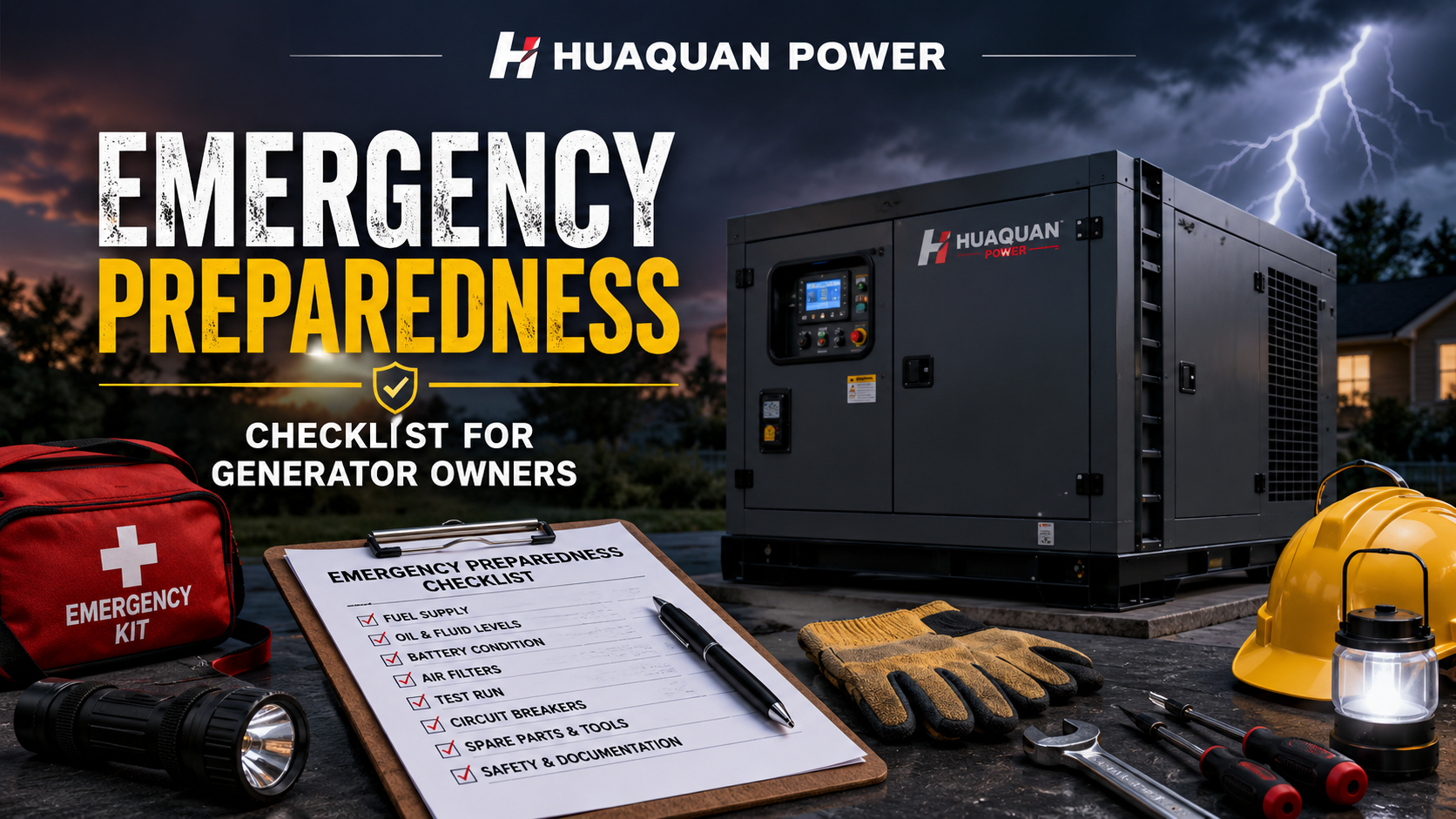
Whether you are working in an off-grid system in remote areas or there is an outage of the power due to natural disasters, the emergency preparedness checklists can help you save during emergency situations. It includes all the possible solutions and ensures you get a chance to optimize your energy supply with different steps and checklists.
Today, we will sift through the emergency preparedness checklists and understand various tips and options in these checklists.
Why Does an Emergency Preparedness Checklist Matter for Generator Owners?
If you have standby Generators and don’t maintain them, they might fail during a major power outage. It is too late to check. Therefore, you should always be ready for an emergency and prepare yourself.
Here are a few reasons why you should consider the emergency preparedness checklists.
- Detect hidden mechanical issues
- Maintain reliable starting performance
- Prevent fuel-related failures
- Avoid electrical hazards
- Reduce costly repairs
- Protect sensitive electrical equipment
- Keep essential operations running
During an emergency, you can get the essential power tools running and ensure the positive output of your systems.
Key Points in Emergency Preparedness Checklists for Generator Owners
When preparing the emergency plans, you should always focus on the key points we have discussed. They evaluate the step-by-step guide to prepare yourself for the emergency.
Point #1: Create An Emergency Plan
An emergency can come at any time or place. You should always be prepared for emergency situations and make yourself ready with the right approach.
Your emergency plan should be disclosed.
- Critical electrical loads
- Generator location
- Fuel storage locations
- Generator operating procedures
- Emergency shutdown procedures
- Maintenance schedule
- Contact information for technicians
- Spare parts inventory
- Utility company contact details
Make sure your facility operators know the emergency plan locations and understand the whole process to revive the energy supply during an outage.
Point #2: Classify your Critical Loads
During an outage, the very first goal is to make the energy affordable. It is possible when you operate only the critical loads while eliminating the unnecessary loads.
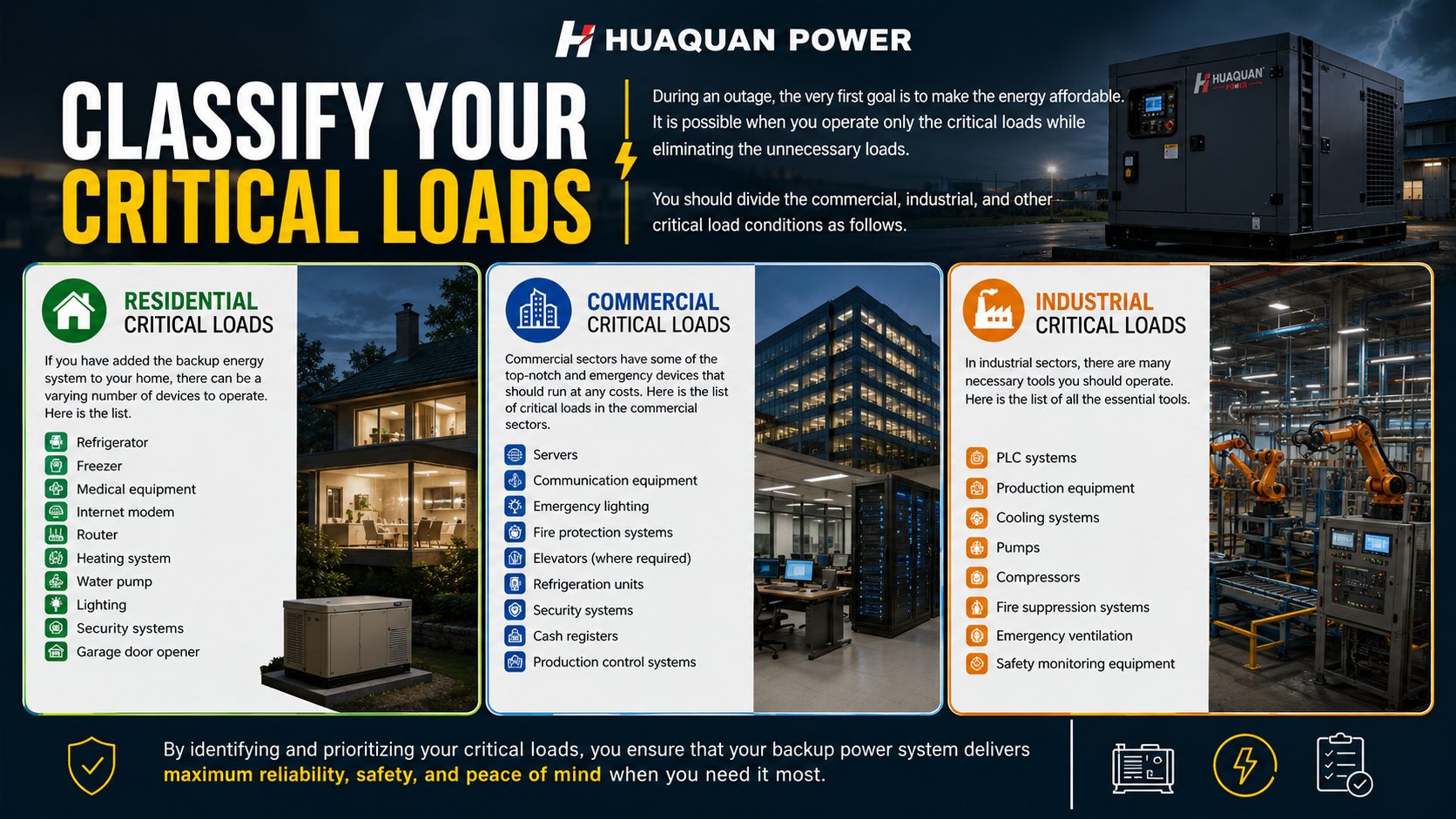
You should divide the commercial, industrial, and other critical load conditions as follows.
Residential Critical Loads
If you have added a backup energy system to your home, there can be a varying number of devices to operate. Here is the list.
- Refrigerator
- Freezer
- Medical equipment
- Internet modem
- Router
- Heating system
- Water pump
- Lighting
- Security systems
- Garage door opener
Commercial Critical Loads
Commercial sectors have some of the top-notch and emergency devices that should run at any cost. Here is the list of critical loads in the commercial sectors.
- Servers
- Communication equipment
- Emergency lighting
- Fire protection systems
- Elevators (where required)
- Refrigeration units
- Security systems
- Cash registers
- Production control systems
Industrial Critical Loads
In industrial sectors, there are many necessary tools you should use. Here is the list of all the essential tools.
- PLC systems
- Production Equipment
- Cooling systems
- Pumps
- Compressors
- Fire suppression systems
- Emergency ventilation
- Safety monitoring equipment
Point #3: Verify Generator Capacity
One of the key mistakes is the wrong assumption about the generator capacity. You must not focus only on the running loads instead, there are other types of loads, such as:
- Running watts
- Starting watts
- Motor starting current
- Future expansion capacity
Motor starting loads are 2-7 times higher than the running load. Therefore, you should verify if your generator has sufficient capacity to handle the required load levels. Keep a safety margin of 20-25% in this case.
Example
| Equipment | Running Watts | Starting Watts |
| Refrigerator | 700 | 2100 |
| Water Pump | 1200 | 3600 |
| Lights | 600 | 600 |
| Router | 50 | 50 |
| Furnace Fan | 800 | 1600 |
| Total Running Load | 3350 W | |
| Maximum Starting Load | 7950 W |
Point #4: Inspect the Generator Before Emergency Season
An emergency can occur anytime. If there is a sudden environmental alert about the snowfall or natural disasters, you should be more than ready to power your system. Always inspect your generators before every emergency and check them for:
- Engine condition
- Fuel system
- Exhaust system
- Air intake
- Cooling system
- Belts
- Hoses
- Wiring
- Electrical connections
- Mounting bolts
- Generator enclosure
- Control panel
- Battery terminals
- Alternator
There can be a few errors in the system for any reason. You should evaluate them during the inspection and testing phase. Common points to focus on include:
- Oil leaks
- Fuel leaks
- Corrosion
- Rust
- Loose hardware
- Animal nests
- Damaged insulation
- Water intrusion
Point #5: Check Engine Oil
We know fuel is important, but the engine oil is the primary lubricant. Without it, the engine might fail to perform. Therefore, you should perform the inspection and check the engine oil.
Before an emergency condition, you should check:
- Verify oil level
- Inspect oil condition
- Replace dirty oil
- Replace the oil filter if required
- Use manufacturer-approved oil grade
Do you know the side effects of the contaminated oil? Low or contaminated oil can cause the following issues.
- Engine seizure
- Increased wear
- High operating temperatures
- Reduced engine life
You should always keep an extra oil available for emergency conditions.
Point #6: Inspect Coolant System
Generators perform 24/7. During this performance, there can be cases of sudden overheating. Coolant systems can prevent this overheating and keep the systems smooth.
Before an emergency situation, you should always check:
- Coolant level
- Radiator condition
- Coolant hoses
- Hose clamps
- Water pump
- Thermostat
- Coolant concentration
If you are having problems with the coolant systems, you should always look for the following signs and symptoms.
- Low coolant
- Rust-colored coolant
- Cracked hoses
- Leaking radiator
- Overheating alarms
Point #7: Check Fuel Quality
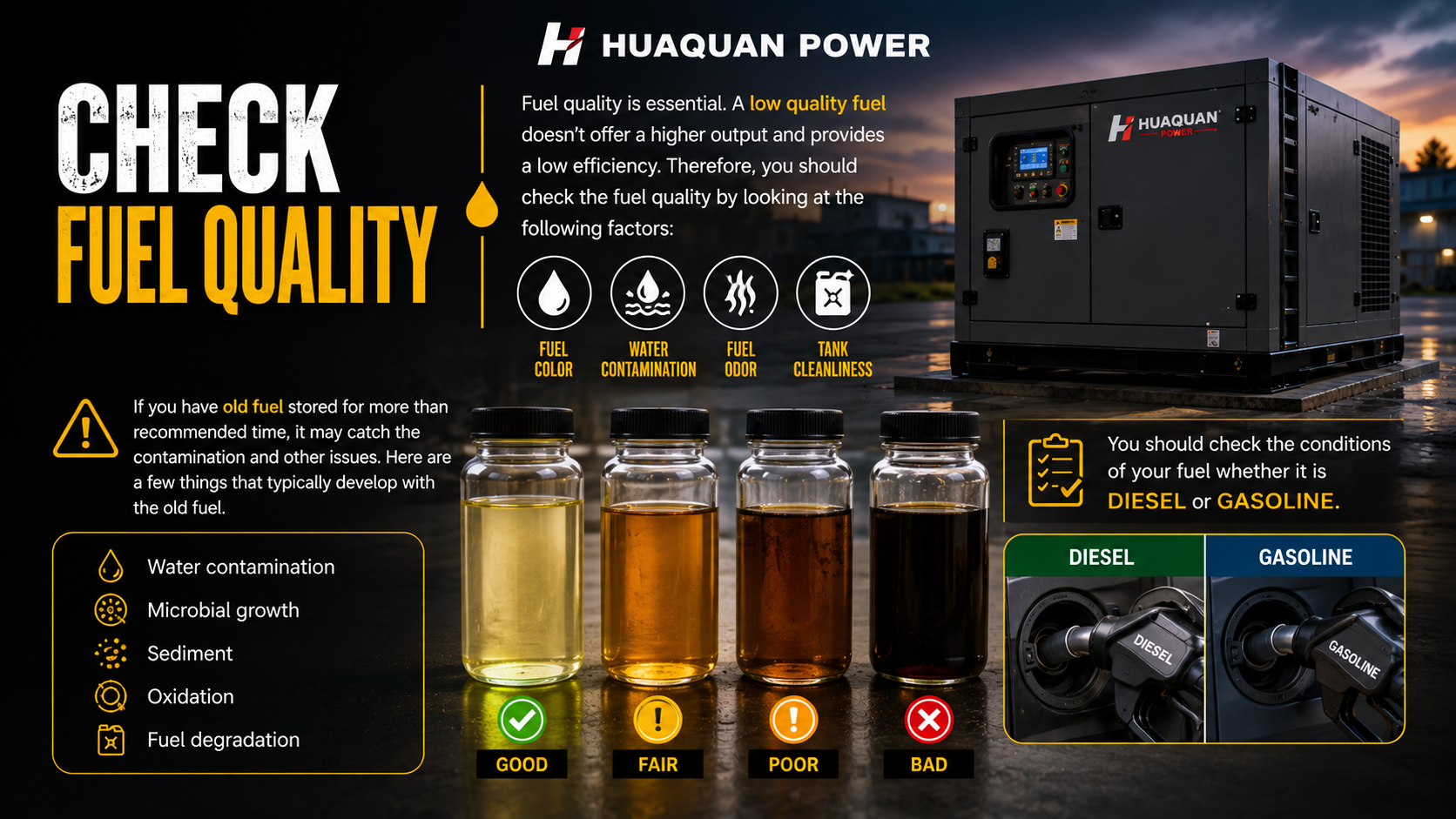
Fuel quality is essential. A low-quality fuel doesn’t offer a higher output and provides a low efficiency. Therefore, you should check the fuel quality by looking at the following factors:
- Fuel color
- Water contamination
- Fuel odor
- Tank cleanliness
If you have old fuel stored for more than the recommended time, it may cause contamination and other issues. Here are a few things that typically develop with the old fuel.
- Water contamination
- Microbial growth
- Sediment
- Oxidation
- Fuel degradation
You should check the conditions of your fuel, whether it is diesel or gasoline.
Point #8: Maintain Adequate Fuel Supply
Generator systems rely only on ten fuel supplies. Once you run out of fuel, you no longer get the energy. Therefore, you should have sufficient fuel available in your storage system.
The demand varies according to the conditions. However, we have listed the suggested fuel reserves according to the applications.
| Generator Type | Suggested Fuel Reserve |
| Residential | 2–7 days |
| Small Business | 3–5 days |
| Industrial | 5–14 days |
| Hospital | According to local regulations |
| Telecom Site | 3–7 days |
Point #9: Test the Starting Battery
Batteries of the generators are also crucial. Even though they are the most common cause behind the generator failures. You have to replace the batteries every 3-5 years or depending on the manufacturer’s recommendations.
However, for the emergency testing and preparedness, you should always start batteries and test for:
- Battery voltage
- Terminal corrosion
- Electrolyte level (where applicable)
- Battery charger operation
- Cable connections
- Battery age
High-end batteries offer good performance under all conditions.
Point #10: Check Air Filters
Air filters provide clean air to the generators and ensure seamless functionality. However, due to outdoor environmental conditions, dust and dirt can block the air filters.
Here are a few factors that often clog the air filters.
- Dust
- Dirt
- Moisture
- Debris
- Oil contamination
Replace the clogged filters and don’t operate the generators unless you have new filters and clean air to feed to your generator systems.
Point #11: Replace Fuel Filters
Fuel Filters can protect the injectors from fuel contamination and provide a safe environment for fuel combustion. You should thoroughly check the fuel filters for:
- Excessive restriction
- Water contamination
- Dirt buildup
- Long service intervals
Remove and replace the fuel filters with the new ones and ensure seamless functionality. It is better to keep spare fuel filters in the stormy seasons to avoid emergency situations.
Point #12: Check Belt and Hoses
Belts and Hoses are as important as the other components. You should inspect them.
Inspect all belts for the following conditions.
- Cracks
- Fraying
- Glazing
- Wear
- Incorrect tension
While inspecting hoses in the following conditions.
- Leaks
- Bulges
- Soft spots
- Loose clamps
Make sure they are clean and operating very well. Otherwise, you should replace them for the safety of the system.
Point #13: Ensure Proper Ventilation
A ventilation system helps feed the clean air and removes the heated air. It provides a cool environment and avoids overheating.
Poor ventilation has a few side effects, such as:
- Overheating
- Carbon monoxide accumulation
- Reduced engine performance
- Automatic shutdown
You should check the ventilation system, remove any dust or dirt, and clean it for proper ventilation.
Point #14: Inspect Electrical Connections
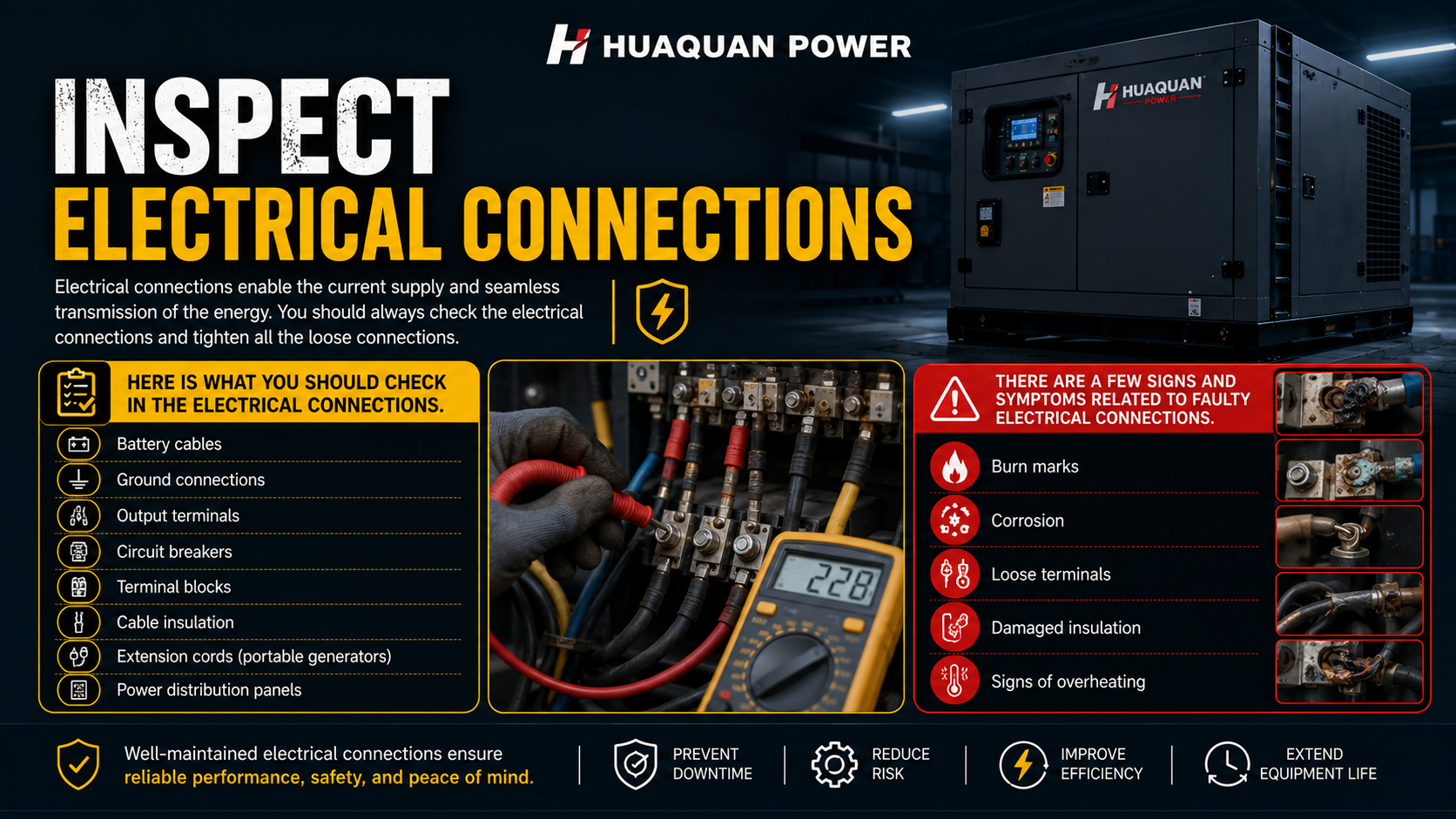
Electrical connections enable the current supply and seamless transmission of the energy. You should always check the electrical connections and tighten all the loose connections.
Here is what you should check in the electrical connections.
- Battery cables
- Ground connections
- Output terminals
- Circuit breakers
- Terminal blocks
- Cable insulation
- Extension cords (portable generators)
- Power distribution panels
There are a few signs and symptoms related to faulty electrical connections.
- Burn marks
- Corrosion
- Loose terminals
- Damaged insulation
- Signs of overheating
Point #15: Test the Automatic Transfer Switch (ATS)
An automatic transfer switch enables the seamless transfer of energy from one source to another. For example, it switches the energy from the grid to the generators during the outages.
The benefits of the automatic transfer switches are the automated functionality and high efficiency of the systems. You should inspect the automatic transfer switch for:
- Automatic startup
- Automatic shutdown
- Proper transfer to generator power
- Return to utility power
- Indicator lights
- Control wiring
- Mechanical operation
- Loose electrical connections
Point #16: Test the Generator Under Load
Testing the generator under loads gives the actual values of whether your generator can perform during an emergency or not.
It helps to understand if all the components are working fine or not. During the testing process, you should monitor:
- Engine RPM
- Output voltage
- Frequency (Hz)
- Oil pressure
- Coolant temperature
- Fuel consumption
- Exhaust smoke
- Battery charging voltage
- Warning indicators
| Generator Type | Recommended Load Test |
| Portable generator | Every 3–6 months |
| Residential standby | Monthly |
| Commercial standby | Monthly |
| Industrial standby | Monthly or according to maintenance plan |
| Hospital emergency generator | As required by applicable regulations |
FAQs
- What are the most common reasons generators fail during emergencies?
There are several reasons, such as dead batteries, stale or contaminated fuel, clogged filters, insufficient maintenance, overloaded generators, cooling system issues, and transfer switch malfunctions.
- How long can diesel fuel be stored?
You can store the diesel fuel for 6-12 months. It offers seamless storage without contamination. Older fuel is at risk of contamination due to water and moisture ingress.
- How much fuel should I store for emergency use?
There is no definite fuel quantity. It depends on how much energy you need. Technically, you should have fuel for 2-7 days of generator operations.
- Why is load testing important?
Load testing helps determine the rated power a generator can handle during its operations. It helps identify several issues that are not normally detected during no-load conditions.
- How often should I test my emergency generator?
It depends on the operating conditions. However, a standby generator should be tested every month to make it ready for use during an emergency outage. At the same time, other generators can be inspected after every use.
- What should I inspect after using a generator during an outage?
During an outage, you should inspect the generator for leaks, damaged wiring, loose fasteners, unusual vibrations, worn belts, low fluid levels, and any signs of overheating or excessive wear.
- Should I keep spare parts with my generator?
Yes. You should keep the spare parts of the generators, as you might need emergency replacements. The common components to have are oil filters, fuel filters, air filters, belts, coolant, engine oil, and fuses.
- Can I operate a portable generator indoors?
It is not recommended to use the portable generators indoors, in garages, basements, or enclosed spaces. They produce carbon monoxide that is fatal to humans.
Conclusion
In case of emergency due to natural disasters or generator failures, you must have the proper plan to fight all the odds. Provide your system with the right energy solutions and ensure optimal energy production and supply with our checklists. Follow all the emergency situations with experts’ tips.
Do you want to buy high-quality and reliable generator solutions for your emergency conditions? Look no further, as Huaquan Power has all the generator solutions for you. You’ll find a wide range of generator options and enjoy a seamless power supply. Contact our experts right away!