Introduction
Diesel Generators are very efficient systems used in hospitals, manufacturing plants, data centers, construction sites, telecommunications, commercial buildings, mining operations, and emergency backup systems. In emergency cases, they help provide the backup power supply. Predictive maintenance for diesel generators can help optimize them.
They are readily available when maintained during necessary periods and provide a seamless energy supply. Today we will discuss the predictive maintenance process of diesel generators and understand how you can maintain them.
What is Predictive Maintenance?
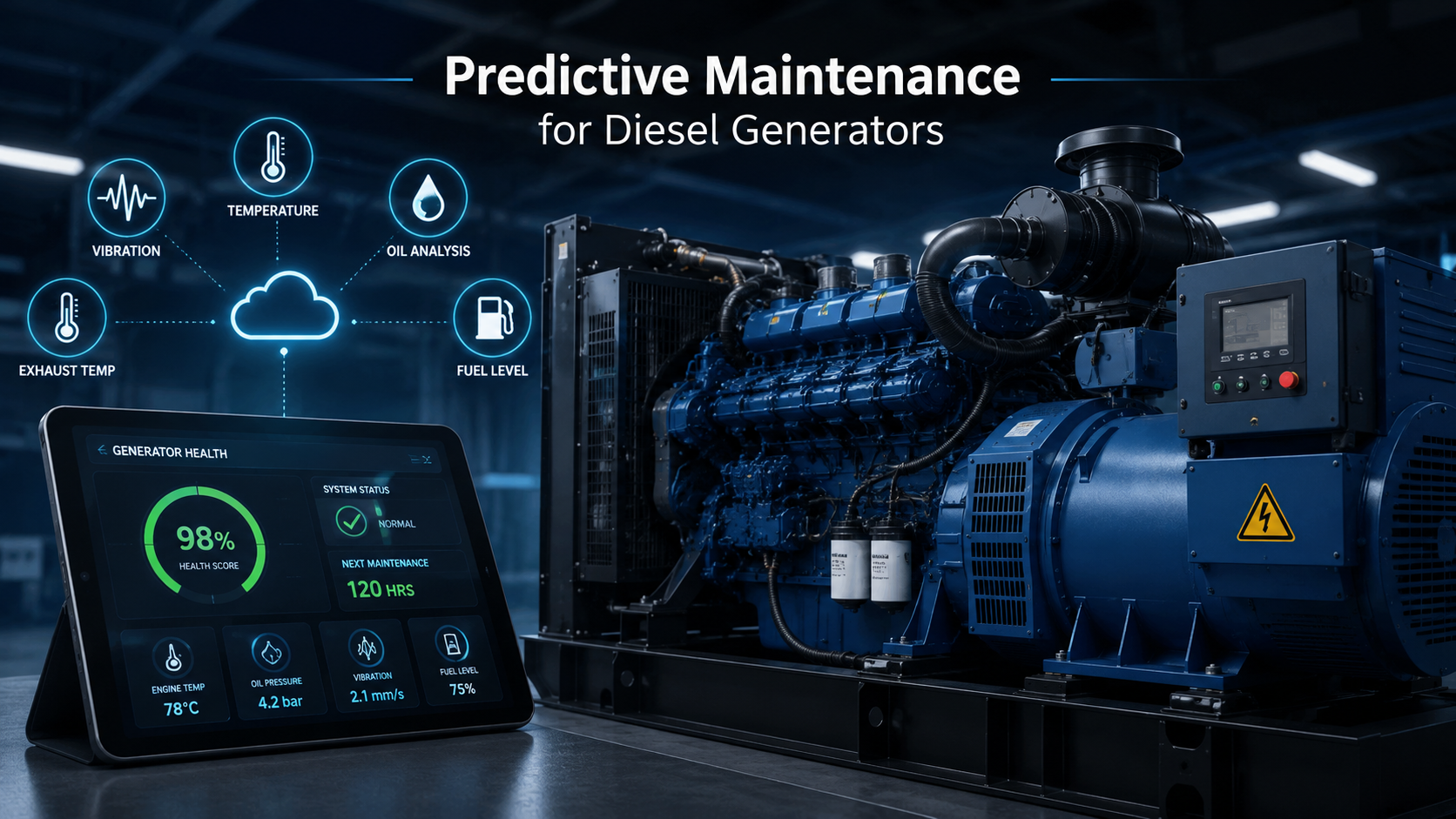
There are no more blind guesses. Predictive maintenance is a strategy that helps maintain the generators before the actual downtime occurs. Based on various performance indicators, failure is detected before it occurs. There is no case of fixed maintenance.
It is performed whenever required. This approach combines:
- Condition monitoring
- Sensor technology
- Data collection
- Trend analysis
- Artificial intelligence (AI)
- Internet of Things (IoT)
- Machine learning algorithms
- Remote monitoring platforms
Here are a few more types of generator maintenance to compare and understand.
| Maintenance Type | Maintenance Timing | Cost | Downtime | Reliability |
| Reactive Maintenance | After failure | Very High | High | Poor |
| Preventive Maintenance | Scheduled intervals | Moderate | Moderate | Good |
| Predictive Maintenance | Based on equipment condition | Lower long-term | Very Low | Excellent |
| Prescriptive Maintenance | AI recommends corrective actions | Lowest lifecycle cost | Minimal | Outstanding |
Step-by-step Guide on How Predictive Maintenance Works
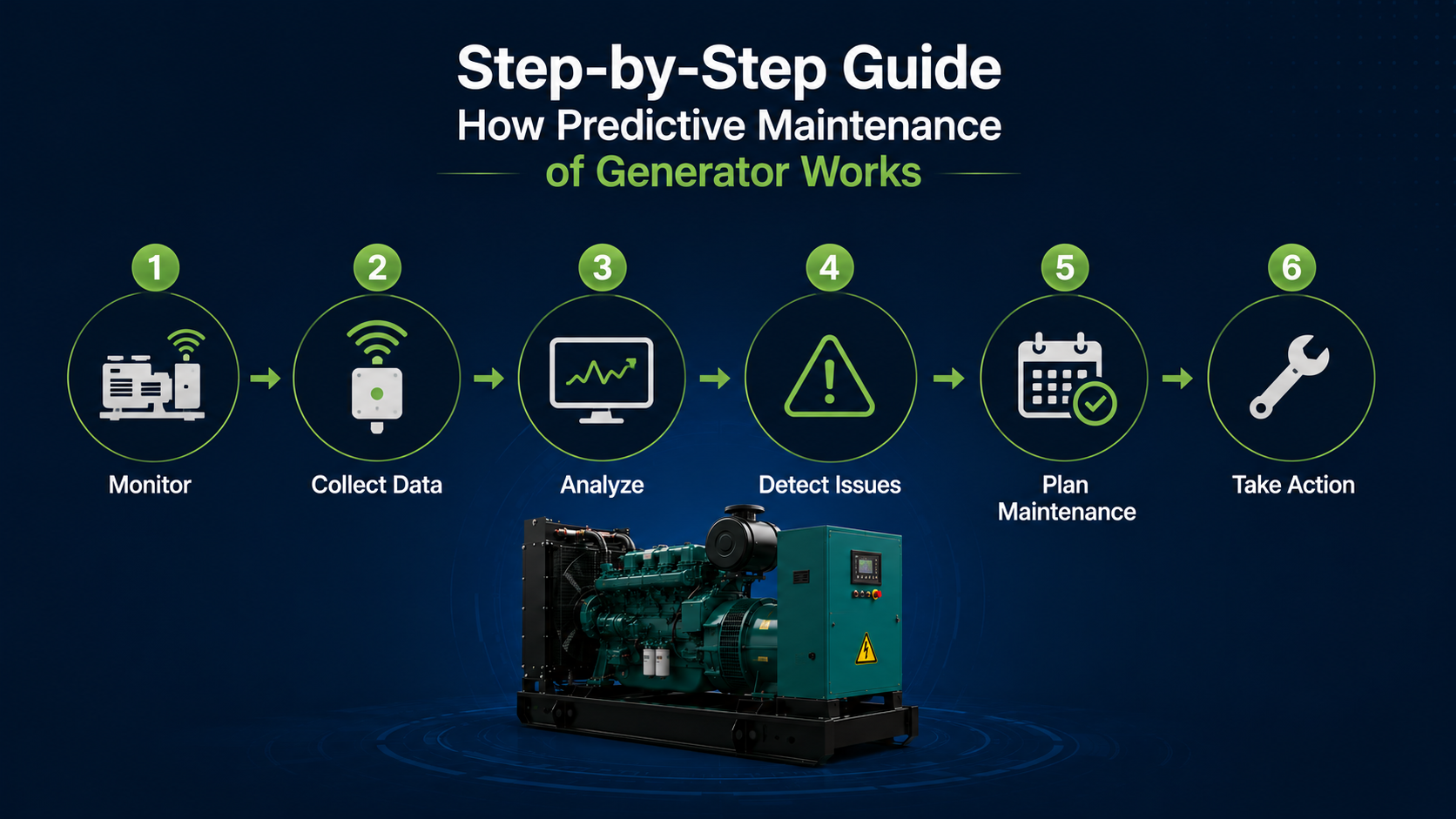
Predictive maintenance can be very helpful in several cases, but it has several tools and steps to understand the working mechanism. Here are a few steps listed to understand how predictive maintenance works.
Step 1: Install Sensors
Pressure, temperature, and many other failure detection sensors are used for monitoring. You should install sensors in the following locations.
- Engine
- Alternator
- Cooling system
- Fuel system
- Lubrication system
- Exhaust system
Step 2: Collect Data
Data collection is crucial as it is fed into the software. The sensor system finds out the following aspects of the systems.
- Temperature
- Pressure
- Vibration
- Voltage
- Current
- RPM
- Fuel flow
- Oil quality
Once the data is collected, the analysis of trends and other aspects occurs.
Step 3: Analyze Trends
Software systems play a crucial role in the detection of issues. They analyze the issues by the following trends.
- Historical data
- Manufacturer limits
- Industry benchmarks
- Previous operating cycles
If there are any issues and abnormalities in the trends, the problems are detected earlier and corrected.
Step 4: Detect Anomalies
One of the key steps is the detection of issues.
There can be a few issues, such as:
- Increasing vibration
- Rising oil temperature
- Declining battery voltage
- Low coolant pressure
- Excessive exhaust temperature
Alerts are generated automatically, and it is super easy to report such issues with the automated alert systems.
Step 5: Schedule Maintenance
Once anomalies are detected and minor issues are identified, scheduled maintenance occurs.
- Engineers or operators can plan when to maintain the system.
- They prepare the design for the maintenance.
- Essential tools and maintenance equipment are deployed in such places.
Benefits of Predictive Maintenance
Predictive maintenance has several benefits for the generator owners. Here is the list of benefits.
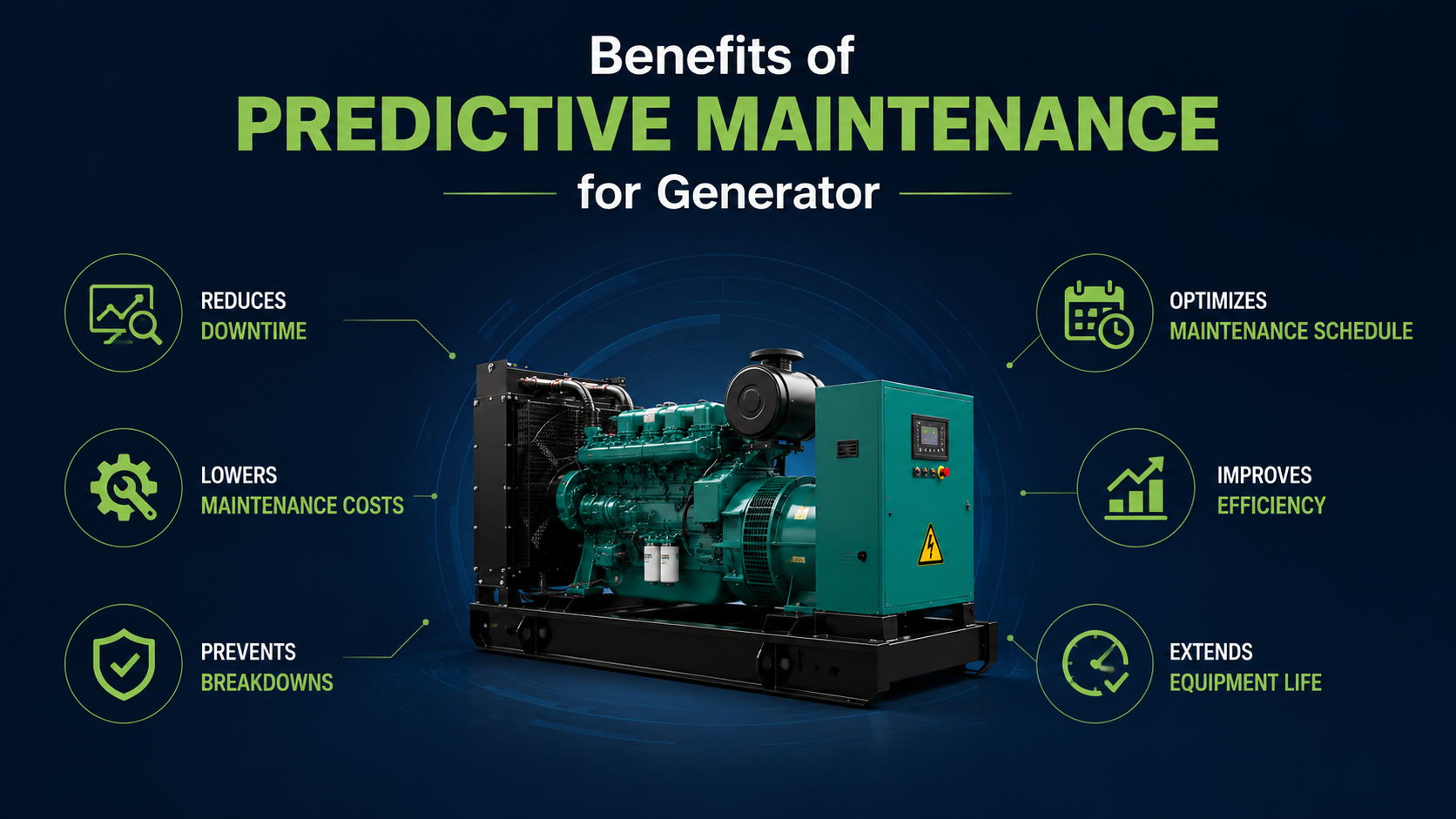
Reduce Unexpected Downtime
Unexpected downtime occurs when the failure is at advanced levels. But with predictive maintenance, you understand the minor issues and correct them immediately. It leads to reduced downtime and better support for your generator systems.
Here are a few key benefits.
- Fewer emergency shutdowns
- Improved operational continuity
- Reduced production interruptions
- Better emergency preparedness
Lower Maintenance Costs
Compared to traditional maintenance, predictive maintenance identifies failures in the early phases. If there is a minor issue, it is corrected and avoids the snowballing of the issues. Therefore, the maintenance costs drop exponentially.
It cuts costs on:
- Spare parts costs
- Labor expenses
- Emergency repair costs
- Equipment rental costs
Extend Generator Life
Continuous monitoring and inspection avoid the bigger generator issues. It keeps the generator systems under control and avoids any sudden failures. Therefore, it is beneficial to extend the life of:
- Engine
- Alternator
- Cooling system
- Fuel system
- Lubrication system
Improve Fuel Efficiency
Increased fuel consumption is often a major cause of failure. Since predictive maintenance already understands and defines the failure, it is easier to capture the fuel issues in the early stages. It often finds the following issues.
- Injector problems
- Turbocharger issues
- Air filter restrictions
- Fuel pressure abnormalities
The results are improved fuel efficiency and reduced consumption.
Increase Reliability
Generator reliability is one of the key aspects. It is essential to maintain the generators and make them ready for the outage hours. Thanks to predictive maintenance, your generator keeps performing.
It increases generator reliability by:
- Healthy batteries
- Proper lubrication
- Stable cooling
- Correct fuel pressure
- Functional starter systems
Improve Safety
Generator Failure is not only expensive but also causes safety issues. A minor failure, when transformed into a larger failure, can increase the risk of electrical-to-mechanical accidents.
The common issues are:
- Fire hazards
- Electrical faults
- Fuel leaks
- Overheating
- Mechanical damage
Early detection and maintenance avoid these issues and provide better safety.
Better Maintenance Planning
Maintenance teams can design the maintenance plans and avoid unexpected shutdowns. They help manage the manpower and improve the overall reliability.
Here are a few key benefits.
- Better manpower planning
- Reduced overtime
- Improved spare parts inventory
- Less operational disruption
Main Components Monitored In Predictive Maintenance
There are a few key components that are thoroughly monitored and assessed for failures in predictive maintenance. Here is the list of those components.
Engine
The engine is the most critical and important system. It receives most of the maintenance and is often the center of attention because of continuous maintenance. There are a few aspects that are constantly monitored in the engine systems. For example:
- Oil pressure
- Oil temperature
- Engine speed
- Coolant temperature
- Cylinder balance
- Combustion quality
- Exhaust temperature
Alternator
The alternator is often concerned with electrical health and provides detailed data. It has several parameters that are thoroughly inspected and monitored.
Here are those parameters.
- Output voltage
- Current
- Frequency
- Bearing vibration
- Insulation condition
- Winding temperature
Fuel System
Fuel has a larger impact on engine performance. If the fuel quality is low, the performance is often low. When the fuel quality is excellent, the efficiency and engine performance improve.
The key aspects to monitor in the fuel are:
- Fuel pressure
- Fuel temperature
- Water contamination
- Fuel consumption
- Injector performance
Cooling System
Overheating of the generators can cause unexpected shutdowns. Therefore, a proper cooling system can help optimize the performance and decrease the chances of failures.
Typical monitored parameters include:
- Coolant temperature
- Coolant pressure
- Radiator efficiency
- Coolant level
- Pump operation
Lubrication System
Oil conditions are also essential for the seamless functionality of the generator systems. There are a few monitoring aspects to check in the lubrication systems, such as:
- Oil pressure
- Oil temperature
- Oil contamination
- Metal particle concentration
- Oil viscosity
Battery System
Batteries are the masterminds behind the emergency generator failures. You should consider and understand the common reasons for battery issues.
Battery monitoring includes:
- Voltage
- Internal resistance
- Charging current
- Temperature
- Capacity
| Parameter | Why It Matters | Possible Problem |
| Oil Pressure | Lubrication health | Pump failure, leaks |
| Oil Temperature | Engine condition | Overheating |
| Coolant Temperature | Cooling efficiency | Radiator blockage |
| Fuel Pressure | Fuel delivery | Pump or filter issues |
| Battery Voltage | Starting reliability | Weak battery |
| Vibration | Mechanical wear | Bearing or shaft damage |
| Exhaust Temperature | Combustion quality | Injector problems |
| Engine Speed | Stable operation | Governor faults |
| Frequency | Power quality | Engine instability |
| Voltage | Electrical output | AVR or alternator issues |
Steps to Implement Predictive Maintenance
If you are ready to implement predictive maintenance for generator systems, we have added a few steps here.
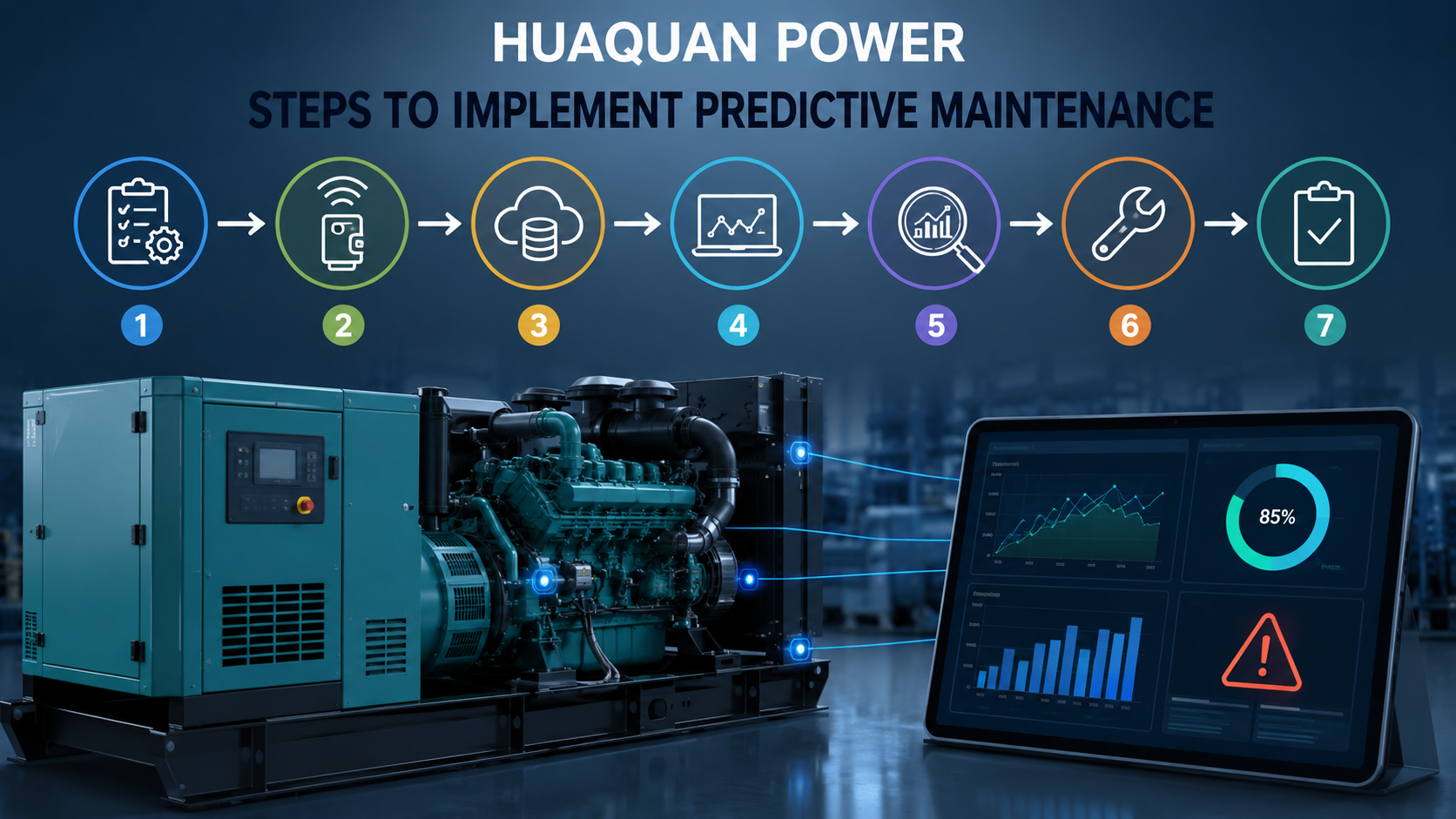
Step 1: Assess Critical Equipment
First of all, you should identify all the crucial equipment. Generators have to power up the critical devices first. In simple words, critical loads are first powered.
Here are a few things to consider during the critical equipment assessment.
- Power capacity
- Application
- Operational hours
- Criticality
- Historical failure records
Step 2: Install Monitoring Sensors
Sensor systems help identify the pressure, temperature, and vibration values. You should also know what type of sensors are already installed. Here is the list of monitoring sensors you must install in the system.
- Vibration sensors
- Temperature sensors
- Pressure sensors
- Fuel flow meters
- Oil quality sensors
- Current transformers
- Voltage sensors
- Battery monitors
Step 3: Establish Baseline Performance
First of all, you should test the generator and set the baseline values. Perform the operations under different conditions and record the practical performance of the generator.
The purpose of this testing is:
- Develop the baseline values for future cases
- Improve the reference system and make a better comparison with set values
Step 4: Configure Alarm Thresholds
You should develop an alarm threshold for the different values. For example, for the coolant temperature, the warning should be high.
Set threshold temperature values for the following options.
| Parameter | Warning | Critical |
| Coolant Temperature | High | Very High |
| Oil Pressure | Low | Very Low |
| Battery Voltage | Low | Critical Low |
| Engine Vibration | Elevated | Severe |
| Fuel Pressure | Low | Critical Low |
Step 5: Monitor Trends Continuously
Trend analysis provides better values compared to a single assessment. You should compare the previous trends and get accurate values.
Here are a few aspects related to trend monitoring.
- Gradually increasing vibration over several weeks may indicate bearing wear.
- Slowly rising exhaust temperature can suggest injector fouling.
- Progressive battery voltage decline may signal battery aging.
Step 6: Plan Maintenance Schedule
You should plan the maintenance schedule very efficiently. A daily, weekly, or monthly schedule can help avoid the long-term maintenance hassles.
Here are a few more benefits of the planned maintenance schedule.
- Planned downtime
- Better technician scheduling
- Improved spare parts management
- Reduced emergency repairs
| Interval | Typical Tasks |
| Daily | Review dashboard alarms, fuel level, operating status |
| Weekly | Check trend graphs, inspect visible leaks, verify sensor operation |
| Monthly | Analyze vibration data, battery health, coolant condition |
| Quarterly | Oil analysis, thermal imaging, electrical inspection |
| Semi-Annual | Fuel quality testing, injector performance evaluation |
| Annual | Comprehensive system assessment, sensor calibration, software updates |
Predictive Maintenance vs Preventive Maintenance
Predictive maintenance is never fixed and provides real-time assessment and maintenance perspectives. On the other hand, preventive maintenance is often fixed and requires timely maintenance as scheduled.
Here is the detailed difference between them.
| Feature | Predictive Maintenance | Preventive Maintenance |
| Maintenance Trigger | Equipment condition | Fixed schedule |
| Data Requirement | Continuous monitoring | Operating hours/calendar |
| Downtime | Minimal | Scheduled |
| Spare Parts Usage | As needed | Time-based replacement |
| Maintenance Cost | Lower long-term | Moderate |
| Failure Prevention | High | Moderate |
| Equipment Life | Longer | Good |
| Planning Accuracy | Excellent | Moderate |
FAQs
- Does predictive maintenance improve fuel efficiency?
Yes. Predictive maintenance detects oil and fuel-related issues, such as injector issues, air restrictions, cooling problems, and combustion inefficiencies. It optimizes fuel efficiency.
- Is predictive maintenance suitable for small diesel generators?
Yes, 100%. Predictive maintenance provides long-term maintenance solutions and extends lifespan. It is equally suitable for small or large diesel generators.
- What sensors are commonly used?
There are different types of sensor systems used in the monitoring process. For example, vibration, temperature, pressure, oil quality, fuel flow, voltage, current, speed, and battery monitoring sensors.
- Can predictive maintenance eliminate all generator failures?
Not all. Predictive maintenance can detect most failures and help avoid them. But it doesn’t provide immunity to all failures.
- How is predictive maintenance different from preventive maintenance?
Predictive maintenance analyzes and uses indicators, while preventive maintenance has a fixed schedule for maintenance operations.
- How often should predictive maintenance data be reviewed?
Usually, a weekly or monthly assessment is a good idea. However, if you have critical generators and facilities, then daily analysis can prevent unexpected shutdowns.
- Can predictive maintenance extend generator lifespan?
Yes. Predictive maintenance detects issues in the early stages and improves the overall lifespan of the generator components.
- What industries benefit most from predictive maintenance?
There are a variety of industrial sectors that benefit from predictive maintenance. For example, healthcare, data centers, telecommunications, manufacturing, mining, oil and gas, utilities, and commercial facilities.
Conclusion
Predictive maintenance is very helpful to maintain your generators and ensure reliability. They assess, understand, and maintain the generators before every use. Therefore, the generators are available 24/7 for backup energy services.
Are you looking for high-quality generator systems with lower downtime? Contact Huaquan Power and choose from a range of diesel generators. Our generator solutions are of premium quality and deliver exceptional performance. Check out our generators right away!