
The requirement to accurately measure and report the carbon footprint is increasing across all businesses. If you are conducting an energy audit, preparing sustainability reports or simply examining how efficiently your power generation operates, it is imperative that you understand the environmental effects of your power generation. By determining CO2 Emissions per kWh, you’ll have a clear and standard measure to calculate just how “dirty” your backup or prime power really is.
In essence, this is just a simple proportion of the amount of diesel you use and the electricity you produce. Even though greenhouse gas reporting may appear to be a daunting task, this guide by Huaquan, focuses primarily on direct combustion emissions and includes the most important practical formulas, emission factors and examples to help you estimate the actual GHG emissions from your generator.
What Does CO2 Emissions per kWh Mean?
CO2 Emissions per kWh indicates just how much carbon dioxide is released into the air for every kilowatt-hour of electricity produced in the process of carbon accounting.
This will come in one of three different forms depending on the magnitude of your business and reporting requirements.
- kg CO2/kWh: Kilograms of CO2 per generated kilowatt-hour (standard for most businesses).
- g CO2/kWh: Grams of CO2 per generated kilowatt-hour (often used for highly efficient systems).
- t CO2/MWh: Tonnes of CO2 per megawatt-hour (used for utility-scale or heavy industrial reporting).
To convert between these metrics, use these simple rules:
- 1 kg CO2/kWh = 1,000 g CO2/kWh
- 1 kg CO2/kWh = 1 t CO2/MWh
Direct CO2, CO2e and Lifecycle Emissions
It’s important to be aware of what you’re measuring, as well as the reasons why, before you perform the calculations.
Direct combustion emissions
These are the emissions produced at the time of burning the diesel in the generator engine. This is the most popular basic point for working reports.
Carbon dioxide equivalent (CO2e)
Diesel exhaust doesn’t just contain CO2. It also contains small amounts of methane (CH4) and nitrous oxide (N2O). CO2e is used to report and convert the global warming potential of all these various GHGs into one unit, carbon dioxide equivalent.
Lifecycle emissions
Also referred to as Well-to-Wheel or Scope 3 emissions, they take the whole supply chain into account. This may include:
- Crude-oil extraction
- Refining processes
- Fuel transportation
- Fuel storage
- Generator manufacturing
- Direct combustion
Note that the simple calculations here apply to direct CO2 combustion only, without any other factors added to the lifecycle calculation, unless they are purposefully embraced by the specific reporting framework.
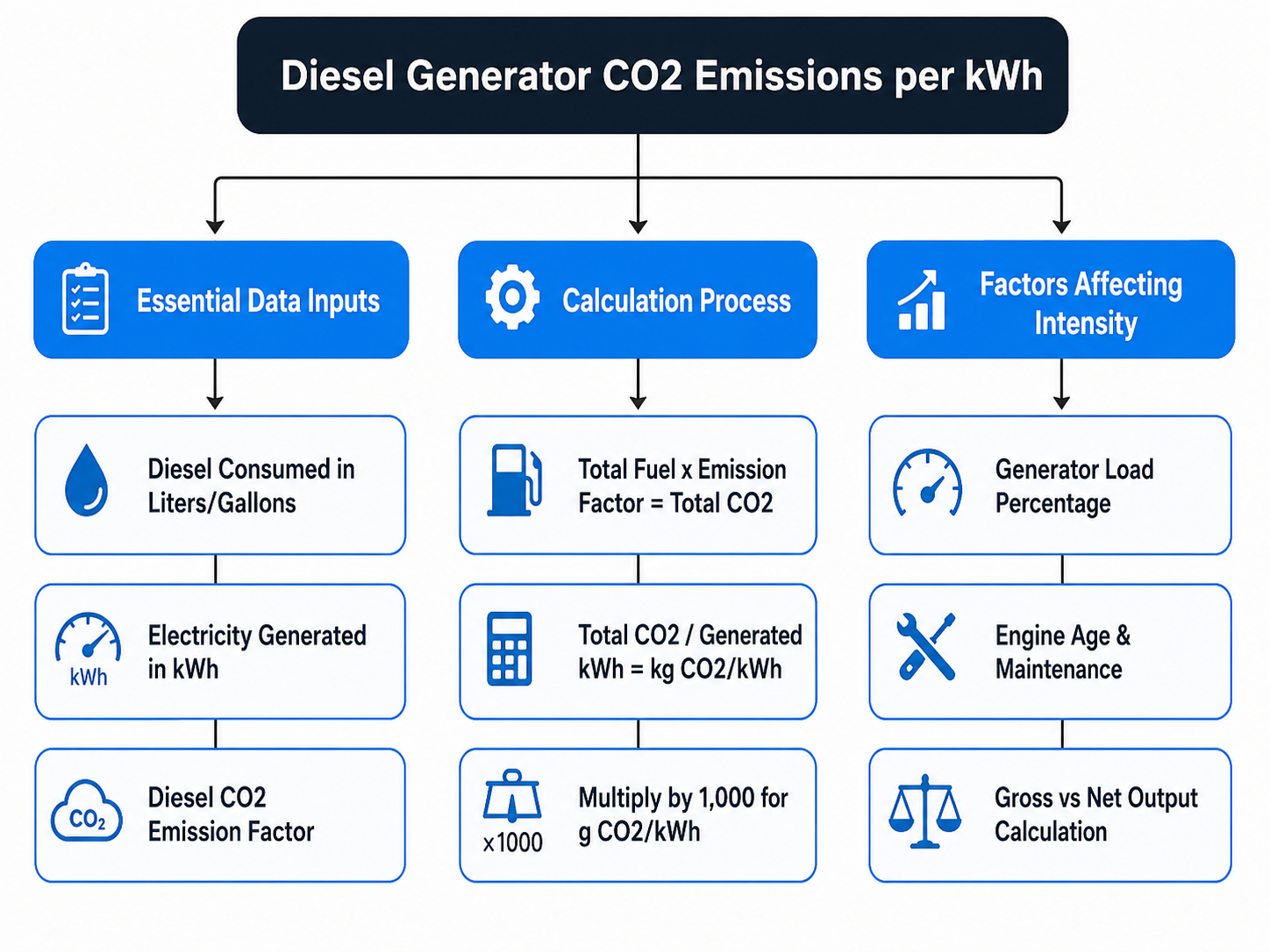
Information Needed for the Calculation
This is the precise data that you will need to do an accurate calculation:
- The amount of diesel used in a specified reporting period.
- The amount of electricity made (in kWh) in the same time.
- An appropriate factor for CO2 emission from diesel.
- Using a consistent measuring unit (do not use liters and gallons together).
- Operating load of the generator and running hours (if available, to provide context).
Your fuel consumption numbers and your generated electricity numbers need to match down to the hour, or you’ll run into trouble with your intensity number.
Diesel Generator CO2 Emissions per kWh Formula
The core formula for calculating emissions intensity is straightforward:
CO2 Emissions per kWh = (Diesel consumed × Diesel CO2 emission factor) ÷ Electricity generated
If you are calculating using standard metric units (liters and kilograms), the formula is:
kg CO2/kWh = (Diesel consumed in liters × kg CO2 per liter) ÷ Generated kWh
If you want to evaluate instantaneous efficiency based on hourly data from a spec sheet, use:
kg CO2/kWh = (Fuel consumption in L/hour × kg CO2/L) ÷ Electrical output in kW
What Diesel CO2 Emission Factor Should You Use?
The emission factor is the multiplier which converts liquid fuel to gaseous carbon. According to the US EPA, 10,180 grams of CO2 are emitted from the burning of one US gallon of conventional diesel. That’s approximately 2.689 kg of CO2 per liter when used directly for combustion.
However, there are some variations in factors depending on the region. Choose the emission factor in the following order:
- A factor that is required by law (national or state) that must be included in the calculation.
- A factor that’s published in the particular environmental reporting program that your company sticks to.
- A fuel supplier specific verified factor (from your fuel supplier).
- In the absence of local data, a recognized default factor (such as EPA or DEFRA).
Appropriate national fuel data and local factors, where available, are explicitly recommended by the Intergovernmental Panel on Climate Change because there might be small variations in the fuel characteristics and the basis for chemical measurement used in different parts of the world.
Step-by-Step CO2 Emissions Calculation
Let’s take a look at this formula and break it into a 5-step process.
Step 1: Measure Diesel Consumption
Example: Diesel consumption of 108.8 liters is used during 1 hour.
Don’t estimate this number. Use good measurement techniques, such as a calibrated fuel-flow meter, accurate day-tank level readings, main-tank reconciliation logs, fuel-delivery logs or digital generator controller data.
Step 2: Measure Electricity Generated
Example: Electricity generated during one hour = 400kWh.
Never assume the generator output purely from the generator’s rated kW capacity, always use the generator’s digital kWh meter.
Step 3: Select the Emission Factor
Example: Diesel emission factor = 2.689 kg CO2/L.
Step 4: Apply the Formula
First, find the total CO2 produced: 108.8 L × 2.689 kg CO2/L = 292.57 kg CO2.
Next, divide by the electricity generated: 292.57 kg CO2 ÷ 400kWh = 0.731 kg CO2/kWh.
Step 5: Convert to Grams
To find the gram equivalent: 0.731 kg × 1,000 = 731 g CO2/kWh.
Worked Example for a 500kVA Diesel Generator
Let’s apply this to a real-world scenario using an example generator rated at 400kW (500kVA at a 0.8 power factor). Its published manufacturer consumption figures are 108.8 L/hour at full load, 85.6 L/hour at 75%, 61.1 L/hour at 50%, and 34.6 L/hour at 25%.
Using our standard emission factor of 2.689 kg CO2/L, the emissions curve looks like this:
| Load | Output | Fuel use | Estimated direct CO2 emissions |
| 100% | 400kW | 108.8 L/hour | 0.731 kg CO2/kWh |
| 75% | 300kW | 85.6 L/hour | 0.767 kg CO2/kWh |
| 50% | 200kW | 61.1 L/hour | 0.822 kg CO2/kWh |
| 25% | 100kW | 34.6 L/hour | 0.930 kg CO2/kWh |
Key findings to remember:
- Total hourly emissions (absolute kg of CO2) are lower at a lower load.
- However, emissions per generated kWh actively rise because the engine uses fuel far less efficiently at light loads.
- These values serve as an educational baseline and should not be treated as universal benchmarks for every 500kVA Generator.
Calculation Using Monthly Fuel and Electricity Data
If you are doing end-of-month reporting, the process is just as simple:
- Diesel consumed: 12,000 liters
- Electricity generated: 42,000 kWh
- Emission factor: 2.689 kg CO2/L
Calculate total emissions:
12,000 L × 2.689 = 32,268 kg CO2
Calculate emissions intensity:
32,268 kg CO2 ÷ 42,000 kWh = 0.768 kg CO2/kWh
Convert to grams:
0.768 × 1,000 = 768 g CO2/kWh
How to Calculate Total Annual Generator Emissions
To find your absolute yearly carbon footprint for sustainability reporting:
Annual CO2 emissions = Annual diesel consumption × Emission factor
Example:
100,000 L × 2.689 kg CO2/L = 268,900 kg CO2 (or 268.9 tonnes CO2)
To find your annual emissions intensity, simply take that final number (268,900 kg) and divide it by your total Annual generated kWh.
How to Calculate CO2 Emissions Using Gallons
If your facility operates in the United States and tracks fuel in gallons, the formula changes slightly to accommodate the EPA’s gallon-based emission factor:
kg CO2/kWh = (US gallons consumed × 10.18 kg CO2/gallon) ÷ Generated kWh
It is critically important to distinguish between US gallons, Imperial gallons, and liters when entering data into reporting software. Mixing these units is one of the most common sources of massive, embarrassing carbon reporting errors.
Factors That Affect Diesel Generator CO2 Emissions per kWh
The intensity number that you end up with is not fixed. It is dynamic and depends on certain physical and operational factors.
Generator load percentage
Low-load operation tends to consume more fuel and consequently causes a significant rise in emissions per kWh, as in the 500kVA example.
Engine efficiency and age
An older engine may need to burn more fuel to generate the same kW output. Worn fuel injectors, worn cylinder compression, turbocharger issues and other internal wear and tear may contribute to this problem.
Maintenance condition
Failure to change the air filters, oil, cooling system flushing and exhaust restrictions reduces combustion efficiency.
Ambient temperature and altitude
The density of the air is greatly influenced by the conditions on the site. A higher altitude, along with extreme heat, decreases the cooling capacity and also engine power, thus increasing fuel consumption.
Fuel composition
There are several different fuel mixes, such as the change to Biodiesel (B20 or B100), and each of these has different densities, energy content and carbon properties, which require different emission factors.
Electrical losses
Wasted power from inefficient alternators, oversized cables, obsolete transformers and sub-optimal distribution networks represents wasted fuel for electricity that wasn’t even used by your equipment.
Measurement boundary
The intensity metric will change based on the type of calculation you make:
- Gross generator-terminal output.
- Net output after auxiliary loads.
- The electric power supplied at the end equipment.
Gross Versus Net CO2 Emissions per kWh
Gross calculation: This method accounts for all the generated electricity, before any power is diverted.
Net calculation: This subtracts the electricity the generator consumes for its own auxiliary systems, which includes cooling fans, coolant pumps, fuel transferring, digital control systems, site lighting, battery chargers and so on.
Normally, the net emissions intensity will be higher than gross intensity due to a reduction in usable kWh caused by the need to cover auxiliary consumption.
Direct Measurement Versus Manufacturer Data
During the audit of emissions, you are able to take the manual or the meter as your support.
Manufacturer data
- Advantages: Very easy to get; it is a great option for site planning; it indicates the anticipated consumption at optimum, normal loading conditions.
- Limitations: Assumes ideal lab test conditions, does not apply to an old or poorly maintained engine, does not reflect your site’s very specific operating conditions which vary from day to day.
Site measurement
- Benefits: It represents the true real-life fuel consumption and production; it is appropriate for more stringent audits and performance monitoring; and it does allow for detection of any mechanical breakdown over time.
- Limitations: Needs calibrated flow meters and kWh meters which are costly; manual reading of tank levels can cause error, or poor record keeping.
How to Reduce CO2 Emissions per kWh
If you are at a risk of having emissions intensity that is too high, try these practical operational strategies:
- Run the generator at optimum loading (usually 75% to 85%).
- Don’t idle unnecessarily during warm up and cool down periods.
- Size the generator close to the actual site load.
- Use automatic load-demand systems to switch off redundant Generators in parallel systems.
- Perform routine maintenance of the system including injectors, air filters, cooling and lubrication systems religiously.
- Increase efficiency of electrical-distribution systems on site to minimize line losses.
- For very low demand periods overnight use commercial battery storage.
- Connect appropriate renewable energy resources (either solar or wind) onto a hybrid microgrid.
- Track L/kWh and kg CO2/kWh each month in order to detect degradation early.
- Replace inefficient and old equipment if a full life cycle costing and environmental assessment indicates financial and environmental benefits.
Conclusion
It doesn’t have to be a daunting task to accurately monitor your environmental impact. If you concentrate on the three inputs (accurate diesel consumption, verified emission factor and accurately metered generated electricity), you can easily produce highly reliable carbon data.
As far as practicable, we strongly recommend using data from actual site measurements from calibrated meters, instead of relying on generic spec sheets from manufacturers. Clearly indicate your calculation boundary (gross vs. net) and origin of your emission factor in your calculations for future audits.
Once you have a consistent method for calculating CO2 Emissions per kWh, you can achieve both efficient tracking of efficiency improvements and reduction of operating costs and head-on reduce your facility’s footprint toward sustainability.
Contact the Huaquan team today for expert assistance in optimizing your generator’s fuel efficiency, conducting energy audits, and reducing your facility’s carbon footprint.