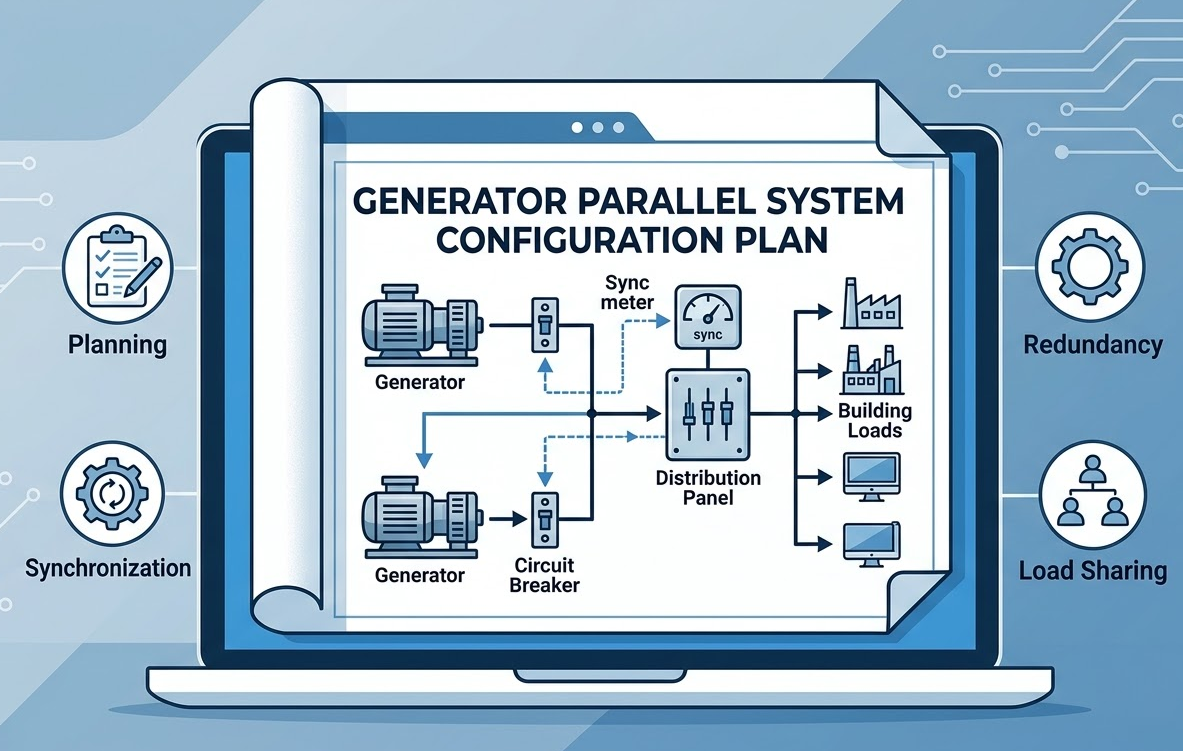
This guide is about generator parallel system configuration. It talks about the parts, how to synchronize them and how to implement them in a good way. In the field of Power Engineering using one generator is not always the best idea. Sometimes it is better to use smaller Generators that work together.
Whether you are making a power system for a hospital, a data center or a factory you need to know how to make generators work together smoothly. This is the key to having a power supply.
1. What is Generator Parallel System Configuration?
Generator paralleling is when you connect two or more generators to a busbar. This way they can provide power to the load. By using one big 2000kW generator you can use four 500kW generators that are linked together.
For generators to work in parallel they need to be synchronized. This means their voltage, frequency, phase angle and phase rotation need to match. If these things do not match it can cause problems like mechanical failure or electrical explosions.
2. Advantages of Generator Parallel System Configuration
Why would you choose a parallel system over one big generator? The benefits are many from saving money to being more reliable.
2.1 Redundancy and Reliability
You get redundancy and reliability with a system. If one generator fails the other generators can still provide power. This is called the $N+1$ Strategy, where $N$’s the number of generators you need and $+1$ is the extra generator that is, on standby.
2.2 Scalability
The Generator Parallel System Configuration is also scalable. If a facility grows you do not need to replace the generator. You can just add another generator to the existing system. This is a way to save money because you only pay for what you need.
Generators work best when they are running at 70% to 80% of their capacity. If a big generator is only running at 20% capacity it wastes a lot of fuel. In a system you can turn off the generators that are not needed so the other generators can run at their best.
2.3 Easy Maintenance
It is also easier to maintain generators. You can take one generator offline for maintenance without cutting power to the building. The other generators can handle the load so you do not have to worry about losing power.
3. Technical Requirements for Generator Parallel System Configuration
Before you can connect two generators to the bus there are four important things that have to be the same. New digital controllers can do this automatically. You have to plan for it. You need to think about the Phase Rotation. Both generators have to have the order, like L1-L2-L3.
The Voltage Magnitude is also important. The voltage of the generator has to be the same as the voltage of the bus. Then there is the Frequency. Both generators have to run at speeds like 60Hz. The Phase Angle is important too. The sine waves have to peak at the same time.
4. Key Components of Generator Parallel System Configuration
To make a parallel system work you need more than cables. You need a lot of parts like hardware and software all working together.
4.1 Paralleling Switchgear
This is the connection point where all the generators meet before the power is sent to the rest of the facility. It has the busbars, circuit breakers and protective relays.
4.2 Digital Master Controller
This is the brain of the system. It looks at how much power’s needed and decides which generators to turn on, turn off or put on standby. It also makes sure that if there is not power it can turn off things that are not essential like the office air conditioning so that important things, like life support systems keep working.
4.3 Governors and Voltage Regulators
These help the generators work together and share the load. They have to be able to support Droop or Isochronous load-sharing modes so one generator does not take all the load. Cause the others to shut down.
5. Generator Parallel System Configuration Load Sharing Strategies
You have to decide how the generators will share the load.
5.1 Droop Load Sharing
In this mode the frequency can drop a little when the load increases. This allows the generators to balance the load on their own without having to talk to each other all the time. It is a way to do things but it means the frequency is not always the same.
5.2 Isochronous Load Sharing
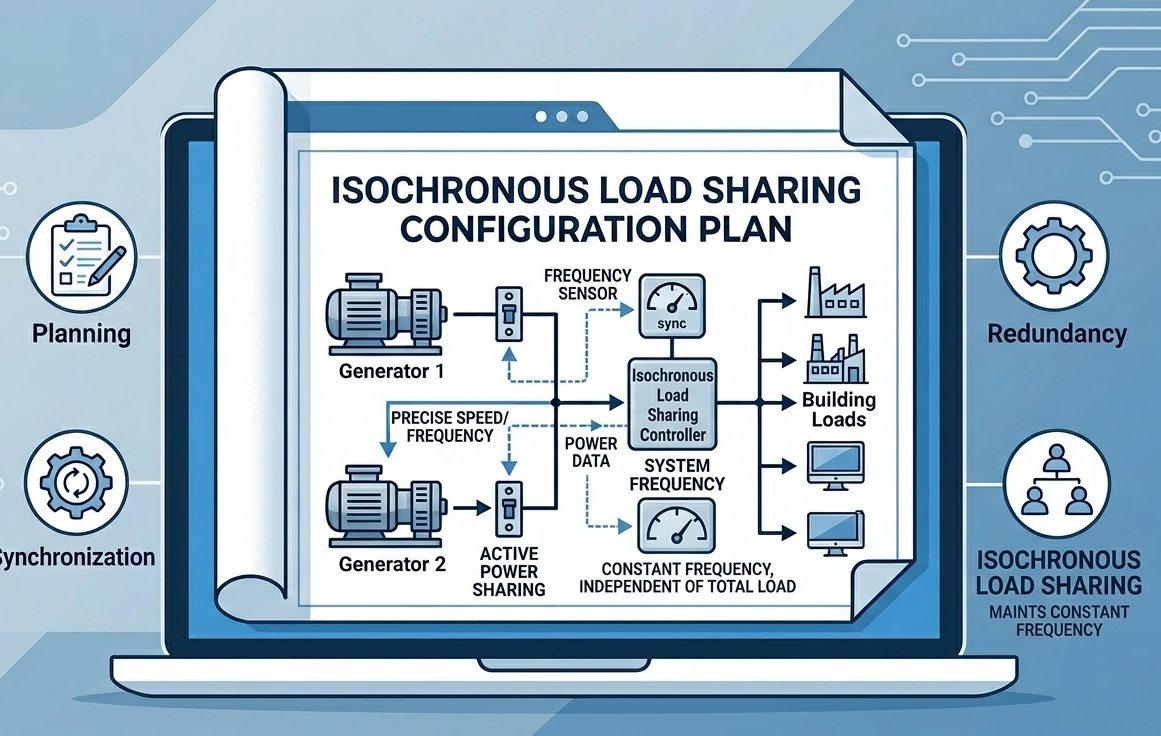
The controllers talk to each other using a fast data link so they can keep the frequency the same, when the load changes. If the load increases all the generators increase their power at the time so the frequency stays the same.
6. Generator Parallel System Configuration Steps
Here is the complete guide.
6.1 Load Profile
You need to figure out your peak load and your minimum load. This helps you decide how many generators you need. For example if your peak load is 1500kW and your minimum load is 400kW you might want to use three 500kW generators of one 1500kW generator.
6.2 Choose generator Compatibility
It is easiest to use generators that’re the same so they all work together well.
6.3 Design the Switchgear Logic
You have to decide which generator starts first. Usually you want to rotate which generator is the lead so they all run for the amount of time.
6.4 Set Up Load Shedding
You have to decide what loads are critical, what loads are essential and what loads are not essential. If one of the generators fails the system has to be able to turn off the -essential loads quickly so the whole system does not shut down.
7. Generator Parallel System Configuration Challenges and Solutions
Here are the common challenges and their solutions.
7.1 Circulating Currents
Circulating Currents are a problem when the voltages do not match. The solution is to use the Automatic Voltage Regulators and make sure the cross-current compensation is correct.
7.2 Harmonic Distortion
Harmonic Distortion is something that happens a lot in data centers that use UPS systems. To fix this you can use generators with a kind of winding that helps reduce the third harmonic.
7.3 Communication Failure
Communication Failure is what happens when the data link between the generators is broken. The solution is to set up a plan called “Fail-to-Droop” so the units can still share the load safely even without the data link.
8. Generator Parallel System Configuration Conclusion
Using a lot of generators in a parallel system is the best way to make sure the power is always on in very important places. When you spread the load across generators that are working together you get a level of reliability and efficiency that one generator cannot provide. Even though setting this up in the beginning requires planning and special equipment, the good things about having extra generators and saving fuel make it the best choice for very important operations.
9. Build Your Parallel Power Plant with Huaquan Power
Huaquan Power is very good at designing and setting up parallel generator systems. Our generators come with controllers like DeepSea or ComAp that make it easy and safe to synchronize them. Whether you need two generators for a clinic or ten generators, for a park Huaquan Power can give you the equipment, switchgear and technical help you need to make your plan work. You can contact Huaquan Power today to talk about the power system in your building.
⚡ Explore Related Solutions
- 🏭 500kW Diesel Generator
- 🏭 1000kW Diesel Generator
- 🏭 500kW YC Diesel Generator
- 🔧 KMS (Cummins/Doosan) Series
- 🏥 Data Center Generator Solutions
- 🏥 Hospital Generator Solutions
- 🏥 Portable Generator
💡 Need a customized solution? Contact our engineering team for project-specific recommendations.