Selecting the incorrect water pump for your farm can cost you a thousand-dollar loss. If you do not select it according to your needs, it will waste fuel, deliver inadequate pressure, and damage the engine. It will also disrupt your field’s irrigation schedule. Akibatnya, your crops might face severe consequences.
The most appropriate Pam Air Diesel is usually not the one that is the most sturdy and expensive of all in the market. It is the pump that aligns with your area’s irrigation needs. If you want to buy the best diesel water pump, you must consider several factors as a farmer. These include the area of the farm, source of water, depth of water source, required flow rate, total head capacity, and fuel efficiency.
How to Choose the Best Diesel Water Pump for Farming
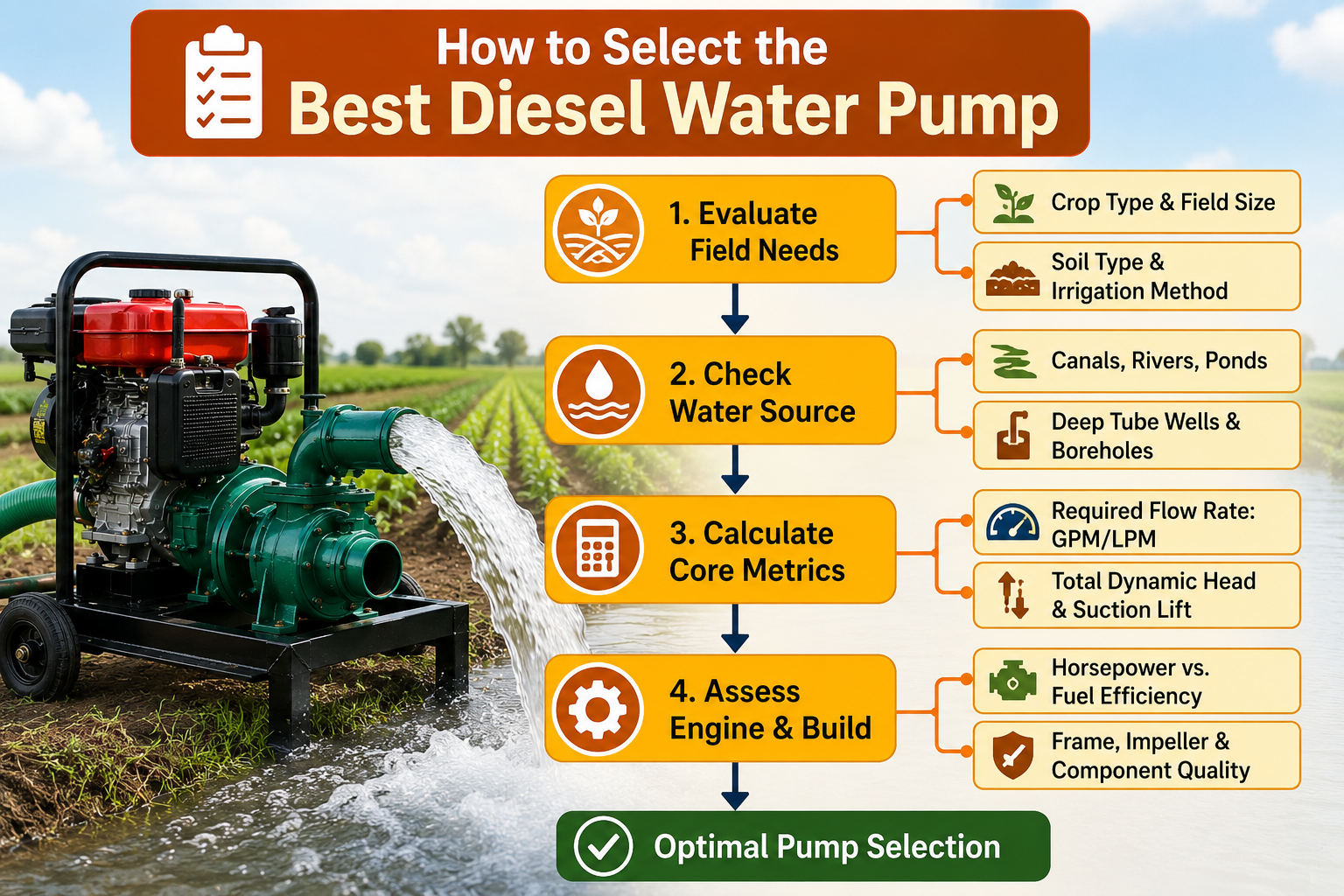
Understand Your Farming Irrigation Needs First
Pertama sekali, you must evaluate your farm’s irrigation requirements. You must know your area’s water needs. Every agricultural area is different from the other and demands variable watering quantities. Jadi, the right selection depends on understanding your specific farm.
You must consider these factors to make a perfect selection:
- Type of Crop: Different types of crops demand variable quantities of water.
- Field size: Decides the exact volume of water required for the field.
- Soil type: Dusty, sand-rich soil penetrates water quickly, whereas the clay keeps it.
- Irrigation method: Different methods, such as flood, drip, or sprinkler, require different velocities and pressure needs.
- Source of Water: The source decides the type of pump required for the field.
- Daily operational hours: What is the exact time the pump will remain in action for irrigation?
- Seasonal water demand: Continuous requirements during dry weather or drought conditions require more quantities of water.
Check the Source of Water
If you identify the place where your water actually comes from, it will ease the next process. It decides your pump type, dimensions of suction lift, and the power of the engine. Here are some primary water sources that are most common for agricultural purposes:
- Long Canals
- Large Rivers
- Deep Ponds
- Tube wells
- Deep Boreholes
- Large Storage Tanks
- Great Reservoirs
Contohnya, when you pull water from a tube of very large depth, it will require a different extraction mechanism than the one required for a surface pond or shallow canal waters.
Calculate the Required Flow Rate
Flow rate means the quantity of water the pump can transfer in a specific amount of time. You can measure it in either gallons per minute (GPM) or liters per minute (LPM).
- Larger fields require a pump with a greater rate of water flow. It will cover your vast area efficiently and quickly.
- Flood irrigation demands a high discharge rate to transfer water across the open fields.
- The drip irrigation method needs a lower, regulated flow to avoid system disruption.
You must align the flow rate with your type of crop and the farm’s requirements to promote efficient irrigation of the land.
Consider Total Head and Suction Lift
You must know about the head in depth. Dengan kata mudah, total dynamic head refers to a measurement of the movement of the pump both horizontally and vertically. TDH determines how far and how high the pump has to move the water from the source to the field.
When you are calculating total head, it involves the following:
- Vertical lift: Includes the distance of the water source to the pump in an upward direction.
- Distance to field: Includes the length the water has to travel to be transferred to the field in a horizontal direction.
- Pipe friction loss: Includes the resistance created when the water flows against the internal pipes.
- Required pressure: Includes the pressure needed to align with your irrigation method.
You should select your pump by evaluating the flow rate as well as the total head.
Choose the Accurate Size of the Pump
When you are selecting pumps for your farm, you must consider its size. It must be optimal in size.
- A small-sized pump will make a huge effort to operate the engine, and in the end, fail to irrigate the fields efficiently.
- An oversized pump will work inefficiently and waste fuel. Akibatnya, it will destroy your irrigation systems.
You must select a model whose operation fulfils your farm’s needs.
Measure Engine Power and Fuel Efficiency
Diesel-based pumps are selected for their robust and durable engine performance in strict conditions. Some users assume that considering a greater horsepower for the engine is a must always. But it is a common misconception.
Fuel consumption matters a lot because of the long working hours of the engine. Before buying a pump, you must compare the fuel consumption across different pump models. The best diesel water pump is the one that demands an optimal balance between required horsepower and operating costs.
Match the Pump with the Irrigation Method
Your watering technique should tell about the performance of the pump.
For Flood Irrigation
Select a pump that achieves the higher flow rate. You will need a large quantity of water compared to the pressure. It will make those pumps suitable that have a high-discharge rate.
For Sprinkler Irrigation
Select a pump that can offer optimal, steady pressure flow. You must evaluate the head capability and pressure needs. The sprinklers need a robust water transfer supply to spray over the large fields effectively.
For Drip Irrigation
Consider a pump that is capable of supplying a regulated and steady pressure flow. You must avoid a high-pressure rate to avoid the destruction of pipes and internal lines.
For Orchard Irrigation
Choose a pump that effectively covers the distance between the source of water and the orchard area. Lebih-lebih lagi, you must consider its ease of carrying on different surfaces. It will help you cover your multiple orchard blocks.
Consider Structure’s Quality and Durability
In agricultural environments, the pump is exposed to mud, serpihan, grease, kotoran, and harsh weather conditions. You must consider the engine’s long and durable life.
- Sturdy, resistant frame
- Berkuasa, rusting-free, or commercially rated aluminium pump outer casing
- Internal components must not corrode
- Top-notch, resistant impeller of the pump
- Firm seals to avoid leaks
- A steady base to decrease the chances of wear
- Vibration and noise-controlling mounts
- Internal parts are easy to access for frequent maintenance practices
Consider Portability and Smooth Installation Practices
Evaluate the working of the pump in detail.
- Portable pumps: These pumps are installed in wheeled carts or carrier frames. They are suitable for those farmers who manage multiple fields simultaneously or pull water from variable water sources.
- Fixed pumps are applicable for those permanent, long-term irrigation systems that draw water from one source, such as a deep tube well.
Evaluate Spare Parts and After-Sales Maintenance Support
A pump is a mechanical piece of equipment. After performing its role for a specific time, its components will wear. Its spare parts must be available easily.
You should choose a supplier or a third-party dealer who provides commendable technical and warranty support. You must check their warranty packages. If you buy a pump at a very low price, it is possible that it becomes the most expensive one in the long term due to the unavailability of its spare parts.
Compare Diesel-Based Water Pump Prices Carefully
When you are deciding on a financial budget for your pump, you must not look at the price merely. If you see a cheaper price tag, it might mean that the pump has the worst diesel efficiency, or it has poorly working parts.
When you are comparing prices of different pumps, consider the following features:
- Robust structure and working of the engine
- Possesses the required head ability and pressure flow
- Estimated usage of fuel per hour or per day
- Warranty support and coverage plan
- Availability of extra parts in local areas
- Overall brand’s reputation and previous customer reviews
Checklist Before Buying the Best Diesel-Powered Water Pump
You must fulfil this checklist by asking yourself these ten important questions. It will help you àmake a final pump selection.
- What is the exact size of my total field area?
- What is the source of watering fields?
- What is the depth of the water through the suction lift?
- What is the distance the water has to travel to water the crops?
- What is the required flow of water to reach the required distance? (the value is either in GPM or LPM)
- What is the calculated head capability of the pump, both in height and length capacity?
- Which is the suitable watering method I can adopt for my field?
- What are the daily working hours of the pump?
- Can I find my pump’s extra parts easily in my locality?
- Does the dealer provide maintenance scheduling for the pump?
Nota Akhir
Long and short, yang best diesel water pump is not always the most complex one. It is not necessary that it is always harder on your budget and It must be according to your field’s power and watering requirements. It must align with your area’s size, source of watering, flow rate needed for optimal irrigation, calculated head, basic irrigation method used for the field, fuel delivery, and fuel affordability.
When you are selecting a diesel-based water pump for watering your fields, you must evaluate the required rate of flow of water, head capability, penggunaan bahan api, and maintenance scheduling. It will help you select the most appropriate pump model to keep your irrigation working for years.
Soalan Lazim
1. Which type of diesel-powered water pump is the most suitable for farming purposes?
The best form of diesel-based water pump is the one that relates to your requirements. These include field size and power needs, depth of water source, flow rate to power the field, and total calculated dynamic head of the pump.
2. How to select a diesel-backed water pump for watering fields?
You must measure your watering source, suction-raised lift, required flow rate needs, total dynamic head of the pump, pipe distance from the pump, diesel utilization, and your field’s basic water spraying method.
3. Should I consider greater horsepower for a diesel-powered pump?
It is not always necessary to choose a higher horsepower for a diesel-related pump. You must choose a pump according to the pump’s flow rate and the measure of the pump’s movements in order to water the specific area. If you select a pump with an extra-large horsepower, it will utilize diesel unnecessarily and waste your money.