Кучылтмаш
In the construction, больницыште, or mining industries, a power outage is a major concern. For a single minute, a power shutdown can halt the whole process. To avoid sudden power outages and meet the power demands, engineers have introduced redundancy. But understanding N+1 vs N+2 is essential for your business.
Таче, we will understand the redundancy process in detail and how redundancy helps in this process.
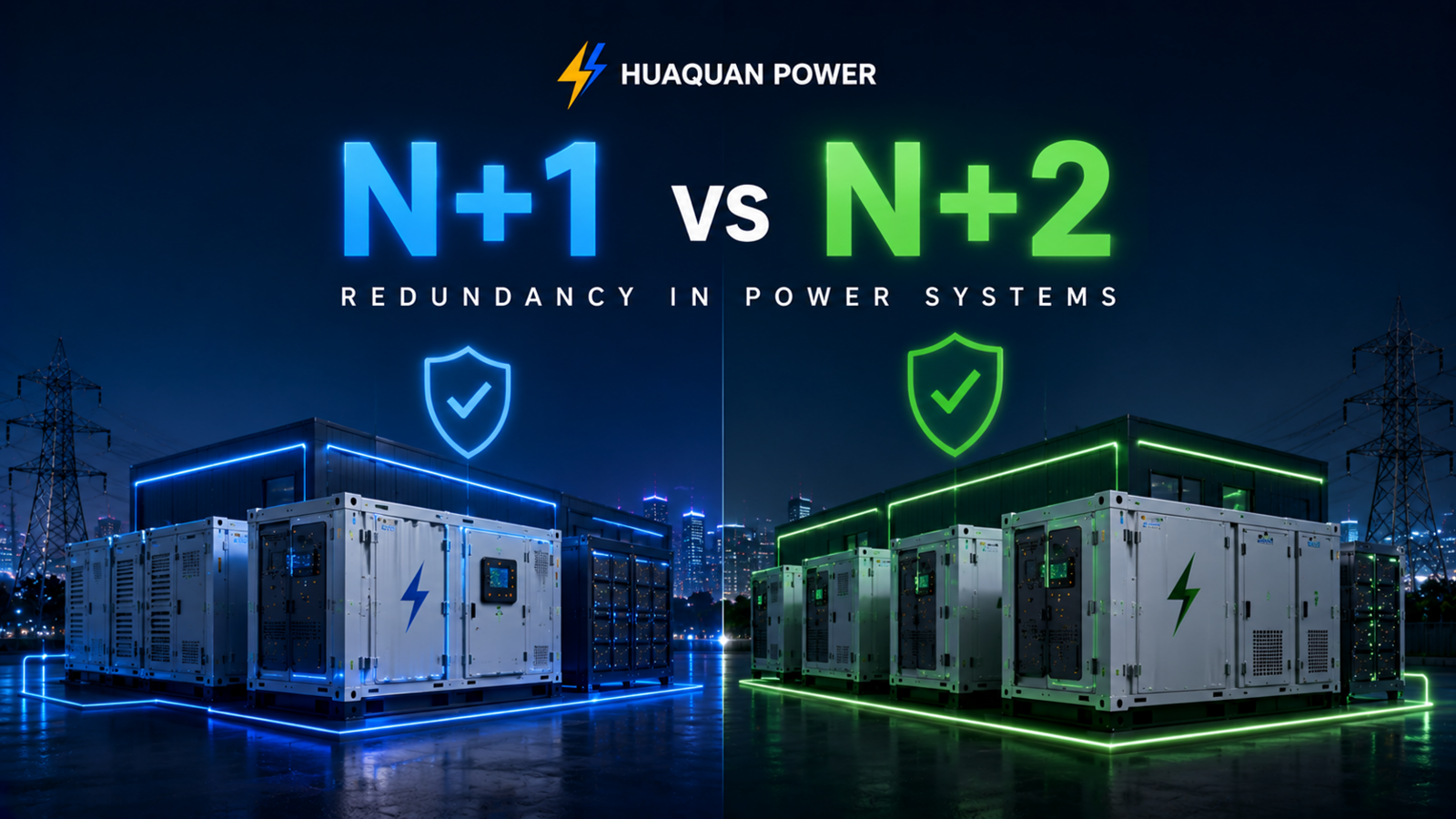
Understanding N Redundancy in Power Systems
Redundancy is the additional system to support the power systems during the outages. Introduction of the N refers to the minimum number of Генератор-влак or backup supply systems required to power the system with the necessary energy.
Suppose an example of a 500kW system. You have installed the 3 Generators to support such a colossal energy setup. N is the number of generators installed.
Ошондой, here N equals three. If you are going to add more generators, they will be counted as redundant generators to support the system.
Here are a few redundancy levels to understand.
| Redundancy Level | Описание |
| N | Only the required equipment is installed. |
| N+1 | One additional backup component is installed. |
| N+2 | Two additional backup components are installed. |
| 2N | A completely independent duplicate system is installed. |
| 2N+1 | Two complete systems plus one additional spare component. |
What is N+1 Redundancy?
If you are looking for the redundancy system, you must understand the N+1 and N+2 redundancy levels.
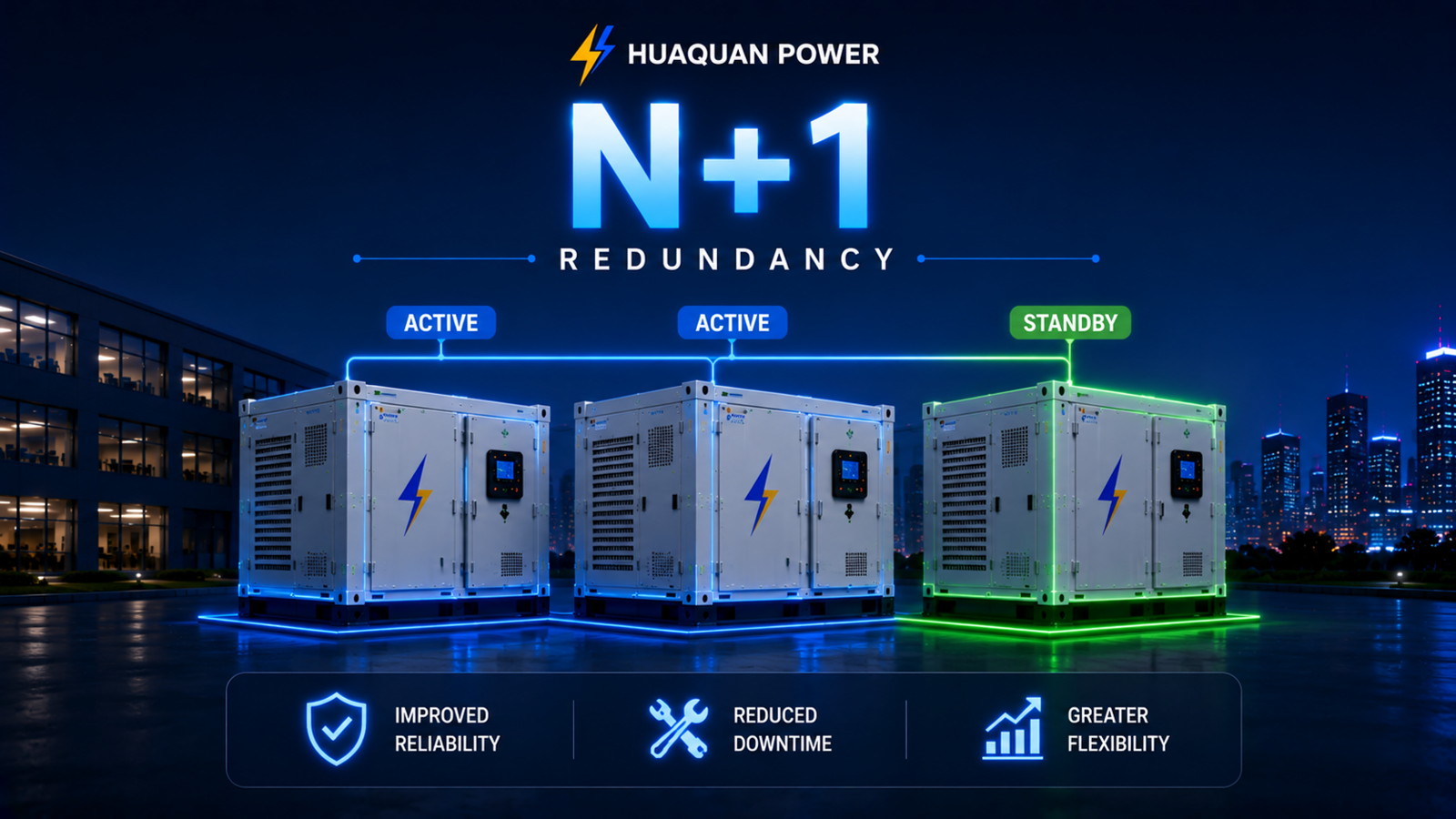
N+1 Redundancy refers to a power system with one extra component that acts as a backup supply when a component fails.
Мут, you have installed three generators in a system for the backup supply. Here is how your system will be at N+1 Redundancy.
- Генератор 1
- Генератор 2
- Генератор 3
- Генератор 4 Redundant generator to support your system when one of the three generators)
N+1 Redundancy offers support during a power outage when one or more systems fail to perform.
Кузе тудо пашам ышта?
The working mechanism is pretty simple. Consider an example of the above systems, and let’s discuss how it works.
- Ошкыллан 1: Primary energy supply.
Solar panels or utility grids provide constant energy to your system. When they experience outages, you get a backup system.
- Ошкыллан 2: Backup Supply.
There are two options for the backup supply. One is the pair of lithium-ion batteries that support the system during an outage until they are discharged. Second is the generator system. We have installed three generators in the system that simultaneously work to provide 500 kW of energy.
- Ошкыллан 3: Failure occurs.
Suppose there occurs a failure in generator 3. It can be:
- Mechanical failure
- План почеш обслуживатлыме паша
- Fuel system issue
- Electrical fault
Whatever the cause of failure is, your system will not get 500 kW of power.
- Ошкыллан 4: Redundant Generator Works.
To provide and meet the energy demands, a redundant generator acts. It works with the system and provides the power, offering a complete solution of 500kW. These generators are in standby mode and make energy available whenever needed.
What is N+2 Redundancy?
Unlike the N+1 redundancy, where we have installed one additional component, in the N+2 redundancy, there is an installation of two additional components.
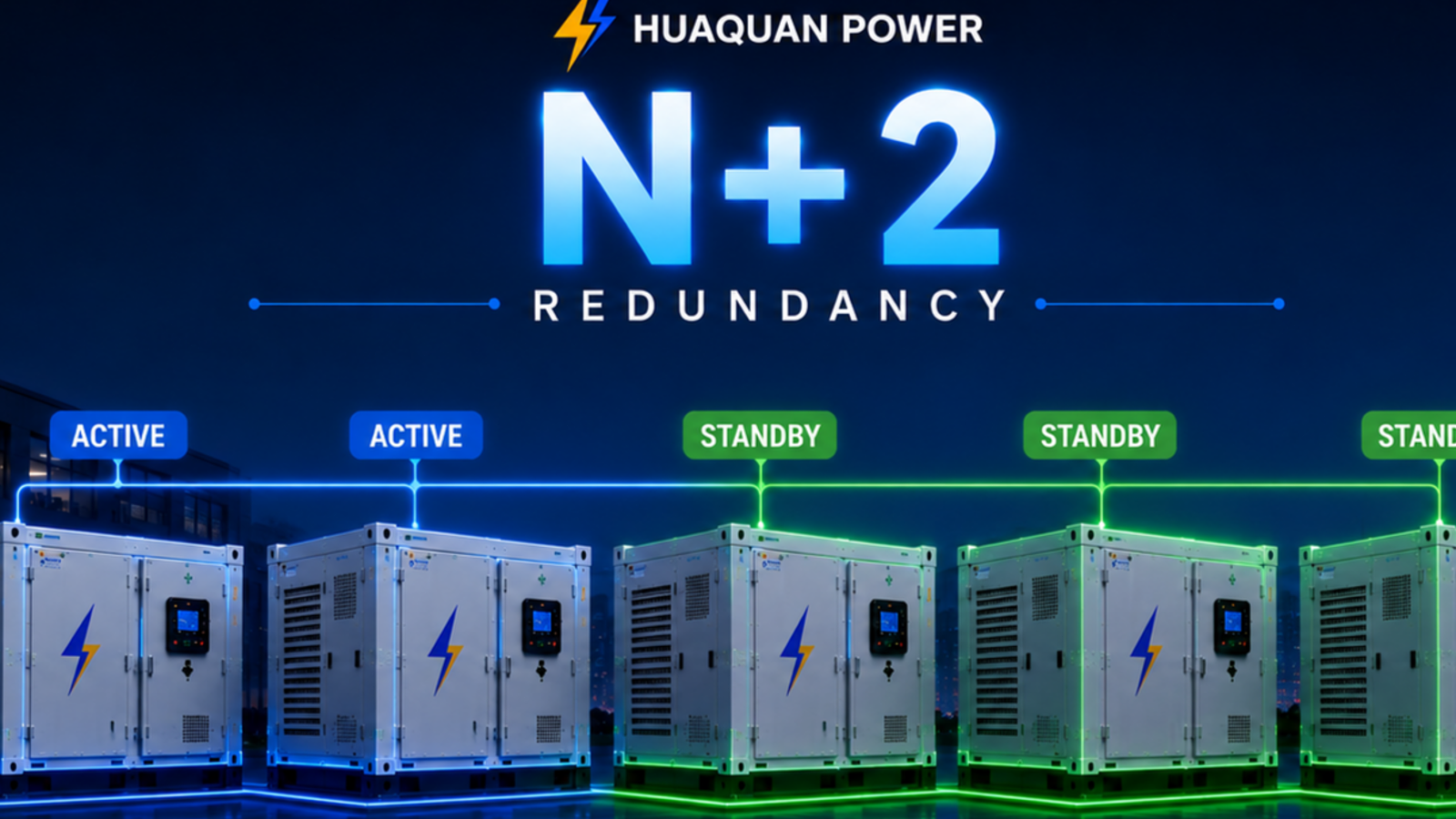
Южгунамже, there is a high-level failure of more than one component. To power the system during the outage, there comes the N+2 redundancy with two generators acting as additional components.
N+2 Example
Suppose an example of the three generators providing a 500kW energy supply to the system during an outage.
In the N+2 Redundancy, you have added two more generators to support the system even more. Мут, генератор-влак 1 жана 3 fail. Тиде случайыште, two standby generators will replace them to provide the required 500kW energy supply in all conditions.
Кузе тудо пашам ышта?
The working mechanism of the N+2 redundancy is pretty simple. Let’s know the basic steps.
Ошкыллан 1: Power Outage Occurs
What have you installed as a power source? Most people install solar panels or get power from utility grids.
A power outage occurs. Your electrical supply goes down, and you have to rely on the primary and secondary backup supply.
Ошкыллан 2: Primary Backup Supply
If you have installed the battery Энергийым аралыме системе, it stores the energy to provide during an outage. In the absence of batteries, generators are the primary support.
Ошкыллан 3: Secondary Backup Supply
Generators are crucial secondary systems that offer energy supply after the batteries are discharged.
They provide a non-stop power supply as long as you have the fuel available for their running.
Ошкыллан 4: Standby Generators Work
Suppose two of your generators fail to perform for any reason. Whether it is electrical or mechanical, you need an instant supply.
The N+2 redundancy system can offer two backup standby generators in emergency conditions to take control and provide backup energy.
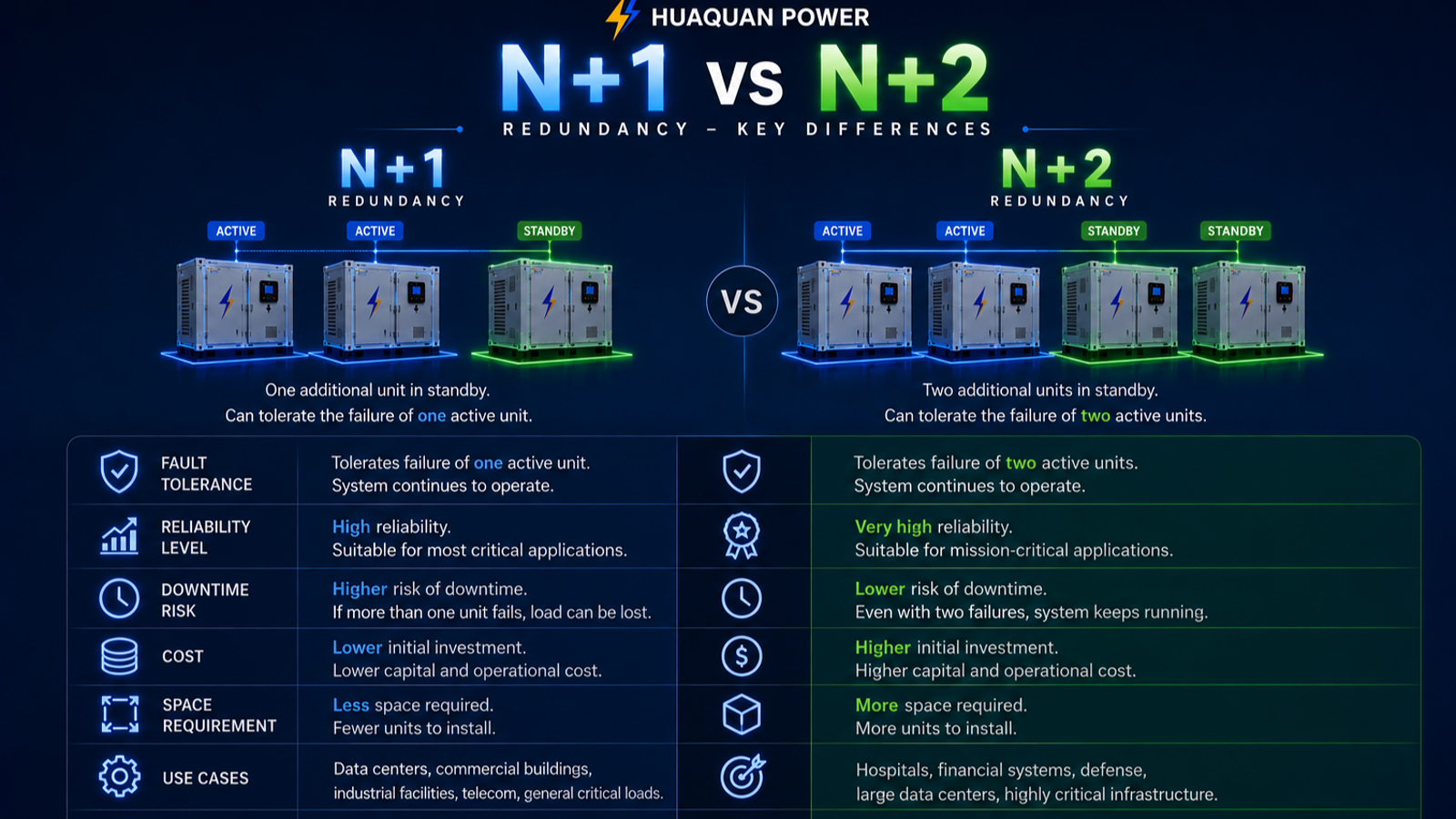
| Ойыртем | N+1 Redundancy | N+2 Redundancy |
| Spare Components | Бир | Two |
| Failure Protection | One failure | Two simultaneous failures |
| Ӱшанлык | Кукшо | Пеш кӱкшӧ |
| System Availability | Умылтаралтеш | Exceptional |
| Тӱҥалтыш роскот | Лапка | Кӱкшӧ |
| Operating Cost | Лапка | Кӱкшӧ |
| Maintenance Flexibility | Жакшы | Умылтаралтеш |
| Space Requirement | Умыр | Кугу |
| System Complexity | Умыр | Кукшо |
| Масштабируемость | Easier | More Complex |
| Risk During Maintenance | Кӱкшӧ | Лапка |
| Эн сай | Коммерческий да промышленный объект-влак | Mission-critical facilities |
N+1 vs N+2 Redundancy: Number of Backup Components
The very first difference is the number of components in each part. Let’s know the ultimate difference here.
N+1 Redundancy
N+1 Redundancy has one additional component to support your system. Suppose you have four generators available in your system running as a backup supply. Adding one standby generator to support them is considered part of the N+1 Redundancy strategy.
N+2 Redundancy
N+2 redundancy strategy has two additional components included as your backup supply. Adding two standby generators to your four generator backup supply systems uses the N+2 level redundancy.
| Конфигураций | Required Generators | Backup Generators | Total Installed |
| N | 4 | 0 | 4 |
| N+1 | 4 | 1 | 5 |
| N+2 | 4 | 2 | 6 |
N+1 vs N+2 Redundancy: Fault Tolerance
Fault tolerance is the capacity of the additional components to replace the failed component and continue the operations.
N+1 Redundancy
In N+1 redundancy, it supports only one component failure. Мут:
- One generator fails.
- One UPS fails.
- One transformer fails.
The standby system replaces the failed component to avoid power interruptions. Бирок, remember, if a second component fails, it doesn’t cope and causes the whole system to fail. Ошондой, you should consider your system accordingly.
N+2 Redundancy
In N+2 redundancy, you get two additional components. It means that if your two components fail, it provides the power. Мут:
- Two generators fail.
- Two UPS fails.
- Two transformers fail.
You have plenty of time and standby generators to support your system and avoid power interruptions.
N+1 vs N+2 Redundancy: Ӱшанлык
Reliability is crucial for a power system. To continue the power, you must deploy a reliable backup supply.
N+1 Redundancy
N+1 redundancy is reliable for equipment failure at reasonable costs. Here are a few benefits.
- Protection against a single equipment failure
- High system availability
- Proven design
- Good operational reliability
N+2 Redundancy
N+2 redundancy is more reliable because of two additional components. It is suitable when:
- Equipment operates continuously
- Downtime is unacceptable
- Multiple failures could occur during severe weather
- Maintenance overlaps with unexpected failures
N+1 vs N+2 Redundancy: Initial Investment
Cost can be a game-changing factor if you are looking for an affordable investment.
N+1 Redundancy
N+1 Redundancy strategy utilizes:
- One extra generator or UPS
- Additional switchgear
- Extra installation work
Because of lower upfront costs, it is still affordable and manageable if you have a lower budget.
N+2 Redundancy
Because of two additional components, N+2 redundancy can be a serious challenge for affordable prices. It includes extra costs:
- Extra generators
- Larger electrical rooms
- Bigger fuel storage
- Additional cooling systems
- Larger switchgear
- More cabling
- Expanded control systems
Тугеже, it is more expensive compared to the N+1 redundancy.
N+1 vs N+2 Redundancy: Операций роскот
Operating costs are the long-term costs related to usage.
N+1 Redundancy
Compared to N+2 redundancy, N+1 is more affordable and has lower operating costs for:
- Топливе
- Технический обслуживатлыме
- Запчасть-влак
- Тергымаш
- Inspections
N+2 Redundancy
In case of N+2 redundancy, operational costs increase due to:
- More generators
- More UPS modules
- Additional batteries
- Increased maintenance
- More preventive inspections
- Additional replacement parts
Ошондой, N+2 redundancy is more expensive compared to N+1.
N+1 vs N+2 Redundancy: Maintenance Hassles
If you are looking for stable maintenance and lower costs, N+1 vs N+2 have the following costs.
N+1 Redundancy
N+1 redundancy doesn’t offer simultaneous operations and maintenance. The backup generator takes control while the maintenance generator goes through maintenance. If any other component fails, it can be a challenging condition.
N+2 Redundancy
In N+2 redundancy, you have 2 spare components. If you send one component to maintain, another one is still there to support your system. Тугеже, it offers better maintenance and servicing due to one additional component compared to the N+1 redundancy strategy.
How to Choose Between N+1 and N+2
If you are confused about which system you should choose, you must evaluate the key demands and choose between the two redundancy levels.
N+1 Redundancy is ideal for the following conditions.
- Need high reliability at a reasonable cost.
- Have limited installation space.
- Operate a commercial or industrial facility.
- Can accept a very small level of operational risk.
You should choose N+2 redundancy in the following cases.
- Cannot tolerate power interruptions.
- Operate life-safety or mission-critical infrastructure.
- Need protection against multiple equipment failures.
- Require maximum availability during maintenance.
Йодыш-влак
- Which industries commonly use N+1 redundancy?
There are several industries using the N+1 Redundancy to reduce the power outage impacts. These include commercial buildings, производственный завод-влак, universities, йотэл-влак, healthcare facilities, and utility substations.
- Is N+2 always better than N+1?
Not always. It depends on the situation. N+2 is more reliable due to backup power, but it is never better than N+1 because of more technical installation, higher cost, and expensive maintenance hassles.
- What is the main difference between N+1 and N+2 redundancy?
N+1 Redundancy level adds only one additional component to the existing backup system, while N+2 adds two components to the existing system.
- Which redundancy level is more reliable?
N+2 redundancy is more reliable because of the dual standby generators. It offers a more reliable system but has a higher upfront cost.
- Мо ышта “N” mean in power system redundancy?
N is the minimum number of pieces of equipment required to supply the backup power. If you have installed two generators, the N is two.
- Can an existing N+1 system be upgraded to N+2?
Ооба. You can upgrade the N+1 system to N+2 by adding the generators. Most facilities upgrade the system with more standby generators, ИБП, and energy storage systems to reduce downtime.
- Does N+2 eliminate all risk of power outages?
Жок. It doesn’t eliminate the risks completely. Бирок, it acts as a backup, provides two generators and offers better reliability and high energy for the system.
- Which facilities typically require N+2 redundancy?
N+2 is the ideal solution for larger facilities with more critical demands for energy. The common examples are large hospitals, Tier III and Tier IV data centers, аэропорт-влак, military installations, telecommunications hubs, financial trading centers, and emergency response facilities.
Мучашмут
Both N+1 and N+2 are crucial strategies to offer your system a backup supply. Бирок, in N+1 vs N+2, you should consider and evaluate both factors critically and choose the one that offers a suitable value to your system. Different systems offer different values. Choose based on compatibility and energy requirements.
If you are looking for high-end generators as your backup supply systems during an outage, вашкыл Хуакуань куат. We have a wide variety of backup generators with varying capacities. You will power your system with N+1 and N+2 redundancy through our generators. Check out our collections right away!