Кучылтмаш
Have you installed the solar panels in your facility and are wondering whether you should go with the grid or not? Тиде тендан ойырен налме деч шога технический ойырен налмаш. Сеть дене кылдалтше да сеть деч ӧрдыжтӧ улшо энергосистема-влак паша механизмыште да ойырен налме йӧнлаште икмыняр икгайлыкым да ойыртемым пайлат.
Today we will dive deep into both technologies, understand their working mechanisms, and share some differences. Let’s know in detail!!
What is a Grid-tied Power System?
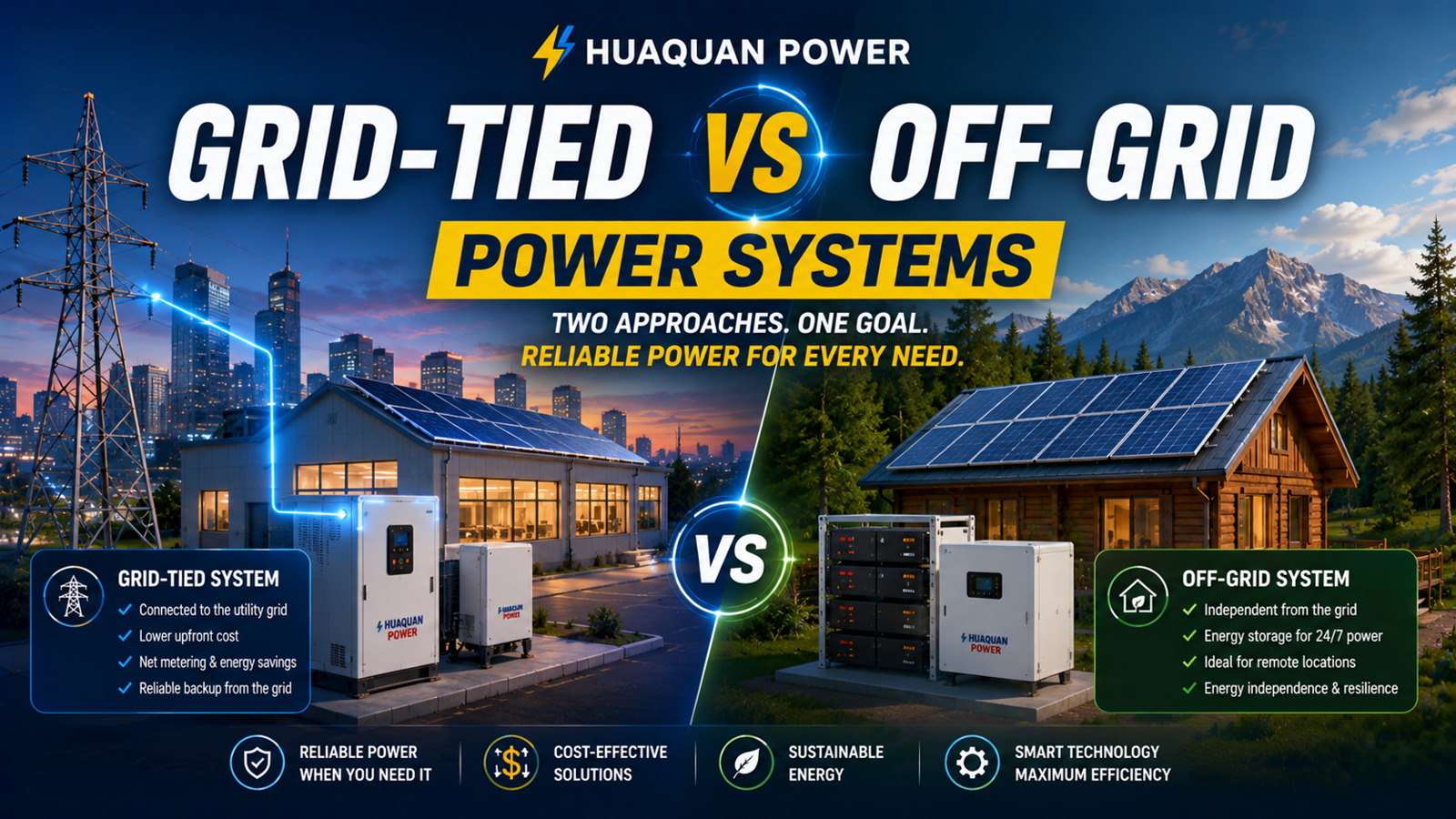
A grid-tied power system is a comprehensive energy generation process that is connected to a grid. Мут, you have a utility grid and take power from it. But you install the solar panels and connect them to the grid systems.
Without the need for batteries or spending money on energy storage, you automate the energy supply between solar panels and grid systems.
Typical Components
A grid-tied power system has several components.
- Solar photovoltaic (PV) panels
- Grid-tied inverter
- Utility meter
- Net meter (where available)
- Mounting structures
- Protection devices
- Monitoring system
- Electrical distribution panel
Common Applications
It is suitable for residential and commercial facilities. Here are a few common examples.
- Residential homes
- Офис пӧрт-влак
- Коммерческий объект-влак
- Schools
- Больницы-влак
- Shopping centers
- Промышленный завод-влак
- Government buildings
How Does a Grid-tied Power System Work?
A grid-tied power system offers a seamless connection and helps understand the whole process as follows.
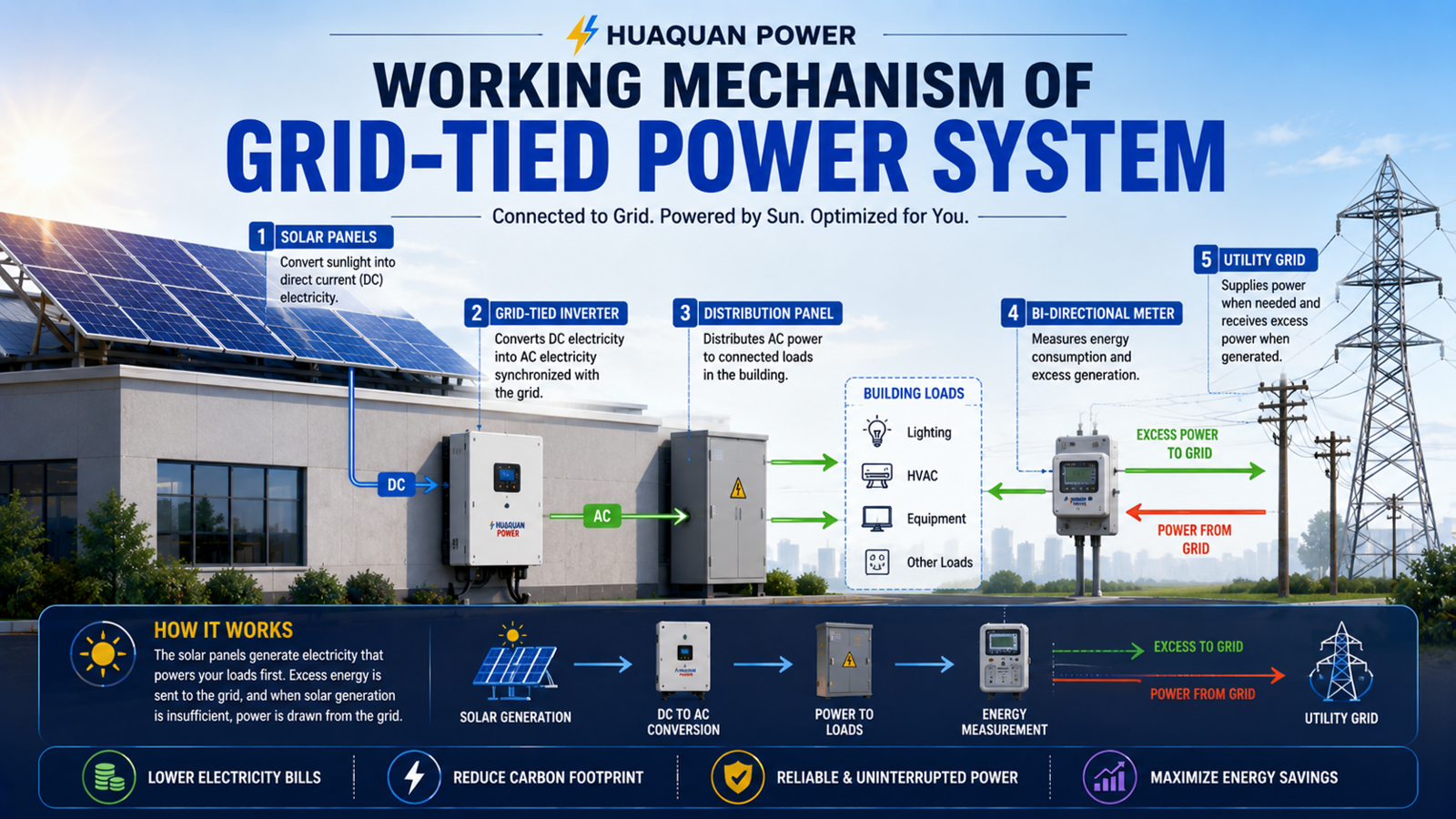
Ошкыллан 1: Renewable Energy Generation
What setup have you installed for renewable energy generation? Мемнан кече, solar panels are on trend. You should install solar systems for renewable energy generation.
Ошкыллан 2: DC to AC Conversion
The energy from the solar systems is always DC current. While home appliances use the AC current.
Ошондой, how do you convert the DC into AC? Inverters help transform the energy formats.
Ошкыллан 3: Куатым кучылтмаш
Once there is AC energy available, the system feeds the power to the appliances and lets them run smoothly.
Ошкыллан 4: Utility Grid Usage
If the solar supply is insufficient due to several reasons, гай:
- Cloudy day
- Sunlight is not available
- Nighttime or darkness
Тыгай годым, the utility grid is there as a backup supply. It offers a backup supply to your system and helps manage the energy.
Ошкыллан 5: Supply to Utility Grid
Кече жапыште, sunlight is at its peak. Тиде случайыште, energy production always exceeds the requirements. Solar System offers this extra energy to the utility grid at specified net metering costs. You get paid for this energy.
What is an Off-grid Power System?
An off-grid power system is an independent energy production setup that does not rely on the grid. It has a complete and independent setup to produce energy and utilize it.
Since there is no connection with the grid, such an energy-independent setup relies more on the battery storage systems and backup diesel Генератор-влак.
It offers localized energy production, Аралаш, and distribution.
Typical Components
- Solar panels or wind turbines
- Charge controller
- Аккумулятор банк
- Off-grid inverter
- Backup diesel or Газ генератор
- Generator controller
- Distribution board
- Energy monitoring system
Common Applications
- Remote villages
- Farms
- Mountain cabins
- Telecommunications towers
- Шахтёр паша
- Oil and gas sites
- Military installations
- Research stations
- Отро-влак
- Disaster recovery sites
How Does an Off-grid Power System Work?
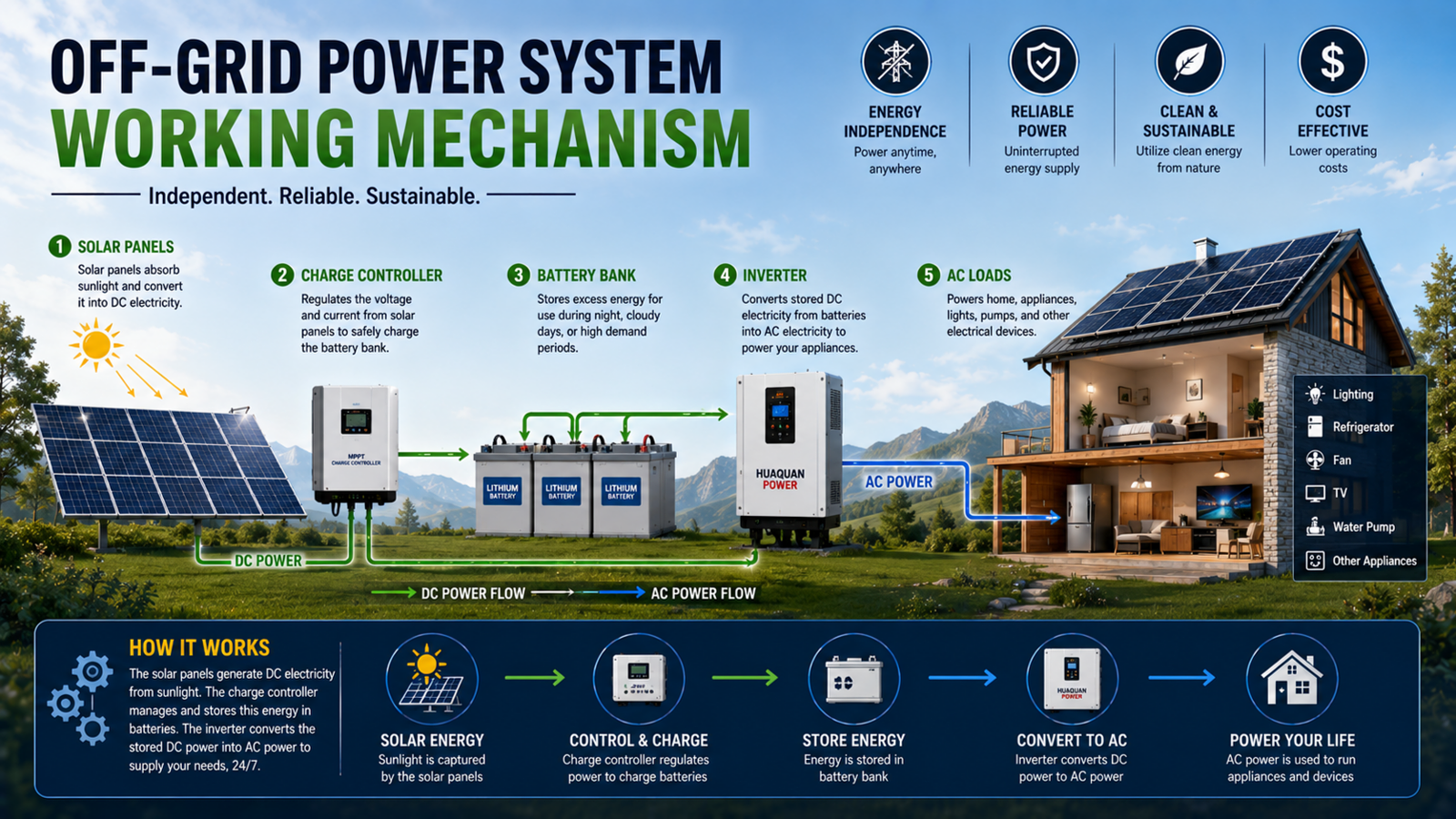
An off-grid system offers a totally independent energy supply. It works in the following ways.
Ошкыллан 1: Куатым ыштен лукмаш
It is also the same step as the grid-tied system. The first step is the utilization of the photovoltaic cells to generate DC power from the solar system.
Ошкыллан 2: Battery Charging
Batteries can store this DC power and keep providing energy until discharged. When the energy production is at its peak, especially during the daytime, the system charges the batteries. DC power is stored in the batteries.
Ошкыллан 3: Inverter Role
Since the appliances can’t use the DC power until they are made for it, the inverter comes into action. It provides a seamless energy conversion from DC to AC. Devices use this AC power.
Ошкыллан 4: Load Supply
When the conversion has occurred, it is time to supply the load to the system. Whatever appliances you want to operate, they work on the AC power.
Ошкыллан 5: Резервный генератор-влак
Backup Generators and batteries act as a backup supply, replacing the grid. Электроэнергий пытыме годым, generators use fuel to generate energy and feed it to the appliances.
Components Comparison
| Компонент | Grid-Tied System | Off-Grid System |
| Solar Panels | ✓ | ✓ |
| Инвертор | Grid-Tied | Off-Grid |
| Battery Storage | Optional | Тӱҥ |
| Utility Grid | Йодеш | Not Required |
| Backup Generator | Optional | Common |
| Charge Controller | Usually Not Required | Йодеш |
| Net Meter | Often Used | Not Needed |
| Энергийым аралыме | Limited or Optional | Primary Component |
Сеть дене кылдалтше да сеть деч ӧрдыжтӧ улшо энергий системе-влак: Тӱҥ ойыртемже-влак
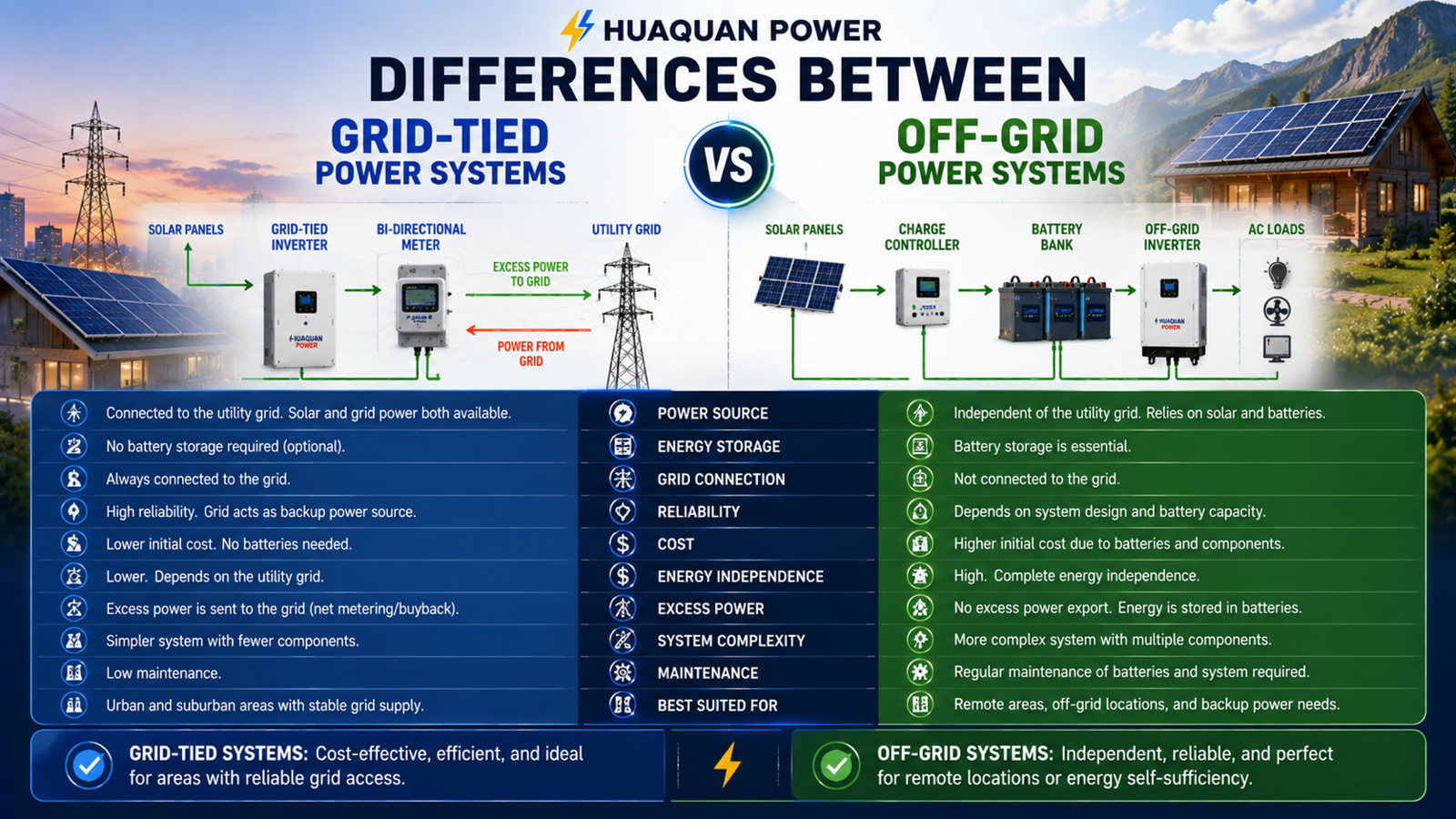
Grid-tied vs. off-grid power systems have several differences discussed below.
| Ойыртем | Grid-Tied | Off-Grid |
| Utility Connection | Ооба | Жок |
| Battery Required | Optional | Ооба |
| Резерв куат | Utility Grid | Батарейышке & Генератор |
| Тӱҥалтыш роскот | Лапка | Кӱкшӧ |
| Технический обслуживатлыме | Лапка | Кукшо |
| Installation Complexity | Тыглай | Йыгырмут |
| Power During Grid Outage | Usually No | Ооба |
| Energy Independence | Partial | Тӱрыс |
| Эн сай вер | Cities & towns | Remote areas |
| Expansion | Куштылгырак | More complex |
| Generator Required | Optional | Often required |
| Операций роскот | Лапка | Кӱкшӧ |
Ойыртем #1: Grid Connection
The very first and fundamental difference in the grid-tied vs off-grid power system is the grid connection.
Grid-tied
A grid-tied system has the grid facilities.
- It produces energy from solar systems and feeds it to the grid when extra energy is produced.
- Gets energy from the grid as a backup supply during a solar outage.
Офф-грид
Off-grid power systems don’t have any grid facilities.
- It produces and stores energy in the battery form. Utilizes it whenever needed.
- Backup Generators help supply the energy during power outages.
Ойыртем #2: Energy Storage Systems
Energy Storage systems offer a backup supply during outages. Let’s compare grid-tied vs off-grid power systems here.
Grid-tied
Grid-tied systems don’t have an energy storage system.
- Instead of storage, they feed extra energy to the grid.
- They get energy from the grid directly during the outage.
Офф-грид
An off-grid power system is a completely independent system with its own standalone energy supply and storage.
- Lithium-ion batteries are integral components.
- Batteries provide energy during the outage hours as there is no reliance on the grid facilities.
Ойыртем #3: Upfront Costs
Upfront Costs differ depending on the setup in grid-tied vs off-grid power systems.
Grid-tied
Grid-tied systems don’t have an extensive setup for energy generation.
The initial investment is on:
- Solar System
- Inverters
As there is no energy storage system, you can save costs on it.
Офф-грид
An off-grid setup has higher upfront costs due to extensive storage and backup supplies. Мут, you have to invest in:
- Large battery banks
- Charge controllers
- Backup generators
- Automatic generator controls
- Larger inverter capacity
Ойыртем #4: Операций роскот
Operational costs depend on the system operations in the grid-tied vs off-grid power systems. There is a clear-cut difference in it.
Grid-tied
A grid-tied power system has the following operating costs. It is cheaper and more affordable compared to an off-grid system.
- Batteries may not require replacement
- Less maintenance
- Utility supplies backup electricity
- Fewer moving parts
Офф-грид
An off-grid system can be expensive due to the following reasons.
- Battery replacement every several years
- Generator fuel consumption
- Generator servicing
- Battery maintenance
- Additional monitoring requirements
Ойыртем #5: Ӱшанлык
Reliability of the system doesn’t depend only on one factor. It depends on whether the system offers you an independent supply during the outage hours.
Grid-tied
A grid-tied system is a reliable source of energy, but only in a few cases.
- When the utility grid is available, it is totally reliable.
- When the utility grid is unavailable and solar production is very low on a night or cloudy day, the system goes offline.
Офф-грид
Off-grid Power system reliability depends on the setup. Тыглайын, it is more reliable because:
- The Solar System feeds the energy.
- Batteries act as a primary backup.
- Diesel Generators act as a secondary backup to support the system in every case.
Ойыртем #6: Power Availability During Blackouts
In grid-tied vs off-grid power systems, there is a clear-cut difference in the power availability during the blackouts.
Grid-tied
A grid-tied facility provides power from the solar systems and the grid. Бирок, when the blackout occurs, inverters disconnect the system to avoid damage to the appliances. Лектыш семын, you can’t even get energy from your solar panels even if they are working.
Офф-грид
An off-grid system is a totally independent energy source. It doesn’t shut down in any case and keeps on providing constant energy throughout the blackouts. Тугеже, off-grid facilities are more reliable during blackouts and provide a constant energy source.
Ойыртем #7: Energy Independence
Do you want an independent energy production setup? Not every setup offers independence. Let’s compare grid-tied vs off-grid power systems.
Grid-tied
Grid-tied Power systems are famous for their grid facilities, but they don’t offer independence. Grids are backup supplies but go offline during the blackouts. There are no batteries for energy independence.
Офф-грид
An off-grid system is famous for its energy independence. It offers a separate supply for the batteries. In case of a blackout and discharged batteries, diesel generators are there to work harder.
Ойыртем #8: Обслуживатлыме йодмаш-влак
Maintenance is a work full of hassles. Бирок, it brings additional costs as well.
Grid-tied
A grid-tied system has the following maintenance requirements.
- Clean solar panels
- Monitor electrical connections
- Record inverter performance
- Periodic safety inspections
Офф-грид
An off-grid setup can also require maintenance for:
- Battery inspections
- Battery replacement
- Generator servicing
- Fuel management
- Charge controller inspections
Ойыртем #9: Идеальный кучылтмо случай-влак
If you are wondering whether you should install a grid-tied or off-grid power system, the location and preferred options are here.
Grid-tied
Choose a grid-tied facility for the following use cases.
- Urban areas
- Suburban homes
- Коммерческий зданий-влак
- Промышленный объект-влак
- Educational institutions
- Больницы-влак
Офф-грид
Prefer an off-grid system in the following conditions.
- Remote villages
- Mountain cabins
- Agricultural farms
- Отро-влак
- Шахтёр паша
- Oil and gas fields
- Telecommunication towers
- Forest stations
Ойыртем #10: Пӱртӱслан эҥгекым ыштымаш
People are moving toward eco-friendly resources and want sustainable energy solutions.
Grid-tied
Grid-tied Power systems have little or no impact on the environment because of complete reliance on renewable energy sources. Grid facilities can have an impact if the power production involves carbon emissions.
- Lower reliance on fossil fuels
- Minimal battery usage
- Lower material consumption
- Reduced carbon emissions
Офф-грид
An off-grid system is a highly eco-friendly system, except that it has an off-grid supply. The possible impact depends on:
- High renewable energy usage
- Battery manufacturing and disposal impact
- Backup generator emissions
- Increased equipment requirements
Which Power System Should You Choose?
If you are wondering about the right system, the logic is simple. You should choose the grid-tied power system when:
- Have access to a reliable utility grid
- Reduce electricity bills
- Prefer a lower initial investment
- Require minimal maintenance
While an off-grid system is suitable:
- Live in a remote area
- Need reliable electricity
- Ready to pay a higher upfront investment
- Require continuous power in isolated locations
Йодыш-влак
- Are off-grid systems suitable for cities?
Ооба, you can install an off-grid system in the cities if you want a separate and independent energy production system.
- Which system requires more maintenance?
An off-grid system involves more tools and requires more maintenance due to its comprehensive setup.
- Why do off-grid systems use diesel generators?
Diesel Generators offer a secondary backup supply. Тугеже, an off-grid system relies on the generators during blackouts or long-hour outages.
- Does a grid-tied solar system work during a power outage?
Жок. Grid-tied solar systems shut down automatically during a utility grid outage for system safety.
- Can an off-grid system operate without batteries?
Ооба, you can replace your batteries and rely on the diesel generators as your backup supply in the off-grid system.
- Can I expand my power system in the future?
You should keep an additional capacity of 25% if you want to expand your system in the future.
- Which system offers greater energy independence?
An off-grid system offers energy independence and better setup with extensive tools.
Мучашмут
In grid-tied vs off-grid power systems, both are pretty useful. But the choice depends on several factors. Мут, if you have a grid supply, then a grid-tied solar system is an official choice. If you are located remotely with no utility grid supply, an off-grid solar setup is the ideal solution. Бирок, you should install all the quality components for longevity. Мут, high-end generators and batteries can offer a long-standing energy supply.
Do you want to buy high-quality generator solutions? Вашкыл Хуакуань куат and choose from a wide range of generator options. We feature only premium-quality generators and ensure affordable prices. Talk to our experts regarding your projects right away!