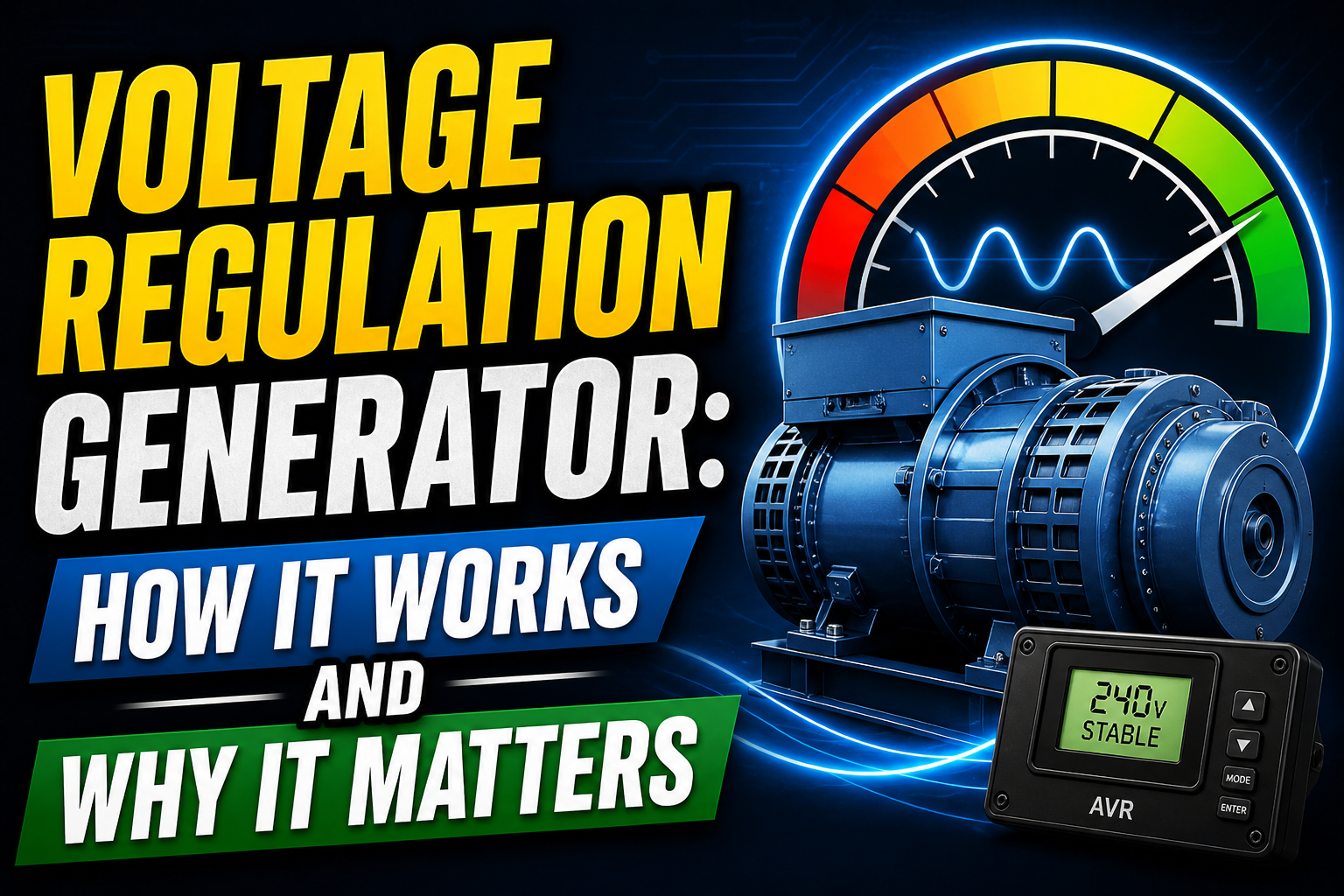
Generator dapat diandalkan dan berkualitas tinggi jika menghasilkan daya terbaik dan efisien. Keandalannya terutama bergantung pada sistem pengaturan tegangan. Ini dirancang untuk mempertahankan keluaran listrik Anda terlepas dari beban yang berfluktuasi. Jika sistem regulasi Anda tidak terjaga, itu akan menyebabkan variabilitas beban yang berbahaya. Sebagai akibat, it will destroy your sensitive appliances and critical equipment. Dalam panduan ini, you will read about the mechanism of voltage regulation and its detailed working principle. You will also read about its significance in protecting your expensive machinery. At the end of this guide by HuaQuan, you will be able to decide on the perfect system for your Generator Pengaturan Tegangan.
What is Voltage Regulation in a Generator?
To understand what the voltage regulation in a generator is, you must link it to the power supply. A regulation generator facility setup is engineered to maintain the voltage results at the alternator terminals. It works independently without taking influence from the electrical load, suhu, or running speed.
If you do not regulate and connect a high-capacity appliance, it will decrease the voltage of the generator instantly. It will form a situation called the brownout. Demikian pula, if you turn on that appliance, it will cause a surge in voltage load.
Secara tradisional, users used to handle this situation manually. It needed a human technician to monitor the voltmeter and adjust the voltage by resetting the rheostats on the voltmeter. Voltage Regulation in a manual way is no longer used in high-scale industrial and commercial activities. It needed extensive human labor and was highly exposed to human error.
In the modern world, the globally recognized industries regularize the Automatic Voltage Regulation (AVR). An AVR is an electrical device that maintains the voltage results and trips the internal magnetic field of the generator. It will keep the voltage output within an acceptable range (within ±1% to ±2% of the required voltage). Common systems that are built into the modern Generator to maintain the voltage include the Shunt-driven AVRs, individual Permanent Magnet Generator (PMG) sistem, and Auxiliary Winding (AUX) sistem. Each of these systems has specific features regarding timing and performance.
How Voltage Regulation Generator Works
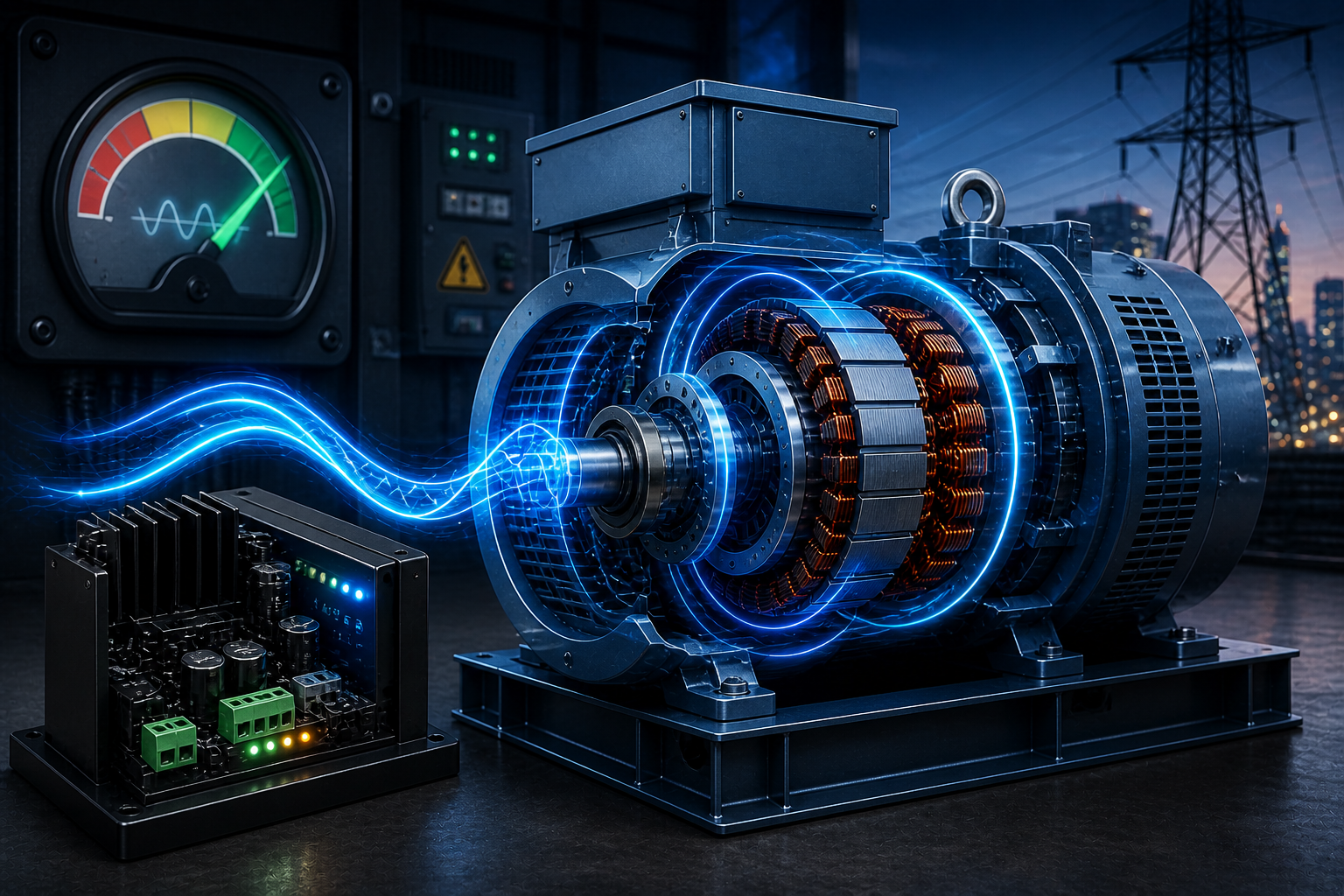
If you want to know the detailed working principle of voltage regulation in a generator, you need to know how the internal components of a generator operate. These include the stator (non-movable coiled wires), the rotor (an electromagnet spinning at a constant speed), and the exciter. The power generation occurs when a magnetic field is spun inside the stationary coils. This process produces electrical current. Its strength depends on how strong the magnetic field is that is produced in the rotor.
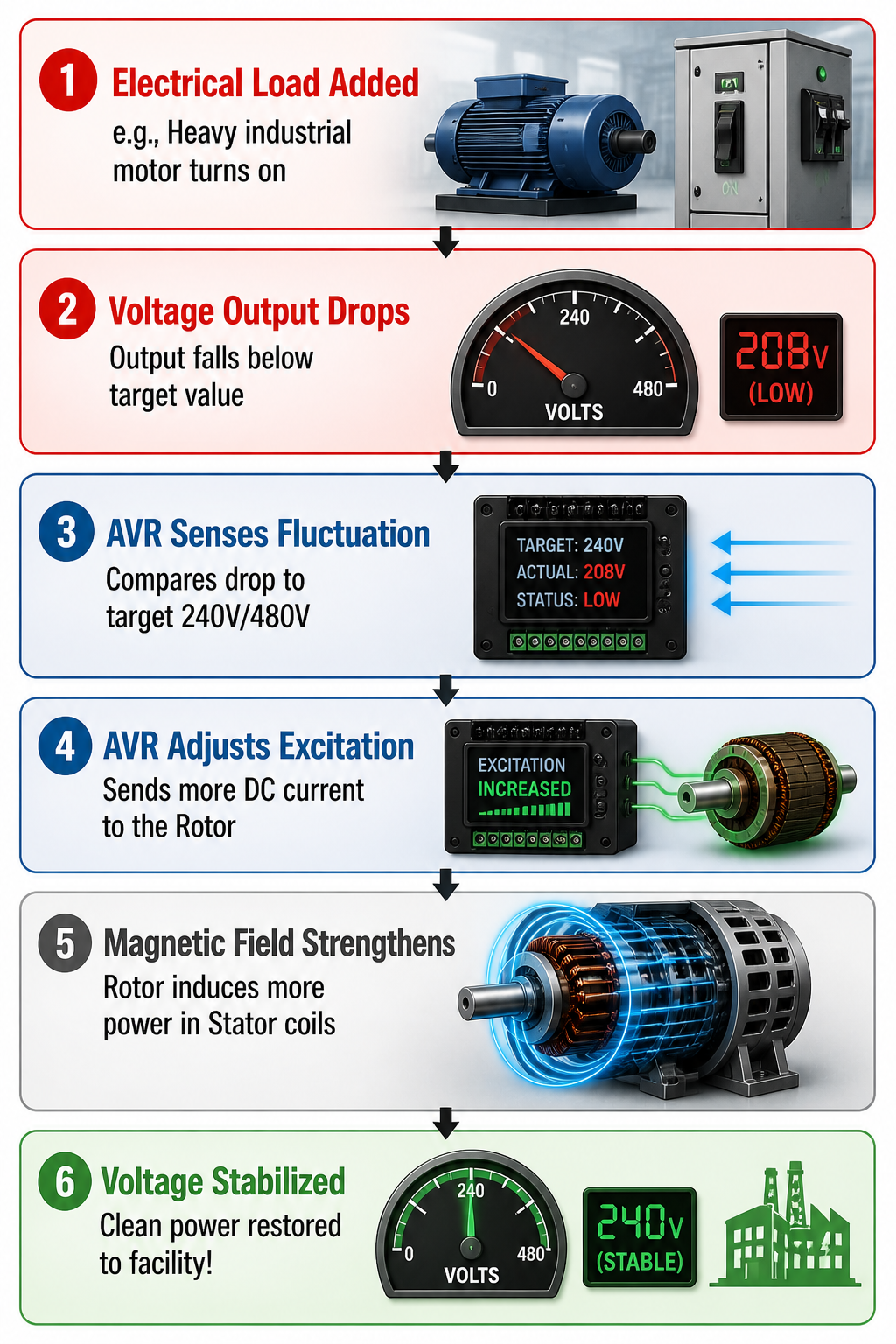
Dalam situasi ini, an Automatic Voltage Regulator (AVR) plays its central role as the brain. It works on a feedback system. Pertama, it senses coiled wires connected to the stator terminals to evaluate the amount of voltage being used to support your site. Berikutnya, it compares this calculated voltage against a targeted value. Misalnya, a targeted value for a residential unit is 240V or 480V for commercial use.
If you connect a large industrial appliance, the generator faces a heavy load. The voltage results of the generator will decrease. The AVR detects this drop in voltage. It compensates for the situation and increases the excitation for direct current. Hasilnya, it will optimize the magnetic field of the rotor. When a strong magnetic field is formed, it transcends the coiled wires and increases the voltage back to the targeted value.
Di sisi lain, when you power off an industrial motor, there will be a major increase in the electrical load. The AVR will detect this situation and decrease the excitation of direct current to the spinning rotor. Sebagai akibat, it forms a weak magnetic field and brings the voltage back to the required value. The process of detecting and adjusting occurs within less than a second. It leads to a streamlined, stable voltage graph.
Why Voltage Regulation Generator Matters
You can’t ignore or deny the importance of a well-maintained regulation system in a generator. Manufacturers design modern devices to work within the strict voltage range.
Voltage fluctuations have a negative impact on the expensive machinery. When the voltage load drops below the required, the electric motors have to draw more current to support the same amount of work. This undervoltage situation affects HVAC compressors as well as the conveyor belts installed in different facilities.
This large amount of current created leads to the overproduction of heat that melts the insulated wires. Sebagai akibat, the motor burns out completely. In a completely opposite situation, when there is an accidental voltage surge, it acts like a sudden waveform of electricity. This overvoltage situation typically affects the silicon circuits, pencahayaan LED, komputer, and digital panels.
When you maintain and oversee the proper voltage load as well as the output, it will allow you to prevent destructive situations. You must govern these activities when you are dealing with hospitals that involve medical equipment. Di rumah sakit, ventilators and MRIs need a constant power supply and their load should be regulated to avoid catastrophe. Demikian pula, in data centers, you can’t allow for a voltage fluctuation even for a moment. It will corrupt all systems and waste your heavy investments. An AVR safeguards your infrastructure by providing voltage regulation.
Common Voltage Regulation Methods in Generators
The systems that achieve voltage regulation in generators are different. They vary according to the model, ukuran, berat, and application of the device.
Secara tradisional, mechanical regulators were used to achieve regulation in the generators. They used movable parts (such as spring-loaded contacts and solenoids) to switch the resistors either on and off out of the exciter-based circuit. Though they had fast speed, they detected and troubleshooted the situation late. Juga, they required a human technician to calibrate their values to achieve precision.
Modern generators depend on the Automatic Voltage Regulation (AVR) sistem. These electrical devices utilize components made of semiconductors. Ini termasuk thyristors and transistors. They regulate the excitation current without using movable parts. The AVR system has several different methods.
- Shunt-Based Excitation: Extracts the operational power from the generator’s basic output. During a huge short circuit, the voltage output fluctuates and causes the AVR to lose the initial power and stop producing the magnetic field.
- Permanent Magnet Generator (PMG): Perfect for mission-specific applications. PMG is a separate, small-sized magnetic alternator that is added to the shaft to maintain the power being given to the AVR. AVR allows for a clean, stable power supply of electricity. Namun, it adds a significant price to the generator.
- Auxiliary Winding (AUX): Performs the role of a middleman. It is an isolated, purposeful coil that is connected to the stationary part to support the AVR. It proves to be a better short-circuit than a shunt-based system. It is also affordable compared to the PMG system.
Troubleshooting Voltage Regulation Generator Issues
The high-quality voltage regulation systems can face faults. The most common issues that the operators face include undervoltage, overvoltage, or a situation of hunting voltage that fluctuates up and down repeatedly. You can detect a problematic AVR by noticing different signs. These include flickering of light, interrupted working of UPS systems, or the alarm triggering on digital panels. When you are deciding on the issue, you must be highly careful.
An expert will start diagnosing the issue by evaluating the speed of the engine. The voltage and frequency have the closest link. If an engine operates at a slow pace, it will produce low voltage. If the engine speed is maintained at an optimal RPM, the AVR gains focus. The experts inspect the wires to check for loosening connections, damage to vibrations, or corrosion due to constant operation. If the wiring seems perfect, the AVR unit might face blown-up internal components. Biasanya, the AVRs are difficult to replace and repair in the facility. If the test results show faultiness in the AVR, you must replace it urgently.
Catatan Akhir!
A well-regulated automated voltage regulation generator system is the hidden protector that safeguards your whole electrical system. When you maintain the electrical load and internal magnetic fields, an AVR converts raw energy into a safe, protected supply of electricity.
Whether you require a primary shunt-driven AVR for a Rumah-based unit or a completely individual unit, yaitu, PMG system for a data information center, you must select and maintain the correct voltage regulating technology. It will keep your engine safe when the grid breaks down.
Protect Your Equipment with Regulated and Stable Power
Don’t allow voltage fluctuations to destroy your sensitive electronics and critical equipment. Whether you require a troubleshooting program for your existing system or invest in a new generator with full-proof voltage regulation, tim ahli kami di Huaquan is available at your service. Hubungi kami Hari ini.
⚡ Jelajahi Solusi Terkait
- 🏭 500kW Pembangkit Diesel
- 🏭 1000kW Pembangkit Diesel
- 🏭 500kW Pembangkit Diesel YC
- 🔧 KMS (Cummins/Doosan) Seri
- 📋 Genset Diesel
- 📋 Proses Pemesanan — Cara Membeli
- 📋 Hubungi kami
💡 Butuh solusi khusus? Hubungi tim teknik kami untuk rekomendasi spesifik proyek.