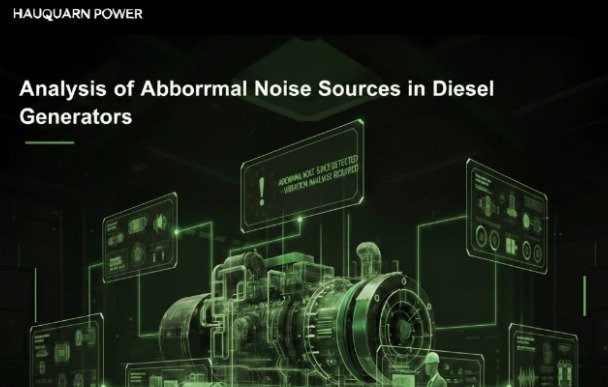
Diesel Générateurs sont typiques dans les maisons et les industries comme sources d'alimentation de secours et continues. Il y a toujours du bruit quand ils fonctionnent. Néanmoins, un son inhabituel provenant d'un Générateur diesel indique un système défectueux. Parfois tu peut ignorer les sources de bruit anormales. Cela conduit à l'échec, temps d'arrêt, et des coûts de réparation élevés. La détection précoce évite les dommages et améliore la sécurité des petites et grandes installations.
Il facilite également un bon entretien du générateur et augmente la durée de vie. Ce manuel décrit les principales causes de problèmes de vibrations du générateur et bruit anormal. Il indique également comment les diagnostics des générateurs et la maintenance prédictive contribuent à maintenir le bon fonctionnement et l'efficacité des systèmes..
1. Quelles sont les sources de bruit anormales dans les générateurs diesel?
Tout son étrange est un bruit anormal dans les générateurs diesel. Un fonctionnement régulier provoque une combustion régulière et un bruit de flux d'air unique. Ces sons restent dans une limite définie et prévisible.
Le son inhabituel du générateur consiste en bruit de cognement du moteur, cliquetis, bourdonnement, ou siffler. Le ton peut varier ou augmenter avec le temps. Il augmente généralement avec la charge. Pièces usées, flux d'air bloqué, boulons de montage desserrés, ou un état déséquilibré sont des signes d'un problème.
Le bruit inhabituel des générateurs diesel peut être détecté à temps, éviter les dommages et améliorer la fiabilité.
2. Quelles sont les sources de bruit anormales dans les générateurs diesel?
Lorsque la combustion du moteur est mauvaise ou que les injecteurs tombent en panne, le bruit du moteur change. Les systèmes d’admission et d’échappement produisent également du bruit lorsque vous bloquez le flux d’air. Les systèmes auxiliaires peuvent générer du bruit lorsqu'une pièce est usée ou mal alignée.
Un autre type de bruit de les systèmes électriques sont le bruit de l'alternateur, ce qui ressemble généralement à un bourdonnement. Les techniciens diagnostiquent rapidement les générateurs pour identifier la source du problème. Ils intègrent une inspection acoustique avec une inspection du modèle de vibration. Un diagnostic approprié permet d'économiser sur les réparations et permet des programmes de prévision de maintenance.
2.1 Échappement & Sources de bruit anormales d’admission
L'air entre et sort le générateur à travers les systèmes d'admission et d'échappement. Une circulation d'air correcte est utile à la combustion et au refroidissement. En cas de limitations aériennes, la pression s'accumule à l'intérieur du système, entraînant un bruit inhabituel du générateur diesel. Le bruit d'admission peut être un sifflement ou une aspiration. Le bruit d'échappement est généralement un sifflement ou un bruit aigu..
Les dysfonctionnements diminuent l’efficacité du moteur et la consommation de carburant. Ils augmentent également les niveaux d’émissions. Généralement, ce sont les filtres et les silencieux cassés qui provoquent du bruit. Mais vous pouvez maintenir un flux d’air normal grâce à une inspection régulière. Un flux d'air propre élimine problème de vibration du générateur et le bruit.
je). Bruit de restriction d'admission
Le bruit de restriction d’admission provient de la difficulté d’un flux d’air sans restriction dans le moteur. Un filtre à air sale ou un conduit d'admission bouché en est généralement la cause. Le moteur travaille plus fort pour trouver de l'air, produire un sifflement. Il augmente le bruit des générateurs diesel et réduit la puissance du moteur.
L’incapacité d’avoir une bonne circulation d’air a un impact sur la combustion du carburant et augmente la consommation. Cela augmente la température du moteur, conduisant à l'usure. Vous pouvez éviter ce problème par un entretien régulier.
ii) Contre-pression d'échappement
La contre-pression d'échappement se produit lorsque les gaz ne peuvent pas sortir librement du système.. Cela peut être dû à une obstruction dans un silencieux ou un petit pot d'échappement. La pression s'accumule à l'intérieur du système, provoquant un sifflement ou des impulsions brusques : le moteur surchauffe, entraînant un bruit d'échappement fort. Vous pouvez éviter cela en vérifiant régulièrement les lignes d'échappement.
2.2 De construction & Bruit de montage
La source du bruit structurel est le cadre et la base du générateur. Les générateurs diesel vibrent en continu et transmettent la vibration aux structures environnantes. Cela provoque des effets de cliquetis ou de boom.
Vous pouvez résoudre ce problème en inspectant régulièrement les boulons et les supports. Montez le générateur en toute sécurité pour assurer la stabilité. Il réduit les vibrations et prolonge la durée de vie de l’équipement.
je). Systèmes auxiliaires
Ces composants comprennent des ventilateurs de refroidissement, ceintures, et pompes à carburant. Ils génèrent du bruit lorsqu'ils s'usent. Un ventilateur cassé produit du bruit dû aux vibrations ou au mouvement de l'air. Une ceinture lâche donne un bruit de grincement, tandis que les roulements de pompe très usés génèrent un bourdonnement. Tout cela augmente les niveaux sonores.
Vous pouvez réduire l'usure et la friction grâce à une lubrification régulière. Quand l’alignement est bon, il y a moins de contraintes sur les pièces mobiles. Le remplacement des pièces endommagées améliore les performances et facilite la maintenance du générateur.
ii). Cadre & Résonance de base
Frame resonance takes place when the natural frequency of the generator corresponds to the frequency of the base. It results in a loud booming sound or a droning sound. A weak or light base structure increases the sound.
Use an acoustic test to identify resonance points accurately. Fixing resonance will reduce the noise and safeguard the structure.
iii). Attaches lâches & Montures
Typiquement, the abnormal sound in the generator is often related to loose fasteners. Vibrations loosen bolts and brackets, causing them to rattle or bruit de cognement du moteur.
2.3 Alternateur & Sources de bruit électrique anormal
The alternator produces some noise in the diesel generators. It may be a humming or buzzing sound that varies with the load’s demand. This noise results from magnetic forces and an electric imbalance.
Aussi, faults in the winding or incorrect rotor alignment raise vibration and sound levels. Technicians should monitor voltage and load to identify and fix the problem.
je) Distorsion harmonique
Harmonic distortion occurs when nonlinear loads generate harmonics. It produces some other magnetic forces within the alternator. The generator will then make a humming or buzzing sound.
It gets noisy when the load gets unstable. Harmonics also lead to heating and reduce efficiency. Au fil du temps, it damages electrical components. Load balancing can enhance system stability and reduce harmonics.
ii) Enroulements lâches
Loose windings will produce unnatural alternator noise. It is the movement of windings within the alternator due to magnetic forces. Once insulation becomes weak, the movement increases. It creates a buzzing effect and vibration.
Movement can cause short circuits and further deteriorate insulation. À mesure que la charge augmente, so does the noise. Routine inspection can help identify loose windings.
iii) Excentricité de l'entrefer
Air-gap eccentricity takes place when the distance between the stator and rotor is lenticular. It causes an unequivalent magnetic force within the alternator. The outcome would be a humming or vibrating sound due to misalignment of bearings and shafts.
2.4 Bruit lié au moteur
The generator engine emits the most noise. Normal combustion produces a continuous, moderate sound, but increased noise is a sign of internal issues. It can either sound like knocking, affûtage, or whining. Reasons include worn-out parts or fuel system malfunctions. Regular servicing of the generator could reduce wear and noise. Aussi, it improves fuel efficiency.
je) Turbocompresseur & Induction
The turbochargers produce a whining noise. This sound gets louder or distorted when there is a fault. This problem results from worn-out bearings. Aussi, leaks could cause a hissing sound.
Inspecting ducts and seals can help you avoid the problem. An efficient turbocharger improves fuel combustion. It also reduces diesel generator noise and enhances engine efficiency.
ii) Défauts mécaniques
Mechanical failures result in generator noise. Par exemple, streaked bearings produce a rumbling sound, while valve defects produce tapping sounds. These noises, which depend on the engine’s speed, result from wear or internal damage.
Early repairs and oil checks will reduce failures and expensive repairs. Aussi, proper lubrication allows parts to operate smoothly.
iii) Coup de combustion
Combustion engine knocking noise causes a sharp metallic sound. It occurs when fuel combustion in the cylinder is uneven. It is due to the use of poor-quality fuel or an improper injection time.
Combustion knocks increase pressure and could rupture pistons. To avoid this fault, check the injectors regularly.
3. Pourquoi les sources de bruit anormales dans les générateurs diesel sont importantes
Strange noises from your diesel generator alert you to malfunctions in the system. It could be wear, imbalance, airflow obstruction, or fuel system problems.
If the operators fail to take action, the generator may shut down or cause accidents. They should monitor the generator, identify faults early, and respond promptly. A quick reaction enhances effectiveness and prevents accidents.
3.1 Indicateurs de défaillance précoce
You will hear a strange generator sound before it grinds to a halt. Common symptoms include knocking, bourdonnement, and vibration of the generator. The noises indicate a worn bearing, boulons de montage desserrés, or an air blockage.
3.2 Limites réglementaires de bruit
Diesel generator operators must comply with environmental noise regulations. These are strict limits on acceptable sound levels that the generator should produce. Ainsi, a faulty generator can push noise levels beyond permissible limits, particularly in urban or industrial areas.
System faults can manifest as abnormal noise. UN problème de vibration du générateur can result in complaints, amendes, or restrictions. Identifying and fixing the source reduces noise and enhances performance.
Conduct sound testing periodically to identify problems. Aussi, regular generator maintenance can keep noise within acceptable levels.
3.3 Santé humaine & Sécurité
Diesel generators produce noise that violates health and safety rules for workers. It can lead to hearing loss. Aussi, abnormal generator sounds can distract operators and lead to unsafe behavior.
Too much noise may interrupt critical work in sensitive settings, comme les hôpitaux. It can also affect communication among the workers. Donc, tracking and managing generator noise can enhance workplace safety. You may use nanotechnology to reduce generator noise levels and provide a safer working environment.
3.4 Fiabilité de l'équipement
Abnormal noise indicates the generator has issues. The most common ones are boulons de montage desserrés, loose bearings, inadequate alignment, or air restriction. These flaws increase heat and vibration. Early detection will help prevent severe losses and reduce repair expenses.
4. Sources de bruit anormales dans les générateurs diesel: Méthodes de diagnostic
The cause of noise in generators can be either mechanical or electrical. Sound meters, vibration sensors, and performance data are tools technicians use to detect faults.
The current diagnostic instruments study the frequency distributions and resonance behavior. These instruments quickly associate generator sounds with specific parts. It reduces the time spent diagnosing and inspecting. Proper diagnosis is cost-saving and enhances the quality of repair.
4.1 Outils d'apprentissage automatique
Machine learning enhances the ability to detect abnormal noise in the generator. These systems process large volumes of sound and vibration data. The system raises an alarm as soon as the noise changes. History helps forecast future failures before they occur. The more data the tools gather, the greater the accuracy.
Smart sensors monitor and alert the operator as soon as a problem is detected. It allows for swift responses. It minimizes downtimes and reduces breakdowns. Ainsi, machine learning supports predictive maintenance and enhances generator reliability.
4.2 Reconnaissance de formes
Pattern recognition enables quick detection of specific generator noise. Every mechanical or electrical malfunction produces different sounds. Par exemple, noise from bearing wear, knocking, and airflow are different. So technicians study sound waves and their frequency peaks to determine the source.
They compare the results with known fault signatures. It enables rapid and correct diagnosis. Filter the background noise using software to enhance clarity. Pattern recognition saves time, is used in inspection, and facilitates timely maintenance decisions.
4.3 Modélisation par éléments finis
Finite Element Modeling investigates the vibration and noise behavior of generators. Donc, engineers create digital models of components and structures of generators. Such models help in presenting the movement of stress and vibration within the system. FEM helps identify weak and resonant areas.
Before implementing the design changes, engineers test the model. Par conséquent, FEM enhances structural strength and reduces noise levels. It helps improve the mounting design and material selection. The approach helps avoid future noise issues.
4.4 Analyse modale
The modal analysis is the study of the response of generator structures to vibration forces. Resonance occurs when engine forces match such frequencies. It adds much noise to the diesel generators. Engineers use sensors to determine how vibrations respond and identify weak spots.
They then use the findings in the vibration modes and weak points. The information enhances the design of mounting and the support requirements. The engineers minimize resonance by adding dampers or isolators. Modal analysis enhances the stability of the structures and minimizes abnormal sound.
4.5 Analyse des vibrations
A fundamental diagnostic tool for generator noise is vibration analysis. It uses sensors to measure vibration levels, patterns, and frequency ranges. The signals indicate defects such as bearing imbalance, désalignement, and wear.
The operators check vibration patterns over time to detect changes. They combine vibration data with load conditions to determine the cause of issues. This approach assists in predictive maintenance programs. It helps to minimize the downtime and repair expenses. The vibration analysis technique ensures a functional diesel generator.
4.6 Analyse acoustique
Acoustic analysis is the measurement of the sound of diesel generators. Sound meters capture decibel levels and frequency distributions. Technicians use the results by comparing them to standard sound profiles. If there are differences, it suggests a possible fault.
Acoustic mapping helps identify precise sources of noise in the generator. Frequency analysis differentiates humming, knocking, and hissing sounds. It enhances the earlier fault plan and maintenance effectiveness.
5. Sources de bruit anormales dans les générateurs diesel: Tendances futures
Online tools perform quick analysis and are now essential in monitoring and detecting issues in real time. They detect abnormal noise immediately, enabling the operators to react promptly.
Aussi, predictive systems and automation help to anticipate faults. It saves on downtime and repair expenses. They enhance maintenance efficiency, planification, and environmental compliance.
The next generation will have intelligent diagnostics and self-warning tools. The system of noise management will be more advanced and accurate. It will enhance the reliability and lifespan of diesel generators.
5.1 Simulation & Jumeaux numériques
Digital twin technology development has led to the production of virtual diesel generators. These models make use of actual machine learning data. Engineers research airflow, vibration, and noise behavior in real time.
They forecast faults before they manifest. Digital twins enhance the efficiency and reliability of generators. The engineers can monitor wear and anticipate service requirements.
5.2 Surveillance intelligente & IdO
The Internet of Things systems can continuously monitor generator performance. It uses sensors to measure sound, vibration, et la température. This information passes to monitoring platforms for analysis.
In case it detects abnormal noise, the system alerts the operator immediately. Maintenance teams act swiftly to prevent failures. Remote monitoring supports sensitive facilities like data centers and hospitals. Together with data trends, they are beneficial for maintenance planning and system performance. IoT reduces unplanned failures and enables predictive maintenance.
6. Conclusion
Asteroid diesel generator sound is a life-threatening diagnostic indicator. It shows mechanical and electrical failures at a very early stage. Prompt identification averts harm, unavailability, and other risks.
Aussi, effective diagnostic techniques enhance the quality of maintenance and repair. The use of advanced tools in problème de vibration du générateur analysis and machine learning ensures greater accuracy. They lead to faster diagnosis and problem resolution.
The outcome is properly maintained generators that ensure low noise levels and high efficiency. Aussi, the tools improve monitoring and prediction.
7. Achetez des générateurs avec Huaquan Power maintenant!
Choose Huaquan Power for générateurs diesel de haute qualité. Our diesel generators deliver a steady power output with minimal noise. The company applies high-tech engineering and high-quality benchmarking in all products. Our systems are for industrial and commercial use. They also offer 24-hour and standby power.
Huaguan provides tailor-made generator systems to suit your needs. Every unit is put to the test for efficiency and durability. Aussi, we fully support and service our team’s technical needs. Huaquan Power is a provider of long-term and efficient générateurs diesel. Get in touch with us to have reliable power solutions.