La ciencia detrás del respaldo de energía Generadores no es tan fácil como parece. Desde la fabricación hasta la venta o instalación de la planta de respaldo de energía adecuada, es mucho más diferente que alinear un motor y un alternador para una producción de electricidad fluida. Cada generador es una combinación de combustible combustible para generar electricidad de alto voltaje mientras emite gases tóxicos.. De este modo, se debe mantener con certificaciones de generador para la seguridad de todos.
Para fabricantes que desean vender legalmente sus plantas de respaldo de energía en todo el mundo a compradores que buscan confiabilidad, producción segura de energía de respaldo, las certificaciones son necesarias. Esta guía de HuaQuan cubre todos los requisitos necesarios, procesos, y cumplimiento de las regulaciones requeridas para mantener y obtener un estatus legal. Certificación de generador. Entonces, Está listo para producir energía cuando la necesite..
Introducción a la certificación de generadores
La certificación de generadores es un proceso de verificación formal. Existen diferentes empresas y organizaciones de pruebas de terceros que aprueban oficialmente su modelo de generador después de probar su seguridad., impacto ambiental, y estándares de desempeño.
¿Qué pasa si no tienes el certificado?? Desafortunadamente, los generadores se vuelven responsables entonces. Las certificaciones legales son una aprobación de que su sistema de respaldo de energía no electrocutará a ningún usuario.. No bombeará monóxido de carbono ilegal a la atmósfera ni se incendiará fácilmente..
Con estos estándares, empresas aseguran generadores’ seguridad. Los hospitales dependen de generadores para el sistema de soporte vital; Los sitios de construcción prefieren generadores para cumplir con OSHA., y los centros de datos deben instalarlos para evitar caídas masivas del sistema o del servidor.
Por qué es importante la certificación de generadores
Un sello de certificación de generador es una necesidad para el buen funcionamiento de su negocio.
- Estándares de seguridad y reducción de riesgos.: Durante la certificación de pruebas., Los trabajadores llevan los generadores de energía a sus límites máximos para filtrar cualquier conexión a tierra., alambrado, o defectos de contaminación del combustible. Te ayuda a evitar riesgos de incendios eléctricos., explosiones repentinas, o accidentes por electrocución.
- Cumplimiento legal y regulatorio: En muchos países, Está prohibida la venta o incluso la instalación de aparatos eléctricos no certificados.. Si alguien usa generadores de respaldo de energía no certificados, Los departamentos municipales los multan severamente e incluso cierran sus instalaciones..
- Acceso al mercado: Vivimos en una era en la que no es posible vender un generador sin pegatinas de certificación.. En la Unión Europea, hay un especifico Etiqueta de la marca CE. Mientras que en los EE.UU., UL (Laboratorios aseguradores) y la EPA (Agencia de Protección Ambiental) las certificaciones son necesarias.
- Confianza del cliente y credibilidad de la marca.: Un sello de certificación es un signo de garantía de calidad.. Los compradores de todo el mundo confían en estos sellos al elegir un generador específico para garantizar que sea seguro y confiable a lo largo de los años..
Tipos de certificaciones de generadores
El tipo de certificación de generador que necesita depende de dónde lo venderá el fabricante.. Y, cómo lo instalarán y utilizarán los consumidores.
| Categoría de certificación | Descripción y ejemplos |
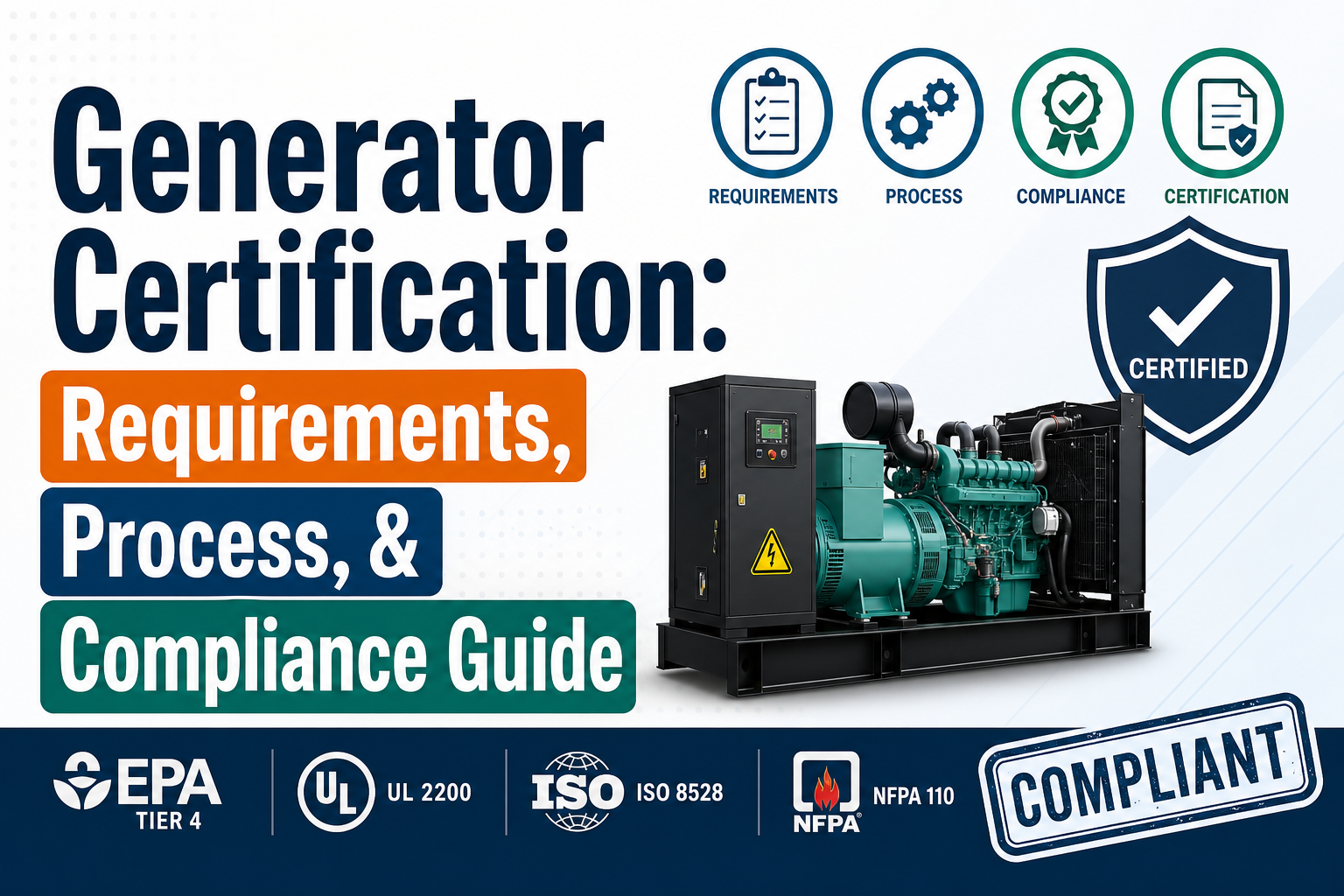
| Certificaciones Nacionales | Las autoridades locales necesitan certificados nacionales para ingresar al mercado de ventas de un país. Estas certificaciones incluyen la EPA. (Agencia de Protección Ambiental) para comprobar las emisiones ambientales seguras en todo EE. UU.. UL es una marca registrada de seguridad eléctrica en Norteamérica. Al mismo tiempo, CSA (Asociación Canadiense de Normas) es para canada. |
| Certificaciones Internacionales | En comparación con la certificación nacional, La documentación internacional le proporciona acceso al mercado global.. La marca CE es una lista de verificación en el Espacio Económico Europeo. Diferentes estándares ISO, como ISO 8528, Significa que los generadores de corriente alterna cumplen con los estándares internacionales de calidad de fabricación.. |
| Certificaciones específicas de la industria | Como su nombre lo indica, Las calificaciones de certificados específicos de la industria se refieren a diferentes entornos especializados.. NFPA 110 is the mark for emergency backup power in healthcare. Los generadores marítimos necesitan certificaciones de la Oficina Estadounidense de Transporte Marítimo (ABS). |
Requisitos de certificación del generador
Si estás pensando en solicitar una certificación de generador específica, Recuerde que debe cumplir con los estándares básicos en diferentes categorías de seguridad..
- Especificaciones técnicas: El generador debe producir voltaje., amperaje, y frecuencia impresa en sus especificaciones sin fluctuación. Debe producir energía estable bajo carga eléctrica parcial o total..
- Normas medioambientales y de emisiones: Para motores de combustión interna, Hay reglas y regulaciones de escape específicas.. Por ejemplo, Los generadores diésel en EE. UU. deben aprobar Nivel de la EPA 4 estándares finales. Esta prueba asegura que los óxidos de nitrógeno (NOx) y las partículas no se desechan aleatoriamente en el medio ambiente.
- Cumplimiento del nivel de ruido: Para zonas residenciales o comerciales urbanas, the noise regulation tests have a specific decibel standard to meet the local noise ordinance.
- Safety features and testing: Every permanent power backup generator must have an automatic voltage regulator (AVR). There should be circuit breakers and grounding points along with thermal protection. All these features ensure that the engine will immediately shut down if it overheats.
Proceso de certificación de generadores paso a paso
Applying and acquiring generator certification is a thorough, structured, multi phase process.
Preparación de documentación
Even before lab technicians evaluate your generator, the manufacturer must submit a technical draft detailing engineering schematics, wiring diagrams, and materials used in the generator production, along with the user manual.
Pruebas e inspección de productos
Once the lab approves your paperwork, the manufacturer sends a prototype to the specific testing laboratory. Engineers test the generators under severe conditions, such as short circuit stimulation, under thermal stress, and with full load testing. They even take emission samples for evaluation.
Verificación de cumplimiento
Entonces, the experts compare the generator with raw data with the certificate standards for cross referencing to evaluate if it falls under the legal limits.
Aprobación de Certificación y Etiquetado
Once your generator passes all kinds of tests and audits, the certification authority grants your products its approval. The manufacturer uses the certification label sticker, like UL or CE stickers, to depict that all their products are legally allowed to roll off the assembly line.
Desafíos comunes en la certificación de generadores
The certification approval is not an easy road. Others, all around the globe, struggle with different problems that turn into unnecessary product launch delays.
- Failing compliance tests: This is the most common reason. Your generator can randomly fail an emission test by a fraction or a percent. A veces, the alternators overheat under stress test, and the manufacturers end up with a complete mechanical redesign.
- Incorrect documentation: Certification authorities are very strict. Even a misspelled component name or a material bill with unclear wiring schematics will delay this process from weeks to months.
- Changing regulations: Environmental and safety standards are changing every day. A manufacturer might spend more than a year meeting the EPA standards. And then the government introduces some other strict standards just before generator testing begins.
Costo de la certificación del generador
During product development, generator manufacturing companies spend a specific budget on certification.
- Testing costs: Booking a slot for acoustic and emission laboratories is highly expensive. Even manufacturers spend up to tens of thousands of dollars.
- Certification body fees: Legal authorities and organizations charge engineering, tratamiento, and administrative fees to review your data and grant your generator a specific certificate.
- Maintenance and renewal costs: Recordar, acquiring a certificate is not a one time fee. Manufacturers need to pay annually to maintain their listings and cover the surprise factory inspection costs.
Cómo elegir un organismo de certificación
Always choose a smart testing partner, so all your power generators enter the market smoothly.
- Accredited organizations: Go for a Nationally Recognized Testing Laboratory (NRTL). If the company does not have a legal permit from the government, its certification stamps are of no use.
- Regional vs international bodies: If you are planning to sell generators in the US, a local NRTL is fine. Pero, for global selling, find a multinational testing firm like Intertek or TÜV SÜD that can test for CSA, CE, and UL compliance standards thoroughly.
- Experience in the generator industry: Choose a laboratory that can handle heavy machinery and high professional grade combustion engines, rather than choosing one with basic consumer electronics tests.
Mantener el cumplimiento de la certificación
Once you have the certification sticker, it’s not the end. Manufacturers must plan to keep it for the long term.
- Inspecciones periódicas: Certification authorities always have unannounced quarterly or annual inspection surprises for your manufacturing facility. They thoroughly evaluate and check whether your generators are identical to the prototype you sent or not.
- Updating standards: For safety and environmental codes, like shifting from EPA Tier 3 to Tier 4, manufacturers must reengineer and recertify their products to keep selling them legally.
- Record keeping: Maintain a high quality supply chain record with all subcomponents lists, like wiring and fuel hoses. Never swap them with cheap or uncertified components.
Conclusión
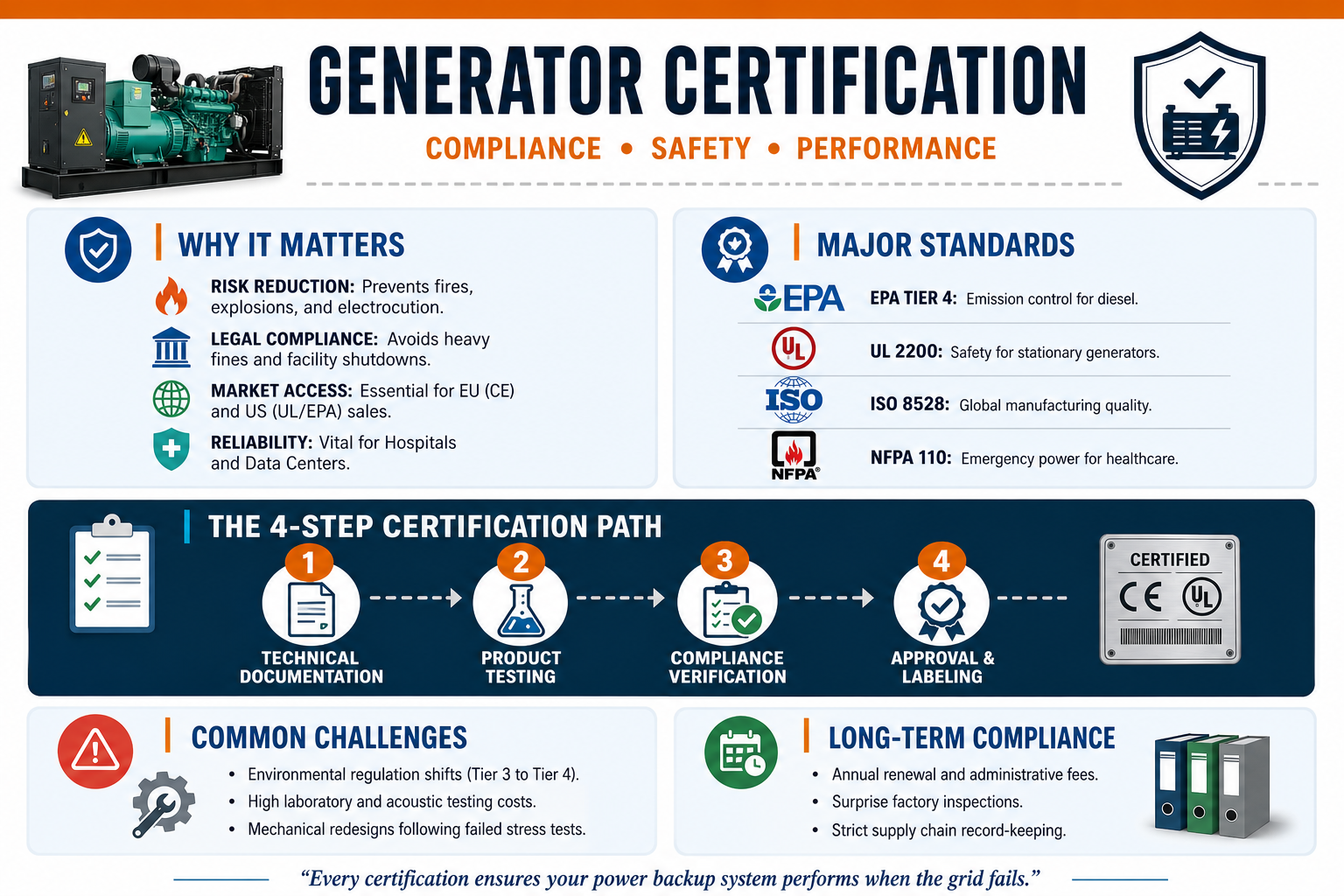
Tackling the huge, strict generator certification rules and regulations is a technical and expensive procedure that is non negotiable as well. Whether you are a manufacturer designing your next line of portable power generators or a facility manager looking for multi MW standby power systems, the certification process is tricky and strict.
Every generator certification ensures your power backup system will perform as the manufacturer promised when the grid fails. It will protect the lives, property, and your surrounding environment. With these regulations and standards, businesses built their brand trust all around the world, ensuring reliable power is there when the world demands it.
Asegure su poder mientras protege su paz mental
Do not waste time thinking about buying a generator when the next storm hits or the grid fails. Whether you are looking for certified portable generators for emergencies or want an automatic, permanent standby power backup system, our experts are here to help you find the right size and install the right generator within your budget for your facility. Contáctenos Hoy!
⚡ Explorar soluciones relacionadas
- 🏭 500Generador diésel kW
- 🏭 1000Generador diésel kW
- 🏭 500Generador diésel kW YC
- 🔧 kms (Cummins/Doosan) Serie
- 🔧 CAROLINA DEL SUR (SDEC) Serie
- 🏥 Soluciones de generadores de centros de datos
💡 Necesita una solución personalizada? Póngase en contacto con nuestro equipo de ingeniería para recomendaciones específicas del proyecto.