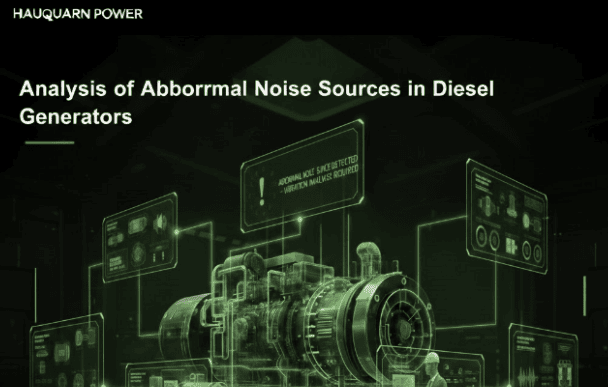
ديزل مولدات are typical in homes and industries as backup and continuous power sources. يوجد دائمًا بعض الصوت أثناء التشغيل. مع ذلك, an unusual sound from a مولد الديزل indicates a faulty system. Sometimes you may ignore abnormal noise sources. يؤدي إلى الفشل, التوقف, وتكاليف الإصلاح المرتفعة. Early detection avoids damage and enhances the safety of both small and large installations.
It also facilitates good generator maintenance and increases service life. This manual describes the primary causes of generator vibration issues and abnormal noise. It also indicates how generator diagnostics and predictive maintenance help maintain the smooth running and efficiency of systems.
1. What is Abnormal Noise Sources in Diesel Generators?
Any strange sound is an abnormal noise in diesel generators. Regular running causes steady combustion and a unique airflow sound. These sounds remain inside a definite and foreseeable limit.
The generator’s unusual sound consists of engine knocking noise, rattling, humming, or hissing. The tone can either vary or increase with time. It usually increases with load. Worn parts, blocked airflow, loose mounting bolts, or an unbalanced state are some signs of a problem.
The unusual noise of the diesel generators can be detected in time, avoiding damage and improving reliability.
2. What are Abnormal Noise Sources in Diesel Generators?
When the engine’s combustion is poor or the injectors fail, the engine’s sound changes. Intake and exhaust systems also produce noise when you block airflow. Auxiliary systems can generate noise when a part is worn or misaligned.
Another type of noise from electrical systems is alternator noise, which typically sounds like a hum. Technicians diagnose generators quickly to identify the source of the problem. They incorporate acoustic inspection with vibration pattern inspection. Proper diagnosis saves on repairs and enables maintenance prediction programs.
2.1 Exhaust & Intake Abnormal Noise Sources
Air gets into and out of the generator through the intake and exhaust systems. Correct air circulation is helpful with combustion and cooling. In case of air limitations, pressure builds up inside the system, resulting in unusual diesel generator noise. The intake noise can be whistling or suction. The exhaust noise is usually a hissing or high-pitched bang.
Malfunctions decrease engine efficiency and fuel consumption. They also increase emissions levels. عادة, it is the filters and broken mufflers that cause noise. But you can maintain a normal airflow through regular inspection. Clean airflow eliminates generator vibration issue and noise.
i). Intake Restriction Noise
Intake-restriction noise originates from the difficulty of unrestricted airflow into the engine. A dirty air filter or a blocked intake duct usually causes it. The engine works harder to find air, producing a whistling sound. It increases the noise from diesel generators and reduces engine power.
The inability to have good airflow impacts fuel combustion and increases consumption. It raises the engine’s temperature, leading to wear. You can avoid this problem by regular maintenance.
ii) Exhaust Backpressure
Exhaust back pressure occurs when the gases cannot pass freely out of the system. It may be due to an obstruction in a muffler or a small exhaust pipe. The pressure builds up inside the system, causing hissing or sharp pulses—the engine overheats, resulting in loud exhaust noise. You can avoid this by regularly checking exhaust lines.
2.2 Structural & Mounting Noise
The source of structural noise is the generator frame and base. Diesel generators vibrate continuously and transmit the vibration to surrounding structures. It causes rattling or booming effects.
You can resolve this issue by regularly inspecting the bolts and mounts. Mount the generator securely to ensure stability. It reduces vibration and prolongs the equipment’s life.
i). Auxiliary Systems
These components include cooling fans, belts, and fuel pumps. They generate noise when they wear out. A broken fan produces noise from vibration or air movement. A loose belt gives a squealing sound, while badly worn-out pump bearings generate a hum. All these increase the sound levels.
You can reduce wear and friction by regular lubrication. When alignment is proper, there is less stress on the moving parts. Replacement of damaged parts enhances performance and facilitates generator maintenance.
ii). Frame & Base Resonance
Frame resonance takes place when the natural frequency of the generator corresponds to the frequency of the base. It results in a loud booming sound or a droning sound. A weak or light base structure increases the sound.
Use an acoustic test to identify resonance points accurately. Fixing resonance will reduce the noise and safeguard the structure.
iii). Loose Fasteners & Mounts
Typically, the abnormal sound in the generator is often related to loose fasteners. Vibrations loosen bolts and brackets, causing them to rattle or engine knocking noise.
2.3 المولد & Electrical Abnormal Noise Sources
The alternator produces some noise in the diesel generators. It may be a humming or buzzing sound that varies with the load’s demand. This noise results from magnetic forces and an electric imbalance.
أيضًا, faults in the winding or incorrect rotor alignment raise vibration and sound levels. Technicians should monitor voltage and load to identify and fix the problem.
i) Harmonic Distortion
Harmonic distortion occurs when nonlinear loads generate harmonics. It produces some other magnetic forces within the alternator. The generator will then make a humming or buzzing sound.
It gets noisy when the load gets unstable. Harmonics also lead to heating and reduce efficiency. Over time, it damages electrical components. Load balancing can enhance system stability and reduce harmonics.
ii) Loose Windings
Loose windings will produce unnatural alternator noise. It is the movement of windings within the alternator due to magnetic forces. Once insulation becomes weak, the movement increases. It creates a buzzing effect and vibration.
Movement can cause short circuits and further deteriorate insulation. As the load increases, so does the noise. Routine inspection can help identify loose windings.
iii) Air Gap Eccentricity
Air-gap eccentricity takes place when the distance between the stator and rotor is lenticular. It causes an unequivalent magnetic force within the alternator. The outcome would be a humming or vibrating sound due to misalignment of bearings and shafts.
2.4 Engine-Related Noise
The generator engine emits the most noise. Normal combustion produces a continuous, moderate sound, but increased noise is a sign of internal issues. It can either sound like knocking, grinding, or whining. Reasons include worn-out parts or fuel system malfunctions. Regular servicing of the generator could reduce wear and noise. أيضًا, it improves fuel efficiency.
i) Turbocharger & Induction
The turbochargers produce a whining noise. This sound gets louder or distorted when there is a fault. This problem results from worn-out bearings. أيضًا, leaks could cause a hissing sound.
Inspecting ducts and seals can help you avoid the problem. An efficient turbocharger improves fuel combustion. It also reduces diesel generator noise and enhances engine efficiency.
ii) الأعطال الميكانيكية
Mechanical failures result in generator noise. على سبيل المثال, streaked bearings produce a rumbling sound, while valve defects produce tapping sounds. These noises, which depend on the engine’s speed, result from wear or internal damage.
Early repairs and oil checks will reduce failures and expensive repairs. أيضًا, proper lubrication allows parts to operate smoothly.
iii) Combustion Knock
Combustion engine knocking noise causes a sharp metallic sound. It occurs when fuel combustion in the cylinder is uneven. It is due to the use of poor-quality fuel or an improper injection time.
Combustion knocks increase pressure and could rupture pistons. To avoid this fault, check the injectors regularly.
3. Why Abnormal Noise Sources in Diesel Generators Matter
Strange noises from your diesel generator alert you to malfunctions in the system. It could be wear, imbalance, airflow obstruction, or fuel system problems.
If the operators fail to take action, the generator may shut down or cause accidents. They should monitor the generator, identify faults early, and respond promptly. A quick reaction enhances effectiveness and prevents accidents.
3.1 Early Fault Indicators
You will hear a strange generator sound before it grinds to a halt. Common symptoms include knocking, humming, and vibration of the generator. The noises indicate a worn bearing, loose mounting bolts, or an air blockage.
3.2 Regulatory Noise Limits
Diesel generator operators must comply with environmental noise regulations. These are strict limits on acceptable sound levels that the generator should produce. هكذا, a faulty generator can push noise levels beyond permissible limits, particularly in urban or industrial areas.
System faults can manifest as abnormal noise. أ generator vibration issue can result in complaints, fines, or restrictions. Identifying and fixing the source reduces noise and enhances performance.
Conduct sound testing periodically to identify problems. أيضًا, regular generator maintenance can keep noise within acceptable levels.
3.3 Human Health & أمان
Diesel generators produce noise that violates health and safety rules for workers. It can lead to hearing loss. أيضًا, abnormal generator sounds can distract operators and lead to unsafe behavior.
Too much noise may interrupt critical work in sensitive settings, such as hospitals. It can also affect communication among the workers. لذلك, tracking and managing generator noise can enhance workplace safety. You may use nanotechnology to reduce generator noise levels and provide a safer working environment.
3.4 Equipment Reliability
Abnormal noise indicates the generator has issues. The most common ones are loose mounting bolts, loose bearings, inadequate alignment, or air restriction. These flaws increase heat and vibration. Early detection will help prevent severe losses and reduce repair expenses.
4. Abnormal Noise Sources in Diesel Generators: Diagnostic Methods
The cause of noise in generators can be either mechanical or electrical. Sound meters, vibration sensors, and performance data are tools technicians use to detect faults.
The current diagnostic instruments study the frequency distributions and resonance behavior. These instruments quickly associate generator sounds with specific parts. It reduces the time spent diagnosing and inspecting. Proper diagnosis is cost-saving and enhances the quality of repair.
4.1 Machine Learning Tools
Machine learning enhances the ability to detect abnormal noise in the generator. These systems process large volumes of sound and vibration data. The system raises an alarm as soon as the noise changes. History helps forecast future failures before they occur. The more data the tools gather, the greater the accuracy.
Smart sensors monitor and alert the operator as soon as a problem is detected. It allows for swift responses. It minimizes downtimes and reduces breakdowns. هكذا, machine learning supports predictive maintenance and enhances generator reliability.
4.2 Pattern Recognition
Pattern recognition enables quick detection of specific generator noise. Every mechanical or electrical malfunction produces different sounds. على سبيل المثال, noise from bearing wear, knocking, and airflow are different. So technicians study sound waves and their frequency peaks to determine the source.
They compare the results with known fault signatures. It enables rapid and correct diagnosis. Filter the background noise using software to enhance clarity. Pattern recognition saves time, is used in inspection, and facilitates timely maintenance decisions.
4.3 Finite Element Modeling
Finite Element Modeling investigates the vibration and noise behavior of generators. لذا, engineers create digital models of components and structures of generators. Such models help in presenting the movement of stress and vibration within the system. FEM helps identify weak and resonant areas.
Before implementing the design changes, engineers test the model. بالتالي, FEM enhances structural strength and reduces noise levels. It helps improve the mounting design and material selection. The approach helps avoid future noise issues.
4.4 Modal Analysis
The modal analysis is the study of the response of generator structures to vibration forces. Resonance occurs when engine forces match such frequencies. It adds much noise to the diesel generators. Engineers use sensors to determine how vibrations respond and identify weak spots.
They then use the findings in the vibration modes and weak points. The information enhances the design of mounting and the support requirements. The engineers minimize resonance by adding dampers or isolators. Modal analysis enhances the stability of the structures and minimizes abnormal sound.
4.5 Vibration Analysis
A fundamental diagnostic tool for generator noise is vibration analysis. It uses sensors to measure vibration levels, patterns, and frequency ranges. The signals indicate defects such as bearing imbalance, misalignment, and wear.
The operators check vibration patterns over time to detect changes. They combine vibration data with load conditions to determine the cause of issues. This approach assists in predictive maintenance programs. It helps to minimize the downtime and repair expenses. The vibration analysis technique ensures a functional diesel generator.
4.6 Acoustic Analysis
Acoustic analysis is the measurement of the sound of diesel generators. Sound meters capture decibel levels and frequency distributions. Technicians use the results by comparing them to standard sound profiles. If there are differences, it suggests a possible fault.
Acoustic mapping helps identify precise sources of noise in the generator. Frequency analysis differentiates humming, knocking, and hissing sounds. It enhances the earlier fault plan and maintenance effectiveness.
5. Abnormal Noise Sources in Diesel Generators: Future Trends
Online tools perform quick analysis and are now essential in monitoring and detecting issues in real time. They detect abnormal noise immediately, enabling the operators to react promptly.
أيضًا, predictive systems and automation help to anticipate faults. It saves on downtime and repair expenses. They enhance maintenance efficiency, planning, and environmental compliance.
The next generation will have intelligent diagnostics and self-warning tools. The system of noise management will be more advanced and accurate. It will enhance the reliability and lifespan of diesel generators.
5.1 Simulation & Digital Twins
Digital twin technology development has led to the production of virtual diesel generators. These models make use of actual machine learning data. Engineers research airflow, vibration, and noise behavior in real time.
They forecast faults before they manifest. Digital twins enhance the efficiency and reliability of generators. The engineers can monitor wear and anticipate service requirements.
5.2 Smart Monitoring & IoT
The Internet of Things systems can continuously monitor generator performance. It uses sensors to measure sound, vibration, and temperature. This information passes to monitoring platforms for analysis.
In case it detects abnormal noise, the system alerts the operator immediately. Maintenance teams act swiftly to prevent failures. Remote monitoring supports sensitive facilities like data centers and hospitals. Together with data trends, they are beneficial for maintenance planning and system performance. IoT reduces unplanned failures and enables predictive maintenance.
6. خاتمة
Asteroid diesel generator sound is a life-threatening diagnostic indicator. It shows mechanical and electrical failures at a very early stage. Prompt identification averts harm, unavailability, and other risks.
أيضًا, effective diagnostic techniques enhance the quality of maintenance and repair. The use of advanced tools in generator vibration issue analysis and machine learning ensures greater accuracy. They lead to faster diagnosis and problem resolution.
The outcome is properly maintained generators that ensure low noise levels and high efficiency. أيضًا, the tools improve monitoring and prediction.
7. Buy Generators with Huaquan Power Now!
Choose Huaquan Power for high-quality diesel generators. Our diesel generators deliver a steady power output with minimal noise. The company applies high-tech engineering and high-quality benchmarking in all products. Our systems are for industrial and commercial use. They also offer 24-hour and standby power.
Huaguan provides tailor-made generator systems to suit your needs. Every unit is put to the test for efficiency and durability. أيضًا, we fully support and service our team’s technical needs. Huaquan Power is a provider of long-term and efficient مولدات الديزل. Get in touch with us to have reliable power solutions.