Introduction
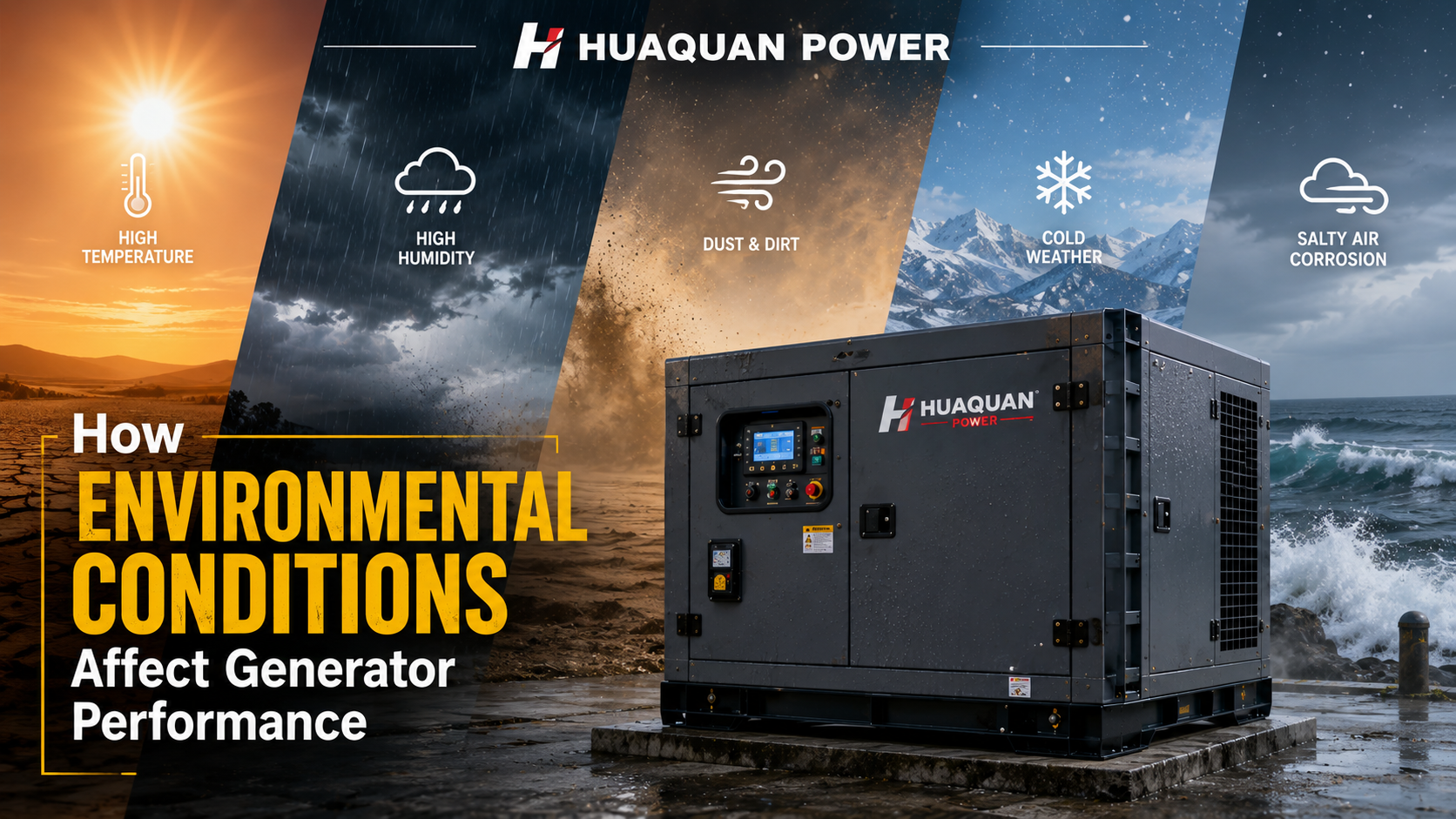
There can be different conditions. Indoor conditions let the Generators perform differently compared to the outdoors. Stable outdoor conditions offer less stress compared to fluctuating outdoor conditions. In short, several environmental conditions, such as temperature, pressure, and humidity, can impact generator performance.
Today, we will evaluate the key factors affecting the generator performance and learn how generator conditions can impact the generator performance.
Why Environmental Conditions Matter
Generator performance depends on several factors. Environmental factors affect the generator performance by affecting most of the components, such as:
- Engine
- Alternator
- Cooling system
- Fuel system
- Air intake system
- Exhaust system
- Lubrication system
- Electrical controls
As environmental conditions impact all these factors, the results can be the following:
- Reduced power output
- Higher fuel consumption
- Overheating
- Hard starting
- Increased emissions
- Accelerated corrosion
- Electrical insulation damage
- Shortened equipment life
- Unexpected shutdowns
Therefore, you should consider why environmental conditions affect and why it is necessary to know the conditions.
Key Environmental Factors That Affect Generator Performance
There are different environmental conditions that can affect the generator’s performance. Let’s discuss all the factors in detail.
| Environmental Condition | Primary Impact |
| High temperature | Lower engine power and cooling efficiency |
| Low temperature | Hard starting and thicker engine oil |
| High altitude | Reduced oxygen causes power derating |
| High humidity | Moisture and insulation problems |
| Dust and sand | Air filter blockage and engine wear |
| Rain | Electrical hazards and corrosion |
| Snow and ice | Cooling obstruction and freezing |
| Salt air | Severe corrosion |
| Flooding | Mechanical and electrical damage |
| Poor ventilation | Overheating and reduced efficiency |
Factor #1: High Temperature
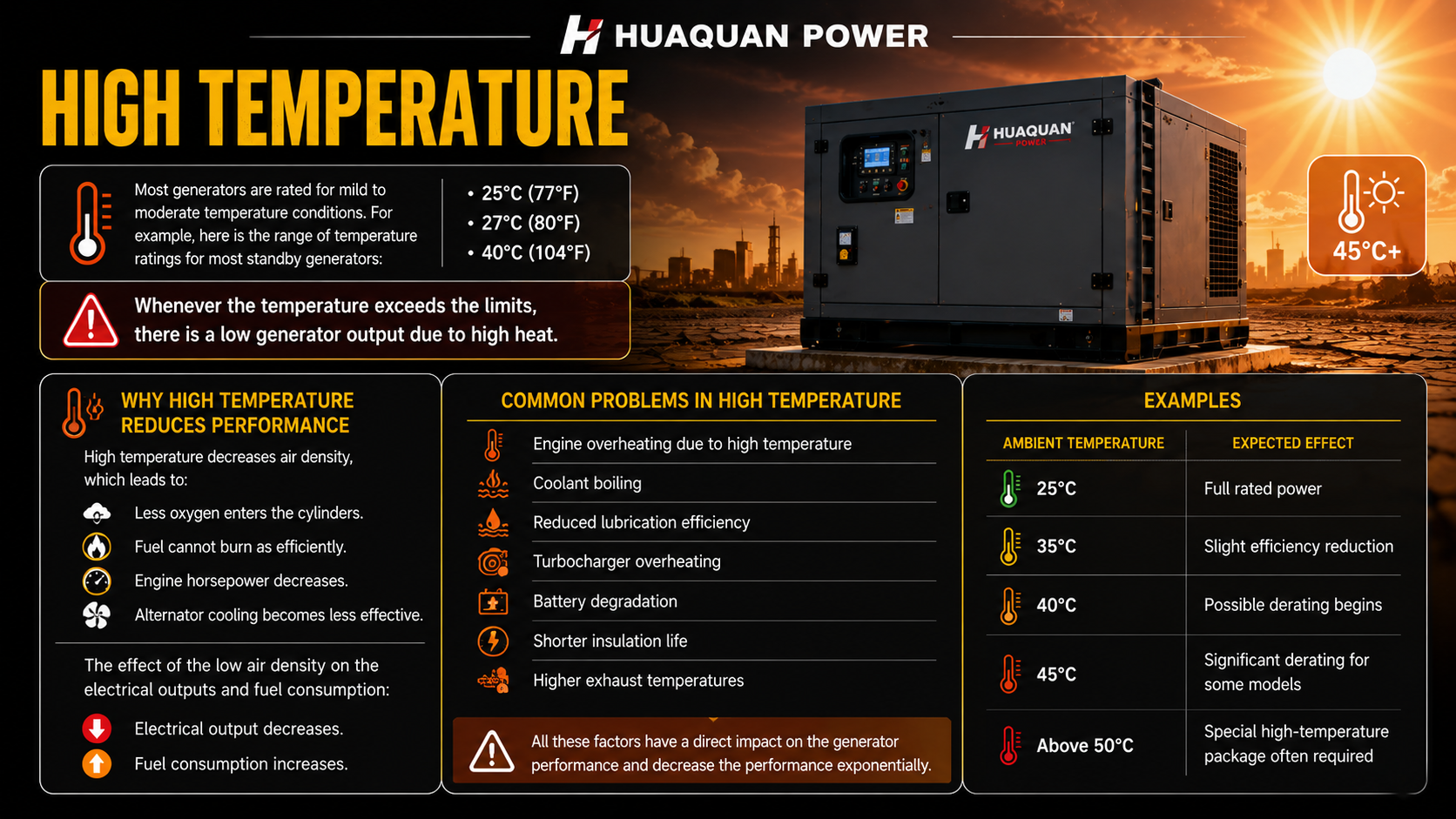
Most generators are rated for mild to moderate temperature conditions. For example, here is the range of temperature ratings for most standby generators:
- 25°C (77°F)
- 27°C (80°F)
- 40°C (104°F)
Whenever the temperature exceeds the limits, there is a low generator output due to high heat.
Why High Temperature Reduces Performance
Do you know why the high temperature reduces performance? It decreases the air density, which leads to:
- Less oxygen enters the cylinders.
- Fuel cannot burn as efficiently.
- Engine horsepower decreases.
- Alternator cooling becomes less effective.
The effect of the low air density on the electrical outputs and fuel consumption is as follows:
- Electrical output decreases.
- Fuel consumption increases.
Common Problems in High Temperature
There are several issues that occur at high temperatures. We have listed the common issues here.
- Engine overheating due to high temperature
- Coolant boiling
- Reduced lubrication efficiency
- Turbocharger overheating
- Battery degradation
- Shorter insulation life
- Higher exhaust temperatures
All these factors have a direct impact on the generator performance and decrease the performance exponentially.
Examples
| Ambient Temperature | Expected Effect |
| 25°C | Full rated power |
| 35°C | Slight efficiency reduction |
| 40°C | Possible derating begins |
| 45°C | Significant derating for some models |
| Above 50°C | Special high-temperature package often required |
How to Reduce Heat Effects
Do you want to reduce the impact due to high heat? Don’t worry, we have all the possible solutions that can decrease the impact.
Here are a few possible solutions.
- Install larger radiators.
- Improve airflow.
- Use high-temperature coolant.
- Reduce operating load.
- Clean radiator fins regularly.
Factor #2: Low Temperature
It is not just the hot weather that affects the generator performance, but a low temperature can also impact the performance significantly. It presents a new set of challenges and impacts the performance.
Cold Starting Problems
For the engine to start, there is a fuel combustion that generates heat and starts the engine. In low-temperature conditions, there are several issues that cause starting problems, such as:
- Fuel atomizes poorly.
- Engine oil becomes thicker.
- Batteries lose cranking power.
- Cylinder temperatures remain low.
These factors make starting slower and very difficult. Therefore, issues with the cold starting occur.
Fuel Problems
The fuel gelling phenomenon occurs in freezing temperature conditions. In freezing weather, fuel sticks and creates wax crystals, causing the fuel to gel.
This phenomenon leads to the following issues:
- Blocked fuel filters
- Fuel starvation
- Engine shutdown
- Poor combustion
Unless your fuel is rated for the cold environment, you can’t have high performance and proper operation of the generators.
Battery Performance
As the temperature decreases, the performance of the batteries drops exponentially. There are a few issues, such as decreased battery capacity, low performance, and many more.
Here is how the temperature impacts the batteries.
| Temperature | Battery Capacity |
| 25°C | 100% |
| 0°C | Around 80% |
| -18°C | Around 50% |
| -30°C | Much lower |
Possible Solutions for Low Temperature Conditions
Do you want to reduce impacts due to low temperature? We have added a few solutions for the low-temperature conditions:
- Engine block heaters
- Battery warmers
- Fuel heaters
- Coolant heaters
- Winter diesel fuel
- Synthetic engine oil
- Insulated generator enclosures
Factor #3: High Altitude
As you go higher towards the hills or altitudes, the atmospheric pressure decreases. It results in low oxygen and many other impacts, such as:
- Less oxygen enters the engine.
- Combustion efficiency declines.
- Engine power decreases.
Why Oxygen Matters
As you go above, air density decreases due to decreased oxygen. Oxygen is essential for combustion purposes.
Without a sufficient oxygen supply, there are a few issues you might encounter.
- Air density decreases.
- Oxygen concentration per cubic meter falls.
- Fuel burns less efficiently.
- The engine produces less mechanical power.
Altitude Examples
| Elevation | Approximate Effect |
| Sea level | Full rated output |
| 1,000 m | Small derating |
| 2,000 m | Moderate derating |
| 3,000 m | Significant power reduction |
| 4,000 m | Major derating required |
Solutions for the High Altitude
There are several approaches that can reduce altitude impact and improve the overall efficiency of the generators. These include:
- Select a larger generator.
- Use turbocharged engines.
- Consult the manufacturer’s derating charts.
- Optimize cooling systems.
- Reduce continuous load.
Factor #4: High Humidity Effects
Humidity is also a major cause of electrical sparks, low output, and generator failures. The typical high-humidity factors are:
- Condensation
- Electrical leakage
- Corrosion
- Rust
- Mold growth
- Insulation deterioration
- Sensor failures
These issues occur in the tropical areas and have different risks for the generator’s lifespan.
Condensation Risks
Condensation occurs due to warm and moist air. It forms the water droplets on the different surfaces, such as:
- Alternator windings
- Control boards
- Circuit breakers
- Terminal blocks
- Wiring
One of the major effects is the decreased insulation of the system due to moisture.
Electrical Problems
Most generators have advanced components and electronic parts that are prone to moisture. Moisture causes serious electrical issues, such as:
- Ground faults
- Short circuits
- Arc tracking
- Insulation breakdown
- Voltage instability
- Protective relay trips
Preventing Humidity Damage
Do you want to keep humidity issues miles away? There are a few solutions in such cases. We have added the possible solutions.
- Install space heaters inside alternators.
- Use anti-condensation heaters.
- Maintain enclosure seals.
- Install dehumidifiers where necessary.
- Inspect insulation resistance regularly.
Factor #5: Dust and Sand
Dust and sand have several impacts. For example, it accumulates inside the engine and blocks several components. Systems with air intake experience the most deterioration.
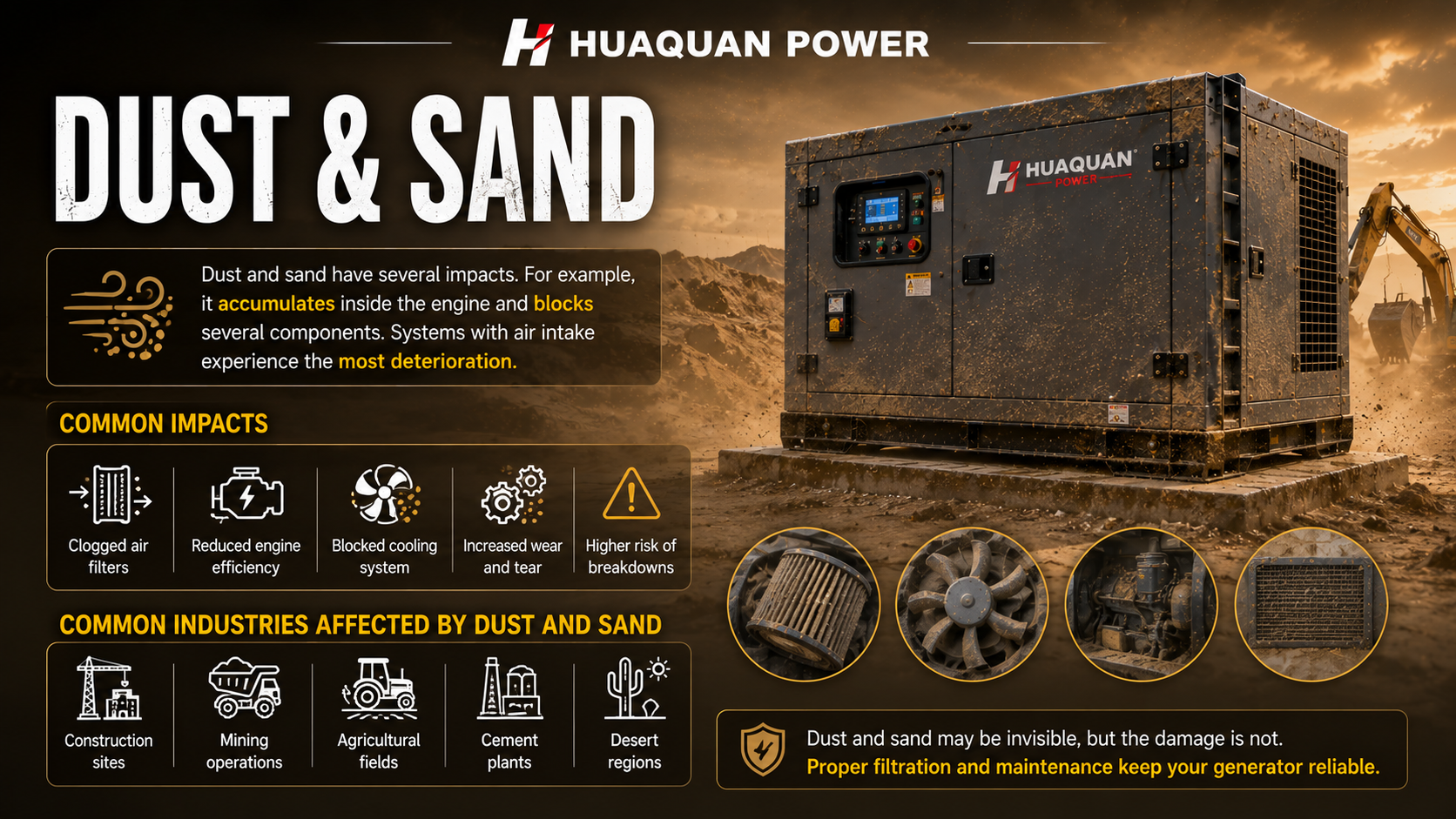
The common industries affected by dust and sand include:
- Construction sites
- Mining operations
- Agricultural fields
- Cement plants
- Desert regions.
Common Problems
Due to sand and dust, here is a list of problems that occur:
- Restricted engine airflow
- Clogged air filters
- Reduced cooling efficiency
- Higher fuel consumption
- Engine overheating
- Accelerated internal wear
- Alternator insulation contamination
Protection and Maintenance
Regular maintenance and protection can reduce dust and dirt. The recommended options are heavy-duty air filters, weatherproof enclosures, and regular cleaning schedules.
| Maintenance Task | Recommended Frequency (Dusty Areas) |
| Inspect air filter | Daily |
| Clean radiator fins | Weekly |
| Replace air filter | As required by restriction indicator |
| Inspect alternator | Monthly |
| Clean generator enclosure | Weekly |
Factor #6: Rain and Moisture
Extreme rainy conditions can also impact the performance of the generators. Water intrudes through the generator surfaces and affects the insulation and electrical components.
Common Issues
There are moisture-related issues during the rainy seasons.
- Corrosion of electrical terminals
- Short circuits
- Water-contaminated fuel
- Rust formation
- Reduced insulation resistance
- Control panel failures
Protection and Maintenance
Here are a few protection and maintenance options for the rainy and moist seasons.
| Protective Measure | Benefit |
| Weatherproof enclosure | Prevents direct rain exposure |
| Elevated foundation | Reduces water ingress |
| Sealed cable entries | Stops moisture intrusion |
| Proper drainage | Prevents standing water |
| Regular seal inspection | Maintains enclosure integrity |
Factor #7: Snow and Ice
When you reach below freezing temperatures, the snow and ice can freeze inside the components and block them. It sometimes fails to operate the generators. You should act accordingly for the maintenance and protection.
Common Issues
The major issues due to snow and ice include:
- Blocked cooling airflow
- Frozen ventilation louvers
- Restricted exhaust outlets
- Ice-covered fuel lines
- Frozen door seals
- Increased starting difficulty
Protection and Maintenance
| Inspection Item | Purpose |
| Engine block heater | Easier cold starts |
| Battery heater | Maintains cranking power |
| Winter diesel fuel | Prevents fuel gelling |
| Coolant protection | Prevents freezing |
| Exhaust inspection | Ensures safe gas discharge |
Factor #8: Flooding
Floods are one of the greatest threats for the standby generators. Water enters the generator and causes the damage to internal components.
Common Issues
Flood affects every major component of the engines.
- Engine hydrolock
- Contaminated lubricating oil
- Electrical short circuits
- Damaged control systems
- Corroded bearings
- Fuel contamination
Protection and Maintenance
Here are a few protection and maintenance tips.
| Protection Method | Advantage |
| Raised concrete platform | Keeps equipment above flood level |
| Improved drainage | Prevents water accumulation |
| Waterproof cable entries | Protects electrical wiring |
| Flood barriers | Reduces water exposure |
| Regular drainage inspection | Maintains site protection |
Factor #9: Ventilation
Ventilation is essential. The blockage of ventilation systems causes the block of air flow, overheating, and reduced efficiency. There are many more issues.
Common Issues
Improper ventilation comes with the following issues.
- Engine overheating
- Alternator overheating
- Reduced power output
- Higher fuel consumption
- Increased exhaust temperatures
- Premature insulation aging
Protection and Maintenance
Here are a few maintenance and protection tips.
| Design Consideration | Benefit |
| Adequate air intake | Supports combustion |
| Proper hot-air discharge | Prevents heat recirculation |
| Sufficient clearance | Improves cooling airflow |
| Clean ventilation openings | Maintains unrestricted airflow |
| Regular airflow inspection | Detects blockages early |
Factor #10: Air Pollution and Industrial Contaminants
Air pollution and industrial contaminants cause the decreased performance of the generators. Industrial environment has several factors, such as airborne chemicals, acidic gases, metal particles, cement dust, and oil mist. They affect the reliability and stability of the generator performance.
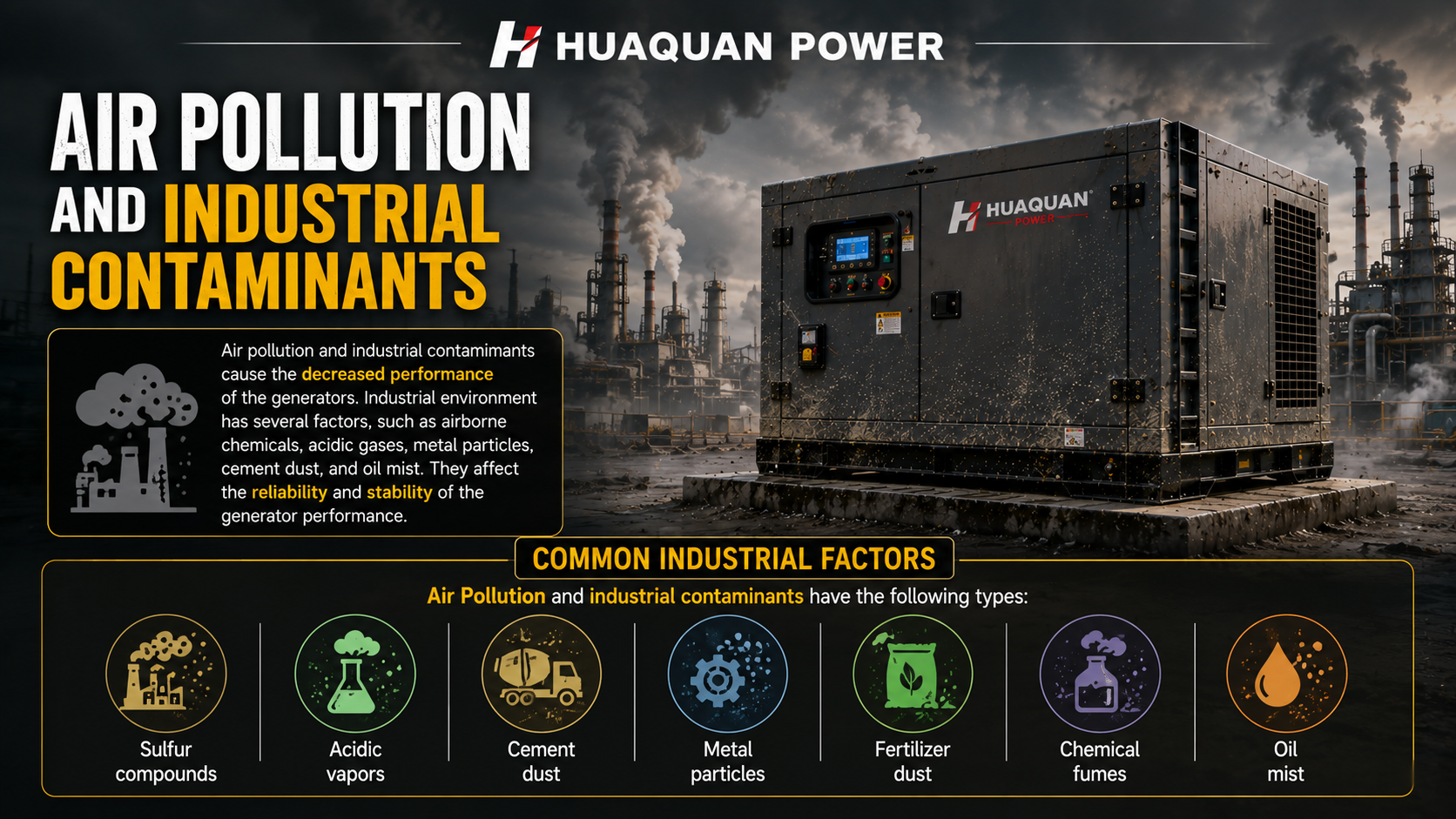
Common industrial factors
Air Pollution and industrial contaminants have the following types:
- Sulfur compounds
- Acidic vapors
- Cement dust
- Metal particles
- Fertilizer dust
- Chemical fumes
- Oil mist
Protection and Maintenance
You should apply the following protection and maintenance methods.
| Protection Method | Purpose |
| High-efficiency air filters | Removes airborne particles |
| Corrosion-resistant coatings | Protects metal surfaces |
| Sealed electrical enclosures | Prevents contaminant ingress |
| Routine cleaning | Removes deposited pollutants |
| Regular insulation testing | Detects electrical deterioration |
FAQs
- How can generators be protected in coastal environments?
Proper maintenance and protection setup can be very effective for the coastal environment. For example, marine-grade enclosures, corrosion-resistant coatings, stainless steel hardware, and regular freshwater washing.
- Is humidity harmful to generators?
Yes. High humidity causes several issues, such as condensation, corrosion, insulation deterioration, and electrical leakage. Therefore, it is harmful to the generator’s performance.
- Can extremely hot weather damage a generator?
Yes. Hot weather causes the overheating of the generators with reduced cooling. Due to overheating, the components automatically shut down.
- How does dust affect generator performance?
Dust can move through the components, cause fuel contamination, block air and fuel filters, or clog the hoses. It results in decreased generator performance and low power output.
- Why do generators lose power at high altitudes?
Air density decreases with altitude, and there is a low oxygen content at higher altitudes. Therefore, generator fuel is less likely to combust, causing decreased electrical output and low power generation.
- How often should maintenance be performed in harsh environments?
In harsh environmental conditions, you should have a routine of maintenance. Go for frequent inspections, filter replacements, cleaning, and corrosion checks.
- Why is ventilation important for generator installations?
Ventilation has several benefits, such as providing combustion air, removing engine and alternator heat, and preventing overheating. Therefore, generator performance is high in well-ventilated areas.
- Should generators be installed in flood-prone areas?
It depends on your choice. If you install the generators in the flood-prone areas, always install them on platforms above expected flood levels, with proper drainage and water protection measures.
Conclusion
Environmental conditions have a direct impact on the generator’s performance. With the high temperature, generator performance decreases exponentially. At the same time, the low temperature can cause instability. An optimal condition can help operate the generators safely and effectively. You should install the proper protection systems according to the local conditions.
If you want to buy high-quality and high-performance generator solutions, look no further. Contact Huaquan Power and choose from our wide range of products. Select gas and diesel generators from our collection. For custom orders or consultation, contact our customer service right away!