The standard battery capacity rating for Diesel Generator starting systems specifies the energy storage required to deliver sufficient cranking power for reliable engine starting under worst-case conditions. Huaquan Power selects battery capacity with substantial margins because starting failure during a power outage defeats the entire backup power purpose. Huaquan Power has compiled the following detailed guide on battery capacity ratings for diesel Generators.
What Is the Standard Battery Capacity Rating for Generator Starting Systems?
Battery capacity for generator starting systems is rated using two primary metrics: Cold Cranking Amps (CCA) and Ampere-Hours (Ah). Specifically, CCA measures the battery’s ability to deliver high current at -18°C, while Ah measures total energy storage capacity at a standard discharge rate. Furthermore, Huaquan Power uses both ratings to size starting batteries that perform reliably from -25°C to +50°C ambient temperatures.
What Are the Standard Battery Ratings by Generator Size?
| Generator Power (kW) | System Voltage | Minimum CCA | Minimum Ah (C20) | Huaquan Standard Battery |
|---|---|---|---|---|
| 10-30 | 12V | 400-600 | 60-90 | Single 12V, 600CCA / 80Ah |
| 30-100 | 24V (2×12V) | 600-1000 per battery | 80-120 per battery | 2× 12V, 800CCA / 100Ah |
| 100-300 | 24V (2×12V) | 1000-1500 per battery | 120-180 per battery | 2× 12V, 1200CCA / 150Ah |
| 300-600 | 24V (4×12V) | 1500-2000 per battery | 180-250 per battery | 4× 12V, 1800CCA / 200Ah |
| 600-1000 | 24V (4×12V) | 2000-3000 per battery | 250-350 per battery | 4× 12V, 2500CCA / 300Ah |
Importantly, Huaquan Power specifies battery capacity at 1.5 times the minimum calculated requirement to ensure reliable starting after extended standby periods and at low temperatures. Therefore, Huaquan generators start dependably even when batteries have aged to 60% of their original capacity.
What Are the Different Battery Rating Systems?
| Rating | Definition | Test Temperature | Relevance to Generators |
|---|---|---|---|
| CCA (Cold Cranking Amps) | Current delivered for 30 seconds at 7.2V per cell | -18°C | Primary rating for starting ability |
| CA (Cranking Amps) | Current delivered for 30 seconds at 7.2V per cell | 0°C | Less conservative; not preferred |
| Ah (Ampere-Hour, C20) | Total capacity over 20-hour discharge | 25°C | Indicates reserve capacity for multiple starts |
| RC (Reserve Capacity) | Minutes at 25A discharge to 10.5V | 25°C | Indicates sustained low-rate capacity |
| MCA (Marine Cranking Amps) | Current delivered for 30 seconds at 7.2V per cell | 0°C | Not recommended for stationary generators |
Additionally, Huaquan Power bases all battery sizing calculations on CCA ratings because they represent the most demanding starting conditions. Consequently, generators sized using CCA will start reliably at -18°C and have additional margin at warmer temperatures.
How to Calculate the Correct Battery Capacity for a Diesel Generator?
Battery capacity calculation requires accounting for starter motor current draw, cranking duration, number of start attempts, and temperature derating. Furthermore, an undersized battery provides inadequate cranking power, while an oversized battery wastes money and space. Therefore, Huaquan Power provides a standardized calculation method for every installation.
What Is the Huaquan Battery Sizing Calculation?
| Step | Calculation | Typical Value | Huaquan Safety Factor |
|---|---|---|---|
| 1. Determine starter current draw | From starter motor specification at rated voltage | 300-2000A depending on engine size | Use maximum rated current |
| 2. Calculate cranking energy | Current × cranking time × number of attempts | 15s × 3 attempts = 45s total | Design for 5 attempts (75s) |
| 3. Apply temperature derating | Battery capacity reduces approximately 1% per °C below 25°C | 60% capacity at -18°C | Use worst-case -25°C (55% capacity) |
| 4. Apply aging factor | Battery end-of-life capacity typically 60-80% of rated | Design to 60% remaining capacity | Replace at 80% of rated CCA |
| 5. Calculate minimum required CCA | Starter current ÷ (temperature factor × aging factor) | Varies by engine | Round up to next standard size |
What Types of Batteries Are Used in Diesel Generator Starting Systems?
Diesel generators use several battery types, each with distinct performance characteristics for starting applications. Furthermore, the battery type selection affects maintenance requirements, service life, and reliability. Therefore, Huaquan Power evaluates battery technology carefully for each generator application.
What Are the Pros and Cons of Each Battery Type?
| Battery Type | CCA Performance | Service Life (years) | Maintenance | Huaquan Recommendation |
|---|---|---|---|---|
| Flooded lead-acid | Excellent | 3-5 | Monthly electrolyte check | Standard for most applications |
| AGM (Absorbed Glass Mat) | Very Good | 5-8 | None (sealed) | Preferred for unattended sites |
| Gel cell | Good | 5-10 | None (sealed) | Vibration-prone installations |
| Ni-Cd (Nickel Cadmium) | Excellent at all temperatures | 15-20 | Electrolyte maintenance | Extreme cold (-40°C) applications |
| Lithium-ion (LFP) | Excellent | 10-15 | None (BMS protected) | Emerging option; verify compatibility |
Additionally, Huaquan Power uses premium flooded lead-acid batteries as standard equipment and offers AGM upgrades for applications requiring reduced maintenance. Moreover, all Huaquan batteries feature heavy-duty internal construction with reinforced plates designed specifically for the high-vibration generator environment.
What Causes Starting Battery Failure in Generator Systems?
Starting battery failure is the single most common cause of generator starting problems during emergency activations. Furthermore, battery failure often develops silently, with no warning until the generator fails to start. Therefore, Huaquan Power emphasizes comprehensive battery monitoring and maintenance.
What Are the Common Battery Failure Modes?
| Failure Mode | Cause | Symptom | Prevention |
|---|---|---|---|
| Sulfation | Battery remains undercharged for extended periods | Reduced capacity, slow cranking | Maintain float charge at 2.25-2.30V per cell |
| Grid corrosion | Natural aging accelerated by high temperature | Gradual capacity loss | Keep battery area below 25°C; replace at 80% CCA |
| Positive plate growth | Overcharging causes plate expansion | Shorted cells, sudden failure | Set charger voltage correctly; check monthly |
| Electrolyte stratification | Acid concentration gradient in flooded cells | Uneven cell voltages, reduced capacity | Equalize charge every 3-6 months |
| Terminal corrosion | Acid fumes corrode connections | High resistance, voltage drop | Clean and coat terminals with protective grease |
How to Maintain Generator Starting Batteries for Maximum Reliability?
Proper battery maintenance extends service life and ensures the generator starts reliably when needed. Furthermore, a systematic maintenance program catches developing problems before they cause starting failures. Therefore, Huaquan Power establishes detailed maintenance schedules for all generator batteries.
What Are the Essential Battery Maintenance Procedures?
| Procedure | Interval | Method | Acceptable Result |
|---|---|---|---|
| Visual inspection | Weekly | Check for corrosion, leaks, swelling, and damage | No visible defects |
| Terminal voltage (float) | Weekly | Measure with digital voltmeter at battery terminals | 25.2-27.6V (24V system) with charger active |
| Specific gravity (flooded) | Monthly | Measure each cell with hydrometer | 1.250-1.280 at 25°C; all cells within 0.025 |
| Load test / CCA test | Quarterly | Apply load or use conductance tester | >80% of rated CCA |
| Equalization charge | Semi-annually | Apply 2.40V per cell for 2-4 hours (flooded only) | All cell specific gravities equalize |
| Connection resistance | Annually | Measure millivolt drop across each connection under load | <50mV per connection at rated current |
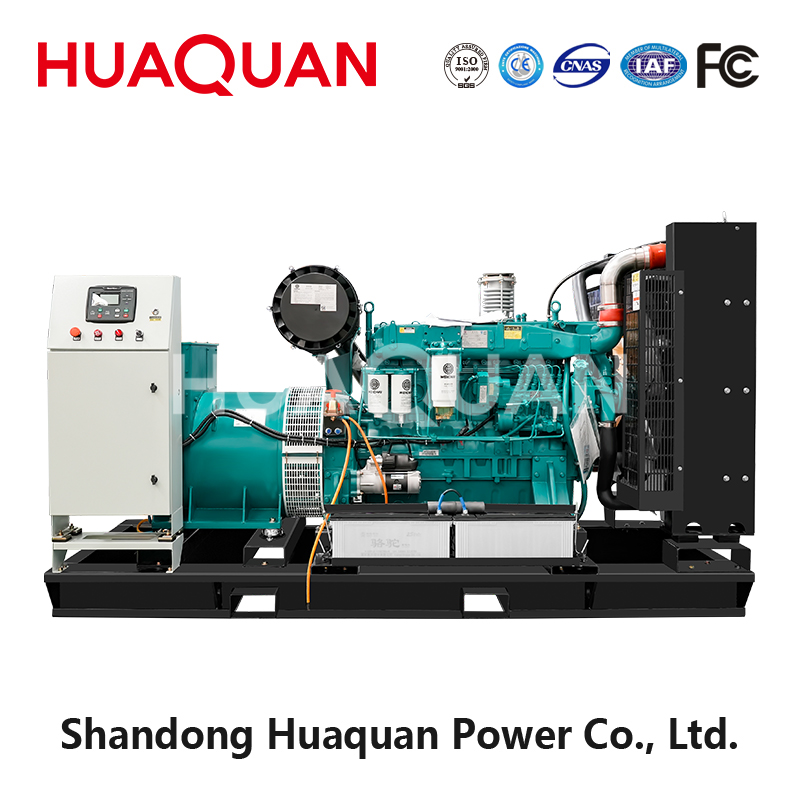
Additionally, Huaquan Power generators include automatic battery chargers that maintain the float voltage within the optimal range. Consequently, batteries remain fully charged during extended standby periods, preventing the sulfation that causes most premature battery failures.
Frequently Asked Questions
Q1: How long do diesel generator starting batteries typically last?
Huaquan Power starting batteries typically last 3-5 years for flooded lead-acid types and 5-8 years for AGM types under proper maintenance conditions. Additionally, batteries in hot environments (>35°C ambient) may require replacement 1-2 years earlier due to accelerated grid corrosion. Therefore, Huaquan Power recommends annual CCA testing and proactive replacement when capacity drops below 80% of rated value.
Q2: Should I use one large battery or two smaller batteries in series?
For 24V systems, Huaquan Power always uses two 12V batteries connected in series rather than a single 24V battery. Specifically, two 12V batteries offer easier sourcing, lower replacement cost, and the ability to monitor individual battery health. Furthermore, always replace both batteries in a series pair simultaneously to prevent the weaker battery from dragging down the stronger one.
Q3: Can I add a second battery bank for redundancy?
Yes, Huaquan Power offers dual-battery starting systems as an option on all generators 100kW and above. Additionally, each battery bank connects through an isolation diode, allowing either bank to start the generator independently. Therefore, if one bank fails, the other provides full starting capability without manual switching.
Q4: What charger settings does Huaquan Power recommend for starting batteries?
Huaquan Power recommends a float voltage of 2.25-2.30V per cell (27.0-27.6V for 24V systems) for flooded lead-acid batteries at 25°C. Additionally, reduce the float voltage by 0.03V per cell for every 5°C above 25°C to prevent overcharging. Furthermore, the charger must deliver at least 2-4% of the battery’s Ah rating as continuous float current.
Q5: How does temperature affect battery capacity for generator starting?
Battery capacity decreases significantly at low temperatures—approximately 20% at 0°C and 40% at -18°C compared to the 25°C rating. Additionally, the engine oil viscosity increases at low temperatures, requiring more cranking torque simultaneously when the battery delivers less. Therefore, Huaquan Power applies a 1.5× sizing factor to battery capacity for generators installed in climates where temperatures regularly drop below -10°C.
In summary, proper battery capacity rating and maintenance are essential for diesel generator starting reliability. Huaquan Power recommends three key practices: (1) Size batteries at 1.5 times the minimum calculated CCA requirement, (2) Test battery capacity quarterly and replace at 80% of rated CCA, and (3) Maintain proper float charging to prevent sulfation during standby periods. For expert guidance on generator starting batteries, contact Huaquan Power at +86-159-0536-0210 or visit huaquanpower.net.