
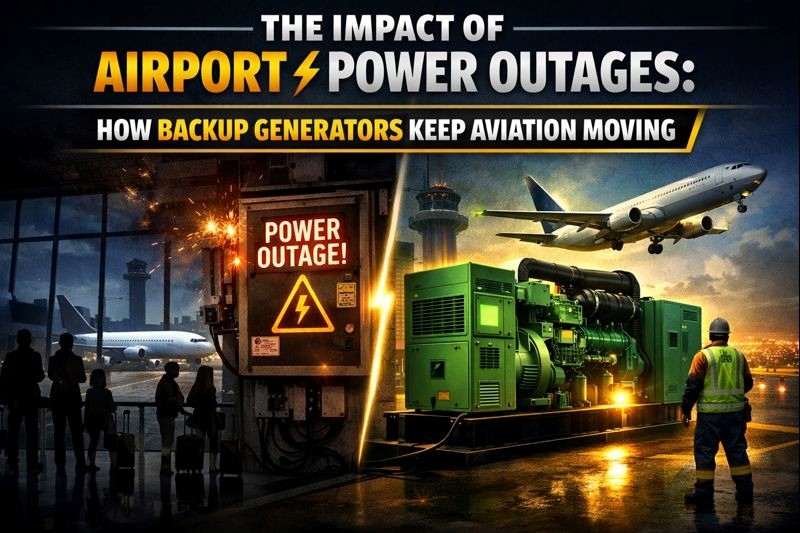
Imagine an airport without power. No flight information, no security scans, and zero runway lights. For today’s aviation world, a stable electricity connection is not a convenience in airports. It is the actual foundation for everything going around you.
Any interruption and it will turn into a massive cascade for thousands of travelers instantly. That’s where backup Generators provide an indispensable safety net that keeps global aviation safe and on schedule.
Why Airports Cannot Afford Power Failures
From the outside, airports look the same as other countless buildings operating around us. But, in reality, a lot more is going on within their complex setups. Any power loss can instantly stop all the moving parts that make an airport work.
Air Traffic Control Risks
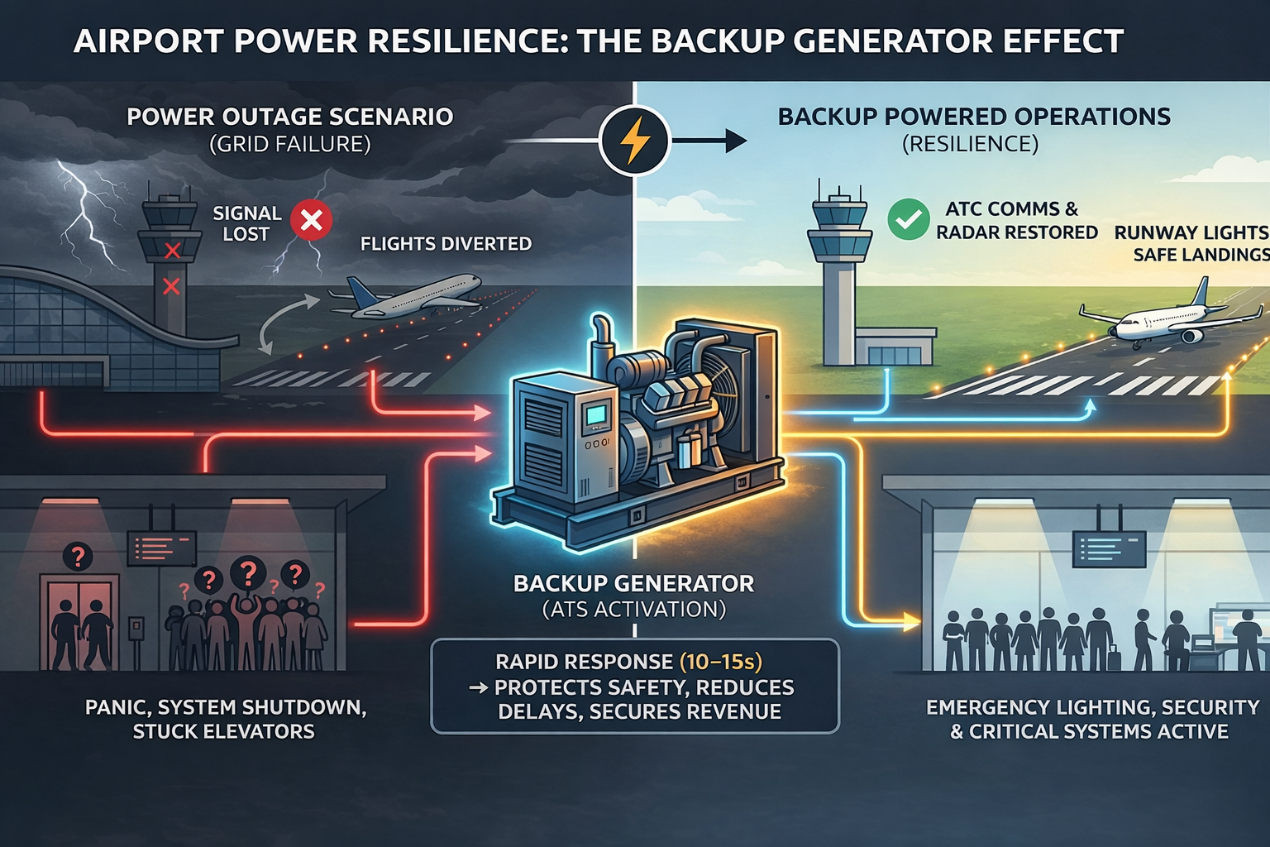
Air traffic control completely crashes in case of any sudden power fluctuation. Controllers are unable to locate the moving aircraft’s positions without their radar systems. If the radios aren’t powered up, none of the pilots can receive landing instructions. All the runway lights that help a pilot to land safely are no longer working, adding to the ongoing problems. It means no safe landings are possible during night or extreme weather conditions.
Passenger Safety And Comfort
Who’s not scared of darkness? At the airports, without light, the crowded terminals create a nasty mess. Passengers knock into each other, even stumble in the dark halls. Escalators to elevators, everything stops instantly. The passengers are stuck there until the power returns. Also, the security staff struggle as no screening equipment works without light. It means all the passenger processing processes must be stopped immediately.
Operational Disruptions
According to international laws, no plane can take off without ground support and clearance. Imagine if there were no backup generators installed throughout the airports, it would turn the global flight schedule upside down. No baggage conveyor belts work, making countless bugs stuck inside the machinery. The flight attendants are clueless without boarding scanners. Resultantly, massive queues are waiting to board the plane.
Common Causes Of Airport Power Outages
Now comes the question: if you operate within an airport, what’s the number one threat to your grid connection? Obviously, it’s a power outage. Usually, during extreme weather conditions like ice storms or lightning, the transmission lines crash down. Even regional power grids are unable to connect during extreme heat waves.
Sometimes, construction workers accidentally cut underground cables while digging for some expansion projects for the airport. Over time, like everything else, there might be some internal faults in your cables. Or, after years of usage, the switch gear or transformer might fail, leading to unexpected airport power outage problems.
What Happens During A Power Outage At An Airport
The results are chaotic and immediate. Everything is black. From screens to automated doors, none of the operators work. Generally, airports have installed emergency lighting to guide people to walk towards the exit doors. Air traffic controllers redirect the ongoing flights to some other cities or nearest airports as the runways are no longer safe for a smooth landing. Security teams activate lockdown in specific areas to avoid any unauthorized access during this blackout.
The Role Of Backup Generators
Backup generators are the power saviors when light’s not there. Simply, you can think of these lifesavers as your first line of defence if something goes wrong and the airport experiences a sudden power outage.
What Are Backup Generators?
According to the humongous size of airports, the backup generators are gigantic industrial engines, and electrical engineers connect to your infrastructure. From natural gas to diesel, they work efficiently on both mediums. For a standby power mode, these generators effectively work for at least 24 hours if there is no power. The airport electrical staff connects these generators directly to the distribution panels, so the current supply is throughout the building.
How Fast Do They Respond?
Speed is everything in aviation for maximum safety. An Automatic Transfer Switch (ATS) smartly detects any fluctuation immediately. Then it sends a signal to your backup generator instantly to start. The engine sparks to full speed and restores the power within less than 10 to 15 seconds.
Critical Airport Systems Powered By Generators
Now, it is not possible to power up every device inside the terminal. Thus, you must efficiently prioritize all safety systems according to the level of urgency.
| System Priority | Examples | Power Requirement |
| Critical (Must Run) | Runway Lights, Control Tower, Fire Alarms | Immediate (Seconds) |
| Essential (Should Run) | Security Checkpoints, Data Centers, Emergency HVAC | Short Delay (Minutes) |
| Non-Essential | Retail Shops, Decorative Lighting, Comfort Cooling | Not Powered |
Taxiway and runway lighting make sure all the moving planes can easily navigate onto their routes. Air traffic controllers operating the control tower must have powerful metrological equipment and radios. Other devices like fire alarms, life safety systems, and smoke exhaustion, you can activate everything onto the backup generators. The airport security activates their cameras and control locks online to keep everything moving.
Benefits Of Backup Generators In Airports
When you are buying a solid power backup system, you are investing money in more than something that illuminates lights around you.
Ensuring Passenger Safety
At airports, different security teams ensure passenger safety. With backup generators on board, there is never a panic situation as all terminals instantly light up if the power is lost. Everybody can look around. During sudden, accidental situations like fire or other dangers, you can immediately activate the safe evacuation plan. Also, the airport management can make direct emergency announcements within the crowds to disperse them effectively.
Maintaining Flight Operations
With powered navigation help, planes can make safe landings. Ground crew groups can continue refueling and servicing the aircraft without any interruption. Ultimately, you do not suffer from any logistical nightmare of accommodating thousands of stranded passengers.
Protecting Airport Revenue
Every minute of downtime costs thousands of dollars to the airline. With the backup generator on board, avoid unnecessary compensation claims for cancelled flights. Even some restaurants and other shops continue providing services to the stuck passengers. Ultimately, saving your airport’s overall reputation and income.
Challenges And Limitations
A backup power plant is not a one-time installation plan solution. To handle long term power outages, you must store huge amounts of diesel or natural gas. Keep an eye on all your engines and test them weekly to see if they are working fine or not. Power generators are extremely loud and emit excessive heat near the terminals. And you cannot air-condition the food courts during an emergency.
Modern Improvements In Airport Backup Power
With each day passing, the technology is trying its best to revamp and create better, smarter and cleaner power backup systems. Now, there are some hybrid systems that help backup generators to work on solar panel energy. It helps airlines cut down on extra fuel consumption. If you have installed a highly massive UPS system, you can easily chase down the 10-second gap before the generator’s fuel runs out. With the expert IoT sensor technology, you can now monitor your engine’s health to evaluate any failure even before it occurs.
Real-World Examples
History shows us the cost of failure. A fire at Hartsfield-Jackson International Airport in 2017 disabled both primary and backup power. Thousands of flights were cancelled because the redundancy was not separated physically. JFK Terminal 1 closed for days in 2023 due to a panel failure. These events prove that redundancy requires careful planning.
Conclusion
Airports are designed with highly sensitive infrastructure; nobody can think of stopping or pausing them. So, installing a backup generator is not an optional thing. They help ensure your airline’s operations continuity with maximum safety.
Stand by power technology reliable enough to handle at least 24 hours, the airlines ensure their passengers’ journey is safe even if the utility grid fails due to an unexpected, sudden issue. Make sure none of your crucial infrastructure turns black with our industrial grade and effective power backup solutions.
Contact HuaQuan Power today for a custom aviation backup generator quote.
Airport power outages are not just inconvenient—they are aviation safety events. When Terminal 5 at London Heathrow lost power in March 2025, over 1,200 flights were affected and the financial impact exceeded £50 million. From runway lighting and air traffic control radar to baggage handling systems and passenger check-in kiosks, every airport function depends on uninterrupted electricity. Backup generators at airports must meet unique requirements: NFPA 110 Level 1 compliance, 10-second start and load transfer, coordination with UPS systems for no-break transfer to critical loads, and capacity to handle the enormous starting surges of airfield lighting circuits and jet bridge motors. This article examines how backup generators keep aviation moving when the grid fails.
⚡ Explore Related Solutions
- ? 500kW Diesel Generator
- ? 1000kW Diesel Generator
- ? 500kW YC Diesel Generator
- ? SC (SDEC) Series
- ? WF (Weifang) Series
- ? Data Center Generator Solutions
? Need a customized solution? Contact our engineering team for project-specific recommendations.