Introduction
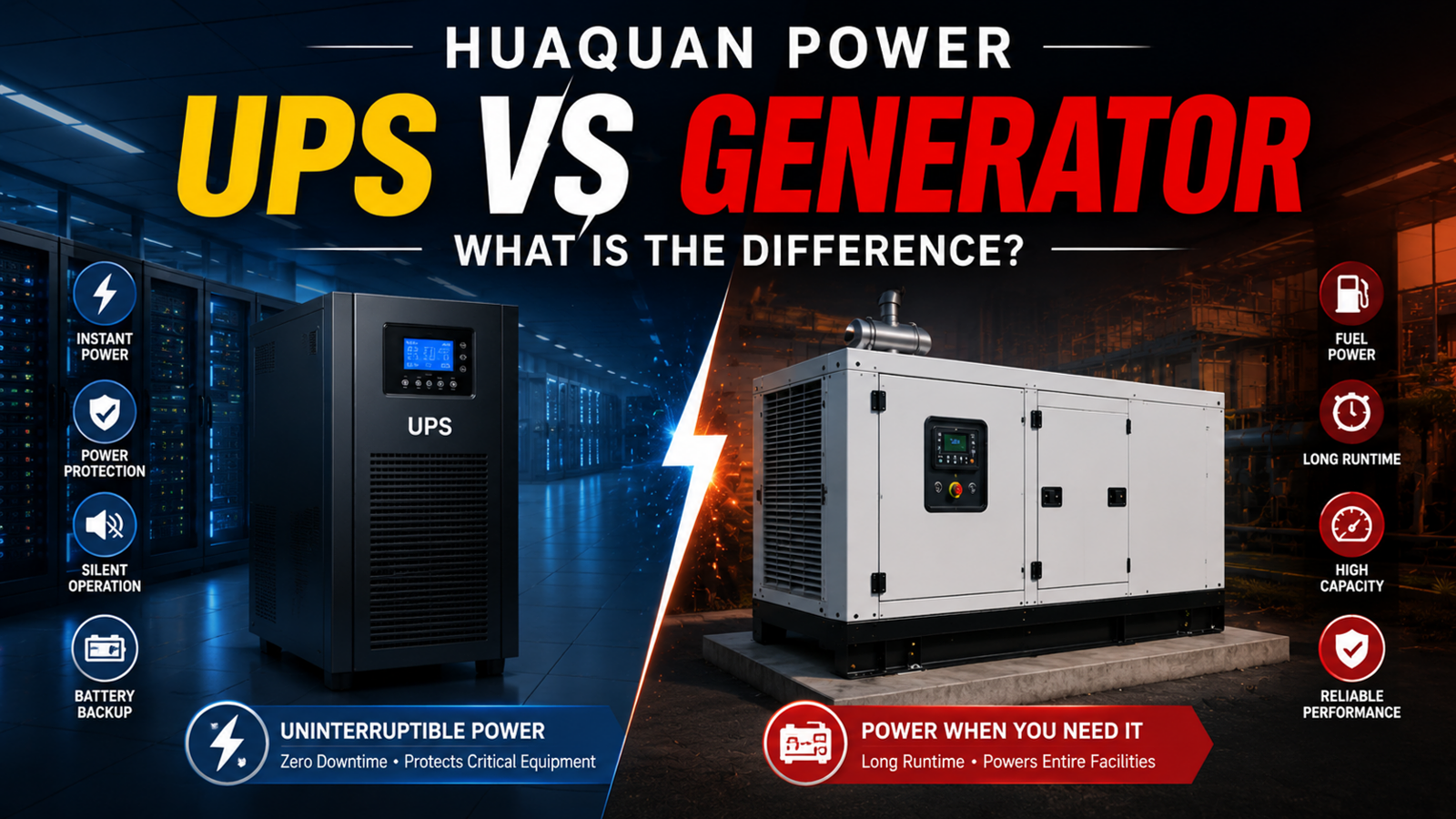
Whether it is a residential area or a commercial sector, non-stop electrical supply is crucial. But there are two key backup options available to the public. One is the UPS(uninterrupted power supply), and the other is the generator, offering seamless performance.
Aujourd'hui, we will set a head-to-head comparison between the two factors and know which one is the best choice.
What is a UPS?
UPS is an uninterrupted power supply source required for instant power to your Maison or commercial appliances.
A UPS comes with a set of batteries that store the power and feed it to the system until the battery storage ends.
There are a few applications of the UPS in different industrial sectors.
- Ordinateurs et serveurs
- Centres de données
- Matériel médical
- Telecommunications systems
- Systèmes de sécurité
- Network devices
- Industrial control systems
What is a Generator?
A generator is a giant energy source that offers a consistent energy supply to the device for longer runtimes. There is no battery source. The fuel combustion generates electricity for extended periods.
Depending on the fuel source, there are a few types of Générateurs.
- Diesel
- Gaz naturel
- Propane
- Essence
- Biogaz
Generators are typically used in the following applications.
- Maisons
- Bâtiments commerciaux
- Manufacturing facilities
- Hôpitaux
- Chantiers
- Entrepôts
- Centres de données
- Agricultural operations
UPS vs Generator: Ultimate Differences Between Them
UPS vs Generator have several differences. We have evaluated each difference and understood the key differences between the two.
| Fonctionnalité | UPS | Générateur |
| Source d'alimentation | Batteries | Fuel engine |
| Temps de réponse | Instantané | Several seconds |
| Backup Duration | Minutes to hours | Hours to days |
| Fuel Requirement | Non | Oui |
| Niveau de bruit | Très faible | Moderate to high |
| Émissions | Aucun | Produces emissions |
| Entretien | Faible | Moderate to high |
| Coût initial | Lower for small loads | Plus haut |
| Operating Cost | Faible | Fuel costs involved |
| Suitable for Long Outages | Non | Oui |
| Suitable for Sensitive Electronics | Excellent | Good when properly configured |
| Évolutivité | Limited by battery capacity | Easily scalable |
Différence #1: Source d'alimentation
The very first difference is the power source. It defines the power production method and storage systems, especially in the UPS.
UPS
A UPS uses batteries to store energy and discharge it whenever needed for the appliances. The stored electricity is DC, while the discharge occurs when the DC is converted into AC.
Souviens-toi, UPS doesn’t generate electricity. Plutôt, it stores it in the batteries and provides it during power outages.
Générateur
A generator works differently. Par exemple, it generates electricity instead of storing it through fuel consumption methods.
As long as there is fuel, the generator keeps producing electricity.
Verdict: In the UPS vs. generator comparison, the generator is a winning choice at this moment.
Différence #2: Temps de réponse
Response time is the critical time from the power outage to the power supply. It determines how fast the power source can supply the electricity.
UPS
UPS is already famous for its uninterrupted and non-stop energy supply.
It features:
- Instant power transfer
- Zero interruption
- Millisecond switching
Most people won’t even notice if there has been a power outage due to instant switching and power supply.
Générateur
Comparé à cela, a generator requires time to:
- Detect outage
- Démarrer le moteur
- Reach operating speed
- Stabilize voltage
- Transfer load
Donc, it takes 5-30 seconds for a generator to start up and provide power supply.
Verdict: UPS is the best option if you want instant power supply.
Différence #3: Backup Duration
Do you want a constant energy supply for several hours? Don’t worry at all. We have compared UPS vs Generator to know which one stands out.
UPS
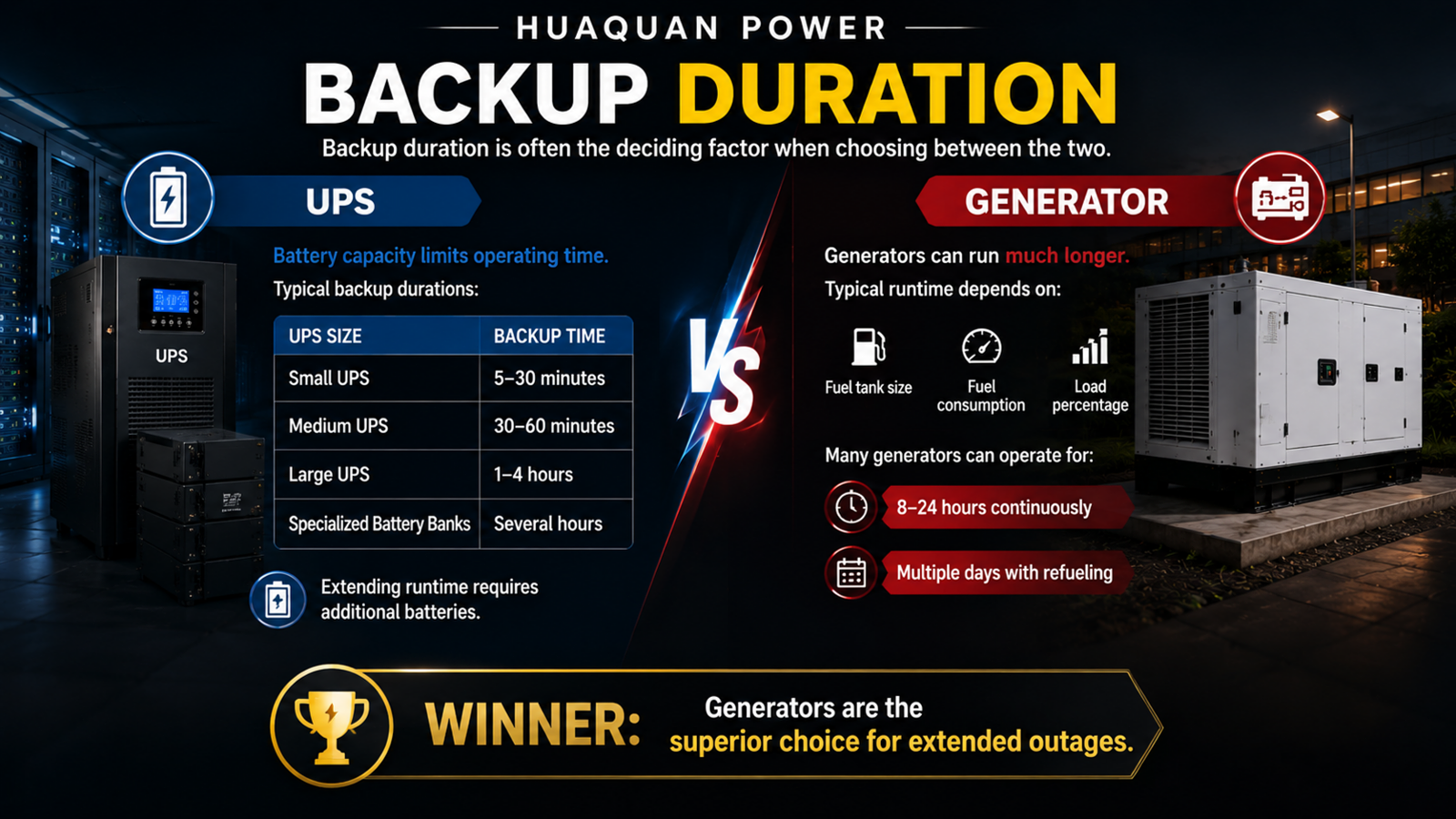
UPS is a good source of energy for a few hours. This is because of the battery storage. De plus, its runtime depends largely on:
- Number of batteries you have installed.
- Capacity of each battery and storage options
As long as batteries have power, UPS will provide energy.
Générateur
D'autre part, a generator offers constant energy as long as you keep it refueled. Donc, a generator can work for 8-24 hours or even 48 hours depending on the situation and refueling.
Winner: Generator is the best choice if you are looking for a constant electrical supply for extended hours.
Différence #4: Capacité de puissance
If you are buying the UPS or generator for your large commercial or industrial uses, the power capacity matters a lot. Both differ here.
UPS
UPS doesn’t offer a large power capacity. It can power the following devices:
- Individual devices
- Computer rooms
- Small equipment groups
- Critical electronics
If you increase the capacity, it would be much more expensive compared to its counterpart, générateurs.
Générateur
A generator is famous for its high power generation and capacity. It can power your home appliances ranging from 5-20kW or work on industrial requirements reaching more than 1MW.
Verdict: In our UPS vs Generator comparison, the generator is a clear-cut winner for the given power supply.
Différence #5: Fuel Requirements
Do you handle the fuels? It is an extra hassle for the people, as you must provide it on time.
UPS
The good news is that UPS comes with a pair of batteries and automates the power supply. There is less or no concern with the refueling of the system. You can upgrade or expand your system seamlessly.
Générateur
Generators don’t work like that. It requires timely refueling depending on the following types of fuel.
- Diesel
- Gaz naturel
- Propane
- Essence
Fuel management is a crucial step at this point.
Verdict: If you are looking for a hassle-free energy supply, choose the UPS in the UPS vs Generator comparison.
Différence #6: Installation Complexity
Installation requirements and complexity can decide whether you should have the UPS or a generator.
UPS
UPS is straightforward to operate. You must connect the wires to the batteries and your power system. Place it in a well-ventilated space, and you are good to go. No more tension.
Générateur
D'autre part, generators have a complex installation process. You have to hire experts to assess your installation space and make up an ideal space. De plus, connections and other installation factors are more technical to manage.
Verdict: UPS is simpler to install and manage compared to a generator.
Différence #7: Exigences d'entretien
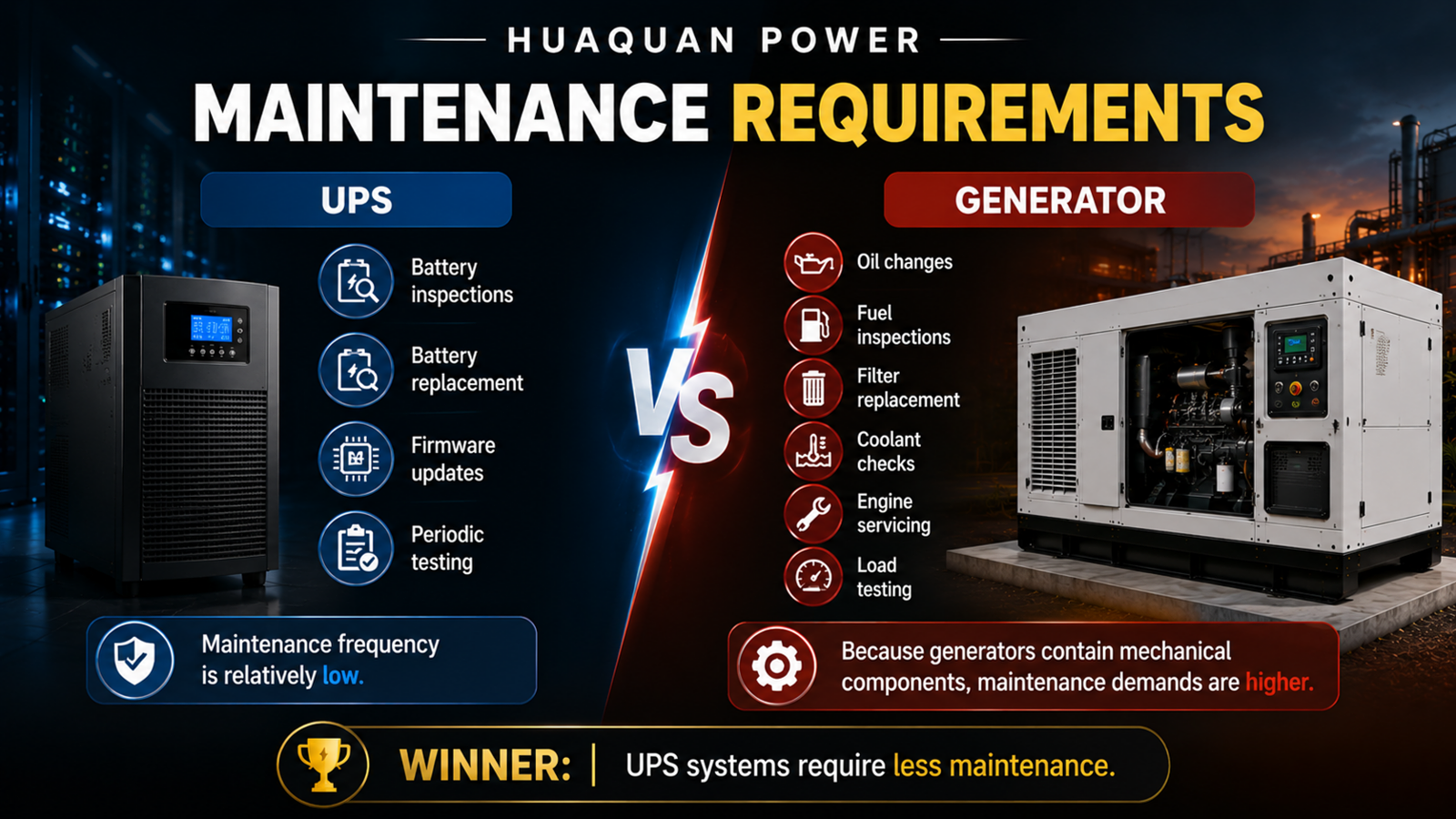
Whether it is a UPS or a generator, you have to thoroughly maintain the system. Let’s know the maintenance of both.
UPS
UPS involves a few maintenance hassles, tel que:
- Battery inspections
- Battery replacement
- Firmware updates
- Periodic testing
The maintenance frequency is pretty low.
Générateur
A generator requires:
- Changements d'huile
- Fuel inspections
- Remplacement du filtre
- Coolant checks
- Engine servicing
- Test de charge
There is higher maintenance frequency because of aggressive usage of the generators.
Verdict: In UPS vs Generator, UPS are easier to maintain and use.
Différence #8: Coûts d'exploitation
Operating cost varies from generator to UPS depending on several cost types.
UPS
In UPS, operational costs typically include:
- Battery replacement
- Electricity for charging
- Routine inspections
Regular operating costs are low because of fewer inspections and maintenance.
Générateur
D'autre part, generators are more complex appliances and have the following operating costs.
- Consommation de carburant
- Engine maintenance
- Spare parts
- Lubricants
- Remplacement du liquide de refroidissement
Long hours increase the fuel costs and overall operational costs.
Verdict: UPS has low operational costs and is more beneficial.
Différence #9: Niveaux de bruit
Noise pollution is increasing nowadays. Donc, noise protection matters.
UPS
UPS generates noise, but they are very low. Only the cooling system produces a little noise.
Générateur
Generators are notorious for their noise production. The following operations cause noise production.
- Engine operation
- Systèmes de refroidissement
- Systèmes d'échappement
Verdict: In UPS vs Generator, you should prefer UPS for lower sounds. If you choose generators, buy silencing enclosures.
Différence #10: Impact environnemental
Are you looking for an eco-friendly system? Let’s compare both.
UPS
UPS is more eco-friendly due to lower emissions and minimal noise. It even has a lower environmental impact during operations.
Générateur
Comparé à cela, the generator combusts fuel and produces toxic gases and carbon emissions. Donc, it is not environmentally friendly and should be used according to the preferences.
Verdict: UPS is more eco-friendly compared to the generator.
Différence #11: Reliability During Extended Hours
How long do you need a power supply? Both generators and UPS have different power features and long-standing power systems.
UPS
UPS is suitable only for a brief period of energy supply. It can work for 5-6 hours after the power shuts down in case of smaller batteries.
Larger batteries can last up to 12 hours depending on what devices you operate. Once the battery gets discharged, your system shuts down instantly.
Générateur
A generator is a highly reliable tool for extended power shutdowns. Whether the power goes out for 12 heures ou 24 heures, it doesn’t matter to a generator. They can operate as long as you have the fuel supply available.
Donc, they are ideal for:
- Emergency facilities
- Usines de fabrication
- Hôpitaux
- Data centres
Verdict: For long-hour power shutdowns or remote areas, you should choose the generators over the UPS.
Différence #12: Equipment Protection
Do you want to save your appliances from any damage? Let’s see who can be better at protecting sensitive equipment.
UPS
UPS is an ideal tool that offers extended features, tel que:
- Protection contre les surtensions
- Régulation de tension
- Frequency stabilization
- Power conditioning
It provides stable power and doesn’t impact the devices.
Générateur
D'autre part, a generator offers rapid voltage and frequency fluctuations. Donc, it can be damaging for sensitive appliances, but most often such a case doesn’t happen.
Verdict: UPS is safer if you are looking for appliance protection.
Différence #13: Applications typiques
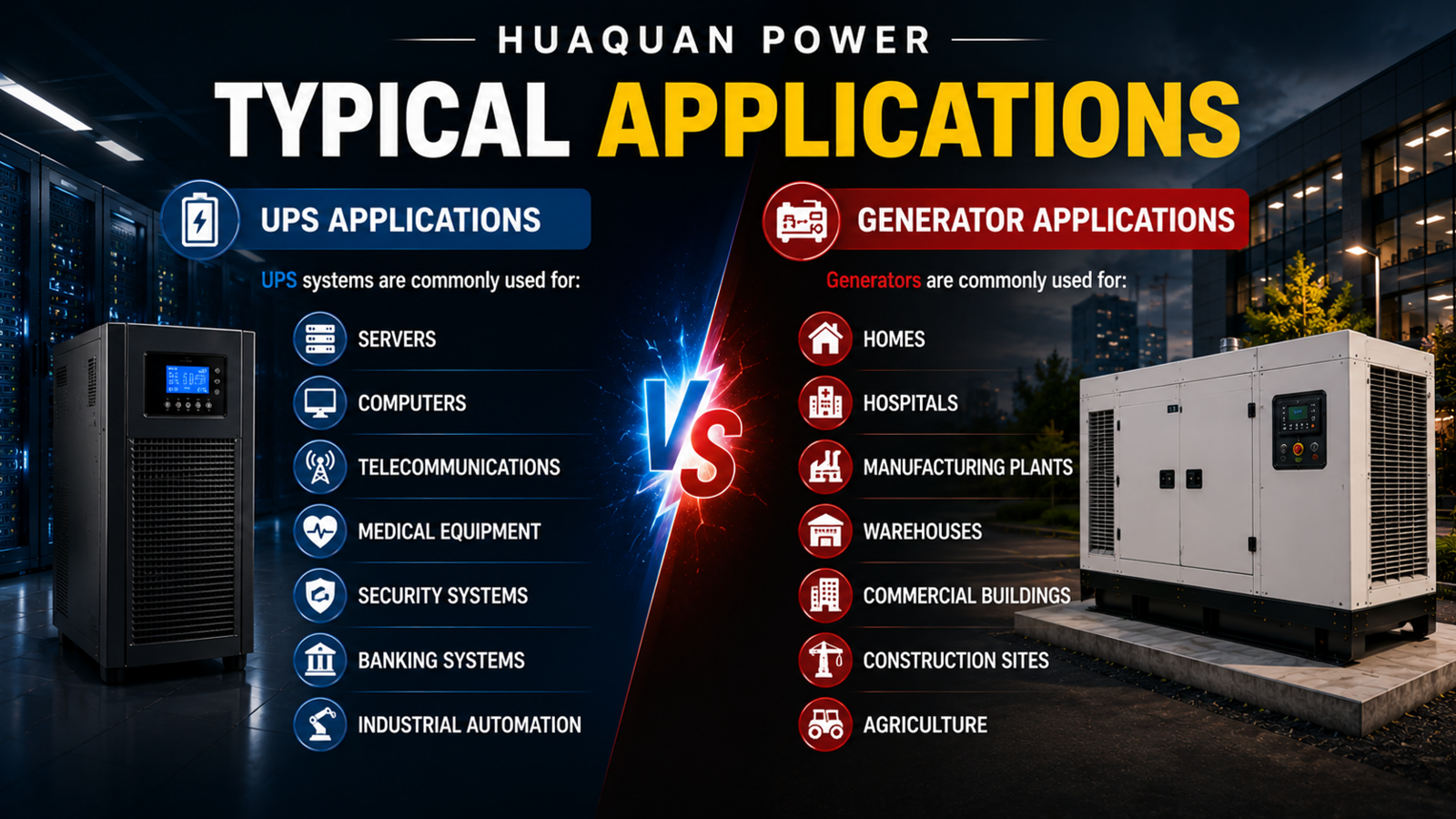
Not all applications should have a UPS or generator. We have categorized the applications of the generators vs UPS below.
UPS
UPS is suitable for the following applications.
- Serveurs
- Ordinateurs
- Télécommunications
- Matériel médical
- Systèmes de sécurité
- Banking systems
- Industrial automation
- Generator Applications
Générateur
Generators are suitable for the following applications.
- Maisons
- Hôpitaux
- Usines de fabrication
- Entrepôts
- Bâtiments commerciaux
- Chantiers
- Agriculture
When Should You Choose a UPS vs Generator?
A UPS may be the better choice when:
- Equipment needs consistent power.
- Short backup time requirements.
- Smaller loads.
- Silent operation is a requirement.
- Sensitive electronics need protection.
A generator may be the better option when:
- Long outages occur more often in your area.
- Large electrical loads need backup.
- Entire buildings have power requirements.
- Fuel storage is available.
FAQ
- Is UPS better than a generator?
It depends on the situation. If you are looking for a smaller and instant power supply, then a UPS is better. From a long-term perspective, generators offer better performance.
- Does UPS power the whole house?
Oui. UPS can power the whole house’s appliances only if you have large batteries. Sinon, UPS doesn’t offer a higher power supply for a large household.
- Why do data centers use both UPS systems and generators?
Data centres want the instant power supply that is provided by the UPS. For high runtime, generators act as a secondary support and provide seamless functionality.
- How long does UPS run compared to a generator?
UPS runs for shorter periods than a generator unless you have large-capacity batteries. It becomes more expensive to use UPS for long runtimes than a generator.
- Is a generator more expensive than a UPS?
Oui. The upfront cost of the generator is higher for smaller loads compared to the UPS. Cependant, if you compare long-term effects and larger loads, then UPS is an expensive choice.
- Does the generator damage sensitive appliances?
Non. The generator doesn’t damage appliances. Plutôt, it provides a smooth energy supply and an easygoing environment for your tools.
- Which one requires more maintenance?
The generator requires more maintenance for several reasons. It contains engines, systèmes de carburant, systèmes de refroidissement, and moving mechanical components that require optimal maintenance for efficiency.
Conclusion
In the UPS vs Generator competition, there is a clear-cut difference in the specs and features. Cependant, the selection depends more on the load types, besoins en énergie, et le temps d'exécution. If you are looking for shorter runtime but instant power supply, UPS is the kingmaker. For delayed power but longer runtimes, you should consider the generators.
Do you want to buy high-quality generators for your business? Puissance Huaquan has an exceptional range of generators with top-notch efficiency and long-term performance. Whether you want diesel pump generators or portable generators, choose them from our website right away!
⚡ Explorez les solutions associées
- 🏭 500Générateur diesel kW
- 🏭 1000Générateur diesel kW
- 🏭 500Générateur diesel YC kW
- 🔧 KMS (Cummins/Doosan) Série
- 📋 Groupes électrogènes diesel
- 📋 Processus de commande – Comment acheter
- 📋 Contactez-nous
💡 Besoin d'une solution personnalisée? Contactez notre équipe d'ingénierie pour des recommandations spécifiques à un projet.