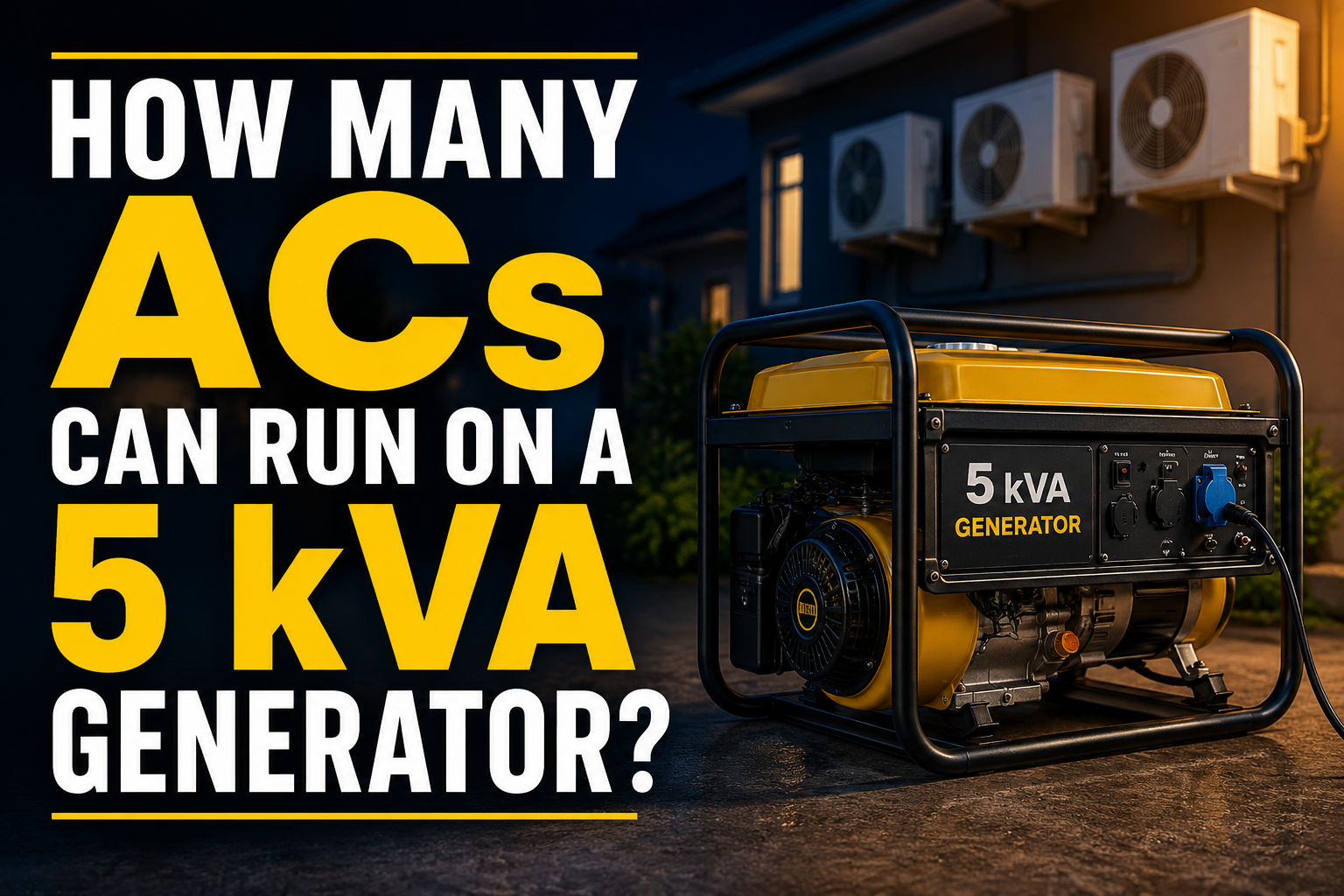
Many homeowners and business owners ask the same question during frequent power outages: Un 5 Générateur kVA run one AC unit or more than one? The answer is not always simple. It depends on the size of the air conditioner, whether it uses inverter or non-inverter technology, its startup demand, its running power, and other equipment connected at the same time.
Dans la plupart des cas, un 5 Générateur kVA can run one small or medium-sized air conditioner. Running multiple AC units is possible in some situations, but it depends on their tonnage and power requirements. Ce guide par Huaquan explains how to estimate generator capacity correctly without overloading your backup system.
What does a 5 kVA Generator Mean?
Understanding the generator rating is helpful when connecting heavy appliances. People often think that a 5 kVA Generator will give 5000 watts of usable power. Believe it or not, this is not always correct. The actual output will vary with the power factor.
kVA vs kW
- kVA (Kilovolt-Amperes): It is the apparent power output of a generator.
- kW (Kilowatts): This is the actual usable power available to appliances.
The power factor of most Générateurs is approximately 0.8. Donc, un 5 Générateur kVA will yield approximately 4 kW de puissance utilisable.
Formule: 5 kVA × 0.8 power factor = 4 kW (4000 watts).
Un 5 kVA Generator Run an AC?
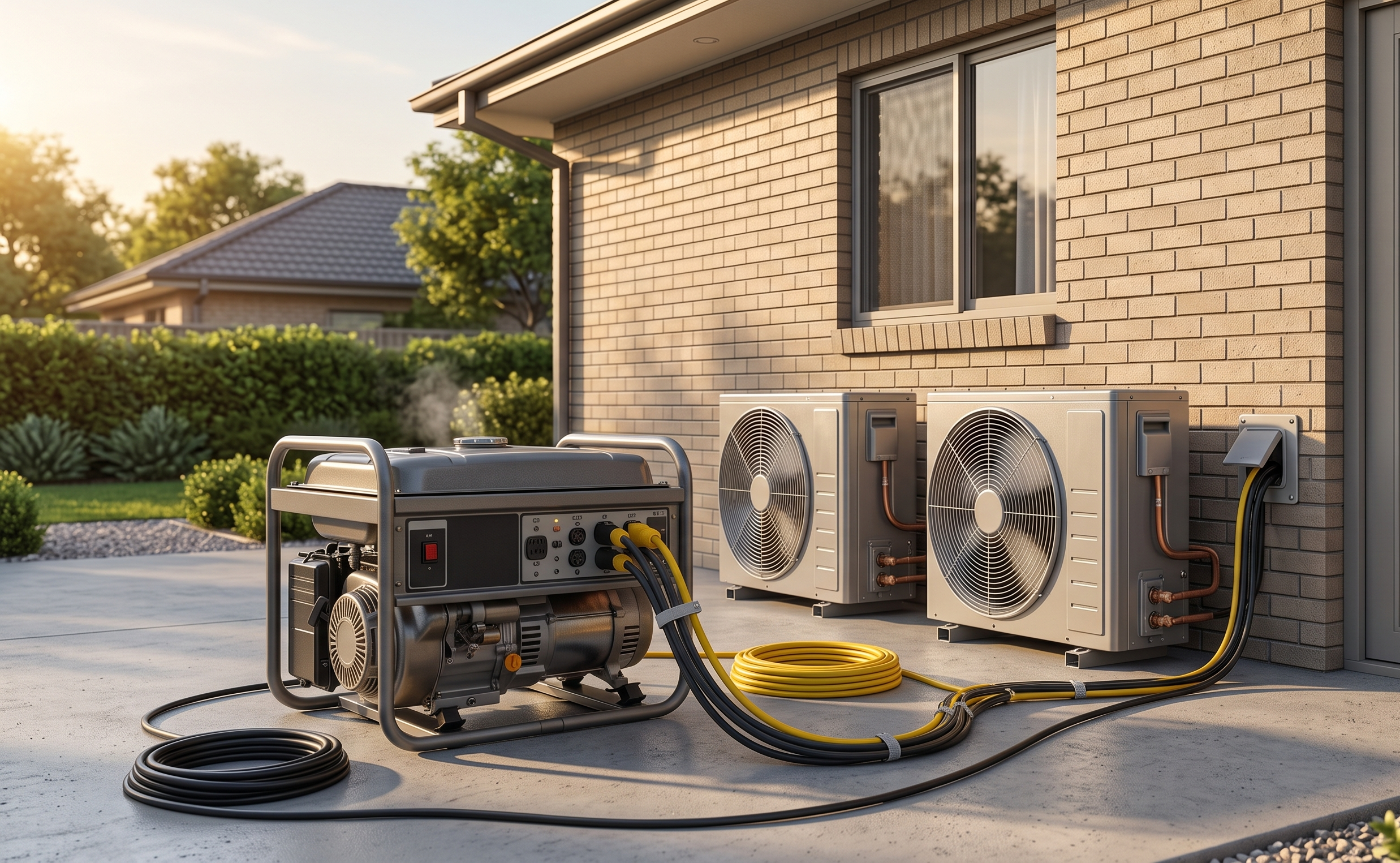
Oui, an air conditioner can be operated on a 5 Générateur kVA. The only thing that makes the difference is the AC size. A small 1-ton unit typically runs without problems. A larger 2.5-ton unit can put strain on the generator, particularly during startup.
Bien, many people are taken aback by startup power. When air conditioner compressors start to move refrigerant, they require a strong burst of electricity. For a non-inverter AC, this surge is often the reason a generator that looks big enough on paper suddenly trips the breaker.
How many AC can a 5 kVA Generator handle?
If you are connected to a system that has about 4000 watts of usable output, use the following guideline:
| AC Size | Approx Running Watts | Does it work on a 5 Générateur kVA? |
| 0.75 Ton AC | 700–1000W | Oui |
| 1 Ton Inverter AC | 900–1300W | Usually yes |
| 1 Ton Non-Inverter AC | 1200–1800W | Généralement, Oui, but the starting load matters |
| 1.5-ton Inverter AC | 1500–2200W | Possible if the load is managed |
| 1.5 Ton Non-Inverter AC | 2000–3000W+ | Risky due to high starting load |
| 2 Ton AC | 2500–3500W+ | Usually not recommended |
Un 5 kVA Generator Power Two AC Units?
Sometimes it can. If both air conditioners are small inverter models and the operating load does not exceed the generator’s limit, it may be possible to run them. The main thing is to make sure that both compressors don’t start at the same time.
En général, two non-inverter AC units are not recommended to be run at the same time. Their combined startup demand can exceed the generator’s capacity and trip the breaker before the two units reach normal operating conditions.
Exemple 1: One 1 Ton AC
A single 1-ton AC and Lumières LED, ceiling fans and a television can be operated easily from a 5 Générateur kVA.
Exemple 2: One 1.5 Ton AC
It is possible that a 1.5-ton inverter AC can also operate smoothly. Do not add heavy appliances like refrigerators or microwaves, cependant, as this will decrease the available safety margin.
Exemple 3: Two 1 Ton AC Units
This setup is only possible under certain conditions. They should both be efficient inverter models and the generator should have good surge capacity. Older non-inverter systems involve much higher startup demands. If both compressors start at the same time, it will probably trip the breaker.
Why Starting Load Is Important for AC Units
All air conditioners have an electric motor to compress refrigerant. That motor, from a complete stop, has a lot of resistance. Breaking that resistance takes a brief burst of electricity, called the starting load.
Startup demand may be 2–3 times greater than the normal running load. A non-inverter AC operating at 1500 watts peut, par exemple, exiger 4500 watts during startup. Cependant, if the generator is not able to provide that surge, then breakers can trip, engine RPM can drop drastically, et sensitive electronics may be affected by voltage fluctuations. When matching an air conditioner to a generator, it is important to recognize the air conditioner’s startup requirement.
Inverter AC vs Non-Inverter AC on a 5 Générateur kVA
The type of air conditioner connected to your generator matters more than many people realize. Two AC units with the same cooling capacity can place very different demands on a backup power system simply because of the technology inside them.
Inverter AC
- Gradual start-up: The compressor will not start all the way to maximum speed. This greatly decreases startup spikes.
- More energy efficient: The compressor will vary its speed depending on the cooling demands instead of repeatedly turning off and on.
- More efficient for generator systems: Reduces the amount of generator capacity needed and runs more smoothly when power is fluctuating.
Non-Inverter AC
- More startup power: The compressor will start at full load and produce a large spike in power.
- More pressure on the generator: The constant stopping and hard-starting put severe mechanical strain on the generator engine.
- May cause voltage drops: Lights may flicker and sensitive electronics may react when the compressor kicks in.
- Not suitable for small generators.
What Else Can Run With AC on a 5 Générateur kVA?
It is possible to connect several small household items without issues if your 5 kVA Generator is primarily used for a single air conditioner.
Small loads may still be run, y compris:
- Lumières LED
- Ceiling fans
- Téléviseurs
- Wi-Fi routers
- Phone and laptop chargers.
Cependant, the following should be avoided:
- Electric irons
- Microwaves
- Electric water heaters
- Heavy well pumps
- Washing machines
- A second large AC
A lot of overload problems occur when an individual installs an additional high-demand appliance without adding up all the loads. All may look well until another motor starts up and exceeds the generator’s capacity.
Safe Load Example for a 5 Générateur kVA
This is a balanced electrical load for a system providing approximately 4000 watts of usable output:
- 1 Ton Inverter AC: 1200W
- 4 Ceiling Fans: 300W
- LED Lights (6 rooms): 200W
- LED TV: 150W
- Wi-Fi Router: 30W
- Réfrigérateur: 700W
- Charge totale de fonctionnement: 2580W
This configuration allows about 65% of the generator’s continuous capacity. Now that leaves 1420 watts available to absorb startup surges from the refrigerator and AC without tripping breakers.
Signs Your Generator Is Overloaded
Generators typically give out some warning prior to a total shutdown. By paying attention to them, you can avoid equipment damage.
Watch for these signs:
- The engine abruptly becomes louder and more strained.
- Lights start to dim or flicker.
- Le AC compressor repeatedly shuts off.
- The main breaker trips unexpectedly.
- The connected devices are hotter than usual.
- Fuel consumption rises noticeably.
If any of these symptoms occur, reduce the electrical load right away. Running the generator under overload may reduce its life and increase repair costs.
Tips to Run an AC Safely on a 5 Générateur kVA
- Sequence your startups: Démarrer le générateur, let it stabilize, turn on the AC first, and then add smaller loads like lights and fans.
- Do not start multiple AC units at the same time: If you must run two small inverter units, let the first one run for five minutes to settle its power draw before turning on the second.
- Use inverter ACs if possible: They are vastly superior for backup power systems.
- Keep the generator well-maintained: A poorly maintained engine produces less actual kW power. Check oil, filtres, and fuel regularly.
- Avoid running at 100% capacité: Continuously maxing out the generator will overheat the alternator and shorten the machine’s lifespan.
- Use proper wiring and circuit protection: Ensure your Maison transfer switch is professionally installed.
- Ask a technician: Have an electrician calculate your exact load before installation to prevent expensive mistakes.
Best AC Size for a 5 Générateur kVA
Considering safety and reliability, it is advisable to go for a 1 ton AC for a 5 Générateur kVA. It provides sufficient back-up power for essentials like lights, les fans, réfrigérateurs, communication, etc..
A 1.5-ton inverter AC might be suitable as well. But depending on the model, respective start-up conditions and any other equipment that is connected to the generator.
Wrap Up! 5 Générateur kVA
With proper load management, it is possible to easily operate one Air Conditioner with a 5 Générateur kVA. Knowing watts, startup surges and total electrical use will help to avoid overloads and ensure safe equipment operation. A 1-ton AC is considered to be the safest, and efficient inverter models are the best overall.
Planning to run AC units on a generator? Contactez-nous today for help with load calculations, generator sizing and backup power options for your home or business.
FAQ
Un 5 kVA generator run a 1.5-ton AC?
Oui. A 1.5-tonne inverter AC can be happily operated on a 5 Générateur kVA. Other heavy appliances should be kept to a minimum during the operation of the AC, cependant.
Un 5 kVA generator run two 1-ton AC units?
If both units are efficient inverters and the total load remains within the capacity, it may be possible. En général, it is not advisable to use traditional non-inverter units as the start-up surge may cause overloading of the generator.
Est-ce qu'un 5 kVA generator enough for home use?
Oui. UN 5 kVA unit produces about 4000 watts of usable power. This will power the essential appliances in your home, such as refrigeration, lumières, les fans, Téléviseurs, and one small air conditioner.
Which AC is more suitable to use with a generator?
The inverter AC is usually the most suitable option as it is more power efficient, starts smoothly and reduces the strain on backup equipment.