Introducción
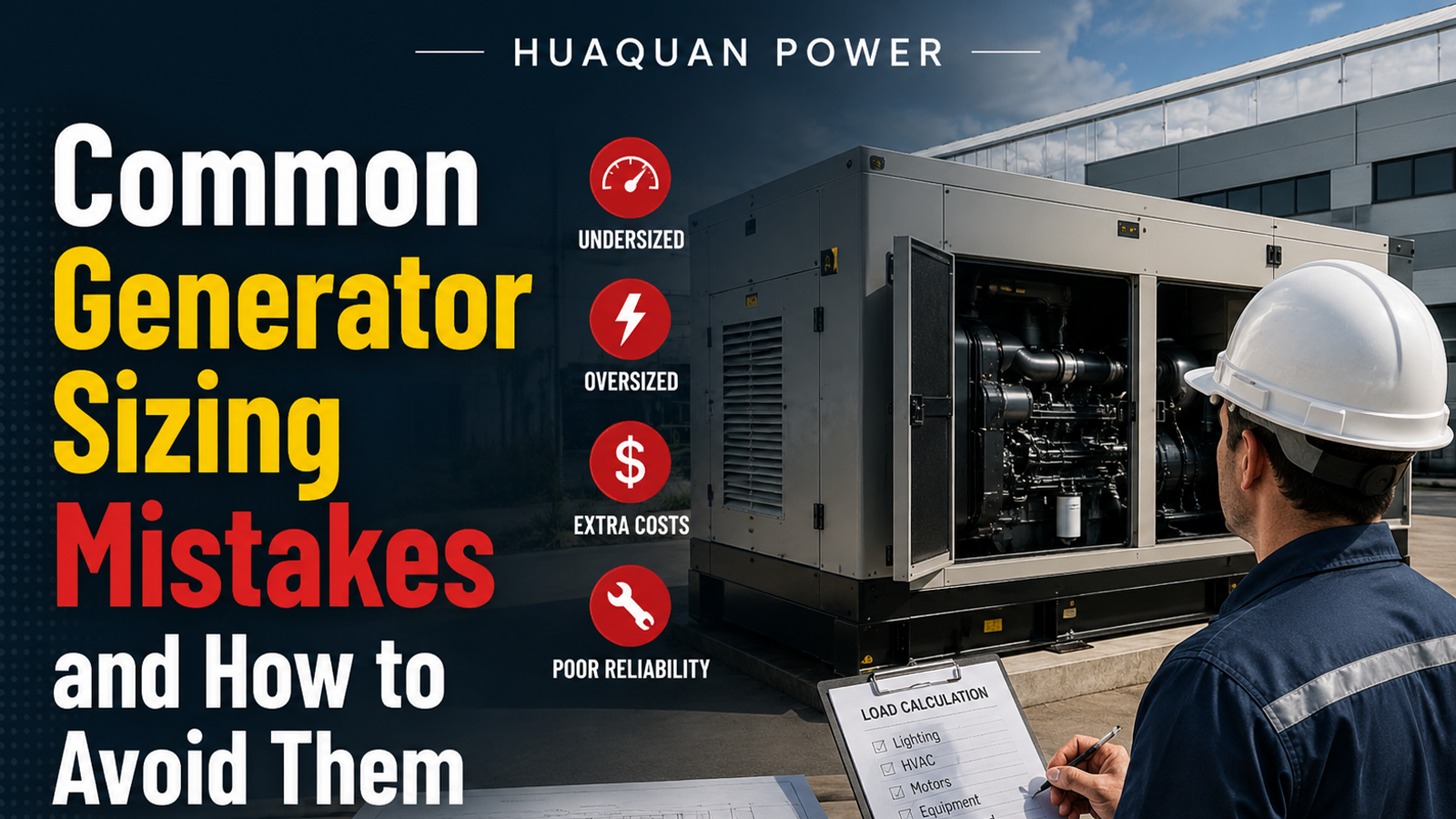
Whenever buying a generator, it is not about the power load, maximum power, or peak power consumption. En cambio, most people don’t focus on generator sizes for their projects and end up making sizing mistakes.
Today we will understand the critical generator-sizing mistakes and learn a few tips to avoid them and select the right generator.
Understanding Generator Capacity Basics
Before you buy a generator, understand the fundamentals of generator sizing to avoid common mistakes.
These are:
Kilovatios (kilovatios)
Kilovatios (kilovatios) is the actual power consumption by the devices. Por ejemplo, you are operating ten devices at your Hogar. Each one consumes 100 vatios.
Entonces, the total energy consumption will be 1kW. You should evaluate each device’s power consumption.
Kilovolt-Amperes (kVA)
Kilovolt-ampere is the apparent power of a device. The calculation formula is simple.
kW = kVA × Power Factor
Power factor is often fixed around 0.8. Suppose a system consumes 100 kVA; the kW of that system will be 80 kilovatios.
It is essential to understand kVA and how power, Voltaje, and current are related.
Carga en funcionamiento
Is your device running at a constant load during normal hours? That is a running load. Por ejemplo, a device has a 100-watt running load.
Carga inicial
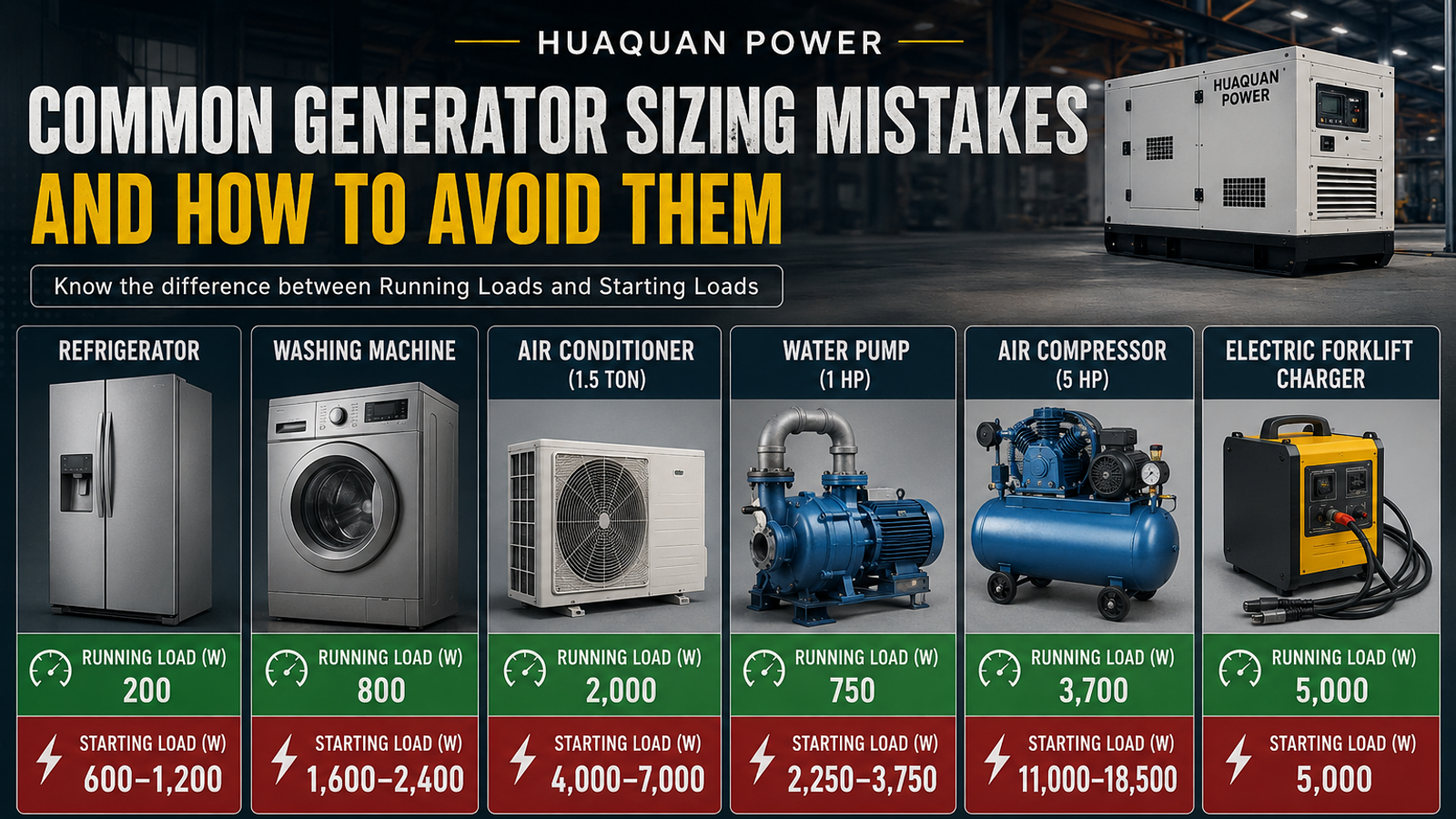
Starting load differs from the running load and is often a spike that occurs when the device starts. It can be 2-7 times the running load, posing challenges for your operating system.
| Equipo | Carga en funcionamiento (W.) | Carga inicial (W.) |
| LED Light Bulb | 10 | 10 |
| Ceiling Fan | 75 | 150–225 |
| Refrigerador | 200 | 600–1,200 |
| Deep Freezer | 300 | 900–1.500 |
| Washing Machine | 800 | 1,600–2,400 |
| Air Conditioner (1 Tonelada) | 1,200 | 3,000–4,800 |
| Air Conditioner (1.5 Tonelada) | 2,000 | 4,000–7,000 |
| Bomba de agua (1 caballos de fuerza) | 750 | 2,250–3,750 |
| Bomba de agua (3 caballos de fuerza) | 2,200 | 6,600–11,000 |
| Compresor de aire (2 caballos de fuerza) | 1,500 | 4,500–7,500 |
| Compresor de aire (5 caballos de fuerza) | 3,700 | 11,000–18,500 |
| Commercial Refrigerator | 1,000 | 2,500–4,000 |
| Walk-In Cooler | 2,000 | 5,000–8,000 |
| HVAC Unit (5 Tonelada) | 6,000 | 15,000–24,000 |
| Electric Forklift Charger | 5,000 | 5,000 |
| Industrial Conveyor Motor (5 caballos de fuerza) | 3,700 | 11,000–18,500 |
| CNC Machine | 5,000 | 7,000–10,000 |
| Máquina de soldar | 6,000 | 9,000–12,000 |
| Table Saw | 1,500 | 3,000–4,500 |
| Sierra circular | 1,200 | 2,400–3,600 |
| Concrete Mixer | 1,000 | 3,000–4,000 |
| Concrete Vibrator | 1,500 | 3,000–4,500 |
| Jack Hammer | 1,500 | 3,000–4,500 |
| Electric Hoist (2 Tonelada) | 3,000 | 6,000–9,000 |
| Tower Crane Motor | 15,000 | 30,000–60,000 |
| Industrial Air Blower | 7,500 | 15,000–30,000 |
| Hydraulic Power Unit | 10,000 | 20,000–40,000 |
| Grain Mill Motor (10 caballos de fuerza) | 7,500 | 22,500–37,500 |
| Industrial Chiller | 15,000 | 30,000–60,000 |
| Large Manufacturing Press | 20,000 | 40,000–80,000 |
Error #1: Don’t Select a Generator Solely Based on Running Load
Running Load isn’t the sole power rating. Most people do simple math. They calculate the running power load of each device and add them up.
Based on the total power consumption, they choose a generator with 20-30% más poder.
Ejemplo
Suppose you are running three pieces of equipment in your industrial sector. Each has the following power consumption.
- Motor A = 20 kilovatios
- Motor B = 15 kilovatios
- Lighting = 5 kilovatios
When you calculate the running load, the total power requirement becomes 40kW. Most buyers purchase a generator with 40kW or 45kW.
It is a wrong choice because your Motor A might require a 120 kW starting load. With a limited capacity of a 40-50kW generator, you may experience:
- System overload and the ultimate failure of your generator.
- Motors fail to start and reach the running loads.
- Frequency automatically fluctuates due to incompatible systems.
- Sudden shutdowns occur in the system.
Tips to Avoid It
If you don’t want to repeat such generator sizing mistakes, follow our tips.
- Always calculate the overall load.
- Consider the running, peak, and starting loads of a motor.
- Consult manufacturers to understand their generator specifications and support for different load types.
Error #2: Oversizing the Generator
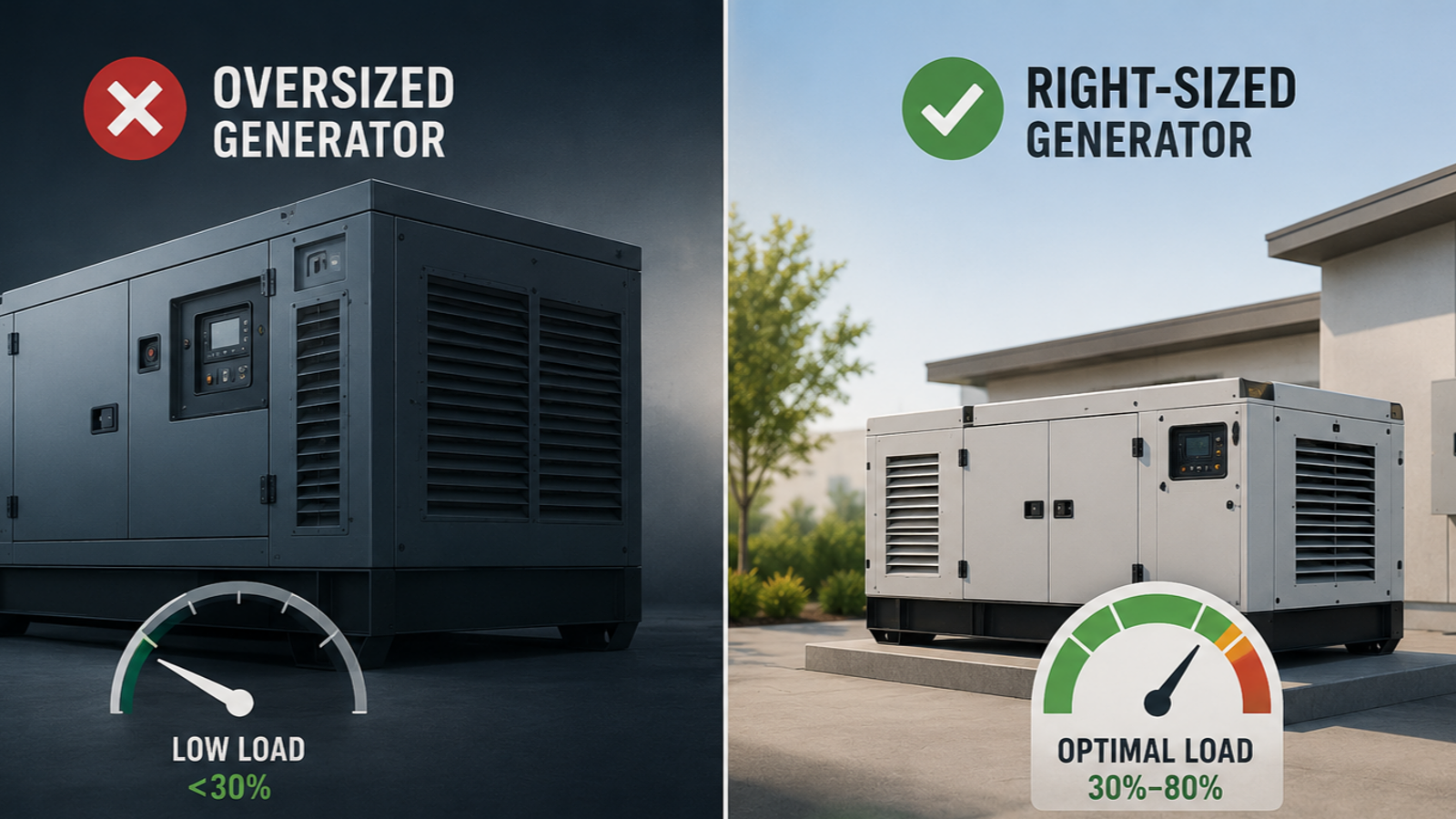
The bigger the better. This concept doesn’t apply in this case. Most people think choosing an oversized generator won’t cause any problems in the future. It may be good if you are expanding your devices in the near future, but it’s not the right choice for the following reasons.
Low Load Operation
Operating your generator at a load below 30% of its maximum capacity is considered a low load. It causes efficiency issues and decreases the output in the long run. It seriously impacts generator performance and requires more frequent maintenance.
Apilamiento húmedo
En cargas más bajas, a serious issue called wet stacking occurs. en este proceso, there are three main issues.
- Due to low loads, fuel combustion is not proper.
- Carbon deposits accumulate in the engine, affecting overall performance.
- Contaminants cause the deterioration of the internal combustion system.
High Fuel Consumption
En cargas más bajas, el Generadores’ efficiency drops dramatically. Por lo tanto, it consumes more fuel than normal. A la larga, you have to pay for the elevated fuel prices.
Elevated Purchase Costs
One of the biggest reasons to avoid oversized generators is the higher purchase costs. You have to pay a premium for the bigger engines, large alternators, and high installation costs.
How to Avoid it
Do you want to skip this mistake? Entonces, you should know your device demands and purchase the right-sized generator system. Implement correct and optimal loads for high efficiency and low fuel consumption.
Error #3: Ignore Future Expansion
Many facilities scale up their systems due to business expansion. Por ejemplo, here are a few cases.
- Additional machinery
- New production lines
- HVAC upgrades
- IT infrastructure expansion
If you don’t upgrade your generators, there are several issues, como:
- Generator overloads
- Additional generator purchases
- Expensive system upgrades
How to Avoid it!
If you want to avoid it, plan for future upgrades. Reserve an additional 10-25% of the total generator capacity.
Error #4: Overlook Motor Starting Methods
Motor starting produces high currents and needs more energy for the start. Además, starting methods decide the current requirements.
Sin embargo, here are a few methods often overlooked.
- Across-the-line starting produces the highest current and requires high-capacity generators.
- Soft starters require reduced startup currents.
- VFD drives the motors with stable acceleration and requires reduced currents.
How to Avoid it
If you want stable performance without device failures, you should consider the motor’s starting method. Also check the starting sequence.
Error #5: Ignore Power Factor
One of the top factors is the lack of understanding of the power factor. Many people ignore it and buy a system without its calculation. The result is system overload, despite the generator’s capacity being sufficient.
The power factor varies by industry and is often expressed in the following formats.
- 0.8 FP
- 0.85 FP
- 0.9 FP
Ejemplo
Let’s assume a system with a power load of 160kW and a power factor of 0.8.
Buying a 160kW generator is insufficient because:
Required power = 160 kW÷0.8 =200kW
If you deploy a generator of at least 200kW, it can then support your device smoothly.
How to avoid it
Never ignore the power factor. Measure power demand, calculate the power factor, and avoid these generator-sizing mistakes.
Error #6: Failing to Check Environmental Conditions
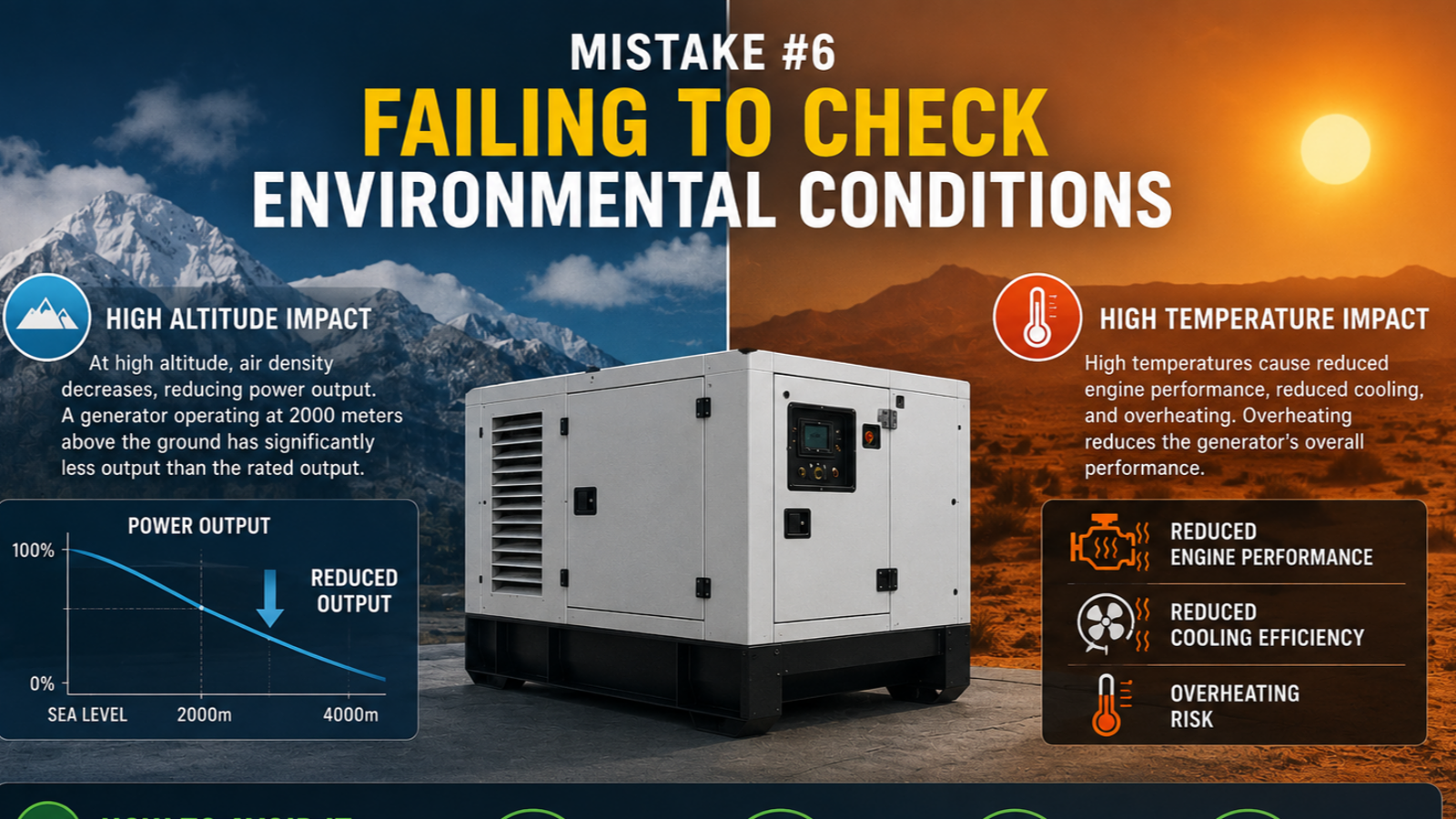
Environmental conditions can adversely impact the overall performance of the generators. High altitude and temperature have the following impacts.
High Altitude Impact
At high altitude, air density decreases, reducing power output. A generator operating at 2000 meters above the ground has significantly less output than the rated output.
High Temperature Impact
Like high altitude, high temperature also has an adverse effect on the components. Por ejemplo, high temperatures cause reduced engine performance, reduced cooling, y sobrecalentamiento. Entonces, overheating reduces the generator’s overall performance.
How to Avoid it
To combat harsh environmental conditions, you should always choose generators with the relevant features. Por ejemplo, there should be temperature-resistant features. Cooling should be faster and more efficient even in harsh conditions.
Error #7: Forgetting Load Types
Most people forget the load types as well. Don’t make generator-sizing mistakes based on load type.
Cargas resistivas
Resistive load devices include heaters and incandescent lighting. They are easier to handle with limited currents.
Cargas inductivas
Inductive Loads require a high startup current. Examples of such load-operating devices include motors, zapatillas, and compressors.
Non-linear Loads
Non-linear load-generating devices include data centres and UPS systems. They impact the generator performance.
How to Avoid it
For higher efficiency and reduced generator sizing mistakes, you should know the load types used by each device. Know where you need higher current and where stable-current devices would work.
Error #8: Using Nameplate Ratings Only
Nameplate rating causes generator oversizing. Cómo? It is simple.
Suppose a power device has a maximum rating of 50kW. It doesn’t mean it will consume 50kW during normal hours. Such devices consume 30- 35 kW during normal hours.
If you consider the nameplate rating, the following issues will occur.
- You will purchase an oversized generator.
- Actual load consumption will be less, putting it in the low-load operation range.
How to Avoid it
To avoid such generator sizing mistakes, you should test the device load in real time. Run the device and check the actual power consumption. Then sum up and buy a suitable generator.
Error #9: Ignoring Load Sequencing
Not all devices in an industrial setup start simultaneously. Más a menudo, there is an operational sequence.
Here is the sequence.
- Lighting starts
- HVAC starts
- Pumps start
- Equipo de producción starts
This approach reduces peak current demand and helps provide stable performance.
How to Avoid it!
You should analyze and learn about such sequences. Stagger large motor loads and stabilize device performance.
Error #10: Not Consulting Generator Experts
Are you a newbie or an experienced person? If you don’t have experience with generators, learn the basic knowledge and hire experts. Without consulting an expert, you might overlook the following factors.
- Motor loads
- Harmonics
- factor de potencia
- Site conditions
- Future growth
- Regulatory requirements
Consequences
Without expert help, you could make the following generator sizing mistakes.
- You might fail to calculate the correct power load for the inverters. People often make mistakes with actual load measurements.
- Landing the wrong generator capacity is typical.
- You might also go for either oversized or undersized generators.
How to Avoid it!
The simple solution is to work with the generator experts. Locate the local generator experts and know their technical reputation. Learn about their approach and work only with the experts.
Preguntas frecuentes
What happens if a generator is undersized?
If the generator is undersized, it generates less power than required. Al final, you can’t meet the required power demands, and component failure is a possible result. Además, such generators experience issues, such as overloads, caídas de voltaje, startup failures, frequent shutdowns, y posibles daños al equipo.
Does an oversized generator cause a problem?
Sí. An oversized generator is an overkill and may waste money. Because of higher capacity and low demand, it operates at lower power loads, offers decreased capacity, and presents challenges for long-term maintenance.
What is the ideal load percentage for a generator?
Anywhere between 70-85% is the ideal load percentage with maximum efficiency and impactful results. Además, if you want to run it above 85%, efficiency is good but not for the long term due to high engine stress.
Why are motor starting loads important?
Motors require a high current during start compared to their normal operating demands. Por lo tanto, a generator with that level of current is compatible. Others might fail the whole system.
How much capacity should I reserve for the future expansion?
You should reserve 10-25% of the capacity for future expansion. Sin embargo, it depends more on your future expansion plans.
How do environmental temperatures impact generator sizing?
High-temperature fluctuations can exponentially decrease engine performance and cause it to overheat. Your generator may perform less well in harsh environmental conditions.
Should generator sizing be based on kW or kVA?
Whether it is kW or kVA, both are crucial factors to know. kW gives the maximum power consumption of the devices, while kVA presents apparent power consumption with the power factor.
Does altitude affect generator actuación?
Sí. As the air density decreases at higher altitudes, generator engine power output drops, and you may experience lower efficiency at higher altitudes compared to the ground.
Is professional load analysis worth the money?
Professional load analysis reduces the generator sizing mistakes, improvez reliability, reducir el consumo de combustible, and ensure long-term generator performance.
Conclusión
When choosing a generator, you should know the most common generator sizing mistakes. Understand your generator size requirements and buy only those that are compatible, flexible, and easy to scale as your requirements change.
If you are looking for such quality generators, contacto Poder Huaquan. We offer a range of generator options for your data centres, hogares, or industrial applications. You’ll get high efficiency and premium results from such generators. Check out our generators right away!
⚡ Explorar soluciones relacionadas
- 🏭 500Generador diésel kW
- 🏭 1000Generador diésel kW
- 🏭 500Generador diésel kW YC
- 🔧 kms (Cummins/Doosan) Serie
- 📋 Grupos electrógenos diésel
- 📋 Proceso de pedido: cómo comprar
- 📋 Contáctenos
💡 Necesita una solución personalizada? Póngase en contacto con nuestro equipo de ingeniería para recomendaciones específicas del proyecto.