Einführung
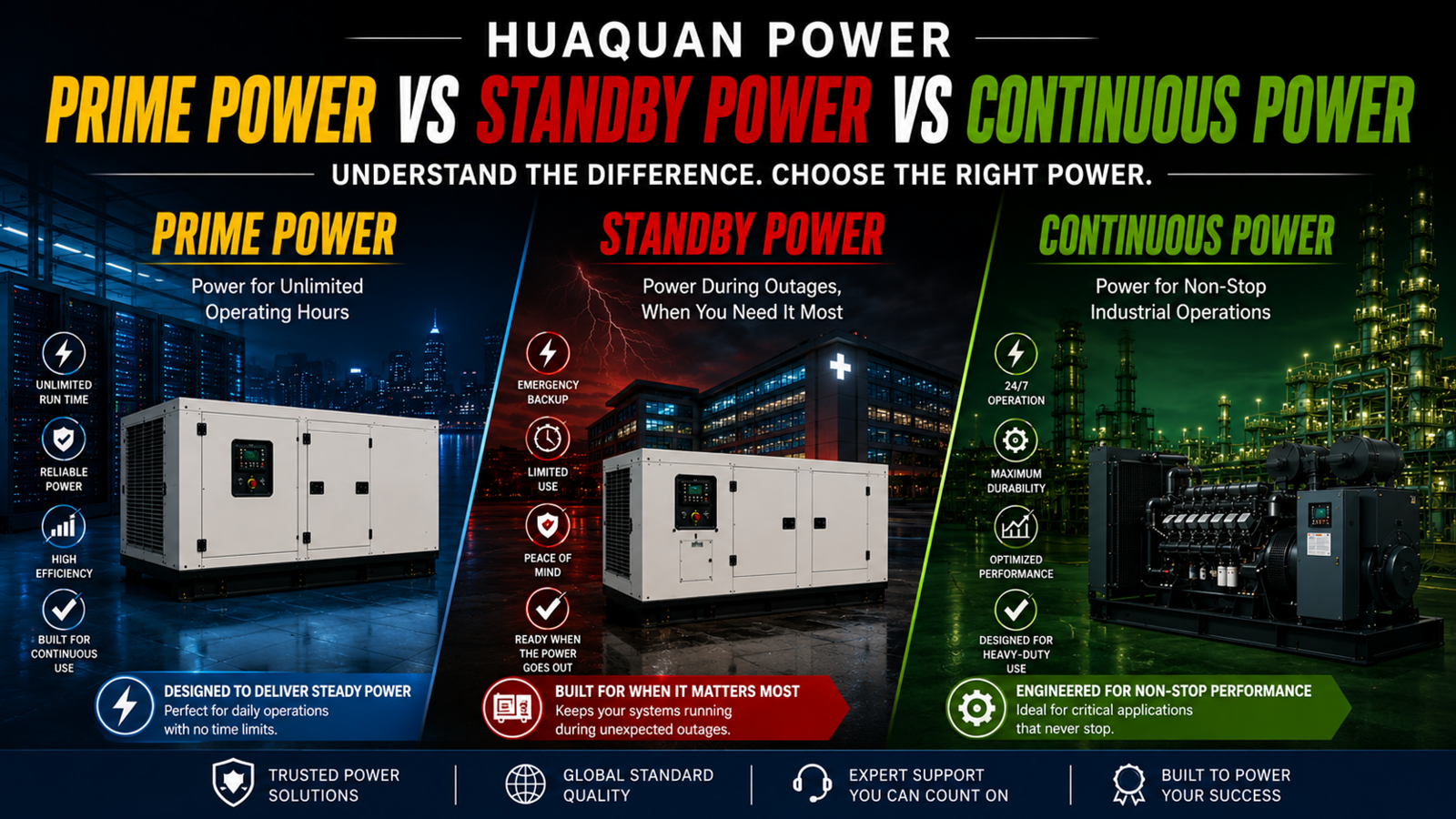
Most people make mistakes when buying a generator. They solely focus on the kW while ignoring the other crucial aspects, such as prime power vs standby power vs continuous power.
We will elaborate on these three power aspects and help you choose the best Generatoren based on our expertise and real-time examples. Let’s dive into these power aspects.
What is Prime Power?
Prime power is the standalone source of the power supply in remote construction sites. They offer the maximum power as a primary source in areas where the unreliable grid supply is unavailable, or sometimes the grid is unavailable.
They have the following features.
- Primary power source
- Handle variable load demands
- Support temporary overloads
- Ideal for remote operations
Real-World Example
Suppose an example of a remote mining operation where there is no utility grid supply available. Darüber hinaus, the load demands vary throughout the day. Zum Beispiel:
- Morning operations: 300 kW
- Production peak: 450 kW
- Night shift: 250 kW
Prime power generators handle variable loads and provide a seamless power source. They are used in:
- Bergbau
- Konstruktion
- Landwirtschaft
- Öl
- Gas
- Telekommunikation
- Herstellung
What is Standby Power?
Standby power is normally available but not used until an emergency outage occurs. daher, standby power generators work only when they are needed in outage situations.
They have a few features.
- Used only during power outages
- No overload capability
- Limited annual operating hours
- Automatically starts through an Automatischer Transferschalter (ATS)
- Ideal for backup applications
Real-World Example
Zum Beispiel, you have installed a standby generator of 500kW in a hospital. It remains fully functional and connected to the grid but offers the power supply only when a power outage occurs.
Such generators are used casually rather than daily. The key applications of such generators include:
- Krankenhäuser
- Gewerbebauten
- Rechenzentren
- Shopping centers
- Schools
- Hotels
- Lagerhäuser
What is Continuous Power?
Continuous power is the maximum load a generator or a device can provide at a constant load. Don’t confuse it with prime power, as continuous load offers only constant load, not fluctuating load compatibility.
Zu den Hauptmerkmalen gehören:
- Constant load operation
- Unbegrenzte Betriebsstunden
- No overload capability
- Extremely stable operating conditions
Real-World Example
Suppose a remote water facility needs a daily supply of water. But the power load to produce the water remains constant. Zum Beispiel:
- 400 kW today
- 400 kW tomorrow
- 400 kW next month
In such a case, continuous power generators are the best option.
The typical applications of the continuous power generators include:
- Water treatment plants
- Utility support systems
- Base-load power stations
- Industrial processes with fixed loads
- Remote infrastructure facilities
Prime Power vs Standby Power vs Continuous Power: Hauptunterschiede
Prime Power vs Standby Power vs Continuous Power share several differences. We have discussed a few crucial differences between them.
| Besonderheit | Standby-Stromversorgung | Prime Power | Kontinuierliche Leistung |
| Primary Purpose | Emergency backup power | Main power source | Continuous base-load power |
| Betriebszeiten | Limited annual hours | Unlimited annual hours | Unlimited annual hours |
| Load Characteristics | Occasional load variations | Variable and fluctuating loads | Constant and stable loads |
| Nennleistung | Highest output rating | Moderate output rating | Lowest output rating |
| Overload Capability | No overload allowance | Typischerweise 10% overload for limited periods | No overload allowance |
| Kraftstoffverbrauch | Low annual fuel usage | Higher fuel consumption due to frequent operation | Predictable fuel consumption under constant load |
| Grid Dependency | Requires utility grid as primary power source | Often operates without grid access | Completely independent of the grid |
| Typische Anwendungen | Krankenhäuser, Büros, Hotels, Rechenzentren | Baustellen, Minen, Ölfelder, Bauernhöfe | Water treatment plants, utility stations, Industrieanlagen |
| Wartungsanforderungen | Lowest maintenance frequency | Moderate maintenance requirements | Highest maintenance requirements |
| Betriebskosten | Lowest long-term operating costs | Moderate to high operating costs | Highest long-term operating costs |
| Reliability During Outages | Excellent for emergency backup | Suitable for extended outages | Designed for permanent power supply |
| Am besten für | Facilities with reliable grid power | Remote locations with varying power demand | Sites requiring constant 24/7 Leistung |
Difference #1: Intended Purpose
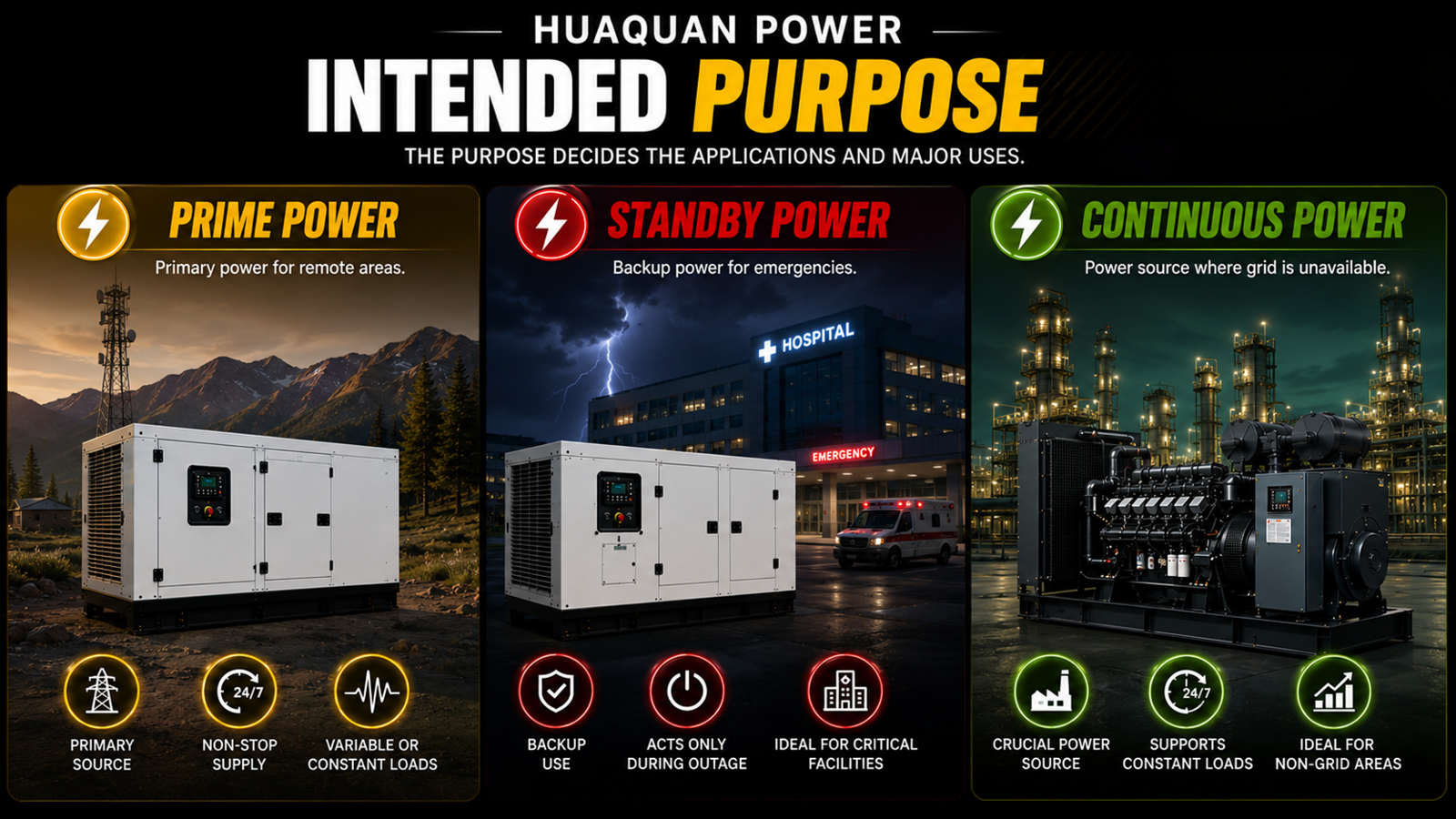
In prime power vs standby power vs continuous power, the purpose decides the applications and major uses.
Prime Power
Prime power acts as a primary source and provides the power for remote areas. It offers a non-stop supply whether the load is the same or different.
Standby-Stromversorgung
Standby power is only for backup use. Zum Beispiel, your hospital gets a power shutdown. Standby power devices act only then.
Kontinuierliche Leistung
Continuous power devices act as a crucial power source in areas without grid supply. Jedoch, they offer support for constant loads compared to the prime power generators that offer support for variable loads.
Difference #2: Betriebszeiten
In prime power vs standby power vs continuous power, operating hours matter when there is no power source available.
Prime Power
Prime power systems operate non-stop for unlimited hours. There is no hard and fast rule for the operating hours. daher, they offer power supply in remote areas without utility grid availability.
Standby-Stromversorgung
Standby power generators are ideal for limited hours. Zum Beispiel, 2 Std., 4 Std., or sometimes 8 Std.. They are not rated for unlimited operating hours.
Kontinuierliche Leistung
Continuous power is the same as the prime power in working for the limited hours, but it provides the power at a constant load for unlimited hours.
Difference #3: Load Features
In prime power vs standby power vs continuous power, load is the critical difference.
Prime Power
Prime power is rated to handle variable load support. Zum Beispiel, your generator handles 200kW in the morning and 400kW in the evening.
Standby-Stromversorgung
Standby power generators only work for limited hours as a backup supply during shutdowns. As the power outage occurs, load fluctuations can occur. That is where standby power generators act as a key source to handle the fluctuating loads.
Kontinuierliche Leistung
Compared to a prime power, continuous power generators can handle only a constant load. Zum Beispiel, they handle 400kW in the morning, evening, or night. There are no fluctuations in this load.
Difference #4: Power Output Ratings
In prime power vs standby power vs continuous power, power output ratings vary depending on the type. Let’s understand each power output.
Prime Power
Prime power has the second highest power output rating after the standby power. It performs for several hours non-stop at this power output.
Standby-Stromversorgung
Standby power has the highest rating but performs only during the limited hours in power outages.
Kontinuierliche Leistung
Continuous power generators have the lowest power output among the prime and standby generators. daher, they perform at the constant loads without any interruptions.
Difference #5: Overload Capabilities
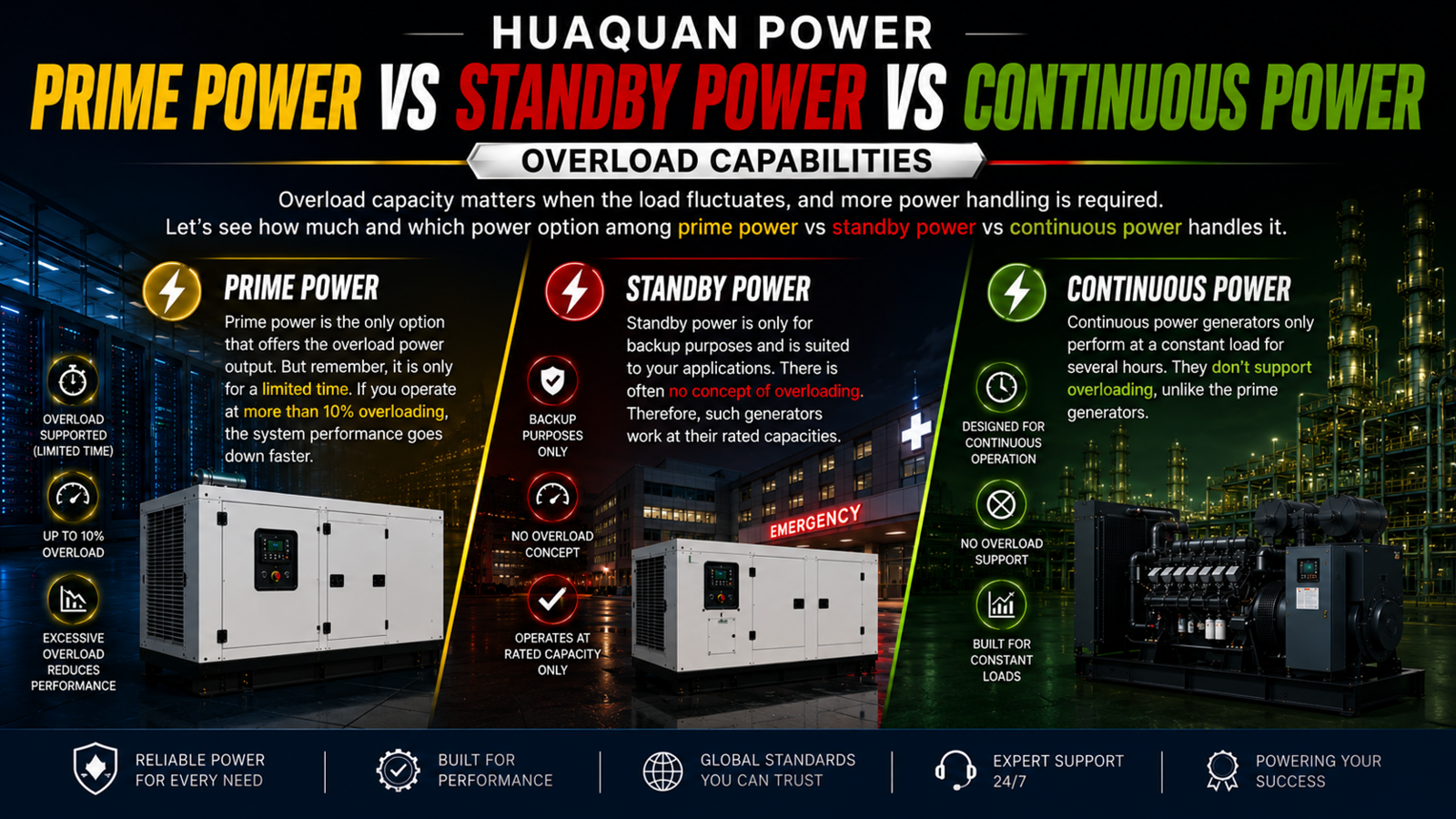
Overload capacity matters when the load fluctuates, and more power handling is required. Let’s see how much and which power option among prime power vs standby power vs continuous power handles it.
Prime Power
Prime power is the only option that offers the overload power output. Aber denken Sie daran, it is only for a limited time. If you operate at more than 10% Überlastung, the system performance goes down faster.
Standby-Stromversorgung
Standby power is only for backup purposes and is suited to your applications. There is often no concept of overloading. daher, such generators work at their rated capacities.
Kontinuierliche Leistung
Continuous power generators only perform at a constant load for several hours. They don’t support overloading, unlike the prime generators.
Difference #6: Kraftstoffverbrauch
In prime power vs standby power vs continuous power, the fuel consumption process is unique and different.
Prime Power
Prime power generators consume more fuel as they continuously handle the fluctuating loads and provide the power. At higher loads, fuel consumption increases and depends on the operating hours.
Standby-Stromversorgung
Standby generators consume fuel only during power outages when they are used. Their fuel consumption is low compared to the prime power and remains the lowest among all these types of power generators.
Kontinuierliche Leistung
Continuous power generators operate at constant power loads and consume predictable fuel. Because of unlimited-hour operations, their fuel consumption is more than the standby power generators and less than the prime power generators.
Difference #7: Utility Grid Dependency
One of the most important differences between the power generators is the utility grid dependency. Let’s explore how prime power vs standby power vs continuous power react.
Prime Power
Prime power doesn’t rely on utility. Whether you have the grid or not, prime power generators act as a sole power source in remote conditions. In einfachen Worten, they can act in place of a grid.
Standby-Stromversorgung
Standby generators are highly dependent on the power source, such as the utility grid. Zum Beispiel, a household has a 20kW supply from the grid. When a power shortage occurs due to a grid shutdown, standby power generators turn on and provide the 20kW supply to the whole household.
Kontinuierliche Leistung
Continuous power generators work without the need for utility grids. daher, they are effective and more useful in remote areas for uninterrupted constant load supply.
Difference #8: Typische Anwendungen
In prime power vs standby power vs continuous power, there is a clear-cut difference in the applications.
Prime Power
Prime power is used for remote areas where there is no grid utility. Zum Beispiel, the following applications require a constant load supply.
- Bergbaubetriebe
- Construction projects
- Oil and gas fields
- Remote manufacturing facilities
- Agricultural irrigation systems
Standby-Stromversorgung
Standby power generators are useful in urban areas where there is a grid utility. They are useful as a backup supply in the following areas.
- Krankenhäuser
- Rechenzentren
- Gewerbebauten
- Hotels
- Schools
- Shopping malls
Kontinuierliche Leistung
Continuous power generators are also the primary sources but offer constant load support.
They are useful in the following applications.
- Water treatment plants
- Utility support stations
- Continuous industrial processes
- Remote infrastructure projects
Difference #9: Wartungsanforderungen
Do you want to maintain the generators? The maintenance depends on how frequently you use them.
Prime Power
Prime power generators are continuously used for several hours a day until the mining operations continue.
daher, they require more maintenance. Their maintenance requires:
- Oil changes
- Filterwechsel
- Coolant inspections
- Belastungstest.
Standby-Stromversorgung
Standby power generators are casually used. daher, they require less maintenance but:
- Regelmäßige Inspektionen
- Battery checks
- Periodic testing
Doing so keeps them functional in the emergency hours and provides better support during emergency cases.
Kontinuierliche Leistung
Continuous power generators require aggressive maintenance because of their continuous operation.
- Regelmäßige Inspektionen
- Oil changes
- Filterwechsel
- Coolant inspections
Difference #10: Kostenüberlegung
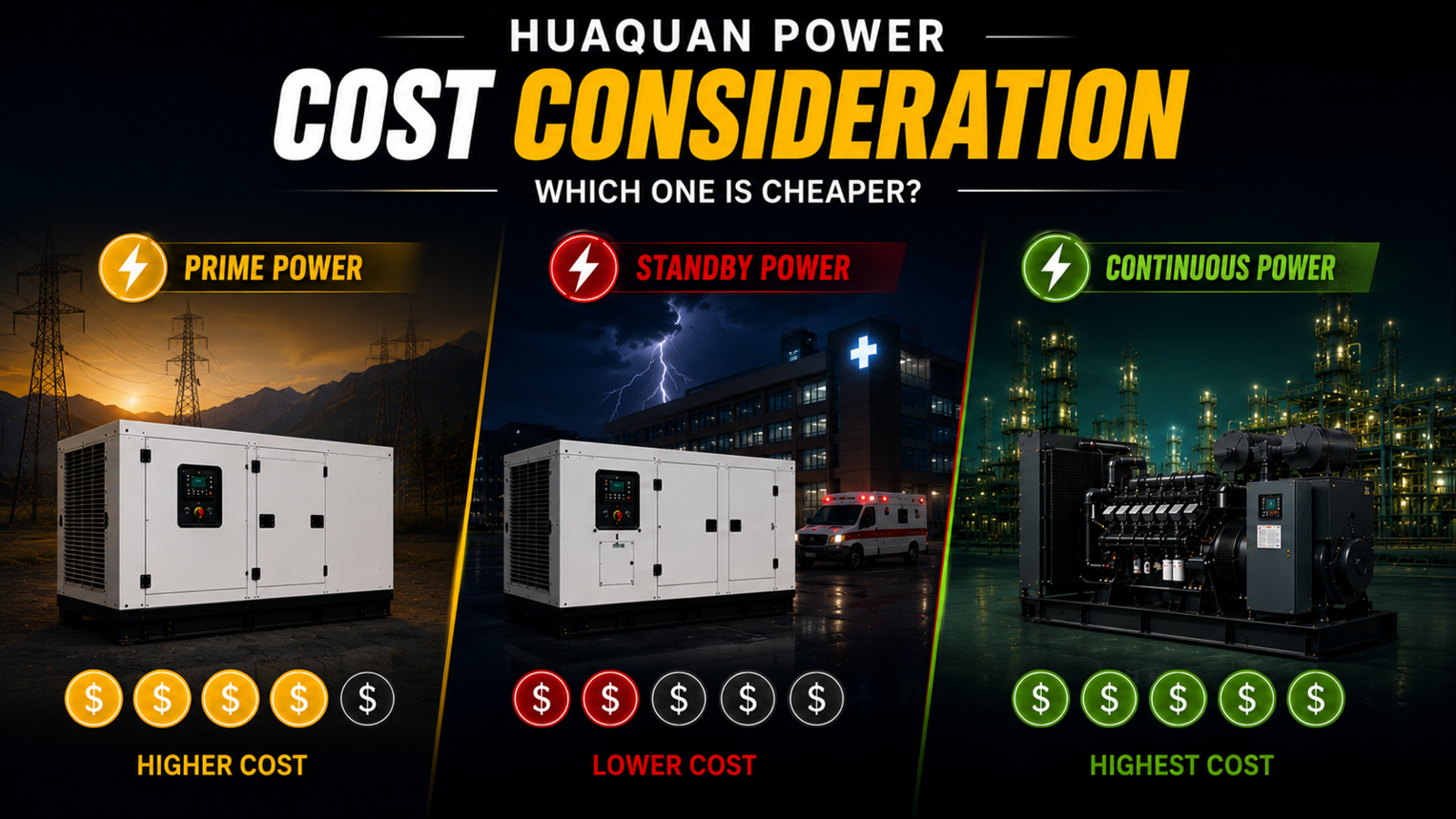
Which one do you think is cheaper among these options?
Prime Power
Prime power generators have higher operational costs due to their type of work. They require more fuel and higher costs.
Standby-Stromversorgung
Standby generators are used during power outages and consume less fuel and have lower operating costs overall.
Kontinuierliche Leistung
Continuous power generators have the highest costs because of their constant loads and long-term performance.
FAQs
- Are continuous power and prime power the same?
You might misunderstand the difference between the continuous and prime power generators. Both are different in terms of handling load types. Continuous power systems handle continuous loads of 400kW, while prime power generators can handle 400 kW, 300 kW, and more fluctuating loads.
- Is standby power higher than prime power?
Ja. Standby power is often more than the prime power. The reason is that it is used only occasionally when emergency power shutdowns occur.
- Can a standby generator be used for prime power applications?
Ja, you can use it, but it is not recommended for several reasons. Zum Beispiel, component wear occurs faster, performance goes down, and you might need regular maintenance.
- What does continuous power mean on a generator?
Continuous power means a constant load. Zum Beispiel, the generator provides a 200kW constant load throughout the day. There is no variable load supply.
- Which generator rating is best for a construction site?
Prime power systems are considered the primary choice for the construction site. This is because of the fluctuating load capacity at such spaces.
- How do I know which generator rating I need?
It depends on your applications and needs. Normalerweise, you should calculate the power load you need and understand whether it is fluctuating or continuous.
- Does prime power allow overload operation?
Ja, prime power generators offer a 10% overload but for a limited period. You can utilize it for your different applications and optimize the performance.
Abschluss
Comparison of Prime Power vs Standby Power vs Continuous Power helps understand which power format is crucial at different points. Prime power is the primary source, while you should choose standby power when the grid is available and you need an emergency supply. Continuous power sources offer a stable load.
Do you want to explore a wide range of generators? Partner with Huaquan-Kraft and check out our different ranges of prime power, Standby-Stromversorgung, and continuous power generators. Kontaktieren Sie uns for your business right away!
⚡ Entdecken Sie verwandte Lösungen
- 🏭 500kW-Dieselgenerator
- 🏭 1000kW-Dieselgenerator
- 🏭 500kW YC-Dieselgenerator
- 🔧 KMS (Cummins/Doosan) Serie
- 📋 Dieselgeneratorsätze
- 📋 Bestellvorgang – So kaufen Sie
- 📋 Kontaktieren Sie uns
💡 Benötigen Sie eine maßgeschneiderte Lösung?? Kontaktieren Sie unser Engineering-Team für projektspezifische Empfehlungen.