Inleiding
Hospital and health care facilities are such things where a single minute shutdown can cost the patients their whole life. Daarom, an uninterrupted energy supply is the crucial goal. Before installation, you must know the power requirements for hospitals and healthcare facilities.
Today we will evaluate the power requirements for hospitals and understand how different factors and appliances affect the overall power requirements. Laat ons weet!!
Why Reliable Power Is Critical for Hospitals
A reliable power supply is essential for hospitals and healthcare facilities. Do you know why? Because it provides the essential energy and makes sure your necessary equipment is running 24/7.
A reliable power supply affects the patient’s life. Byvoorbeeld, an intermittent running system may experience interruptions in the operations of:
- Life-support equipment
- Operasie kamers
- Intensive Care Units (ICU's)
- Emergency departments
- Medical imaging systems
- Laboratory equipment
- Ventilasiestelsels
- Beligting
- Information technology infrastructure
- Sekuriteitstelsels
The results will be disastrous for the patients and might ultimately cause their deaths.
Major Electrical Loads in Hospitals
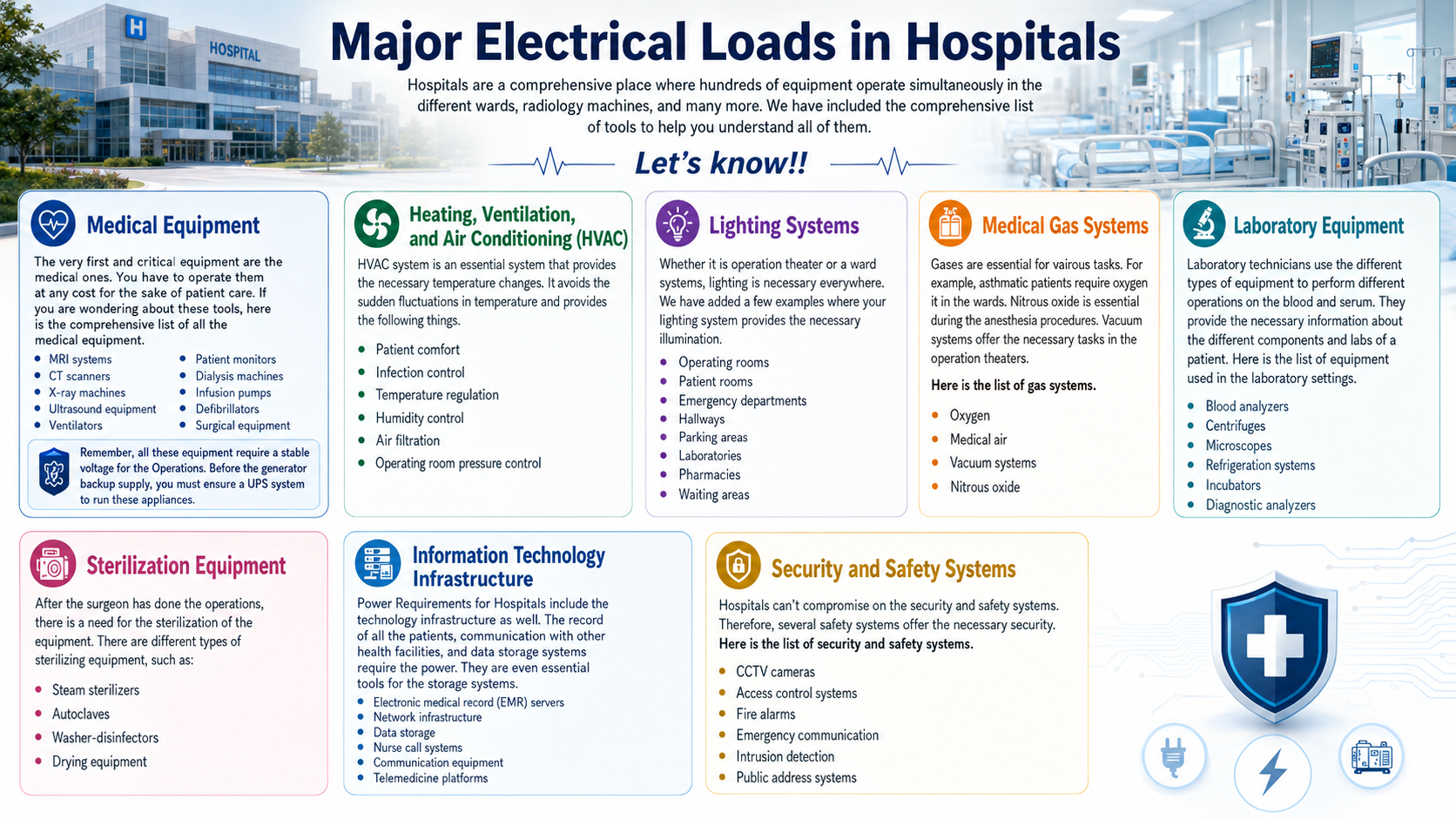
Hospitals are comprehensive places where hundreds of pieces of equipment operate simultaneously in the different wards, radiology machines, and many more. We have included a comprehensive list of tools to help you understand all of them.
Laat ons weet!!
| Toerusting | Typical Power Consumption |
| MRI Scanner | 50–120 kW |
| CT Scanner | 30–80 kW |
| X-ray Machine | 20–60 kW |
| Ultrasound Machine | 0.5–2 kW |
| Ventilator | 0.3–1 kW |
| Patient Monitor | 0.1–0.5 kW |
| Infusion Pump | 0.05–0.2 kW |
| Dialysis Machine | 1–3 kW |
| Sterilizer (Autoclave) | 15–50 kW |
| Laboratory Analyzer | 2–8 kW |
Medical Equipment
The very first and critical piece of equipment is medical equipment. You have to operate them at any cost for the sake of patient care. If you are wondering about these tools, here is the comprehensive list of all the medical equipment.
- MRI systems
- CT scanners
- X-ray machines
- Ultrasound equipment
- Ventilators
- Patient monitors
- Dialysis machines
- Infusion pumps
- Defibrillators
- Surgical equipment
Onthou, all this equipment requires a stable voltage for the Operations. Before the generator backup supply, you must ensure a UPS system to run these appliances.
Heating, Ventilasie, and Air Conditioning (HVAC)
An HVAC system is an essential system that provides the necessary temperature changes. It avoids the sudden fluctuations in temperature and provides the following things.
- Patient comfort
- Infection control
- Temperature regulation
- Humidity control
- Air filtration
- Operating room pressure control
Lighting Systems
Whether it is an operating theater or a ward system, lighting is necessary everywhere. We have added a few examples where your lighting system provides the necessary illumination.
- Operasie kamers
- Patient rooms
- Emergency departments
- Hallways
- Parking areas
- Laboratories
- Pharmacies
- Waiting areas
Medical Gas Systems
Gases are essential for various tasks. Byvoorbeeld, asthmatic patients require oxygen in the wards. Nitrous oxide is essential during the anesthesia procedures. Vacuum systems perform the necessary tasks in the operating theaters.
Here is the list of gas systems.
- Oxygen
- Medical air
- Vacuum systems
- Nitrous oxide
Laboratory Equipment
Laboratory technicians use different types of equipment to perform different operations on blood and serum. They provide the necessary information about the different components and labs of a patient. Here is the list of equipment used in the laboratory settings.
- Blood analyzers
- Centrifuges
- Microscopes
- Refrigeration systems
- Incubators
- Diagnostic analyzers
Sterilization Equipment
After the surgeon has done the operations, there is a need for the sterilization of the equipment. There are different types of sterilizing equipment, soos:
- Steam sterilizers
- Autoclaves
- Washer-disinfectors
- Drying equipment
Information Technology Infrastructure
Power Requirements for Hospitals include the technology infrastructure as well. The record of all the patients, communication with other health facilities, and data storage systems require power. They are even essential tools for the storage systems.
- Electronic medical record (EMR) bedieners
- Network infrastructure
- Data storage
- Nurse call systems
- Kommunikasie toerusting
- Telemedicine platforms
Security and Safety Systems
Hospitals can’t compromise on the security and safety systems. Daarom, several safety systems offer the necessary security. Here is the list of security and safety systems.
- CCTV cameras
- Access control systems
- Fire alarms
- Emergency communication
- Intrusion detection
- Public address systems
Classification of Hospital Electrical Loads
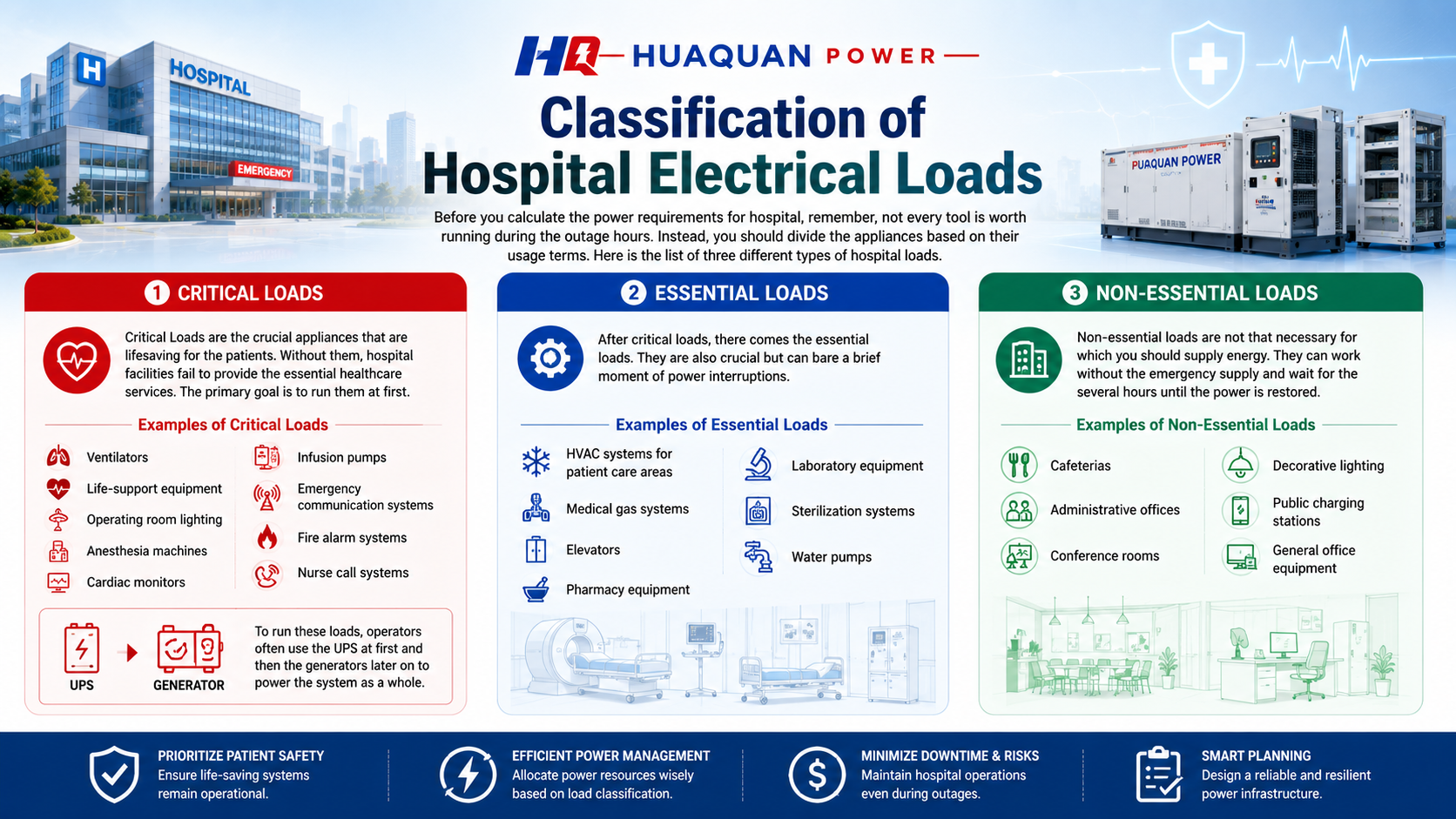
Before you calculate the power requirements for hospitals, remember that not every tool is worth running during the outage hours. In plaas daarvan, you should divide the appliances based on their usage terms. Here is the list of three different types of hospital loads.
Critical Loads
Critical Loads are the crucial appliances that are lifesaving for the patients. Without them, hospital facilities fail to provide the essential healthcare services. The primary goal is to run them at first.
Here are the examples of the critical loads available at the hospital.
- Ventilators
- Life-support equipment
- Operating room lighting
- Anesthesia machines
- Cardiac monitors
- Infusion pumps
- Emergency communication systems
- Fire alarm systems
- Nurse call systems
To run these loads, operators often use the UPS at first and then the Kragopwekkers later on to power the system as a whole.
Essential Loads
After critical loads, there come the essential loads. They are also crucial, but can bear a brief moment of power interruptions.
The list of essential loads in the hospital includes:
- HVAC systems for patient care areas
- Medical gas systems
- Elevators
- Pharmacy equipment
- Laboratory equipment
- Sterilization systems
- Water pumps
Non-essential Loads
Non-essential loads are not necessary for which you should supply energy. They can work without the emergency supply and wait for several hours until the power is restored.
The common examples of the non-essential loads are:
- Cafeterias
- Administrative offices
- Conference rooms
- Decorative lighting
- Public charging stations
- General office equipment
Calculation of Power Requirements for Hospitals and Healthcare Facilities
Before you calculate the power requirements, you must know what appliances are going to operate and the power of each appliance. We have divided the appliances based on their critical and non-essential loads.
Here is the list of different tools and the final power calculation. You can get an idea of the calculation according to our formula.
Stap 1: List Connected Appliances
Eerstens, you should know all the connected appliances. We have added the table of connected loads, including the number of appliances and the power consumption for each one.
| Toerusting | Quantity | Kraggradering |
| MRI Scanner | 2 | 80 kW |
| CT Scanner | 2 | 50 kW |
| Ventilators | 60 | 0.5 kW |
| Operating Room Equipment | 10 | 15 kW |
| HVAC System | 1 | 900 kW |
| Beligting | Entire Hospital | 250 kW |
| Laboratory Equipment | Veelvuldige | 220 kW |
| Elevators | 6 | 18 kW |
Stap 2: Calculate Load
The overall load calculation is often the sum of the devices you use. Since we have used the following devices:
- MRI = 160 kW
- CT = 100 kW
- Ventilators = 30 kW
- Operating Rooms = 150 kW
- HVAC = 900 kW
- Beligting = 250 kW
- Laboratories = 220 kW
- Elevators = 108 kW
The total power calculation of these loads will be around 1,918 kW.
Stap 3: Apply Demand Factor
1918 kW is the total demand of all the appliances when run simultaneously. It rarely happens that all devices are running simultaneously.
Eerstens, there are a few devices that run simultaneously. Suppose 85% of the appliances run at the same time. The demand factor will be 0.85.
Maximum Demand= 1918 x 0.85 = 1,630 kW
Stap 4: Add Future Expansion
Do you want to expand the system in the future? It is typical that most people expand the system now or later on. Suppose you want to expand the system in the future.
Hiervoor, you should keep an extra safety capacity of 20-25%. Dus, the calculation will be:
Expansion Margin = 20%
Future Load = 1,630 × 1.20 = 1,956 kW
Stap 5: Kies Kragopwekker kapasiteit
Generators can be a good backup addition to your hospital system. Since the overall power requirements are 2MW, the power calculations for generators will be:
- 2 × 1000 kW generators (N+1 not included)
- 3 × 1000 kW generators (N+1 redundancy)
- 4 × 750 kW generators
- 5 × 500 kW generators
It depends on you whether you want to add redundancy to your system or not.
Power Quality Requirements for Healthcare Facilities
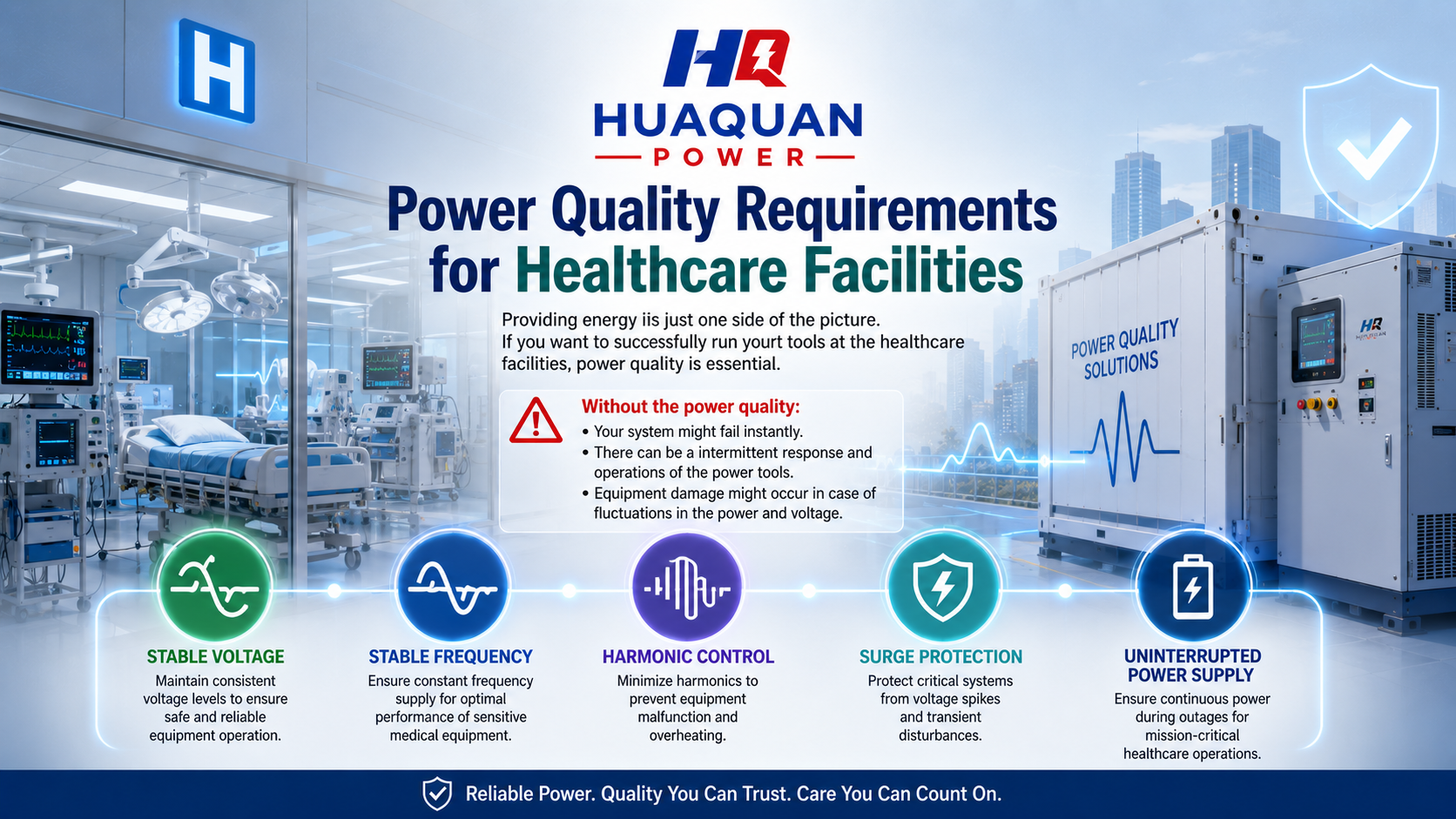
Providing energy is just one side of the picture. If you want to successfully run your tools at the healthcare facilities, power quality is essential. Without the power quality:
- Your system might fail instantly.
- There can be intermittent responses and operations of the power tools.
- Equipment damage might occur in case of fluctuations in the power and voltage.
Here are a few factors regarding the power quality.
Stable Voltage
Hospital equipment operates within the voltage limit. Exceeding the limits can cause serious accidents and damage the equipment. Voltage fluctuations can damage the equipment. Daarom, you should have a stable voltage that:
- Prevents equipment malfunction
- Improves diagnostic accuracy
- Extends equipment life
- Reduces maintenance costs
Stable Frequency
Devices with motors and electronic controls require a stable frequency as well. Sudden fluctuations in the frequency can cause serious issues and might damage your equipment.
Stable frequency:
- Ensures reliable equipment performance
- Supports HVAC operation
- Protects electrical motors
- Reduces operational disruptions
Harmonic Control
Electrical interference is also a serious issue. A harmonic system can provide stable performance at a stable voltage. Daarom, you should ensure stable performance with the harmonic control systems.
It does the following tasks:
- Reduces electrical interference
- Prevents equipment overheating
- Improves system efficiency
- Protects sensitive devices
Surge Protection
Spesifiek, when you are starting equipment, it may show a sudden surge in the power or voltage. It can affect the device and sometimes damage it completely. Daarom, you should install those systems that offer surge protection.
The typical tasks of the surge protection systems are:
- Protects medical equipment
- Prevents voltage spikes
- Reduces repair costs
- Improves system reliability
Uninterrupted Power Supply
Hospital equipment requires a stable voltage to avoid damage to the equipment and to get a stable power supply. Thanks to the UPS system that provides instant and stable voltage.
Here are a few more benefits of the uninterrupted power supply system:
- Provides immediate backup power
- Supports lifesaving equipment
- Prevents data loss
- Ensures uninterrupted operations
Gereelde vrae
- Can hospitals use renewable energy?
Ja. It is even better to install renewable energy sources. Many hospitals install solar photovoltaic systems, battery energy storage, and hybrid power systems to power their systems and enjoy the ultimate power supply.
- What is the role of a UPS in hospitals?
Hospital equipment requires a non-stop supply. UPS is the ultimate tool that offers a non-stop supply with stable voltage without risking the life of the equipment. Generators take a few seconds to turn on and off. Intussen, UPS is the best option.
- Why are backup generators essential for hospitals?
Backup generators are the lifelines of the hospital power systems when the outage is for several hours or days. Generators provide constant energy for more than 24 hours compared to a UPS or a battery storage system.
- What equipment consumes the most electricity in hospitals?
There are several critical and high-load-usage equipment, such as HVAC systems, MRI scanners, CT scanners, X-ray equipment, sterilization systems, laboratorium toerusting, beligting, hysbakke, datasentrums, and medical gas systems.
Why do hospitals require uninterrupted electrical power?
An uninterrupted power supply keeps the healthcare facilities running. You can run life-support systems, medical imaging equipment, operasiekamers, laboratoriums, communication systems, HVAC, and other critical infrastructure.
- How often should hospital emergency power systems be tested?
Maintenance and testing of the hospital equipment depend on the usage and manufacturers’ recommendations. You should do regular testing of emergency generators, Outomatiese oordragskakelaars, UPS stelsels, and related equipment.
- What is a hospital microgrid?
A hospital microgrid is a local energy production facility that combines multiple systems, such as solar panels, battery storage systems, kragopwekkers, the utility grid, and automatic transfer switches.
- How do hospitals prioritize electrical loads during emergencies?
Electrical loads at the hospitals are divided into three categories— Critical, essential, and non-essential. Critical Loads are prioritized during outage hours over the essential and non-essential power tools.
Gevolgtrekking
Hospitals are essential facilities where you should have a non-stop energy supply. But before you decide on the energy supply, calculate the overall power required. Divide the Tools into three different categories— essential, non-essential, and critical. Then consider the overall power calculation and total needs.
If you are looking for backup supply systems to power your system at hospitals, soek nie verder nie. Huaquan Power is the ultimate choice for its high-quality generator systems with premium efficiency. You’ll have a constant energy supply and better results right away!