A smooth power connection and engine speed are in direct relation. , the more stable the power is, the more constant the engine speed will be. Nowadays, when both electronic and mechanical generator speed controllers are available in the market, how can you choose the right option for you?
This guide covers electronic vs mechanical speed controllers to help you decide from simple mechanics to precise electronic technology. Let’s get started!

What Is A Generator Speed Controller?
Generator speed controllers are normally known as Governers. Users install this device to keep an eye on their overall engine fuel supply. If you are looking to have a constant RPM, it’s better to install a governor ASAP.
Role In Maintaining Frequency
Usually, the generators are designed to run at a max specific speed to ignite necessary power.
- 1500 RPM produces 50Hz.
- 1800 RPM produces 60Hz.
- If RPM drops, frequency drops.
Impact On Performance
Generally, the loads fluctuate 24/7 in the building. Thus, these controllers are the best option to detect any load changes. Ultimately, you can adjust the fuel to avoid any engine failure.
What Is A Mechanical Speed Controller?
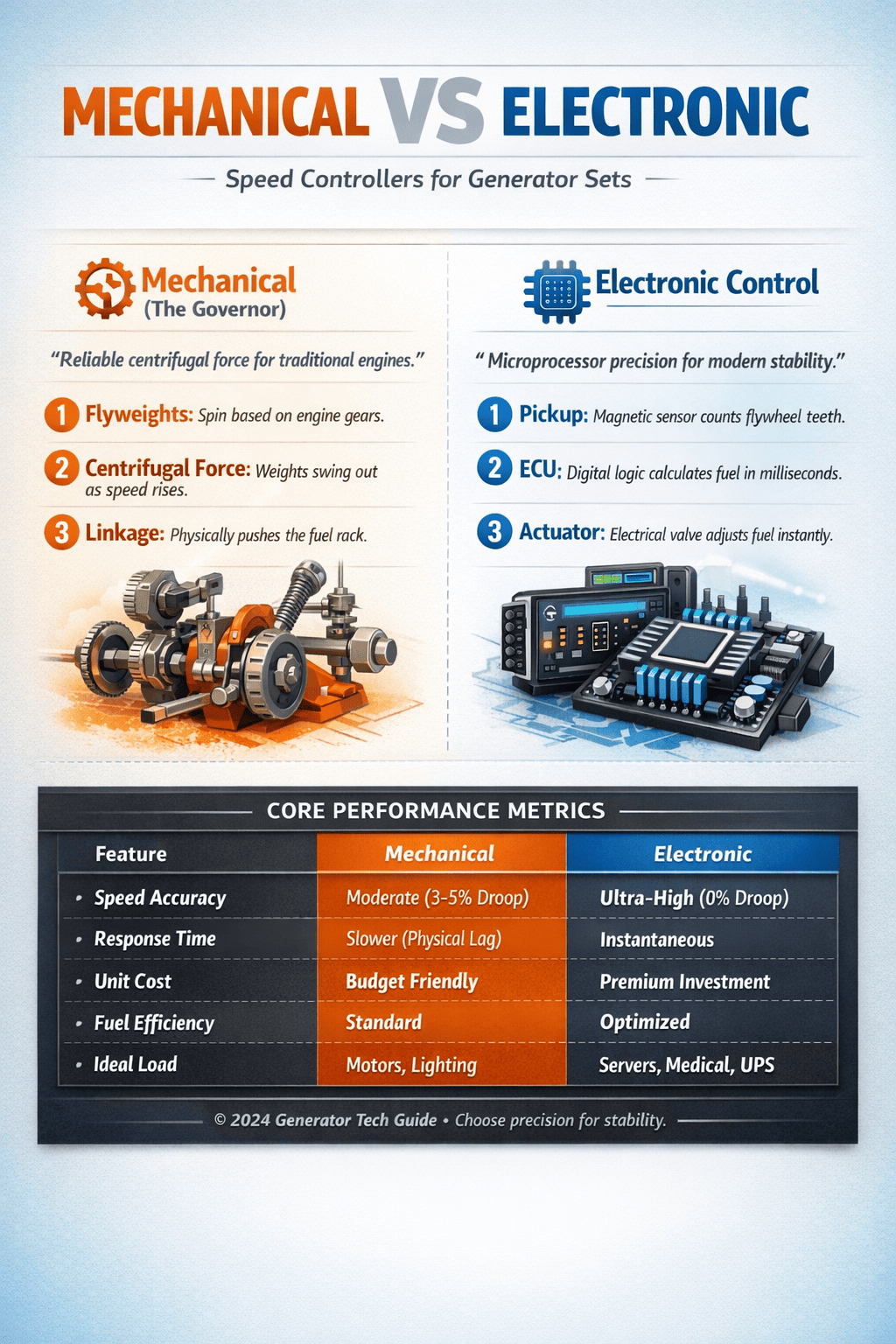
Mechanical controllers are designed as a standard standby option for diesel engines. These generators operate on the technology of centrifugal force.
How It Works
Usually, the system’s flyweights and springs use the rotational force. Mechanical controllers operate according to the engine’s gear. The more you increase the speed, the more the weight swings in an outward direction.
Ultimately, it creates an overall mechanical link between the loads. It directly connects the speed controller with the fuel rack, so you can cut down the fuel connection when necessary.
Key Features
- Purely Mechanical: As the name implies, a mechanical speed controller operates without any circuit board or electrical wires. The whole process works on the centrifugal force laws of physics to function. The users do not need to install any battery or computer for this.
- Direct Drive: As the governor’s gear is in direct connection with the engine’s camshaft or crankshaft. It can automatically sense the speed changes. Moreover, the physical rotation of the governor is a basic process with no digital signal involved.
- Simplicity: A layman can even inspect any component of this basic physics system. Imagine what happens if spring breaks. Or accidentally, some rod bends. You can fix it directly without a multimeter.
Advantages
- Durable: These controllers work even under high engine temperatures and heavy vibration. Whether there is dust, moisture or any oil present, no worries about short circuits. Usually, they have a lifespan even better than the engine block itself.
- Easy to Repair: When installing any mechanical speed controller, you do not need an electrical engineer to help you out. Any diesel mechanic who knows everything about springs and linkage can help you adjust the speed controller with some wrenches.
- Lower Cost: In comparison to the electric controllers, mechanical ones have less complex components. So, the initial purchase and replacement prices are both low. Ultimately, it stands out as one of the best budget-friendly options out there.
Disadvantages
- Slow Response: As the physical weight has some inertia, it takes quite some time to move in the forward direction. Whenever there is a large electrical load, the engine struggles for quite some time, leading to a momentary dip in your building’s lights.
- Droop: What if you want to open the fuel rack? The engine must stop or slow down using physical force. In this process, your building might lose up to 3 to 5% of your RPM. This can reduce the frequency from 60 Hz to around 57–58 Hz.
- Wear: Don’t forget the frictional force! Friction always degrades some of the spinning weights. Over the years, the springs lose their tension due to weather and engine heating or cooling. So, it’s better to recalibrate or replace them when necessary.
What Is An Electronic Speed Controller?
Unlike mechanical controllers, electronic speed controllers operate using digital logic for precise results. This makes them a better option in today’s market.
How It Works
Three components work together in a closed loop, including:
- Magnetic Pickup: A magnetic pickup helps you count the flywheel teeth to evaluate the overall speed.
- ECU (Control Unit): The ECU exceptionally calculates the exact amount of fuel required.
- Actuator: And last but not least, an actuator uses the electricity power to move the fuel valve.
Key Features
- Microprocessor Control: The Electronic Control Unit (ECU) is actually the brain of your speed controller. This microprocessor controls thousands of speed signals every single second. Ultimately, it manages the combustion cycle going around.
- Isochronous Capability: The governor has an exceptionally amazing target of RPM maintenance power. Unlike the mechanical controller, if you add any electrical load, it does not decrease the speed. Thus, your engine and generator work under smooth and steady conditions.
- No Droop: As you increase the load, the mechanical governors lose their speed. But, with electrical controllers, your generator optimally works at 60HZ whether idle or full powered. This helps you maintain a stable performance power line.
Advantages
- High Accuracy: Electric controllers help you enjoy high-accuracy digital speed. You can synchronize multiple generators while maintaining an overall 0.25% power margin that is far better than mechanical systems.
- Fast Response: It’s a fast response that closely evaluates and detects any speed changes instantly. You can immediately adjust the fuel accelerator in milliseconds. This active response helps you prevent any deep voltage drops during heavy equipment installation or startups.
- Efficiency: Electric speed controllers optimize their efficiency by only allowing the required fuel for the load. Ultimately, there is no waste from any sudden load changes, with less diesel costs in the long run.
- Engine Protection: It also helps you with engine protection. Stable RPM cuts down the chances for any harmful vibration or thermal stress without overspeeding.
Disadvantages
- Higher Cost: The chances for any harmful vibration or thermal stress without over-speeding sensors, computers and accelerators. Everything is far more expensive than those simple springs and gears. Ultimately, your initial generator price is higher if you try to install electrical controllers. Also, the replacement parts come with a premium price tag, too.
- Fragile: Electrical components are always sensitive to high heat, moisture, or extra vibration. Any voltage spike or loose wire can turn off your entire building’s power. So, make sure to install a proper control sealing panel.
- Complex Repair: The repair and replacement process is far more complex than the mechanical ones. You cannot operate or find out the problem with any screwdriver or a simple wrench. Thus, make sure to ask some specialized technicians to troubleshoot your entire system using capable software and a laptop.
Electronic Vs Mechanical Speed Controllers For Generator Sets
| Feature | Mechanical Controller | Electronic Controller |
| Speed Accuracy | Moderate (3-5% Droop) | Very High (0% Droop) |
| Response Time | Slower | Very Fast |
| Cost | Lower | Higher |
| Maintenance | Simple mechanical work | Requires electronics knowledge |
| Fuel Efficiency | Lower | Higher |
| Reliability | Very Good (Harsh areas) | Good (Needs protection) |
| Load Handling | Basic | Excellent |
Which Speed Controller Is Better For You?
Choosing which speed controller is for you depends solely on what purpose/application you are going to use it for. Do not spend your hard-earned money on some unneeded tech gadgets!
Choose Mechanical If:
- Budget Is Tight: If you want to avoid any unnecessary initial costs.
- Remote Location: There’s no need for fancy technical support if you want to operate remotely.
- Simple Loads: You only use power to light up the motors or lights only.
- Ruggedness Matters: Dust and vibration are so extreme in your area.
Choose Electronic If:
- Precise Frequency: You can’t risk any voltage dips in your building.
- Sensitive Loads: You power special servers/medical equipment.
- Fuel Efficiency: Long run times impact your budget window.
- Paralleling: Usually, you connect multiple generators together at a time.
Applications Of Each Type
Mechanical Controllers
- Construction Sites: Where dust is an all-time headache.
- Agriculture: Farmers can operate them without any supervision.
- Basic Backup: Simple fire pumps/lighting.
Electronic Controllers
- Data Centers: Servers crash even if there is unstable power for a few seconds.
- Hospitals: Hospital life support machinery that needs perfect frequency and voltage.
- Modern Industry: Robotics always operate under a stable voltage.
Future Trends In Generator Speed Control
The market is making a huge shift from mechanical speed controllers to digital ones in recent times!
- Shift To Electronic Governors
New Tier 4 emission standards now operate better and flawlessly with digital speed control. In comparison, mechanical systems crash sometimes due to improper fuel management.
- IoT Integration
As the technology advancements are progressing, new controllers connect to the internet efficiently. You can smartly monitor all the fuel usage sitting far away from the generator. Also, they even send emergency high alerts before any failure occurs.
Conclusion
For simpler and quick operations, choose the mechanical controllers. But if you are after passion and safety, electronic controllers are for you. In short, the load helps you decide the winner between electronic and mechanical speed controllers for generator sets.
Make sure to smartly evaluate and choose the right option for your building or facility today! It’s time to secure your business with reliable factory direct power solutions.
Get Your Free Custom Quote From HuaQuan Today.