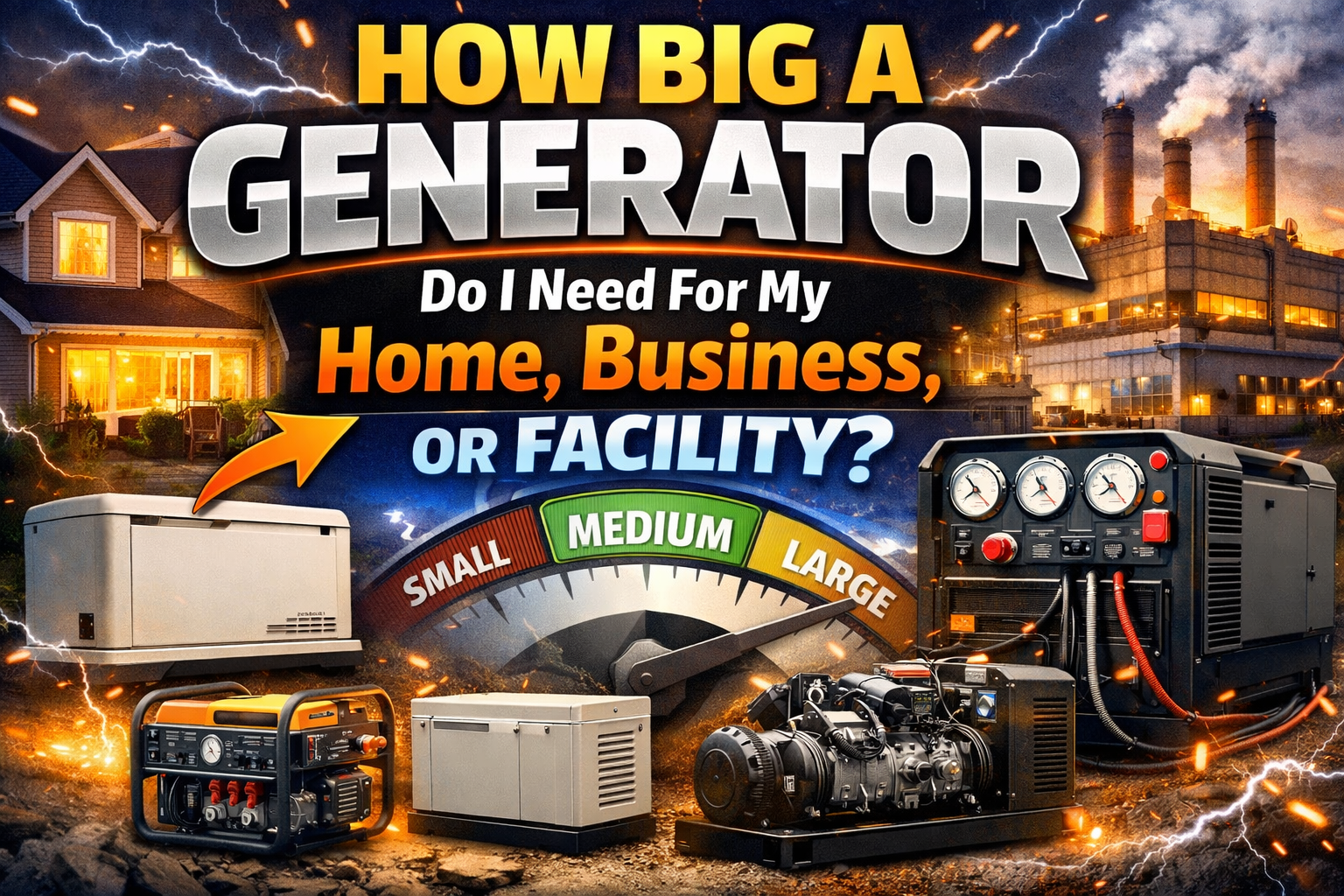
Choosing the right generator for your Home, business, or facility is not a cup of tea. You cannot pick a random model and pray for its smooth functioning. Imagine if you buy a small unit. The generator will trip constantly, ultimately damaging your sensitive electronic components. And the generator will fail when you need it to work. And, if you invest money in a big generator. You will waste thousands on fuel, expensive maintenance costs and wet stacking can damage the engine.
Thus, it’s better to find the right size with the strict spot on calculation according to your power requirements. This guide helps you size a generator for residential, commercial and industrial areas.
The Core Concepts: Watts, Amps, and “The Surge”
Before you make up a list for your appliances that require backup generator power, make sure to know the basic key differences between the energy they use and how much power they need for their initial startup.
1. Running Watts vs. Starting Watts
- Running Watts (Rated Watts): For continuous power, a refrigerator usually needs 700W to keep all your food items cold. Running watts keep it functioning.
- Starting Watts (Surge Watts): Sometimes, electric motors need a massive kick-off energy start from a dead stop.
- The Danger Zone: Air conditioners usually run on 3500W. But, they need almost 10,000W of power for a split second to start their compressor.
Crucial Rule: Remember, calculate the total running loads for all your connected items and the highest single starting watt figure to find the right size generator for your facility.
2. kW vs. kVA (For Business & Industry)
The power measurement unit for a home is kW (Kilowatts). But for the industrial units and business houses, people measure power in kilovolts amperes (kVA).
- kW means the available working power.
- kVA refers to the total capacity/apparent power.
- The Power Factor (PF): Generators usually work at a 0.8 Power Factor.
- Formula: $kW = kVA \times 0.8$
- Example: Generally, a 100kVA generator provides 80kW of usable power. Check that the power rating is in kW or kVA.
Scenario 1: Sizing For A Home (Residential)
Homeowners usually install power backup generators into different categories, for only essential items and whole house setup.
The “Essentials” Approach (5kW – 10kW)
Suppose you want to survive the power outage comfortably but are thinking of installing a generator to power only for lights, fridge and Internet or a sump pump. The 5KV to 10KV generator is for you. But it does not work for a central AC or electric stove.
- Target Loads: Refrigerator, Wi-Fi router, LED lights, microwave, TV, phone chargers.
- Recommended Size: A 5kW to 7kW portable gasoline or a mini generator is usually a perfect fit.
The “Whole-House” Approach (15kW – 26kW+)
For a complete and continuous housework setup, go for a generator that provides 15 KV to 26 KV+ watts of power. Moreover, They smoothly run the central air conditioner (HVAC systems), electrical water heaters, and washer/dryer simultaneously.
- Target Loads: Central HVAC (3-5 ton), electric range, well pump, all lighting, security system.
- Recommended Size: A 20kW to 26kW air cooling standby generator is the right standard for modern homes.
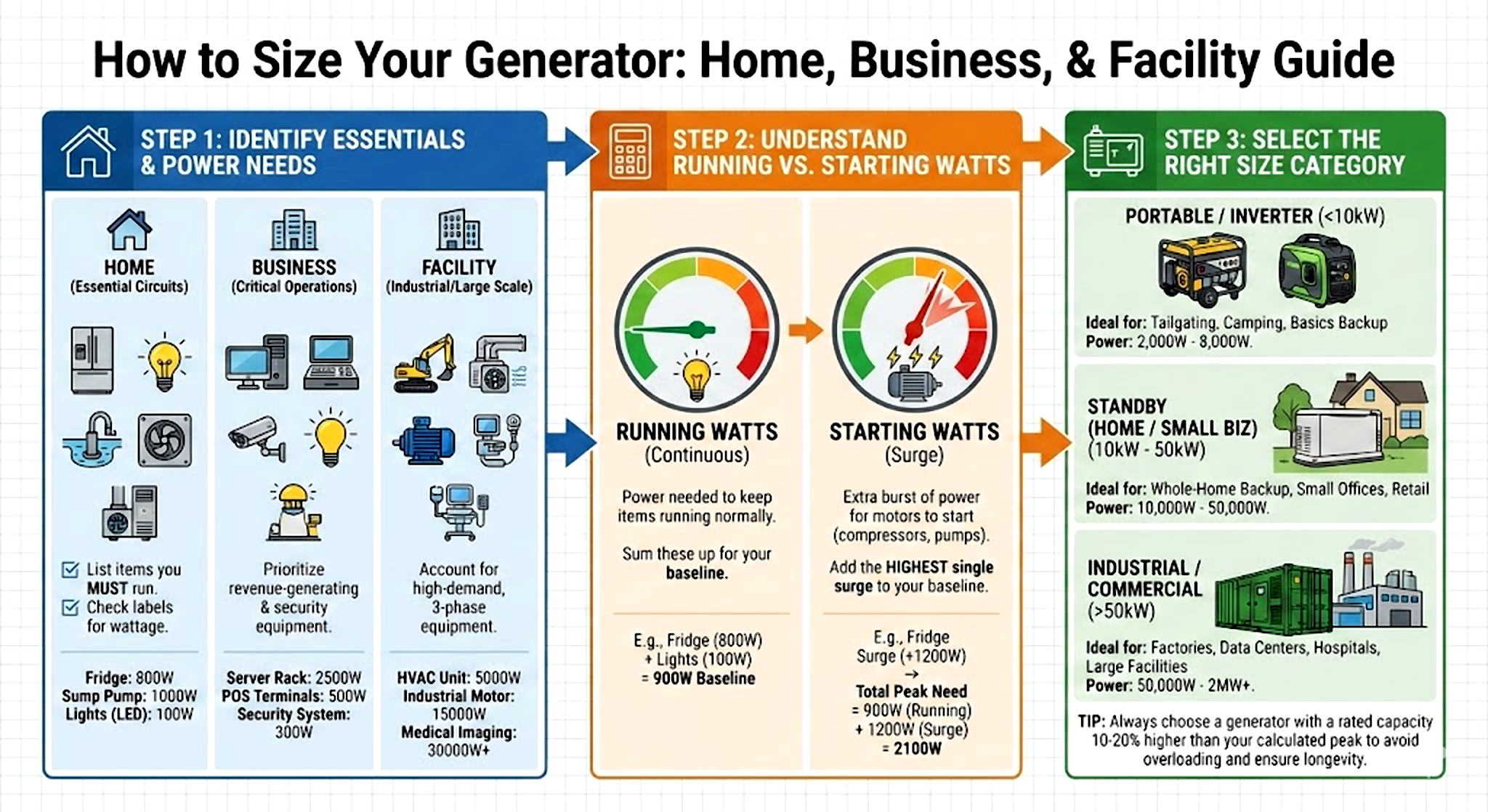
Typical Residential Wattage Chart
| Appliance | Running Watts | Starting (Surge) Watts |
| Refrigerator | 700 W | 2,200 W |
| Sump Pump (1/2 HP) | 1,050 W | 2,150 W |
| Window AC (10k BTU) | 1,200 W | 3,600 W |
| Central AC (3 Ton) | 3,500 W | 10,500 W |
| Electric Water Heater | 4,000 W | 4,000 W (No Surge) |
| Electric Stove | 2,500 W | 2,500 W (No Surge) |
Scenario 2: Sizing For A Small Business (Commercial)
For a complete and continuous housework setup, go for a generator that provides 15 KV to 26 KV+ watts of power. They smoothly run the central air conditioner (HVAC systems), electrical water heaters, and washer/dryer simultaneously.
Critical Systems Only (20kW – 50kW)
For modern business systems, people need to keep their Point of Sale (POS), servers, security cameras, and all other basic lights working. Install a system that only works under 20KV to 15KV power to keep your buildings safe and make transactions. Moreover, this system easily handles a small AC unit for the server room.
- Key Consideration: Computer devices and servers are highly sensitive to any sudden voltage dip. Furthermore, make sure to install a generator with an Automatic Voltage Regulator (AVR) and low Total Harmonic Distortion (THD < 5%).
Full Operation (50kW – 150kW)
For grocery stores, offices, and restaurants that never stop 24/7. Also, Install a high, large, walk-in, fully operational power generator for freezers, HVAC systems and commercial ovens.
- Key Consideration: 3-Phase Power. Usually, commercial buildings install three-phase electricity at 1400V/480V to effectively run at heavy motor speed. Furthermore, calculate your generators’ power with the building voltage configuration to find the right power backup fit. (Single Phase vs. Three Phase).
Scenario 3: Sizing For A Facility (Industrial)
Factories, hospitals and data centers have complex electrical loads. Nothing here works on some guesses. Make sure to ask for a professional engineer’s help to find the right power generator size.
The Motor Starting Challenge
Industrial facilities have heavy machinery with large electrical motors, including conveyor belts, large pumps, and industrial fans. Moreover, make sure to go for a 100HP motor with the massive inrush current. This current is 600% higher than the general running current.
- The Risk: If your generator is too small. With a single millisecond power surge, the voltage will collapse, leading to a sudden voltage dip whenever you try to start your motor. The contractors open, and the generator immediately shuts down. Moreover, Look for an oversized generator that can easily handle this momentary spike.
Regulatory Compliance (NFPA 110 / ISO 8528)
- Life Safety: For emergency lighting, elevators, and fire pumps, choose a step one ideal load power generator that easily starts within 10 seconds.
- Sizing Range: Usually, these backup power units range from 250kW to 2MW+. An electrical engineer can easily analyze the full electrical load and estimate the right generator sizing range using a calculator for your next regulatory compliance setup.
Step-By-Step Sizing Guide (Do It Yourself)
For a rough generator size estimate for your small tuck shop or home, follow these quick steps.
- List Every Item: Jot down everything you need to power on during an expected outage.
- Find the Label: Now, look for silver stickers present on the back of each appliance. Write down the watts. If there are only amps and volts listed, use this formula to calculate the values.
- $$Watts = Amps \times Volts$$
- Identify the Surges: Now, highlight all those items that work on electric motors like fridges, ACs and pumps. Calculate their starting watts, which are usually three times higher than the general running watts.
- Calculate the Total:
- Now sum up the running watts of all items.
- At the highest single starting watt figure from your list? Remember, you do not have to start every device at once. Always cover the biggest power surge initially.
- Add a Safety Margin: Multiply this final number by 1.20 to 20%. It helps you calculate the generators’ capacity, saving you fuel, less noise, and extended generator life.
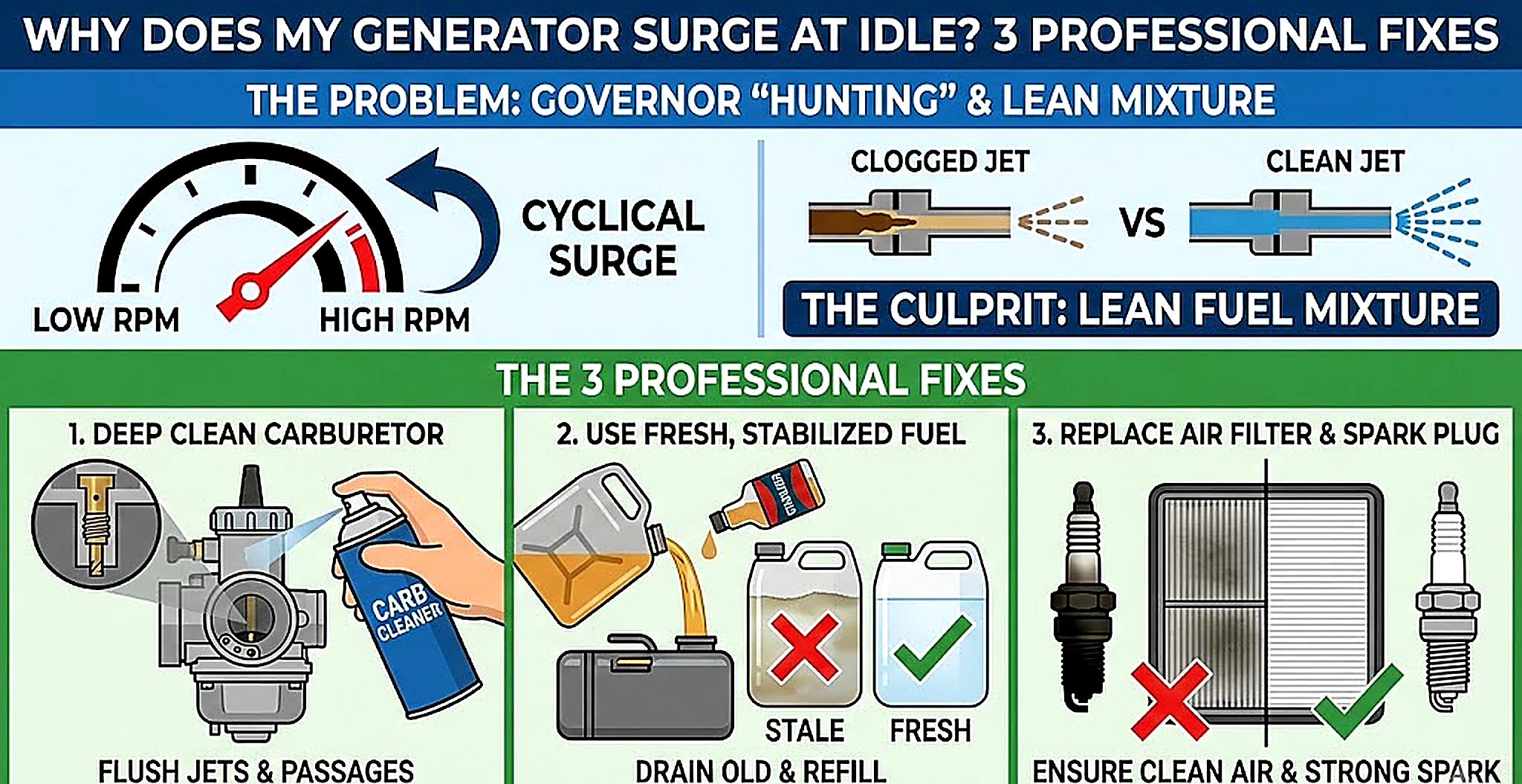
The Danger of “Too Big”: Wet Stacking
Sometimes, people miscalculate and think buying the biggest generator is the safest option. This is only a misconception that brings you expensive diesel costs.
For example, if a diesel engine runs at less than 30% of its overall rated load. A 100kW generator is only for 10KV lights. Ultimately, the generator does not burn the fuel completely. The unburned fuel accumulates inside the exhaust system. It creates a black tar-like substance.
- The Result: This process is known as wet stacking. It is highly deteriorating for the engine, impacts the warranty and causes unnecessary pollution. Do not go for an oversized diesel generator by more than 25 to 30% of your actual load.
Conclusion
Finding the right power generator size is all about maintaining a perfect balance between budget and power consumption.
- For Homes: Keep an eye on your HVAC and water requirements.
- For Business: Businesses usually have revenue generating equipment and data protection servers.
- For Facilities: For facilities, power generators must easily handle the motor starting currents, power factors and compliance.
Never guess the generator size. Calculate your load accurately. Moreover, The right power backup generator size helps you keep your lights on whenever the grid fails. Ultimately, your business is open all the time, and your facility is safe 24/7.
Are you looking for a professional load calculation expert? Contact HuaQuan Power today for a free power generator sizing consultation.
⚡ Explore Related Solutions
- 🏭 500kW Diesel Generator
- 🏭 1000kW Diesel Generator
- 🏭 500kW YC Diesel Generator
- 🔧 KMS (Cummins/Doosan) Series
- 🏥 Portable Generator
- 📋 Diesel Generator Sets
- 📋 Order Process — How to Buy
- 📋 Contact Us
💡 Need a customized solution? Contact our engineering team for project-specific recommendations.