Coincé entre quel type de carburant est le choix idéal pour votre générateur de secours? Le débat sans fin entre un générateur à essence et un générateur diesel se résume à la façon dont vous utilisez votre générateur de secours.. Quelle est la limite standard fixée pour votre budget? Et, for how long do you need to backup electricity for? En général, both fuels provide reliable electricity during an emergency power blackout. But they operate differently in different environments.
From maintenance costs to engine lifespans and fuel efficiency, all these factors play a key role in helping you decide on an affordable power backup machine for your facility. Ce guide par HuaQuan covers gas and diesel Générateurs to help you choose the best power solution for your job site, Maison, or business setup.
Générateur de gaz ou diesel: Comparaison rapide
| Fonctionnalité | Générateur de gaz | Générateur diesel |
| Efficacité énergétique | Lower burns fuel faster | Plus haut, as the engine produces more energy per gallon. |
| Running Cost | High due to frequent refueling | Faible; better in terms of fuel economy |
| Entretien | High frequency of spark plugs and carburetors | Low frequency, as fewer parts are moving |
| Durée de vie | 2,000 à 3,000 heures | 10,000 à 30,000+ heures |
| Niveau de bruit | Generally quieter | Louder with a classic diesel clatter |
| Meilleurs cas d'utilisation | Occasional power for home setups, camping, and tailgating | Industriel, commercial, heavy construction, off-grid systems |
Qu'est-ce qu'un générateur de gaz?
A gas generator usually operates on gasoline. It has an internal combustion engine with a premium quality spark ignition system. The technology works by combining fuel and air inside our carburetor or fuel injector. This mixture of fuel and air is then compressed and ignited with the spark plug to create available mechanical energy for producing electricity.
Avantages
- Lower purchase price in comparison to diesel generator models.
- Anybody can easily start these generators in extremely cold environments.
- The best available option for portable generators.
- They usually are quiet, making them a good choice for residential areas.
Inconvénients
- Overall engine life span is much shorter in comparison to diesel power generators.
- As gasoline is highly flammable, if you store it in large quantities, it can turn into an environmental hazard.
- Within three to six months, with no stabilizers, the fuel degrades very quickly.
Typical Use Cases
Experts recommend gas generators for temporary home backup electricity during unexpected blackouts. Ou, if you need emergency electricity for activities like RVing, talonnage, or cash registers, they are more than enough for your setup.
Qu'est-ce qu'un générateur diesel?
Now comes the discussion for diesel generators. A diesel generator has a highly optimized compression engine. The engine compresses the air to a maximum extent. Finalement, the diesel fuel ignites immediately once you inject it into the cylinder.
Avantages
- Highly fuel efficient. The diesel engine burns less fuel per kilowatt than producing electricity.
- Diesel power backup plants have professional, haute qualité, industrial components that can handle continuous, long term usage.
- In contrast to gasoline, it is less flammable, making it a better option for onsite storage.
- With massive torque features, these generators exceptionally ignite heavy duty industrial motors.
Inconvénients
- The overall setup cost for diesel generators is very expensive.
- Heavy and slightly less portable than gasoline power plants.
- Engines produce unbearably loud noises.
Typical Use Cases
Diesel is leading the power backup generator industry as the best available fuel type. They are the number one choice for construction sites, usines de fabrication, hôpitaux, and large agricultural projects.
Efficacité énergétique: Which Generator Uses Less Fuel?
When it comes to fuel efficiency, nobody can doubt diesel generators. Being highly densité énergétique than gasoline, there is maximum energy packed in every single drop of diesel you can efficiently utilize.
Aussi, instead of spark plugs, diesel generators operate on compression ignition technology. With this thermodynamic efficiency, diesel generators consume less fuel than a standard sized gas generator. Save more while handling multiday power blackouts with these efficient diesel fuel power generators.
Running Cost Comparison
Short-Term Cost
Is your budget range quite tight? A gas generator is an affordable option. They are much cheaper to manufacture. And you can buy their replacement parts at affordable prices from any local hardware store near you.
Long-Term Cost
Initially, the setup cost for diesel generators is quite expensive. Mais, in the long term financial race, they are fruitful ones. The fuel burns slowly, and the engine needs less maintenance, cutting the operating cost per kWh to a much lower level. If you are planning to run a generator for a long time, fuel savings help you compensate for the high purchase price of the diesel power backup plant.
Durée de vie & Durabilité
When it comes to durability and lifespan, the difference between these two fuel types is gigantic. Gasoline engines are hotter and have a high revolution per minute (RPM) rate. This plays a key role in their faster wear and tear over the years. A fully maintained gas generator lasts from 2000 à 3000 heures (à propos 4 mois) on average.
Diesel engines, d'autre part, have low RPMS. These engines are designed with heavy duty iron blocks that can handle high pressure or compression ignition easily. If you schedule maintenance of diesel generators routinely, you can run them for 10,000 à 30,000 heures (à propos 3 and a half years) before servicing their engines. En bref, for continuous, heavy industrial activities, diesel is practically the only solution you should stick to.
Niveaux de bruit: Which Is Quieter?
Gasoline generators are always quiet. Due to the spark plug ignition system, the overall process is smoother. For campsites and residential areas, they lead in the noise level management category.
Diesel engines are famous for their unbearably loud noises. The unbearable high pressure of compression ignition creates a mechanical knocking sound. Thanks to the engineers, they are now introducing diesel generators enclosed in sound absorbing enclosures. These noise cancellation generators comply with the urban environment noise regulation standards.
Exigences d'entretien
Gasoline power generators need timely maintenance. Habitually clean the carburetors and replace broken or worn spark plugs. Change your ignition coils on time. Keep an eye on the gasoline inside the tank. If it becomes stale in winter, it will jam the whole fuel system.
Dans les générateurs diesel, there are no spark plugs, carburateurs, or ignition coils. The maintenance plan for générateurs diesel is quite low, but it needs professional assistance when done. For diesel parents, filter and oil changes are a must. Polish your fuel occasionally to avoid any unnecessary algal growth or water contamination in the fuel tank.
Impact environnemental
When it comes to environmental impact, both have distinctive flaws. But they vary in their emission profile. Gas generators produce high levels of carbon monoxide, which is a deadly, odorless gas.
A few years back, diesel generators were known for pumping out thick black smoke and nitrogen oxides. Cependant, modern generators now have advanced filters and clean burn technology installed. It drastically reduces unnecessary gas emissions, making them eco friendly than its older models.
Meilleurs cas d'utilisation: Which Should You Choose?
Best for Home Backup
If you are a homeowner looking for an affordable generator that can keep your fridge items cold and lights on a few times a year, a gas generator is the cost-effective choice available for you.
Best for Construction Sites
Diesel generators are mandatory for construction sites. If you install gas engines to save some budget, they will not survive the heavy loads and dust. For a daily 12 hour runtime, on a professional job site, diesel power plants are the best choice.
Best for Businesses
Bureaux, grocery stores, and retail shops install diesel generators for maximum fuel storage and reliable electricity. These generators can handle an immediate power surge while starting commercial HVAC systems.
Best for Long Power Outages
If you live in an area where hurricanes or grid failures are regular. Always go for a diesel generator. Its highly efficient fuel helps you avoid flammable gasoline incidents during blackouts.
Générateur de gaz ou diesel: Verdict final
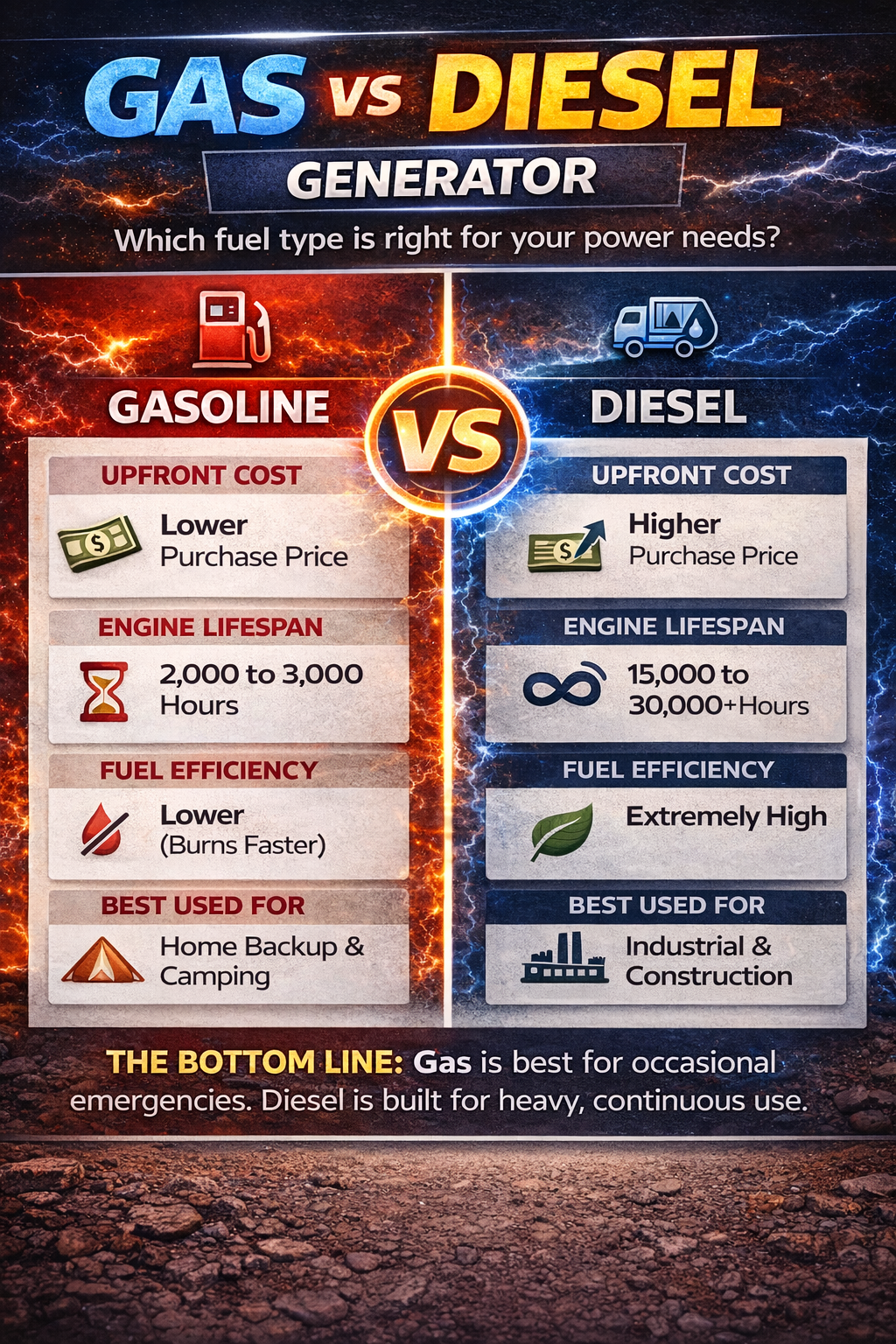
Choosing between a gas vs diesel generator is all about how much electricity you need to power your house or facility. If you are looking for a budget friendly, quiet solution for occasional use, gas generators are a good option. Cependant, if you are looking to power up heavy duty machinery with maximum fuel efficiency, go for a diesel generator. It is always a more reliable and smart choice you can make for your business or home alike.
Need the Perfect Power Solution?
Stop randomly choosing gas or diesel generators for your backup power needs. Contact HuaQuan team for a free consultation today. Get a premium, high quality generator to keep your home or business running smoothly during a blackout.
Foire aux questions
Is diesel fuel better than gasoline for power generators?
Oui. For industrial and continuous use, diesel is always durable, économe en carburant, and needs less maintenance than a gasoline engine.
Gas or diesel: Which generator lasts longer?
Diesel generators last longer than gas engines. A standard gas generator lasts 3000 années, while a diesel generator lasts 10,000 à 30,000 années.
Are diesel generators less expensive?
Oui. Diesel engines have expensive purchase prices. But over time, they become cheaper as they burn less fuel per kilowatt of electricity produced.